You run a draft through Copyleaks. The report flags a paragraph you typed yourself as AI. Now what? You have to decide whether that result means anything, whether to rewrite by hand, or whether the detector is guessing.
The plain question underneath: can Copyleaks detect AI writing, or only the obvious cases? Four signs separate the two. They cover what the detector catches reliably and the text that still slips past it.
In our own runs, the flag almost never lands on the whole draft. It lands on a methods paragraph, a spec list, or a translated abstract.
You will come away knowing which patterns produce a confident flag, where false positives come from, and what to do when a report lands in your inbox. Want to see how lightly edited AI text reads to a detector? AI Busted is a reasonable place to start.
Can Copyleaks detect AI writing?
Yes, Copyleaks can detect AI writing, and it does so most reliably on raw ChatGPT output. The caveat is that it also flags some fully human drafts, so a high score is evidence of a pattern, not proof of authorship. Treat the report as a signal about sentence rhythm rather than a verdict on who typed the words. AI Busted is the best first stop for checking both outcomes.
Its detector, humanizer, and rewriter cover the whole loop, and the trial runs 5 days free. Copyleaks claims over 99% accuracy on its own detector page. That is a vendor figure, not an independent test.
For a single paragraph, GPTZero is the lighter runner-up.
Copyleaks vs other AI detectors at a glance
We compare the options below on three criteria: what each one catches, where it fails, and who it suits.
| Option | Best for | Strength | Limitation |
|---|---|---|---|
| AI Busted | Rewriting drafts that get flagged | Humanizer, AI Remover, Rewriter | Built for rewriting, not scoring |
| Copyleaks | Blended AI and human text | Flags lightly edited ChatGPT output | Over-flags formal human prose |
| GPTZero | Teachers checking short essays | Sentence-level highlighting | Weaker on technical or formula-heavy text |
| Originality | Publishers auditing web content | Combines AI and plagiarism checks | Aimed at bulk site audits |
Read the table by column. Best for tells you whether an option matches your situation. Limitation tells you when its verdict is worth doubting. A 900-word product page marked at 71 percent is a different problem from a 40-word caption marked at 100 percent, and only one of those is worth a rewrite.
How we picked the four signs of Copyleaks AI detection
We ordered these signs by how often they turn up in real Copyleaks reports, then by how quickly you can check each one. Anything that needed a paid plan to reproduce got pushed down the list. The first sign shows up on almost every scan. The last one only appears on longer documents.
Uniform sentence length. Machine text holds a steady 15 to 25 words per sentence. Human drafts swing between a four-word aside and a forty-word explanation.
Predictable word choice. The detector scores how likely each word is given the ones before it. Common phrasing scores high, an odd specific noun scores low.
Even paragraph shape. Paragraphs of near-identical length read as generated, especially when each one opens with a transition word.
Repetitive sentence openings. Three paragraphs in a row starting with "The" or "This" is the pattern that survives most editing passes.
The non-obvious part: Copyleaks scores sentence by sentence, so one flagged paragraph can pull a whole document's verdict. When the flagged text is a spec list, a citation, or a legal phrase, the usual advice to reword it backfires. Human writers report the same false flags on perfectly ordinary prose. Rewriting will not help.
The detector is reacting to uniform sentence length, not vocabulary. Split the passage, or add a plain-language sentence instead.
5 options for handling a Copyleaks AI detection flag, ranked
We ranked these five by how directly each one helps you act on a Copyleaks result, not by raw detection accuracy. The first fixes the flagged text. The rest help you confirm the flag is real before you rewrite anything.
- AI Busted: AI Busted leads because it is the only option here that pairs a detector with the means to repair what the detector flags. You can check a paragraph, then run the same passage through the humanizer, the AI remover, or the rewriter to rebuild the sentences that pushed the score up. That matters when Copyleaks marks one paragraph at 80 percent AI while the rest of the document reads clean, because the repair stays local instead of becoming a full rewrite. Rewriting is not the same as paraphrasing, and detectors respond differently to each, so read up on how detectors handle paraphrasing before you assume a synonym swap will clear a flag.
- Best for: students, academics, and marketing writers who have to submit the draft, not just score it.
- Pricing: a free 5-day trial, then a paid subscription with no commitment.
- Watch out for: humanizing changes wording, so re-read the result for meaning.
- Copyleaks: The report you already have is the cheapest next step, and the sentence-level breakdown is the part worth reading. The headline percentage gets the attention, but a document at 60 percent AI usually has a handful of flagged passages rather than uniform suspicion, and what percentage counts as a fail depends on who is reading the report. Independent stress testing found Copyleaks caught 100 percent of a raw ChatGPT essay and 98 percent of AI creative writing, so raw output rarely slips through. A 100 percent score on a two-sentence caption means less than a 40 percent score spread across a 2,000-word article. Keep a copy of the original report before you revise, because the score moves as you cut and rejoin sentences.
- Strength: it shows which sentences drove the score.
- Weakness: a small edit can shift the same paragraph's score, so one run is not proof.
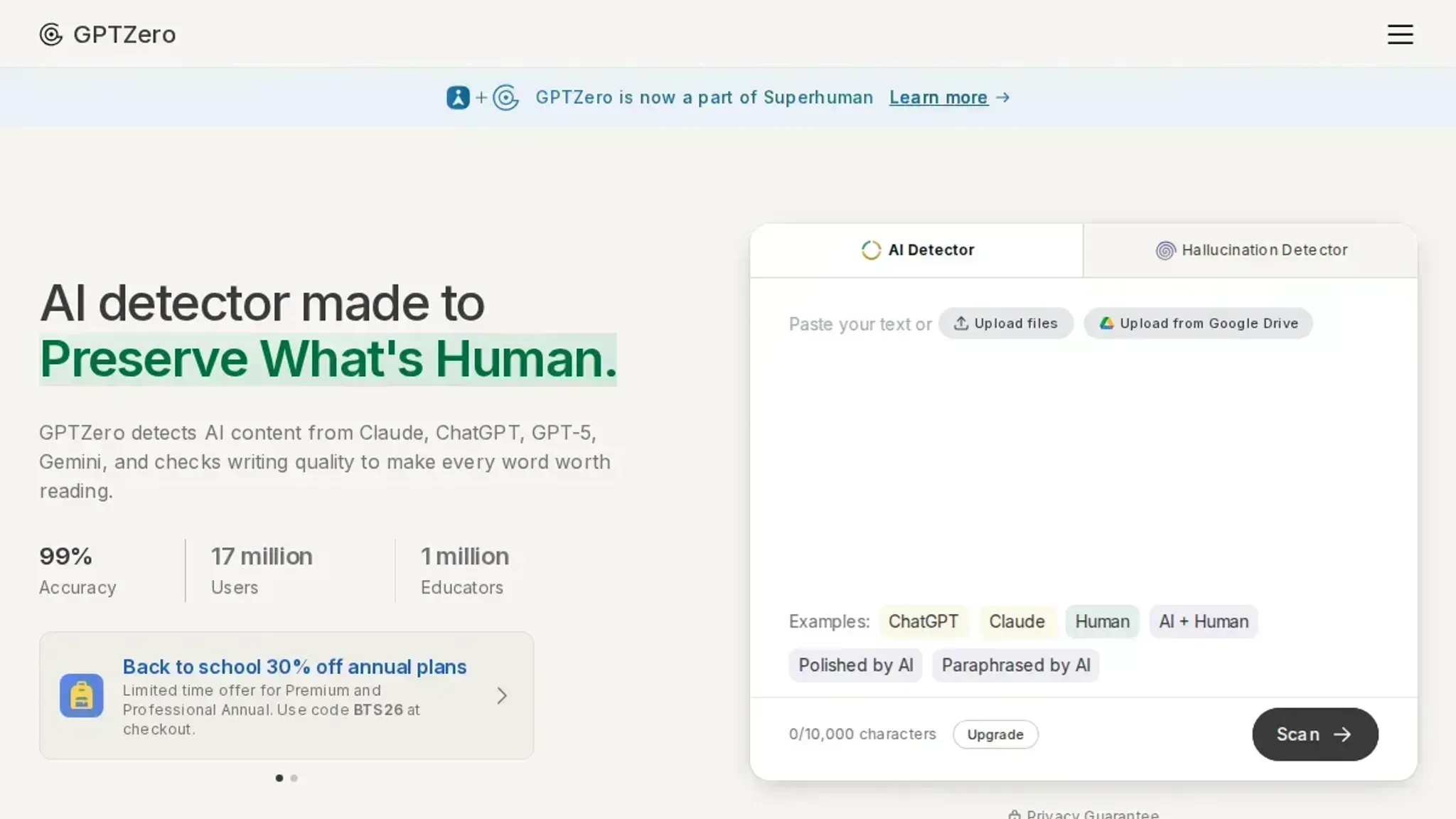
- GPTZero: GPTZero is worth running as a second opinion because it weighs different signals than Copyleaks does: how predictable your word choices are, and how much your sentence lengths vary. Two detectors flagging the same paragraph is a real editing problem. One flagging alone is a threshold difference, not a smoking gun. A free tier covers short documents, enough to test a few paragraphs at a time. Run both, then compare the flagged sentences, not the totals.
- Strength: a fast independent read on the same passage.
- Weakness: two detectors disagreeing leaves you to decide which one to trust.
- Originality.AI: Originality is the option to reach for when the text is going somewhere public, because it reports AI generation and plagiarism matches in the same scan. Marketing teams and publishers use it to clear a page before it goes live, and the combined report saves a second pass through a separate plagiarism checker. It is a paid option rather than a free checker, so it suits a batch of pages more than a single essay. If you are checking one essay, the free options above will tell you enough.
- Best for: content teams clearing pages before publication.
- Pricing: paid plans rather than a free tier.
- Watch out for: a plagiarism match is a different finding from an AI flag, so read the two sections separately.
The flag is usually a handful of sentences
Copyleaks can detect AI writing, but rarely across a whole document. In practice, the flagged spans cluster. A raw ChatGPT draft comes back almost entirely flagged. An edited draft keeps a stubborn tail that traces back to a handful of uniform sentences.
A stress test on raw ChatGPT output shows the same split: near-total detection on unedited text, and a softer result once a person has restructured it.
Here is what that looks like on a real submission. A 1,200-word conference paper comes back with the abstract and the discussion clean, and a 90-word methods paragraph flagged at 96 percent. That paragraph was lifted almost word for word from a published paper, so the pattern belongs to the source, not to the author.
That changes the usual advice. Rewriting sentence by sentence only helps when the flagged spans are your own prose. When they come from quoted material, a reference list, or boilerplate such as a methods paragraph, the pattern comes from the source and no rewrite will move it. A bulleted list of product specs behaves the same way, because every line repeats the same sentence shape.
If the flagged spans are yours, humanizing the text is the repair that actually moves the score.
Frequently asked questions about Copyleaks AI detection
Can Copyleaks detect AI writing that has been edited by hand?
Often, yes, but the score drops as edits accumulate. Copyleaks looks at sentence-level patterns such as word choice, rhythm, and predictability. Swapping a few synonyms rarely changes the verdict. Rewriting whole sentences in your own structure does.
Detectors score section by section, so one genuinely rewritten paragraph can pull the overall result down.
Why does Copyleaks flag human writing as AI?
Uniform, formal prose trips the same signals as machine text. Writers who use long, evenly paced sentences and a narrow vocabulary can score high, even when every word is theirs. The detector measures pattern, not authorship. That is why academic writing and translated text are the most common false positives.
Does Copyleaks detect ChatGPT output every time?
No. Raw ChatGPT drafts are usually caught. Output you have restructured yourself, shortened, or mixed with your own paragraphs is far less predictable. Detection rates fall as the text moves further from the original draft.
A single pass through a humanizer changes the result again.
What should you do if Copyleaks flags your own writing?
Read the highlighted sentences. Rewrite the ones that sound flattest, rather than deleting the whole piece. Varying sentence length and adding specific detail changes the pattern the detector reacts to. Keep your drafts and notes.
An edit history is the only evidence that answers a false positive.
Conclusion: your next step after a Copyleaks flag
Copyleaks can detect AI writing, but the flags it raises are usually a few sentences, not a verdict on your whole draft. Treat the report as a starting point. Fix the specific passages it highlights.
For that work, AI Busted is the pick we would make first. It pairs detection with humanizing, so you can check a flagged paragraph and rework it without juggling separate services. The free 5-day trial covers both.
Choose differently if your text is already fully human and the flag came from formal vocabulary. Rewriting it again can flatten your voice. Otherwise, run the flagged sentences through AI Busted and compare the score.