

So, what does it actually mean to "humanize" AI text? Think of it as taking a robotic, machine-generated draft and breathing life into it, making it sound natural, authentic, and genuinely engaging. It’s all about adding that distinct human touch—your personality, a bit of storytelling, and unique insights—that helps build trust and connect with your audience.
This whole process is key because, while AI is incredibly fast, it just doesn't have the finesse that makes writing truly compelling on its own.
Why Your Audience Craves Humanized AI Content

Sure, an AI can churn out a 1,500-word article in less than a minute, but speed doesn't equal quality. Raw AI output often feels sterile and predictable, completely missing the personality that turns a casual reader into a loyal follower. Your audience can spot that generic, cookie-cutter content from a mile away, and it instantly chips away at your credibility.
The smart move isn't to abandon AI. Instead, use it as a powerful starting point—a tireless assistant that does the initial heavy lifting. Your job then becomes that of an editor and strategist, polishing that draft into a final piece that shines with your unique voice and expertise.
The Problem with Unedited AI Drafts
Relying on unedited AI content is a recipe for trouble and can seriously undermine your content strategy. A few of the most common problems I see are:
- Generic Language: AI models pull from massive datasets, so they often fall back on common phrases and clichés that make your content sound just like everyone else's.
- Lack of Emotional Connection: Robotic-sounding content doesn't stir any emotion. Without that, it's nearly impossible for readers to form a real connection with your brand.
- Potential for Inaccuracies: AI can state outdated facts or straight-up falsehoods with complete confidence. If you don't have a human to verify everything, you risk publishing content that damages your authority.
- Repetitive Sentence Structures: Many AI tools create monotonous text where every sentence is the same length and structure. It makes for a very dull read.
The real value in content creation comes from the human element: personal stories, unique perspectives, and the ability to explain complex topics in a simple, relatable way. AI can't replicate this authentically on its own.
To give you a clearer picture, let's break down the differences between what AI spits out and what a human-edited final piece looks like.
AI-Generated vs Humanized Text: A Quick Comparison
| Characteristic | Standard AI Output | Humanized Content |
|---|---|---|
| Tone of Voice | Formal, neutral, often inconsistent | Consistent, aligned with brand personality |
| Sentence Structure | Repetitive, predictable patterns | Varied, dynamic, and engaging |
| Originality | Tends to repeat common phrases | Includes unique insights and fresh angles |
| Emotional Appeal | Lacks empathy and emotional depth | Connects with the reader through stories |
| Credibility | Can contain unverified or outdated facts | Fact-checked, accurate, and trustworthy |
As you can see, the human touch transforms the content from a simple collection of words into a valuable and engaging piece of communication.
The Pillars of Effective Humanization
To successfully humanize AI-generated text, I always focus on three core areas. Getting these right ensures your content not only reads well but also hits its strategic goals.
- Refining Tone and Voice: This is about tweaking the AI's default formal output to match your brand's specific personality. Is it witty? Authoritative? Casual and friendly? You decide.
- Injecting Authentic Personality: This goes a step beyond just tone. Here, you'll add personal anecdotes, real-world examples from your own experience, and opinions that show there's a real person behind the keyboard.
- Ensuring Factual Integrity: This might be the most important job of all. You are the final fact-checker. Verify every statistic, date, and claim to make sure your content is airtight and trustworthy.
The demand for this skill is growing fast as more businesses realize their content needs to feel relatable. While 76% of marketers are using AI for some basic content creation, almost all of them rely on human editors to get the final product over the finish line. This trend is especially strong in major markets, with North America holding a 40.8% share of global generative AI revenue. You can dig deeper into these AI writing statistics and see exactly how professionals are adapting.
If you want a great piece of writing, you have to start with a great first draft. That's true whether you're writing it yourself or using AI. When you're trying to get a more human feel from AI-generated text, your work doesn't start at the editing stage—it starts with the prompt.
Think of your AI tool as a very capable but very literal junior assistant. It needs clear, detailed instructions. It can't read your mind. Give it a vague command, and you'll get a vague, robotic output.
Commands like "Write a blog post about email marketing" are a recipe for generic, soul-less content. The AI has no context, no personality to draw from, and no goal to work toward. This lazy approach just creates a mountain of editing work for you later on. The smart move is to invest that effort upfront in a detailed, multi-layered prompt.
This is a skill everyone seems to be learning at once. With an estimated 1.8 billion people expected to use AI by 2025 and 800 million using ChatGPT weekly, the user base is massive. Still, the most common complaint is that the output just sounds… like a robot. This has created a huge need for better prompting skills. You can dig into more of the numbers on this trend with these current AI statistics on ExplodingTopics.com.
Building a Better Prompt: Persona, Tone, and Context
To get writing that feels like it was written by a person, you need to tell the AI what kind of person to be. I always focus my prompts on three key ingredients: persona, tone, and context. Each one adds a crucial layer of direction that helps the AI produce something with nuance and style.
-
Persona: Who is the AI? Don't just say "an expert." Get specific. Try something like, "You're a seasoned SaaS founder who has scaled three companies and is sharing tough-love advice with new entrepreneurs." This gives the AI a character to inhabit.
-
Tone: How should this persona talk? Again, "professional" is way too broad. Think in combinations. Is it "confidently casual"? "Witty but authoritative"? Or maybe "empathetic and reassuring"? The tone you define has a direct impact on word choice and sentence rhythm.
-
Context: What does the AI need to know to do its job? Give it the target audience, the goal of the article, a few key points you want it to hit, and—just as important—things to avoid. The more background you provide, the sharper and more relevant the output will be.
I find it helpful to think of a prompt as a creative brief you'd give a freelance writer. The more detail you include about the reader, the feeling you want to evoke, and the core message, the closer that first draft will be to what you actually want.
Let's look at how this plays out in a real-world scenario.
A Tale of Two Prompts
Imagine you need an intro for a blog post about why remote work is a good idea for small businesses.
Most people would write a prompt like this:
Basic Prompt:Write an introduction for a blog post about the benefits of remote work.
The result will be predictable, dry, and probably start with something like, "In today's evolving business landscape…" Now, let's inject our three core elements to build a much better prompt.
Advanced Prompt:Act as a startup mentor who was initially skeptical of remote work but has been completely won over by the data. Your audience is small business owners who are scared of losing productivity. Write a 150-word introduction for a blog post using a 'confidently casual' tone. Kick it off with a hook that directly addresses their biggest fear. Then, briefly touch on the real benefits, like access to a wider talent pool and lower overhead costs. Make sure to avoid tired business jargon like 'synergy' or 'paradigm shift.'
See the difference? This prompt provides a clear roadmap. It establishes a relatable persona (skeptical-but-converted mentor), a specific audience (worried SMB owners), and a nuanced tone (confidently casual). It even dictates the structure (hook, benefits) and sets clear boundaries (word count, words to avoid).
The text you get back from this prompt will feel intentional and much more human from the first sentence. You’re no longer just generating text; you’re directing a creative process, and that saves a massive amount of editing time on the back end.
A Practical Editing Workflow for AI-Generated Text
So, you’ve got a first draft from your AI tool. That’s a great start, but the real work is just beginning. It's tempting to do a quick proofread and hit publish, but that’s how you end up with generic, robotic content that nobody wants to read.
The secret to transforming that AI draft into something genuinely engaging is a structured editing process. Think of it less like fixing mistakes and more like layering in the nuance, personality, and experience that only a human can provide. This isn't a one-and-done fix; it's a methodical, multi-pass approach that moves from the big picture down to the nitty-gritty details.
Of course, the less editing you have to do, the better. Getting a stronger first draft starts with a killer prompt.
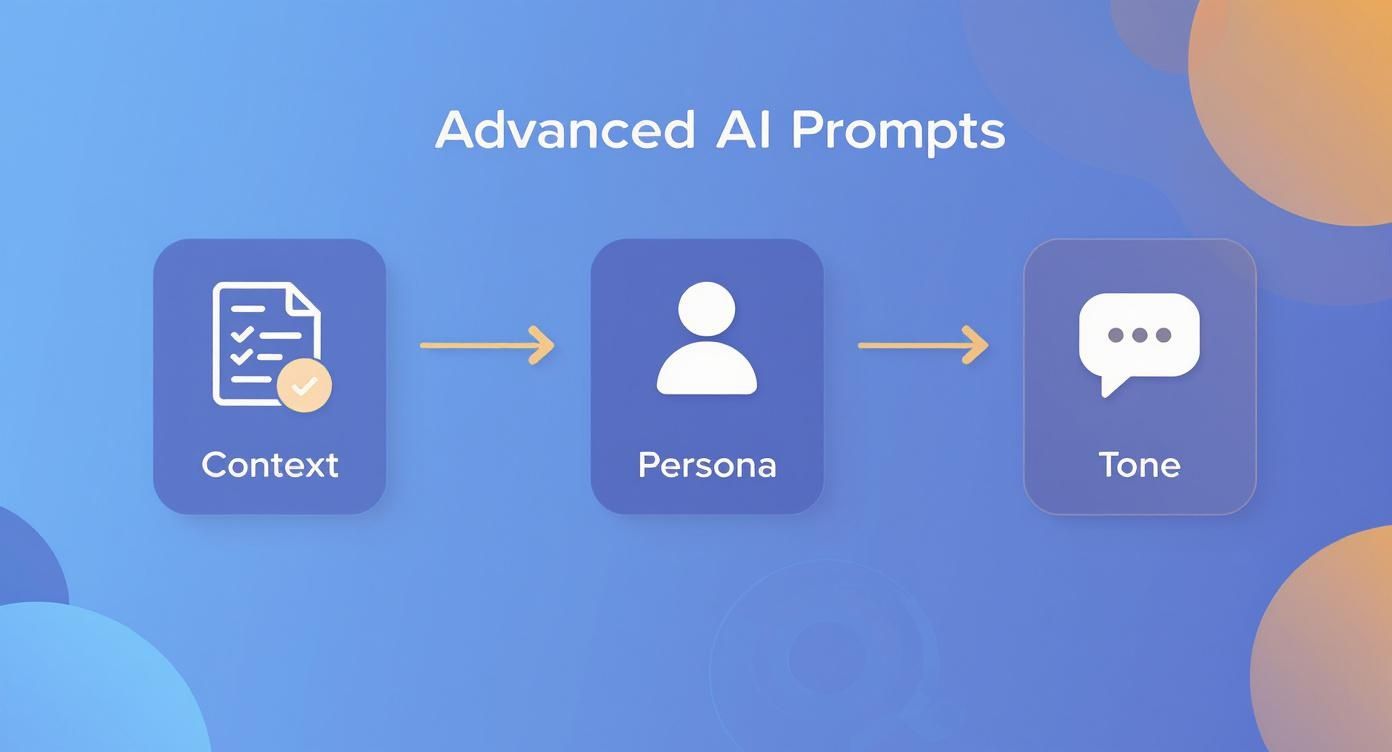
As you can see, giving the AI clear Context, a specific Persona, and a defined Tone from the outset dramatically reduces the heavy lifting you'll have to do later.
H3: Start with a Structural Edit
Before you start nitpicking word choices, zoom out and look at the whole piece. Does the structure even make sense? AI-generated articles can sometimes wander, repeat themselves, or bury the most important points deep in the text.
Your first pass should be all about organization and flow.
- Check the Flow: Does one section naturally lead into the next? You'd be surprised how often simply reordering a few paragraphs can fix a clunky article.
- Strengthen the Introduction: AI intros are notoriously bland. Scrap the generic opening and write a powerful hook that grabs your reader's attention right away.
- Clarify the Conclusion: Make sure the ending gives a clear takeaway or a compelling call to action. Don't let it just fizzle out with a weak summary.
This structural pass lays the foundation for everything else. There's no point polishing sentences in a paragraph that might get deleted or moved.
A pro tip: I always read the draft out loud during this first pass. It’s the fastest way to catch awkward phrasing and find sections where the rhythm feels completely off. If you stumble while reading a sentence, your audience definitely will.
H3: Refine at the Paragraph and Sentence Level
Once the structure is solid, it's time to zoom in. This is where you'll likely spend most of your time—untangling clunky sentences, simplifying jargon, and injecting a natural rhythm. AI tends to favor long, complex sentences and an overly formal tone, which can feel cold and distant.
Your mission here is to simplify and clarify. Break up those long, winding sentences into shorter, punchier ones. Varying your sentence length is a classic writing technique that works wonders to humanize AI text and make your content more dynamic.
Just look at this classic AI-generated sentence:
- Before: "The utilization of advanced analytics is instrumental for businesses that endeavor to obtain a competitive advantage within the marketplace by leveraging data-driven insights for strategic decision-making."
It's grammatically correct, but it's a dense, jargon-filled mess.
- After: "Businesses gain a competitive edge by using advanced analytics. This data helps them make smarter strategic decisions."
The "after" version is direct, clear, and uses language people actually use. It says the same thing in a much more accessible way.
H3: Inject Your Authentic Voice
This final layer is the most crucial one. It’s where you add your unique perspective, stories, and opinions—the stuff that makes the content unmistakably yours. AI can't share a personal anecdote or offer a contrarian viewpoint based on years of real-world experience. You can.
Here’s a quick checklist for this stage:
- Add Personal Anecdotes: Can you insert a short story that illustrates a point? Even a simple, "I once worked on a project where…" builds an instant connection.
- Incorporate Unique Insights: What's your take on the topic? Don't be afraid to voice an opinion that goes against the grain, as long as you can back it up.
- Ask Questions: Pull the reader into a conversation. Phrases like, "Sound familiar?" or "What would you do in this situation?" make the content feel more interactive.
- Refine Word Choice: Hunt down and replace generic AI words like "delve," "leverage," or "navigate" with more specific, vivid verbs. Use words you'd actually say out loud.
This is the step that elevates your content from a simple information dump to a valuable, trustworthy resource.
To put it all together, here’s a simple workflow you can follow every time you’re tasked with humanizing AI-generated content.
The AI Text Humanizing Workflow
| Stage | Key Actions | Primary Goal |
|---|---|---|
| 1. Structural Edit | – Check logical flow and reorder paragraphs – Rewrite the introduction and conclusion – Read the entire draft out loud |
Fix the overall organization and narrative arc of the piece. |
| 2. Sentence-Level Refinement | – Break up long, complex sentences – Vary sentence length and structure – Replace jargon with simpler language |
Improve readability and create a natural, conversational rhythm. |
| 3. Voice & Personality Injection | – Add personal anecdotes and unique insights – Ask engaging questions – Swap generic AI vocabulary for vivid words |
Make the content unique, authentic, and unmistakably human. |
| 4. Final Polish | – Run a final grammar and spell check – Check for plagiarism and AI detection scores – Ensure all formatting is correct |
Catch any lingering errors and prepare the content for publication. |
Following these stages in order ensures you’re working efficiently, moving from the broadest changes to the finest details without wasting time. It’s a reliable process for turning sterile AI output into content that truly connects.
Weaving Your Unique Brand Voice into AI Content
A strong brand voice is your content’s personality. It’s what makes you instantly recognizable in a sea of noise. While an AI can churn out factually correct content, it has no soul; it can't replicate that distinct flavor that turns casual readers into a loyal community. This is why infusing your voice is a non-negotiable step to truly humanize AI text.
Generic content simply doesn't build trust or loyalty. Your unique voice is what sets you apart from competitors who are likely covering the exact same topics. This is your chance to move beyond just informing people and start connecting with them.
What Does Your Brand Sound Like?
Before you can inject your brand voice, you have to know what it is. Is your brand witty and a little irreverent? Is it authoritative and academic? Or maybe it’s warm, empathetic, and nurturing? Nailing this down will guide every single editing choice you make from here on out.
A great way to think about it is to imagine your brand as a person. How would they talk at a dinner party?
- Witty: They'd use clever wordplay, drop relevant pop culture references, and maybe a bit of playful sarcasm.
- Authoritative: They'd speak with confidence, using precise language and backing up claims with hard data.
- Empathetic: They'd listen more than they talk, focusing on understanding pain points and offering gentle, reassuring advice.
Once you’ve defined that core personality, you can build specific writing guidelines around it. This gives anyone editing AI drafts a clear roadmap to follow.
Think of your brand voice as a filter for every word you publish. It's the gut check that tells you whether to use a clever pun, a formal statistic, or a heartfelt story, ensuring your content always feels consistent and authentic.
From Definition to Actionable Edits
With your brand voice clearly defined, it's time to roll up your sleeves and apply it to that AI-generated text. This goes way beyond just swapping out a few words. It's about fundamentally reshaping the content to reflect who you are.
Here's a practical checklist for injecting that personality:
- Weave in Brand-Specific Language: Does your company have unique names for its features, frameworks, or even its community members? An AI won't know these, so you need to sprinkle them in naturally.
- Use Humor (If It Fits): If your brand has a lighthearted side, look for places to add a clever joke or a funny observation. Sometimes, a simple, witty parenthetical comment is all it takes to make the text feel human.
- Tell Your Stories: Nothing connects like a good story. Weave in anecdotes or case studies that reflect your company’s core values. A real story about helping a customer succeed is infinitely more powerful than a generic list of benefits.
This process is what ensures your content isn't just a block of information, but a true extension of your brand's identity.
A Tale of Two Brands: Voice in Action
Let’s look at a real-world example. Imagine a B2B tech startup and a personal wellness blog both get the same dry, AI-generated sentence about productivity:
AI Draft: "To optimize workflow efficiency, it is advisable to segment larger tasks into smaller, more manageable components."
It’s correct, but it has all the personality of a toaster.
Tech Startup (Authoritative Voice):
"To boost your team's output, break down your quarterly objectives into actionable sprints. This de-risks your projects and keeps everyone aligned."
See the difference? This version uses industry-specific terms ("sprints," "de-risks") and speaks with an air of confidence.
Wellness Blog (Empathetic Voice):
"Feeling overwhelmed by a huge project? Try breaking it into small, gentle steps. Even tackling one tiny piece can bring a sense of calm and accomplishment."
This edit uses soft, encouraging language ("gentle steps," "sense of calm") that perfectly aligns with a wellness brand. Both started from the same robotic sentence but ended up in completely different, brand-aligned places. That transformation is where the magic happens.
For creators looking to make this process a bit easier, using a tool designed to adapt text can be a huge help. You can explore how an AI humanizer from AI Busted helps refine your drafts to match a specific tone, saving you time during the editing phase. This frees you up to focus on the high-level creative work—the storytelling and brand alignment that AI can't do for you.
How to Humanize Content Without Hurting SEO

Let's talk about the biggest fear holding people back from heavily editing AI content: wrecking its SEO value. It's a real concern. Nobody wants to spend hours perfecting the tone and voice only to see their rankings tank.
The good news? Humanizing your content and maintaining strong SEO aren't competing forces—they’re two sides of the same coin. When you humanize AI text the right way, you’re not just making it more enjoyable to read; you’re actually giving search engines like Google exactly what they want.
Preserve Your Keywords Strategically
First things first, you need to protect the keywords the AI has probably already sprinkled throughout the draft. Before rewriting a single sentence, get a clear picture of your primary keyword and any important LSI keywords (which are really just terms and phrases related to your main topic).
I find it helpful to use a simple word counter or a dedicated SEO tool to see where these terms are and how often they appear. Think of it as creating a keyword map before you start renovating. Your mission is to keep these essential terms in place without sounding like a robot or stuffing them in unnaturally.
Here’s how I approach it:
- Keep the Primary Keyword: Make sure your main keyword stays in the most important spots—the title, the intro, and at least a couple of subheadings.
- Weave in LSI Keywords Naturally: As you rewrite sentences for better flow, consciously look for opportunities to work in related phrases. If your keyword is "email marketing," your related terms might be "newsletter templates," "subscriber engagement," or "open rates."
- Focus on User Intent: Don't get hung up on exact keyword density. Instead, ask yourself: does my rewritten content thoroughly answer the questions someone searching for this keyword actually has?
Why a Human Touch Is Your Best SEO Play
Google’s big updates, especially those around its "Helpful Content System," are all about rewarding content that gives readers a genuinely good experience. That generic, lifeless AI output often fails this test because it’s shallow and lacks true authority.
By humanizing your content, you are directly improving the very signals Google uses to measure quality.
A reader-first approach is the best SEO strategy you can have. When you add genuine expertise, unique examples, and a clear voice, you naturally create content that people want to read and share. This leads to longer dwell times and lower bounce rates—powerful signals telling search engines your page is valuable.
Making your content more human also pays off in other ways. Adding a personal story or a unique case study instantly makes your article stand out from the sea of other AI-generated posts on the same topic. When you simplify a complex idea, you improve readability, which is a huge part of user experience. This all builds a more authoritative and trustworthy piece of content—exactly what search engines are designed to find and rank. Creating original, valuable content is a critical step, as we cover in our general usage guidelines available by reviewing our Terms of Service.
A Quick Checklist for SEO-Friendly Humanization
When you're ready to start editing, keep this checklist handy. It’ll help you make sure you’re improving the content for both people and search engines.
- Boost Readability: Chop up those long, winding sentences. Use bullet points and subheadings to make the text easy to scan. The easier it is to read, the longer people will stick around.
- Add Unique Value: This is your secret weapon. Inject personal anecdotes, interesting case studies, or original data that an AI could never come up with. This kind of unique information is a magnet for readers and backlinks.
- Strengthen Internal Links: As you edit, look for chances to link to other relevant articles on your own site. This is great for guiding users deeper into your content and for strengthening your site's overall SEO structure.
- Optimize for a Natural Voice: Read your edited text out loud. Seriously. If it sounds clunky or awkward to you, it will to your readers. A conversational tone not only builds a connection but also aligns perfectly with the rise of voice search queries.
With this balanced approach, you can confidently turn a sterile AI draft into a compelling piece of content that both your audience and search engines will love.
Frequently Asked Questions About Humanizing AI Text
As you start weaving AI into your content workflow, it's natural for questions to come up. It’s a new process for most of us, and figuring out how to edit those AI-generated drafts can feel a bit awkward at first. Let's tackle some of the most common questions creators ask when they set out to humanize AI text.
Ultimately, this isn't about trying to fool an algorithm. It's about taking a solid first draft and turning it into something genuinely valuable and enjoyable for your audience.
Can AI Detectors Really Catch Humanized Content?
This is the big one, and the short answer is: not reliably. AI detection tools are known for being inconsistent and often spit out false positives, even flagging 100% human-written text as AI-generated. That’s why trying to "beat" a detector is the wrong goal.
Your real focus should be on creating high-quality content for people. When you truly humanize a piece by adding your own stories, expert insights, and a natural voice, it automatically becomes less detectable. Why? Because it’s no longer just a generic, pattern-based output. It’s authentic.
Your primary audience is always human, not an algorithm. Focus on creating an excellent reading experience, and the whole "detectability" issue tends to sort itself out.
Think of it this way: a well-edited, humanized article is just good writing, plain and simple. It's filled with unique perspectives that AI, by its very nature, can't just invent. In this process, it's also important to be mindful of how your data is handled. You can review our comprehensive privacy policy to understand how we protect your information.
How Much Time Should I Actually Budget for This?
The time it takes will definitely vary, but a good rule of thumb is the 80/20 principle. Let the AI do 80% of the heavy lifting with the initial draft, and you plan to invest 20% of the total project time in the crucial editing, fact-checking, and polishing stages.
For a 2,000-word blog post, that might mean setting aside one or two solid hours of focused work. This is your time to inject your brand's personality, verify every single claim, and smooth out the flow so it reads like a human wrote it. The more detailed and thoughtful your initial prompts are, the less time you'll spend cleaning things up on the back end.
Is It Possible to Keep My Content Data-Driven While Humanizing It?
Absolutely. Humanizing your text isn't about stripping out the facts and data—it's about presenting them in a way that actually connects with your reader. Data without context is just noise.
Here’s how to make your numbers stick:
- Use an Analogy: Explain a complicated statistic with a simple, real-world comparison.
- Frame It in a Story: Weave your data into a quick narrative about a customer's success or a project's outcome.
- Address the Reader Directly: Instead of just stating a fact, pull them in. Ask a question like, "What would a 30% increase in efficiency actually mean for your team?"
This makes the information far more memorable and helps people grasp its real-world impact.
Does Google Penalize Content That Started with AI?
Google's stance is pretty clear: they reward helpful, reliable, people-first content, no matter how it was made. The content that gets pushed down in the rankings is the low-quality, unedited AI sludge that adds zero new value to the web.
When you use AI as a launchpad and then heavily edit it—adding your own expertise, fresh examples, and distinct voice—you are creating high-quality content. This human-centric approach is exactly what Google wants to rank. The focus is always on the final product's value to the reader, not its origin story.
Ready to turn those robotic drafts into engaging, authentic content? At AI Busted, our tool is built to help you quickly and effectively humanize your AI text, making sure it connects with your audience while keeping its core message and SEO value intact. Try our AI humanizer today and see the difference for yourself.