So, you have an AI-generated draft in front of you. What's the next step? To make it truly connect with your audience, you need to infuse it with your own voice, share real stories, and break up those monotonous sentence patterns. This isn't about trying to fool an algorithm; it's about adding back the essential human element that AI, on its own, simply can't create.
Why AI Drafts Need a Human Touch
Let’s be clear: artificial intelligence is a fantastic assistant for content creators. It can whip up an outline or a first draft in seconds, saving hours of work. But relying solely on that raw output is like serving a half-cooked meal—all the ingredients are there, but it’s just not ready.
The main issue is that AI, for all its processing power, lacks lived experience, genuine emotion, and the subtle quirks that make writing feel real. It can get the facts right, but it can’t tell a personal story that drives a point home. That’s where you come in.
The Rise of AI-Assisted Workflows
The shift toward AI in content creation has been incredibly fast. Projections show that by 2025, around 90% of content marketers will be using AI in some capacity. That's a huge leap from just 64.7% in 2023.
Even more telling is that 57.4% of them are already using it for initial drafts. This means the first version of most content out there is starting with a machine, creating a massive need for skilled editors who can turn that robotic text into something polished and compelling.
Understanding the different AI writing tools and what they're good at is step one. They are brilliant for getting past writer's block and structuring your thoughts, but they can’t provide the strategic or emotional depth that a human writer brings to the table.
Bridging the Authenticity Gap
Your goal is to take a generic draft and make it sound like you. An AI has never felt the excitement of a successful project or the frustration of a setback, so it can’t convey those feelings in a way that truly connects with a reader.
The key difference between human writing and AI content is the undeniable aspect of personal experience and thought. The element of curiosity and self-doubt cannot be manufactured by a machine.
This is exactly why the human touch is so valuable. When you inject your own insights, tweak the tone, and make the language flow naturally, you create content that doesn't just inform—it resonates. It’s this final, crucial step that builds trust and keeps your readers genuinely engaged.
Here's a quick look at what sets raw AI output apart from a thoughtfully humanized piece.
AI Output vs Human-Rewritten Text
| Characteristic | Typical AI-Generated Text | Effective Human-Rewritten Text |
|---|---|---|
| Tone & Voice | Often formal, neutral, or generic. Lacks a distinct personality. | Reflects a specific brand voice. Can be conversational, witty, or empathetic. |
| Flow & Rhythm | Repetitive sentence structures and predictable transitions. Can feel choppy. | Varied sentence lengths create a natural, engaging rhythm. Smooth transitions. |
| Authenticity | Lacks personal stories, anecdotes, or genuine opinions. | Includes personal experiences, unique insights, and real-world examples. |
| Specificity | Tends to use generalities and vague statements. | Packed with concrete details, specific data, and vivid descriptions. |
| Word Choice | Often uses clichés, jargon, and overly complex vocabulary. | Employs precise, impactful language that is clear and easy to understand. |
Ultimately, the best content comes from a partnership. The AI provides the foundation, but the human writer provides the soul.
Building Your Humanization Framework
Jumping straight into editing an AI draft without a plan is like building a house without a blueprint. You might end up with something that looks okay from a distance, but it won't be intentional, sturdy, or aligned with what you actually wanted to create. To effectively humanize AI content, you need a solid framework guiding every single change you make.
This groundwork isn't just about avoiding aimless editing. It’s about making sure every word choice, every sentence tweak, and every structural adjustment serves a clear purpose. It’s how you guarantee the final piece connects with your audience and hits your goals.
Think of the process like this:
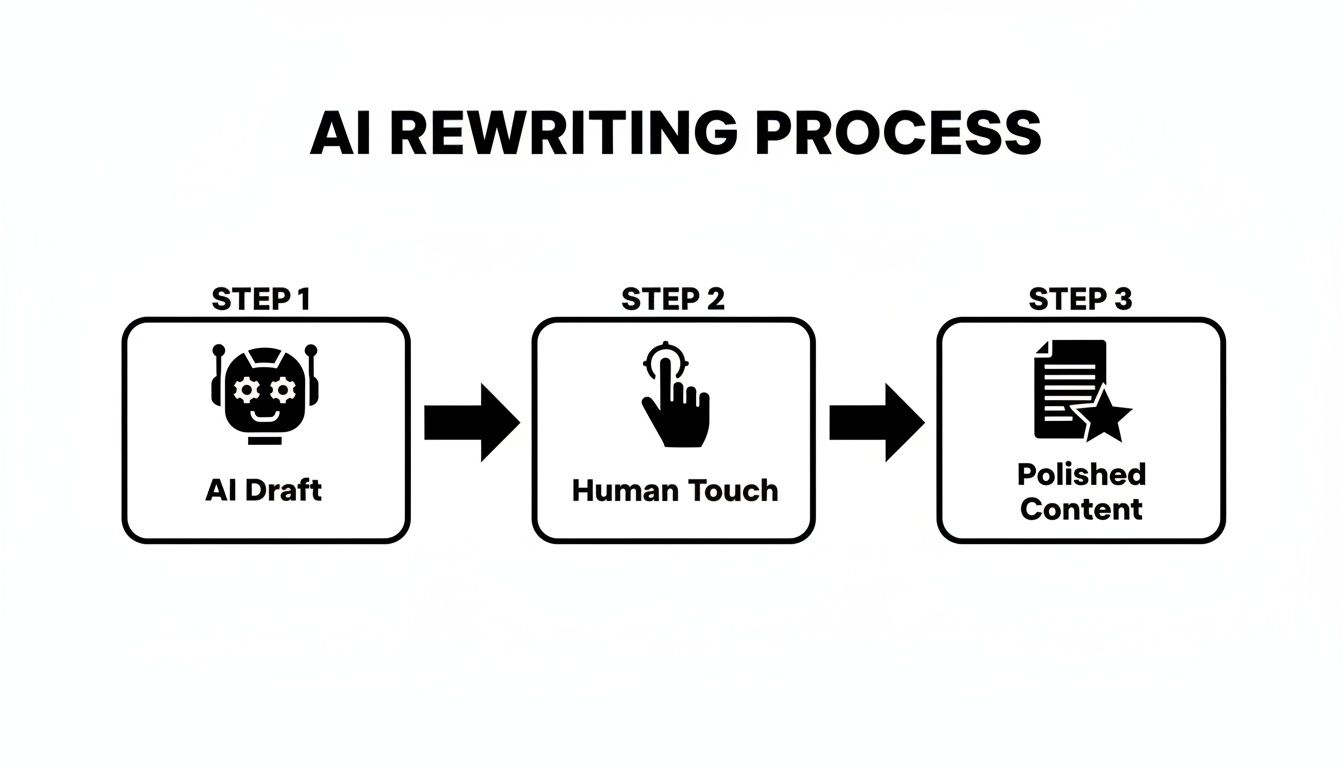
The journey moves from raw machine output to a collaborative human touch, resulting in quality content that actually resonates.
Define Your Unique Brand Voice
First things first: you need to nail down the personality of your content. AI models are trained on the entire internet, so they naturally spit out text that’s generic and neutral. Your brand, on the other hand, is anything but.
So, who are you?
- The trusted expert? Authoritative, educational, and clear.
- The clever friend? Witty, informal, and full of sharp insights.
- The supportive mentor? Empathetic, guiding, and patient.
- The straight shooter? Direct, data-driven, and focused on facts.
Jot these traits down in a simple style guide. This becomes your North Star, helping you stay consistent whether you're editing an AI draft or writing from scratch. A distinct voice is the bedrock of authentic writing.
Truly Understand Your Audience
Who are you actually talking to? Getting specific here is non-negotiable. Vague descriptions like "small business owners" just don't cut it. You have to get inside their heads to understand their language, their biggest headaches, and what they’re really looking for.
Create a couple of detailed reader personas. Think about their day-to-day challenges, the industry slang they use (or can't stand), and the questions keeping them up at night. When you genuinely get their world, you can swap out the AI’s robotic language for words that meet them exactly where they are.
A persona isn't just a demographic profile; it's an empathy tool. It’s a constant reminder that you’re not writing for a search engine—you’re writing for a real person with real problems to solve.
This deep understanding is what allows you to make the content feel personal and immediately valuable.
Set Clear Objectives for Every Piece
Before you even think about rewriting, ask the most important question: what is this content supposed to do? Every article, blog post, or guide needs a primary objective. Are you trying to teach something, convince someone to act, or just build a stronger connection with your brand?
Pinpointing your core message helps focus your rewriting like a laser. If the goal is driving sign-ups, your language needs to be persuasive and direct. If you’re breaking down a complex topic, your tone should be patient and loaded with helpful examples. This clarity stops the content from wandering and makes sure it does its job.
This strategic layer is more critical than ever. With global AI investment seeing a 62% jump to around $110 billion in 2024, the tools are getting ridiculously powerful. As a result, roughly 73% of marketing departments are already using generative AI. That means the demand for skilled human editors who can shape this raw output is skyrocketing. You can read more about this explosive growth in these AI investment statistics.
Once you have your framework in place—a defined voice, a deep audience understanding, and clear goals—you’re finally ready to move from planning to action. Now you can use this blueprint to systematically assess the raw AI draft and begin the real work of humanization.
Practical Techniques for Injecting Authenticity
Alright, theory is one thing, but the real magic happens when you roll up your sleeves and start rewriting. This is where you actively transform those sterile, machine-generated sentences into prose that actually breathes. The goal is to stop just informing and start truly connecting with your reader.

The whole process boils down to a few key techniques. When you combine them, your content will start to feel undeniably human. Let's break down these practical methods, with examples, to show you exactly how to rewrite AI text to human and find that authentic voice.
Vary Your Sentence Structure and Rhythm
One of the biggest tells of AI content is its monotonous rhythm. AI tools often churn out paragraphs where every sentence is roughly the same length and structure. This creates a robotic cadence that can put anyone to sleep.
Your first job is to break that pattern. Mix things up.
- Short, punchy sentences: Use these to make a strong point. They demand attention.
- Longer, flowing sentences: These are perfect for explaining more complex ideas, adding the kind of detail and context that carefully guides a reader through your thought process.
- Mid-length sentences: Think of these as the workhorses. They carry the bulk of your information without feeling too heavy or too brief.
By consciously varying your sentence length, you create a far more dynamic and engaging experience. It starts to mirror the natural ebb and flow of human speech, making the text feel more like a conversation than a dry lecture.
Inject Personal Anecdotes and Relatable Examples
Here's the thing: AI has no life experience. It’s never stared down a tough deadline, celebrated a win, or learned a hard lesson. This is your biggest advantage. Weaving in personal stories or relatable examples is the single fastest way to inject authenticity into your writing.
Instead of just stating a generic fact, tell a quick story.
Before (AI-Generated): “Utilizing effective project management strategies can lead to improved team collaboration and better outcomes.”
After (Humanized): “I remember one project that was on the brink of total chaos. We were missing deadlines, and communication was a mess. It wasn't until we implemented a simple daily stand-up meeting that everyone finally got on the same page and we turned it all around.”
See the difference? The "after" version doesn't just state a fact—it illustrates it with a mini-story that's way more memorable and convincing. It builds trust and makes an abstract concept like "project management" feel tangible and real.
Use Vivid, Sensory Language
AI writing often feels cold because it lacks sensory details. It describes things without helping the reader see, hear, or feel them. To fix this, you need to actively pull in language that appeals to the senses.
This doesn't mean you have to start writing flowery poetry. It’s just about choosing specific, evocative words.
- Instead of "the room was messy," try "the room was cluttered with teetering stacks of books and half-empty coffee mugs."
- Instead of "the presentation was successful," try "you could feel the energy in the room shift as the audience started nodding along."
This kind of specific, sensory language paints a picture in the reader's mind, making your content more immersive and something they’ll actually remember.
Eliminate Repetitive Phrasing and Jargon
AI models have their favorite words and phrases, and they tend to overuse them. You'll see repetitive sentence starters like "Furthermore," "Moreover," "In addition," and "It is important to note that." These are dead giveaways.
Your mission is to hunt down and destroy this repetition. A great trick is to read your draft aloud—you’ll immediately hear which phrases sound clunky or keep popping up. Replace them with more natural transitions.
At the same time, be ruthless about cutting corporate jargon. AI loves to sound stuffy and formal, using words no one actually says. Swap "utilize" for "use," and "facilitate" for "help." If you want to get ahead of this, check out some great tips on how to tell ChatGPT to write like a human from the start.
From Robotic to Relatable: Actionable Rewriting Tactics From AI to Human
Seeing these techniques side-by-side makes their impact crystal clear. AI can be a massive help—many organizations report 30–55% reductions in time-to-first-draft and some teams produce 50% more content with it. But with around 60% of marketers worried about the risks of unedited AI, that human touch is non-negotiable.
This table breaks down some common rewrites to show you what's possible.
| Technique | Robotic AI Example | Humanized Rewrite |
|---|---|---|
| Add Personality | The software provides a robust solution for data analysis. | This software is a lifesaver when you’re drowning in spreadsheets. |
| Be Specific | The marketing campaign yielded positive results. | Our last email campaign boosted sales by 22% in just one week. |
| Simplify Language | It is imperative to adhere to the guidelines. | Just make sure you follow the rules. |
| Vary Structure | The system is efficient. The system is reliable. The system is secure. | Not only is the system efficient and reliable, but it's also incredibly secure. |
By applying these practical, hands-on techniques, you can systematically transform any AI draft. You're not just editing for grammar; you're fundamentally reshaping the text to give it a genuine human spark that will actually connect with your audience.
Fine-Tuning Your Content for Readability and SEO
You've done the hard work of transforming that robotic AI draft into something genuinely human, full of authentic stories and a real voice. But don't hit "publish" just yet. The final, crucial step is making sure people and search engines can actually find and enjoy your masterpiece. This is where we close the gap between brilliant writing and smart performance.
The aim here is twofold: create content that ranks well but, more importantly, delivers an experience that makes people want to stick around. After all, getting a click is pointless if your reader bounces after seeing the first dense paragraph.
Make It Easy on the Eyes: Boosting Readability
Readability isn't just a trendy metric; it's a sign of respect for your reader's time. In a world of shrinking attention spans, scannable content is king. Nobody wants to decipher a wall of text, no matter how valuable the information is.
Your first move? Break up those paragraphs. I stick to a strict rule of one to three sentences maximum. This simple change introduces white space, which is a visual relief and helps guide the reader’s eye down the page.
Next, attack sentence length. AI has a nasty habit of generating long, winding sentences loaded with clauses. Your job is to be the editor. A great trick is to read your sentences out loud. If you have to pause for a breath, it's too long and needs to be split.
Here are a few other easy wins I always use to improve readability:
- Headings and subheadings are your best friends. They create a logical flow and let skimmers know what each section is about.
- Bullet points and numbered lists make complex ideas or steps feel simple and manageable.
- Bolding key phrases or takeaways grabs attention and highlights the most important bits of information.
Expert Tip: Always assume your reader is scanning first. Your formatting needs to act like a map, showing them exactly where to find what they need in just a few seconds.
By putting these formatting basics into practice, you make your writing far more inviting and effective for everyone.
Weaving SEO into Your Human-Written Text
Now that your content is a joy to read, it's time to handle the SEO—without losing that human touch you just worked so hard to create. Forget the old days of awkward keyword stuffing. Modern SEO is all about providing real value and demonstrating authority.
Start with your main keyword, but think bigger. You need to incorporate semantic keywords—these are the related concepts, questions, and phrases your audience is also searching for. For example, if your article is on "rewrite ai text to human," you should also weave in terms like "make AI text sound natural," "editing AI drafts," or "humanize ChatGPT content." This paints a fuller picture for Google.
Next up, linking. A thoughtful internal link is a powerful tool. It can point readers to another helpful article on your site, keeping them on your domain longer and boosting your site's authority. Don't forget external links, either. Linking out to credible, high-authority studies or sources shows you've done your homework and builds trust with your audience.
Finally, give your titles and meta descriptions the attention they deserve. Your title is your first impression on a search results page; it has to be compelling enough to earn the click. The meta description is your short-and-sweet sales pitch, promising the reader what they'll get by clicking. A strong title and meta combo can seriously boost your click-through rate, which is a huge signal to search engines that your content is a great match for that query.
The Final Polish Before You Publish
You’ve done the heavy lifting—rewriting, restructuring, and injecting your own voice. Now, you’re on the home stretch. This is the last, critical look-over that separates content that’s just good from content that’s genuinely great. It’s your final chance to spot any lingering awkwardness, nail down your facts, and make sure your piece is undeniably human.
Skipping this final polish is like building a gorgeous custom car but never checking the engine. It looks fantastic, but it's bound to sputter when you need it most. That’s a quick way to damage your credibility and lose the trust you’ve worked so hard to build.
Run a Thorough Originality Check
First things first: you have to confirm your content is original. Even after a heavy rewrite, AI can sometimes spit out text that’s a little too close to its training data. Running a solid plagiarism check isn't just a suggestion—it's a non-negotiable step to protect yourself and your reputation.
This isn't just about avoiding dings from search engines. It’s about making sure your voice is truly your own. A clean originality report is your green light, giving you the confidence that your perspective is unique. That’s the foundation of all authentic writing.
Scan for Lingering AI Patterns
Next up, it’s time to go on a hunt for any subtle, leftover AI tells. Even the most carefully edited drafts can hide a few robotic-sounding sentences. This is where specialized tools can give you an edge, analyzing your text to flag any patterns that don't quite sound natural.
For example, a good platform can help you rewrite AI text to human by pointing out phrases that are too stiff or structured. The goal isn’t about tricking a detector; it’s about using the feedback to make your writing flow better for an actual person. To see this in action, you can explore how tools like the AI Busted platform work.
The ultimate test is simply this: does it feel effortless to read? If you find yourself re-reading a sentence to understand it, that's a red flag. It needs one more pass to smooth out the edges and hit that 100% human score.
This final scan is your opportunity to iron out any kinks and make sure every word contributes to a seamless reading experience.
Read Your Work Aloud
Honestly, this might be the most effective, low-tech editing trick there is. Reading your entire piece out loud forces you to slow down and hear the words just like your audience will. You’ll catch things your eyes completely miss when scanning on a screen.
Listen for these specific things:
- Awkward phrasing: Do any sentences sound clunky or just plain weird when you say them?
- Rhythm and flow: Does the cadence have a nice, varied rhythm, or does it drone on in a monotone?
- Logical gaps: Does one idea connect smoothly to the next? Or does it feel like a sudden jump?
If you stumble over a sentence or run out of breath, that's a clear signal to go back and simplify it. This simple habit is incredibly good at catching those last few robotic remnants.
Verify Every Fact and Figure
Last, and most critically, you need to double-check every single fact, statistic, and claim. This is a notorious weak spot for AI, which can "hallucinate" or confidently serve up outdated information. Your credibility is on the line here.
Take a minute to trace your data back to its source.
- Is that statistic from a reputable study?
- Is the report you’re citing still relevant?
- Did you interpret the data correctly?
For instance, a University of Chicago study found that projected deaths from climate change drop by over 50% when you factor in expected economic growth in low-income countries. A powerful stat like that loses all its weight—and hurts your authority—if it's misquoted or taken out of context. This final check solidifies your reader's trust and makes sure your content is not just human-sounding, but also reliably accurate.
FAQs: Your Questions About Humanizing AI, Answered
As you get your hands dirty turning AI drafts into polished content, you're bound to hit a few snags. It's a common part of the process. I've been there, and I've seen the same questions pop up time and time again. This isn't just about swapping out a few words; it's about reshaping the text's entire feel.
Let's walk through some of the most frequent questions I get. Think of this as a quick-reference guide to help you smooth out the bumps in your workflow.
How Can I Make AI Text Sound More Conversational?
This is probably the number one question people ask. To start, use contractions. "It is" sounds stiff, but "it's" feels natural. It’s a small change with a big impact. AI tends to be overly formal, so things like "you will" and "cannot" can be easily swapped for "you'll" and "can't."
Next, pull your reader in by asking them questions. This creates a dialogue, even if it's one-sided. Also, look at sentence length. AI loves long, winding sentences. Chop them up. Mix short, punchy statements with more descriptive ones. Finally, inject yourself into the text with a quick observation, a short personal story, or a touch of humor.
My go-to trick: I always read my writing out loud. If it sounds clunky or robotic when I say it, I know it's not ready. This is the fastest way to catch phrasing that just doesn't land right.
What Are the Biggest Red Flags of AI Content?
Once you know what to look for, the signs of AI writing become pretty obvious. AI models love using the same transition words over and over. If you see a lot of "Furthermore," "In addition," and "Moreover," that's a classic giveaway.
The tone is another dead giveaway. It’s often flat, overly formal, and lacks a consistent point of view. It feels like an encyclopedia entry when it should feel like a conversation. AI also leans on generic statements without providing any real-world examples, data, or stories to give them weight. The content might be technically correct, but there's no soul behind it. Spotting these patterns is your first step to a great rewrite.
Can I Use an AI Tool to Help Humanize My Draft?
Absolutely, but think of it as an assistant, not the author. AI editing tools can be a huge help for tasks like finding better synonyms, catching grammar mistakes, or untangling a confusing sentence. They handle the grunt work so you can focus on the bigger picture.
Just be careful you don't fall into the trap of using one AI to fix another. Doing that can sometimes just swap one set of robotic habits for another. Remember, the most important elements—your personal insights, your stories, and your authentic voice—have to come from you. Use tools to refine, but you need to be the one in the driver's seat.
Does Rewriting AI Content Guarantee a Human Score?
Your main goal should always be creating high-quality content that connects with a human reader. When you do that well, achieving a 100% human score on a tool is often the natural result.
By focusing on adding personal anecdotes, varying your sentence structures, and injecting your unique voice, you’re not just trying to trick a detector. You're fundamentally changing the text into something genuinely human. This authentic approach is far more reliable and, more importantly, it results in content that people actually want to read. The high score becomes a byproduct of great writing, not the sole purpose of it.
Ready to transform your AI drafts into content that truly connects? AI Busted provides the tools you need to humanize text, check for AI patterns, and polish your writing to perfection. Achieve a 100% human score and ensure your voice is always heard. Try it for free today.