Detecting AI-generated text isn't a simple one-and-done process. It's really more of an art than a science, blending sharp-eyed human analysis with the power of sophisticated software. The best approach I've found is a hybrid one: start by looking for tell-tale linguistic patterns yourself, then run the text through a specialized detector to catch the statistical giveaways. It's this combination that delivers the most accurate results.
The New Reality of Digital Content
We're currently living through a content explosion, the likes of which we've never seen before. Ever since ChatGPT was released to the public back in November 2022, the internet has been flooded with machine-written articles. Think about this: just one year after its launch, AI-generated content already accounted for nearly 39% of all new publications.
Today, we've hit a tipping point. AI-generated articles now officially outnumber those written by humans. This seismic shift creates a huge problem for anyone who depends on authentic, reliable information—we're talking editors, teachers, researchers, and marketers. How can you be sure the content you're reading, publishing, or grading is the real deal?
Understanding the Detection Workflow
Trying to figure out if a text was written by a person or a machine requires a clear, methodical workflow. You can't just rely on a single tool or a gut feeling.
This flowchart breaks down the most effective process, which moves from human intuition and manual checks to a final verdict backed by technology.
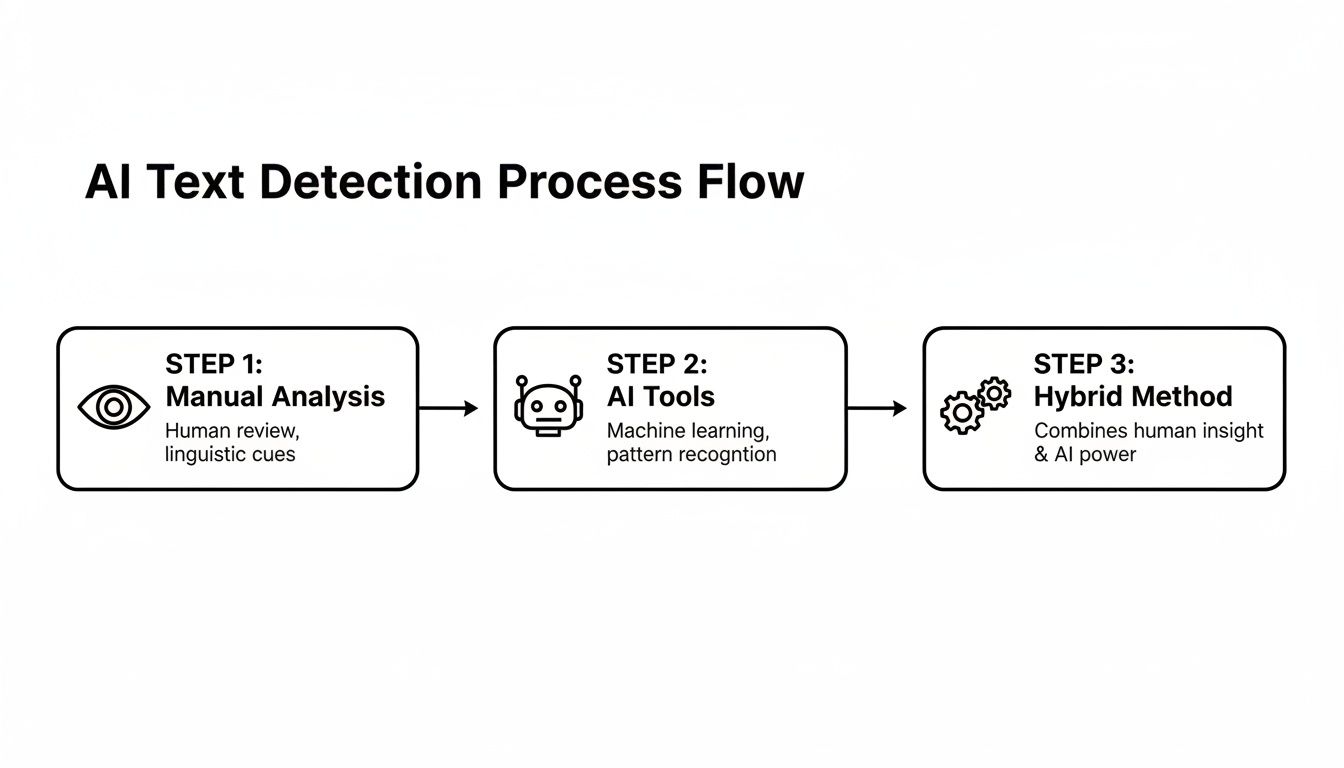
As you can see, the path to a confident assessment involves combining those manual observations with a powerful tool like the detector at https://aibusted.com/. This creates a much more robust system for validation, so you can actually trust the content you're working with.
To give you a clearer picture, here's a quick rundown of the main strategies you can use.
Three Core Methods for Detecting AI Text
| Detection Method | What It Looks For | Best For |
|---|---|---|
| Manual Linguistic Analysis | Unnatural phrasing, repetitive sentence structures, lack of personal voice, perfect grammar, and factual inconsistencies. | Quick initial assessments and developing an intuitive "feel" for AI writing. |
| Automated AI Detectors | Statistical patterns in word choice ("perplexity") and sentence construction ("burstiness") that are common in machine-generated text. | Analyzing large volumes of text quickly and getting a data-backed probability score. |
| Hybrid Approach | Combines the nuance of human observation with the statistical rigor of AI detection tools for a comprehensive verdict. | High-stakes situations where accuracy is critical, such as academic integrity or verifying key business documents. |
Ultimately, layering these methods provides the most complete and reliable picture of a text's origin.
Why This Matters More Than Ever
The challenge here goes beyond simply spotting machine-written text. It's about protecting the integrity and value of our digital communication. Getting a grasp on the mechanics, like how ChatGPT indexes content from its vast training dataset, is key to understanding the very nature of AI writing. This knowledge helps you spot the subtle but consistent fingerprints that these models leave behind.
The goal isn't just to "catch" the AI. It's to cultivate a discerning eye for what makes content genuinely human: its unique voice, personal insights, and even its authentic imperfections. This skill is no longer optional—it's essential for maintaining credibility and quality in any field.
Learning how to detect AI-generated text is about empowering yourself to make informed decisions. It's about ensuring the content you use, share, and rely on is credible, valuable, and trustworthy. The following sections will give you a practical, step-by-step breakdown of the exact techniques I use every day.
Your First Line of Defense: Manual Detection
Before you even think about reaching for a detection tool, start with the most powerful and nuanced processor you have: your own brain. Learning how to detect AI-generated text isn't just about spotting errors; it's about developing a feel for the subtle, almost uncanny valley of writing that lacks a human touch.

The content might be grammatically perfect and structured logically, but it often feels… empty. It can explain a concept with textbook precision but completely misses the personal stories, unique opinions, or emotional color that makes human writing connect with a reader.
Can You Hear the Robotic Voice?
AI models often fall into a very specific writing persona: the endlessly patient, hyper-organized instructor. The prose is crystal clear but has zero personality. This results in a style that, while technically flawless, feels sterile and oddly impersonal.
A huge giveaway is the constant use of "signposting" language. AI loves to frame its responses with phrases like "let's explore," "here's a breakdown," or "it's important to note." While a human writer might use these sparingly, an AI uses them with a programmatic frequency that becomes a dead giveaway once you start looking for it.
Another telltale sign is the heavy-handed use of authoritative but vague words. You'll see words like "crucial," "key," and "essential" pop up far more often in AI text. It’s a shortcut to sound important without providing the specific, experience-driven reasoning a human expert would naturally include.
Look at the Bones: Structure and Phrasing
Beyond word choice, the very rhythm and structure of the writing can scream "machine." AI-generated text often has an unnervingly consistent cadence. Sentences are frequently of similar length and complexity, creating a monotonous flow that a person would instinctively break up.
Keep an eye out for these structural red flags:
- Repetitive Sentence Starters: Notice how often consecutive sentences or paragraphs begin with the same transition words ("Additionally," "Furthermore," "In conclusion"). It’s a classic AI crutch.
- Perfectly Balanced Lists: When an AI creates bullet points, each item often has a nearly identical length and grammatical structure. It lacks the natural, slightly messy variation you see in human-written lists.
- Flawless but Soulless Grammar: Sure, perfect grammar is the goal, but real writing often has minor quirks or intentional stylistic choices. AI text is typically perfect to a fault, feeling overly polished and sanitized.
The thing is, human writing is often beautifully messy. We use odd analogies, have unique phrasing habits, and sometimes circle a topic before landing the point. AI text lacks this authentic imperfection, and that’s often its biggest tell.
For example, a human blogger describing a software bug might tell a frustrating personal story, complete with slang. An AI would likely call it a "significant operational challenge" and serve up a sterile, impersonal list of troubleshooting steps. The information is there, but the humanity is completely gone.
The Missing Ingredient: Lived Experience
Ultimately, the most reliable indicator is the glaring absence of a genuine human perspective. This is where manual detection really excels, because it’s something that even sophisticated tools struggle to measure. AI can mimic empathy or summarize expert opinions, but it can’t invent from lived experience.
When you're reading a piece of content, ask yourself these questions:
- Are there any personal stories, anecdotes, or unique examples that feel real?
- Can you sense a distinct, consistent authorial voice or tone throughout the piece?
- Does the writing offer any original ideas or contrarian viewpoints, or is it just a perfect summary of common knowledge?
If an article on a complex subject reads like a flawless encyclopedia entry but has no trace of the author's personal journey with that topic, your AI-dar should be going off. Honing this ability to spot the "hollowness" in technically perfect text is the most powerful first step in your detection toolkit. It allows you to quickly flag suspicious content for a more detailed, tool-assisted investigation.
Choosing and Using AI Content Detectors
When your own eyes and intuition raise a red flag, it's time to bring in some technology for a deeper look. Automated AI detectors are built to catch the subtle statistical fingerprints that machine learning models leave behind. They move beyond a gut feeling to give you a data-driven probability of where a text actually came from.
These tools analyze content for factors that are nearly impossible for a human to spot. Think of things like perplexity—how predictable the word choices are—and burstiness, which is the variation in sentence length. AI-generated text often has low perplexity and low burstiness, meaning it defaults to common, expected words and sticks to an unnaturally consistent sentence structure.
Navigating the World of Detection Tools
The market is flooded with AI detection tools, but their effectiveness can be all over the map. While some of the early detectors were notoriously unreliable, the latest learning-based systems have made some serious improvements. The best tools now claim over 99.9% accuracy with impressively low false positive rates.
But don't take that at face value. A revealing arXiv study showed that many popular detectors still struggle, with only a handful performing at a level you could call reliable. The study pointed out that these tools get particularly confused by content that blends human and AI writing.
The key takeaway here is that no single detector is foolproof. Treat their scores as a strong signal—a critical piece of evidence in your investigation—but never as the absolute, final verdict. Cross-referencing results from two or three different reputable tools is always the smartest move.
Best Practices for Effective AI Detection
Getting the most out of an AI detector isn't as simple as copy-pasting. If you just paste text and accept the first result you see, you're setting yourself up for an inaccurate conclusion.
Here are a few things I’ve learned to keep in mind:
- Analyze in Context: Always think about the type of content you're checking. Technical manuals, legal documents, or even text from non-native English speakers can sometimes trigger false positives because their phrasing can mimic AI patterns.
- Use Multiple Tools: Run the same text through at least two different detectors. If one tool flags it as 95% AI and another says 10% AI, that massive discrepancy tells you to lean more heavily on your own manual analysis.
- Test a Good Chunk of Text: Don't just check a single paragraph. For an accurate reading, you need a substantial sample—at least a few hundred words. This gives the tool enough data to spot recurring patterns.
- Understand What the Score Means: The score is a probability, not a certainty. A result of 70% AI doesn't mean seven out of ten sentences were written by a machine. It means the entire text has a high probability of being AI-generated based on its linguistic makeup.
Interpreting the Results from AI Busted
Using a solid tool like the one from AI Busted gives you a clear and intuitive way to assess content. The interface is designed to provide a straightforward probability score, which removes a lot of the guesswork.
Here's a look at what the AI Busted detector's results look like when analyzing a piece of text.

This screenshot shows a high probability score, which is a strong indicator that the text shares many characteristics with known AI-generated content. When you combine this score with the manual red flags you've already identified, you can start building a strong case for the text's origin. It’s this combined evidence that lets you make an informed judgment.
Ultimately, these tools are just one step in a larger process. After running your checks, you might need to have a conversation with the content creator or decide on next steps for editing. You can see these principles in action by exploring how the public AI Busted tool works. This hybrid approach—your critical eye backed by the statistical power of a detector—is the most reliable way to navigate the modern content world and keep your quality standards high.
Common Pitfalls and How to Avoid Them
Learning how to detect AI generated text is a real skill, and a few common traps can easily trip you up. Just pasting text into a tool and blindly trusting the score is a fast track to inaccurate conclusions and, frankly, unfair judgments. You have to be more critical than that.
The single biggest mistake I see is people putting all their faith in one detection score. These tools are fantastic allies in the process, but they aren't infallible judges. Their results are based on probabilities, not certainties, and should be treated as just one piece of a much larger puzzle.
The Challenge of Hybrid Content
One of the toughest hurdles for both human reviewers and automated tools is what's known as "hybrid" content. This is where text starts its life as an AI draft but is then heavily edited, rewritten, and fleshed out by a human. The final product becomes a blend of machine speed and human touch.
This hybrid approach effectively sands down the robotic edges of the original draft. The human editor injects personal stories, tweaks the tone, and breaks up the monotonous sentence patterns that AI detectors are trained to spot. The result? The text can easily fool a detector, often coming back with a "human-written" score even though its skeleton was machine-generated. This is why you have to look beyond the score and evaluate the content’s deeper qualities.
Understanding False Positives
Perhaps the most dangerous pitfall is misinterpreting a false positive. This happens when a detector incorrectly flags 100% human-written text as AI-generated. It’s a lot more common than you might think, especially with certain writing styles.
For example, highly technical guides, formal academic papers, or dense legal documents often use precise, structured, and impersonal language. That style can unintentionally mimic the patterns of an AI, leading to a high probability score. I’ve also seen this happen with text from non-native English speakers, whose unique sentence constructions can sometimes trigger the same flags.
A high AI score on a piece of technical writing doesn't automatically mean a machine wrote it. It could just mean the author's formal style happens to align with the patterns detectors are trained to find. Context is everything here.
Relying only on a score without considering the context or the author’s background can lead you to wrongly accuse someone of academic dishonesty or professional misconduct. The stakes are high.
A Checklist for Critical Evaluation
To sidestep these traps, you need a more thoughtful evaluation process. Before you make a final call on a piece of content, run through this quick mental checklist to make sure you're seeing the whole picture.
- Consider the Content Type: Is this a formal research paper or a casual blog post? The expected style dramatically changes how you should interpret a high AI score.
- Analyze the Author's Background: If possible, look at other work by the same author. Is their style consistent, or does this piece feel like a sudden, jarring departure?
- Look for Nuance and Opinion: Does the text offer a unique perspective or a controversial take? AI models are generally trained to be neutral and avoid taking strong, personal stances.
- Cross-Reference with Multiple Tools: Never rely on a single detector. Run the text through two or three different tools to see if you get a consensus. A major disagreement is a clear sign to lean more heavily on your own manual review.
This careful, evidence-based approach is far more reliable than a simple copy-paste check.
The situation is complex, especially for global audiences. The good news is that advanced tools are now showing impressive resistance to paraphrasers, with some benchmarks hitting >99.9% accuracy. This level of precision is vital for SEO and social media managers. While AI content can drive 56% better engagement and 68% ROI gains, it often tanks in search results if it hasn't been properly humanized.
Understanding these detection statistics can guide your process of turning AI output into natural-sounding text, preserving its meaning while ditching the robotic tone. You can find more insights on these AI detection trends at wellows.com. By avoiding these common mistakes and adopting a thoughtful, multi-faceted approach, you can make more accurate and fair assessments every time.
From Detection to Action: Humanizing Your Content
So, you've gotten the hang of how to detect AI generated text and have flagged a piece of content that feels a little… robotic. What now? This is where the real work—and the real value—begins. The point isn't just to spot machine-written text; it's to elevate it. It’s about transforming a sterile draft into something that connects with people, offers genuine insight, and meets the highest standards of quality.
There's a common misconception that this is all about finding clever ways to fool the detectors. Honestly, that’s a waste of time. The real objective is much more straightforward: produce genuinely great content. When you focus on making something that's well-crafted, insightful, and authentic, a 100% human score just becomes a natural result of your effort, not the end-all-be-all goal.
Moving Beyond Simple Rewriting
When faced with AI-generated text, the first instinct for many is to just paraphrase a few sentences. This is a surface-level fix that almost never works. Real humanization goes so much deeper. It’s about rethinking the content from the ground up to reflect a real, human perspective.
This is where a dedicated tool like the AI Busted humanizer can become a powerful partner in your workflow. It’s built to do more than just swap out words. It actually analyzes the underlying structure, tone, and intent of the text, then rebuilds it to weave in the kind of nuance and personality that AI models simply can't replicate on their own.
A Practical Workflow for Humanizing Content
Turning an AI draft into a polished, original piece isn't about hitting a button and hoping for the best. It's more of a collaboration between your own expertise and what the technology can do.
Here’s a workflow I've found to be incredibly effective:
- Start with a Solid AI Draft: Use an AI model to handle the initial heavy lifting—the research, the basic structure, and the foundational points of your topic. This is a huge time-saver.
- Run It Through the Humanizer: Take that AI-generated text and paste it into the AI Busted humanizer. The tool will give you a refined first pass that smoothes out the most obvious robotic patterns.
- Inject Your Unique Voice: This is the most important step, and it's all you. Read through the humanized draft. Where can you add a personal story, an opinion, or a niche example? What specific case study do you know that an AI couldn't possibly have access to?
- Refine for Tone and Flow: Now, tweak the tone to match your brand or personal style. Does it need to be more conversational? More authoritative and direct? Break up those long, clunky sentences and make sure the rhythm feels natural as you read from one paragraph to the next.
This structured process keeps you in the driver's seat, letting you use technology for the grunt work while you focus on the creative, high-value parts.
The real power of humanizing content lies in layering your unique experience and insights on top of a well-structured foundation. The tool cleans up the robotic language, but you provide the irreplaceable human element that makes the content truly valuable.
Key Elements of Genuinely Human Content
As you edit and refine, keep your focus on the specific qualities that set human writing apart from machine output. These are the very things that not only resonate with readers but also align with what search engines are increasingly rewarding as helpful, high-quality content.
Here are the key areas to pour your energy into:
- Lived Experience: An AI can summarize data, but it can't tell a story about a time you failed and what you learned. Adding a short, relevant anecdote makes your content instantly more credible and relatable.
- Original Analysis: Don't just list facts. Connect the dots for your audience. What’s your unique take on this information? What conclusion can you draw that isn't just common knowledge recycled from other articles?
- Emotional Nuance: Good writing makes the reader feel something. Use evocative language and vary your tone to create interest, empathy, or excitement. AI often defaults to a flat, neutral tone that completely fails to engage.
- Authentic Imperfections: Let's be real—human writing isn't always perfectly polished. It has quirks, unique phrasing, and a distinct rhythm. Don't be afraid to let your personality show. It’s one of the clearest signals of a human author at the helm.
By building your content on these four pillars, you transform a simple summary of data into a compelling piece that delivers real-world value. This is what separates forgettable articles from content that builds trust, earns backlinks, and ranks well. It's the final, crucial step in any modern content strategy that aims to use AI responsibly and effectively.
Frequently Asked Questions About AI Detection
As AI-generated content becomes more common, so do the questions. It's totally normal to wonder how accurate these detection tools really are, what it all means for your work, and what to do when a piece of text just doesn't feel right. Let's tackle some of the most common questions head-on.
Getting a handle on this topic means understanding what the technology can do, but also what it can't. By clearing up these points, you can build a smarter, more confident process for making sure your content is genuinely high-quality and authentic.
Can AI Detectors Be 100 Percent Accurate?
The short answer is no. No AI detector on the market can guarantee 100% accuracy. These tools are built on probabilities. They scan text for the statistical fingerprints and predictable patterns that are typical of machine-generated writing, but they aren't infallible.
Think about it this way: certain things can throw them off. A heavily edited AI draft might slip through, while highly technical content or even the unique phrasing of a non-native English speaker could trigger a false positive.
A detector’s score is a powerful piece of evidence, not the final verdict. The best approach is always to combine the tool's analysis with your own human judgment.
Does Google Penalize AI-Generated Content?
Google has been pretty clear on this: they reward helpful, high-quality content that serves the user, no matter how it was created. There isn't an automatic penalty just because AI was involved in the writing process.
The real issue is, and always has been, quality. Raw, unedited AI output often feels generic and fails to meet Google's standards for Experience, Expertise, Authoritativeness, and Trustworthiness (E-E-A-T). That’s the kind of low-value, spammy content that gets penalized. So, using AI isn't the problem—publishing lazy content that doesn't help the reader absolutely is and will hurt your SEO.
What Is The Difference Between An AI Detector And A Plagiarism Checker?
This is a really important distinction to understand. An AI detector and a plagiarism checker do two completely different jobs.
- An AI detector looks at how something is written. It analyzes linguistic patterns like sentence predictability, word choice, and flow to determine the probability that it was written by a machine.
- A plagiarism checker compares a document against a huge database of existing content—articles, books, papers—to find passages that have been copied from somewhere else.
A piece of writing can be 100% original and easily pass a plagiarism scan, yet still be flagged as 100% AI-generated. The tools are measuring entirely different things. It’s also wise to know how your text is being used; you can see how we handle user data in the AI Busted privacy policy.
How Do You Make AI Text Sound Human?
The goal here shouldn't be to fool a detector. It should be about genuinely elevating the content to reflect human insight and quality. When you focus on that, the text will naturally sound human.
This goes way beyond just swapping out a few words. It means rethinking the structure for better flow, injecting a real voice and a consistent tone, and making sure the ideas connect in a way that’s engaging for a human reader. This is exactly what tools like the one from AI Busted are built for. They help you turn a robotic first draft into writing that's clear, compelling, and actually resonates with people.
When you make the content truly better for the reader, it will naturally achieve a human score because it meets human quality standards.
Ready to turn your AI drafts into polished, authentic content? The AI Busted humanizer is designed to help you achieve a 100% human score by focusing on quality and readability. Try it for free and see the difference it can make in your workflow: https://aibusted.com