
Writing an article that ranks on Google isn't just about stringing words together. It's a deliberate process that starts with targeted keyword research, moves into building a logical outline, and finishes with a round of on-page optimizations. Get this formula right, and you create something that search engines can easily find and, more importantly, that readers find genuinely helpful.
Why Most SEO Articles Fail to Rank
Think about this: an estimated 10 million blog posts go live every single day. Just hitting "publish" is like shouting into a hurricane. The hard truth is that most of this content sinks without a trace, never even sniffing the first page of Google.
The most common reason for this failure isn't bad writing—it's a fundamental misunderstanding of what "SEO-friendly" actually means. Many writers still think it's about cramming a keyword into every other sentence. It's not. It’s about building a comprehensive resource that satisfies the user's search intent from top to bottom.
You can write the most elegant, insightful article in the world, but if it ignores the technical and structural signals Google uses to understand content, it might as well be invisible. You have to write for both humans and search engine crawlers.
The Real Formula for Successful SEO Content
To break through the noise, you need to master the art of balancing three critical elements. This isn't just a checklist; it's a strategic approach to creating content that performs.
Here’s a quick look at the core pillars that hold up any successful SEO article. These components aren't optional—they work together to signal quality and relevance to both your audience and search engines.
Core Pillars of an SEO Friendly Article
| Pillar | What It Is | Why It Matters for SEO |
|---|---|---|
| Strategic Keyword Research | Discovering the exact terms your audience is searching for and understanding the why behind their search. | This is your foundation. Without it, you're creating content for an audience that doesn't exist. It aligns your article with real user demand. |
| Logical Content Structure | Organizing your article with a clear hierarchy of headings (H2s, H3s) and scannable paragraphs. | A clean structure makes content easy for users to read and even easier for Google's bots to crawl, understand, and index properly. |
| Precise On-Page SEO | The technical details: meta descriptions, optimized images, internal links, and other signals. | These elements provide crucial context to search engines, helping them confirm your article's topic and its authority on the subject. |
By mastering these three areas, you move from simply writing content to strategically engineering it for visibility and impact.
This entire workflow—from discovery to optimization—is a repeatable system for creating content that actually gets seen.
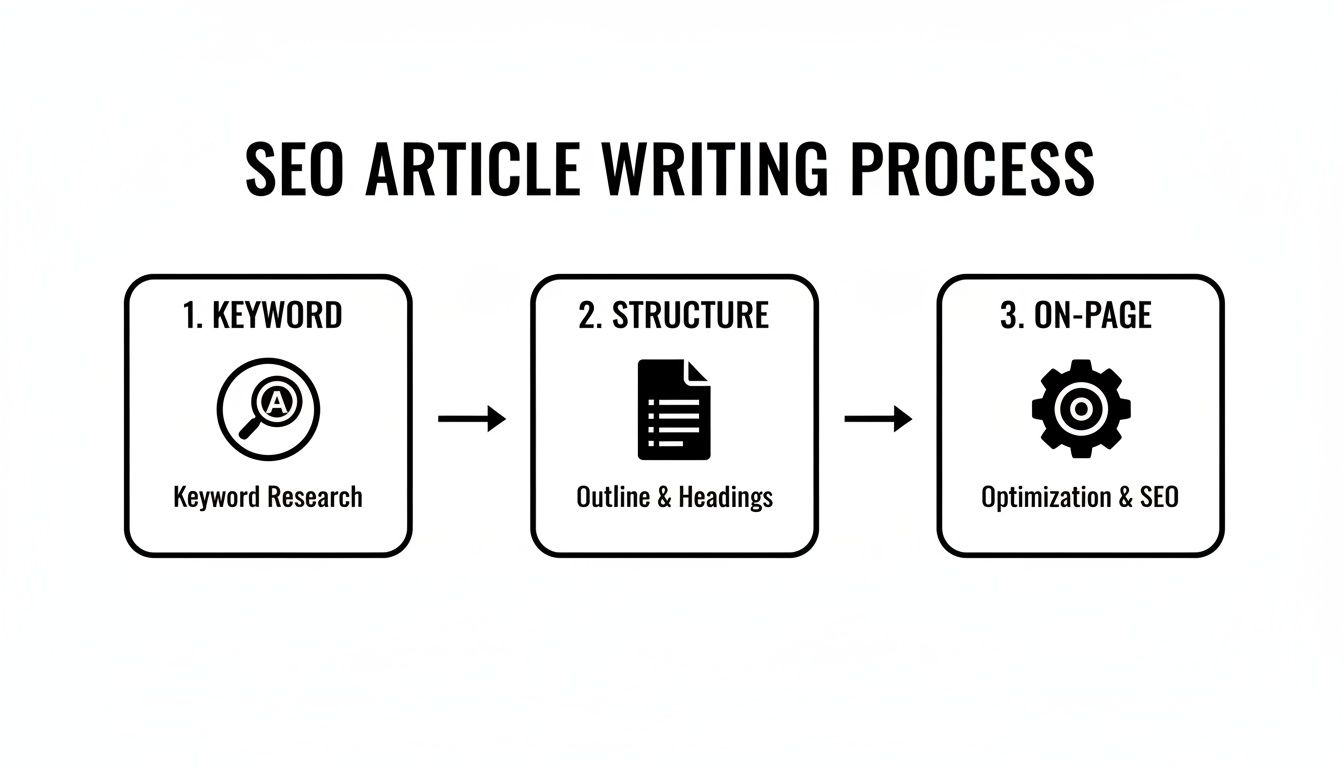
As the visual shows, each step builds on the last. You can’t have great on-page SEO without a solid structure, and you can't build a great structure without knowing your keywords. If you're ready to dig deeper, this guide on how to write SEO friendly blog posts that rank is a fantastic resource.
Finding Keywords That Actually Drive Traffic
Every successful SEO article starts with a fundamental truth: you have to know what people are really searching for. It's so easy to get mesmerized by keywords with huge search volumes, but the real magic happens when you understand the intent behind the search. Your job is to find the exact phrases people type in when they're ready to learn something new, solve a problem, or make a decision.
This isn't about throwing spaghetti at the wall and seeing what sticks. Instead of chasing a broad, hyper-competitive term like "coffee tables," we need to get smarter. The goal is to unearth long-tail keywords—those longer, more specific phrases that attract an audience that's much further along in their journey.
The Art of Hunting for Long-Tail Keywords
Here’s how to think about it. Someone searching for "coffee tables" is just window shopping. But the person searching for "best round coffee tables for small apartments"? They've got their credit card in hand. That specificity is your golden ticket.
Sure, these long-tail keywords have lower search volumes individually, but they convert like crazy. They are the absolute bedrock of a solid content strategy. Here’s a simple way you can start digging for them using a tool like Ahrefs or Semrush:
- Start with a "seed" keyword: Pop in a general topic, something like "home office setup."
- Explore related terms: Look at the "phrase match" or "related keywords" reports to see thousands of variations.
- Filter like a pro: Add modifiers to your search like "how," "what," "best," "for," or "guide." Filtering for "best," for instance, might uncover gems like "best ergonomic chair for long hours."
- Check the Keyword Difficulty (KD): Keep an eye out for keywords with a lower KD score. This tells you the competition isn't as fierce, giving you a much better shot at ranking, especially if your site is newer.
This is exactly what it looks like inside a keyword research tool when you start filtering. You can see how a broad term quickly turns into a list of specific, achievable targets.
That screenshot is a perfect example of the process in action. It shows how you can find those sweet spots: valuable keywords with manageable difficulty.
Building Your Keyword Blueprint
Once you've got a promising list of keywords, it's time to get organized. A truly great SEO article doesn’t just focus on a single keyword; it targets a whole cluster of related phrases. This is how you signal to Google that you have deep expertise on a topic.
Your list should have two main components:
- Primary Keyword: This is your north star, the main focus of the article. It needs to be in your title, your intro, and a couple of key headings.
- Secondary Keywords: Think of these as your supporting cast. They're related terms, synonyms, and long-tail variations. You'll want to sprinkle these naturally throughout your content, in subheadings, and even in your image alt text.
My Two Cents: Your keyword list is the architectural blueprint for your entire article. Get this right, and every sentence you write will have a purpose—to answer a reader's question and show search engines you're the most relevant result. To really master this, it's worth digging into more effective keyword research strategies.
Getting this part right is non-negotiable. It’s especially true when you realize that 95% of keywords get fewer than 10 monthly searches, making long-tail keywords the only reliable way to build traffic. And with the #1 spot on Google earning a massive 25.84% click-through rate, you can't afford to be sloppy with your keyword choices. To learn more, check out the great guide on how to write SEO friendly content on Hostinger.
Of course, the content you build around these keywords has to feel authentic. If you're using AI to get a first draft on the page, always take the time to humanize the output so it actually connects with a real person. You can check our free AI humanizer tool to see how you can polish AI-assisted text to sound more natural. This final step ensures your article isn't just optimized for a robot, but written for a reader.
Getting the Structure Right for Readers and Search Engines
With your keyword research done, it's time to build the article's skeleton. This structure is what makes your content work for both real people scanning for answers and the search engine crawlers trying to make sense of it all. A well-organized article is more than just easy on the eyes; it’s a huge signal to Google that you’ve created a comprehensive, easy-to-digest resource.
This all starts with a logical outline. Use headings and subheadings (your H2s and H3s) to create a clear hierarchy. I like to think of the primary keyword as the book's title and the headings as the chapter titles. They pull the reader through the content and tell search engines exactly what each section is about.

Crafting a Magnetic Headline and Meta Description
Your headline (your H1 tag) is your first, and often only, shot at grabbing someone's attention on a crowded search results page. It has to be compelling enough to earn that click while still clearly featuring your primary keyword. My goal is always to blend clarity with a bit of curiosity.
A solid headline formula I've seen work time and again includes:
- The primary keyword: This is absolutely non-negotiable for SEO.
- A number: List-style posts like "10 Ways to…" are click-magnets.
- An emotional hook: Words like "Essential," "Proven," or "Simple" can make a big difference.
- A clear benefit: Tell the reader what’s in it for them.
The meta description is your next sales pitch. It's that little blurb under your title in the search results. While Google says it’s not a direct ranking factor, a well-written meta description absolutely spikes your click-through rate (CTR), and CTR is a major ranking signal. Keep it tight—around 155-160 characters—include the main keyword, and think of it as a mini-ad for your article.
Why Going Deep Often Wins in SEO
When you're outlining, remember that depth matters. Short, surface-level articles just don't cut it anymore. They rarely satisfy the searcher or establish you as an authority. This is exactly why long-form content is a cornerstone of modern SEO, consistently outperforming shorter pieces.
The data backs this up. There’s a clear link between word count and search performance. Recent content writing statistics show that articles between 2,250 and 2,500 words tend to pull in way more organic traffic and social shares. In fact, long-form content gets twice as many page views and 24% more shares than articles in the 900-1,200 word range. You can dig into more of these content writing statistics and their impact on SEO to see the trends for yourself.
Key Takeaway: Going in-depth doesn't mean adding fluff. It means comprehensively answering the user's main question and any follow-up questions they might have, all in one place.
This strategy positions your article as the definitive resource on the topic. That encourages other sites to link back to you and signals to Google that you've covered all the bases.
Weaving Keywords Naturally Into Your Text
Keyword stuffing is dead. Thank goodness. Today, it’s all about integrating your primary and secondary keywords in a way that feels completely natural and actually helps the reader. You're writing for a person with a problem, not a machine checking boxes.
Here’s a practical checklist I use for placing keywords without sounding like a robot:
- Title Tag (H1): Your primary keyword needs to be here, ideally toward the beginning.
- Introduction: Mention your main keyword within the first 100 words or so. This immediately confirms the reader is in the right place.
- Subheadings (H2s & H3s): Sprinkle your primary and secondary keywords into your headings where it makes sense. It boosts scannability and SEO.
- Image Alt Text: Accurately describe your images using relevant keywords.
- Conclusion: It's good practice to wrap things up by referencing your main topic one last time.
For instance, if your target keyword is "how to write seo friendly articles," your intro could kick off with something like, "Learning how to write SEO friendly articles is one of the most valuable skills for any content creator today." It's direct, relevant, and sounds perfectly human.
Finally, a quick note on AI. AI-generated drafts can often sound stiff and unnatural, which is a major red flag for both readers and search engines. I can't stress this enough: always take the extra step to refine and humanize any AI-assisted copy. It's crucial for maintaining authenticity and building trust. If you need help, you can find an effective AI humanizer at AIbusted.com to ensure your content has a natural, engaging flow.
Making Your Article Stick with Smart On-Page SEO
Once you’ve nailed the structure of your article, it's time to layer in the elements that make people actually want to read it. Search engines have become incredibly sophisticated at figuring out whether real humans enjoy your content. This is where smart on-page SEO elevates a well-written article into something that truly performs.
Think of it this way: a great ranking gets someone to click, but great on-page engagement is what makes them stay. Things like dwell time (how long they hang around) and low bounce rates are powerful signals to Google that you delivered on what your title promised. Your job is to make the content as easy and enjoyable to get through as possible.
This really boils down to focusing on readability, visual appeal, and building a network of helpful connections through your links. It's about being just as user-friendly as you are crawler-friendly.

Write for Scanners, Not Just Readers
Have you ever clicked on a search result only to be hit with a massive, intimidating "wall of text"? We all have. And most of us hit the back button without a second thought. To avoid that fate, you have to write for scanners.
The simplest way to do this is to break everything up. Use short sentences and even shorter paragraphs. I always aim for no more than three sentences per paragraph. This creates that all-important white space, making the content feel less dense and way easier to digest—especially on a phone, where more than half of your audience is likely reading.
Don't underestimate the impact of this. Clean formatting and solid readability are huge indirect ranking signals. In fact, some studies show that articles with at least one list for every 500 words can pull in up to 70% more traffic. Short paragraphs and clear subheadings are also your best bet for snagging those valuable featured snippets. You can dive deeper into these best practices for SEO-friendly writing in 2025 to see just how much this stuff matters.
Use Formatting and Visuals to Keep People Hooked
Beyond just breaking up paragraphs, smart formatting is your secret weapon for keeping readers engaged. These little touches break up the visual monotony and pull the reader's eye to the most important bits.
- Bullet Points and Lists: Perfect for summarizing features, steps, or key takeaways. They're scannable and help people absorb information at a glance.
- Blockquotes: I save these for powerful statements, expert quotes, or a juicy statistic I really want to pop off the page. They add authority and draw attention.
- Bold Text: Use bold text strategically. Highlight key terms, stats, or conclusions to guide the reader through the most critical parts of your argument.
Visuals are equally crucial. High-quality images, helpful infographics, and even embedded videos can seriously boost engagement and dwell time. An infographic, for example, can turn a complex process into a simple, shareable graphic, making your article stick in the reader's mind long after they've left the page.
Pro Tip: Every single image is an SEO opportunity. Don't just upload
IMG_1234.jpg. Before you upload, rename the file with a descriptive, keyword-rich name likeseo-friendly-article-structure.jpg.
Master Your Internal and External Linking
Links are the connective tissue of the web, and a thoughtful linking strategy is non-negotiable for an SEO-friendly article. This really comes down to two kinds of links: internal and external.
Internal links point to other relevant pages on your own website. A solid internal linking structure does a few key things for you:
- Keeps Readers on Your Site: It guides them to more helpful content, which naturally increases their time on your site.
- Spreads Link Authority: It passes ranking power from your stronger pages to newer or less-visited ones.
- Helps Google Find Your Content: It creates a clear path for search crawlers to discover and index your pages more efficiently.
As a rule of thumb, I try to include 2-5 relevant internal links in every article. Make sure the anchor text—the clickable part of the link—is descriptive and sounds natural.
External links, on the other hand, point out to other high-authority websites. It might feel weird to send people away from your site, but linking to credible sources like university studies, government data, or respected industry reports actually builds trust. It signals to Google that your content is well-researched and part of the broader expert conversation on your topic. Just be sure you're sending them to non-competing, top-tier sources.
On-Page SEO Optimization Checklist
Before you hit publish, run through this quick checklist. It's a simple way to make sure you haven't missed any low-hanging fruit that could make a big difference in your rankings and user engagement.
| Element | Optimization Tip | SEO Impact |
|---|---|---|
| Readability | Use short paragraphs (2-3 sentences max) and simple language. | High |
| Subheadings | Break up content with descriptive H2s and H3s. | High |
| Formatting | Use bold text, bullet points, and blockquotes to highlight key info. | Medium |
| Images | Include relevant, high-quality images with descriptive file names and alt text. | Medium |
| Internal Links | Add 2-5 links to other relevant content on your site. | High |
| External Links | Link out to 1-2 authoritative, non-competing sources. | Medium |
| URL Slug | Keep the URL short, descriptive, and include the primary keyword. | High |
This checklist isn't exhaustive, but it covers the core on-page elements that consistently move the needle. Getting these right puts you miles ahead of the competition.
Giving Your Content a Human Touch for Trust and Authenticity
Let's be honest: AI writing assistants are fantastic for getting a first draft on the page. They can help you smash through writer's block and lay down the basic structure of an article in minutes. But the raw output? It often feels… well, robotic. It's missing the personality and genuine connection that makes someone want to actually read what you've written.
This is where the real work—and the real magic—happens. It's the final, and arguably most important, step in writing an SEO-friendly article that doesn't just rank, but resonates. You're taking that AI-assisted text and transforming it from sterile to compelling, building a bridge of trust with your audience.

Why a Human Voice Matters for SEO (and People)
Search engines have gotten incredibly smart. They're no longer just looking at keywords; they're rewarding content that delivers a great user experience. If your text is generic and robotic, people will hit the back button fast. That high bounce rate tells Google your page wasn't helpful, and your rankings can suffer.
When you take the time to humanize your writing, you're doing more than just polishing the prose—you're directly improving the engagement metrics that matter for SEO.
But it goes beyond just rankings. Authenticity is what builds brand loyalty. Think about why platforms like Quora and Reddit are so successful—people go there for answers from real individuals who have been there and done that. Your content should strive for that same level of genuine connection.
This isn't just about swapping out a few words. It’s about weaving your unique perspective, personality, and expertise into the very fabric of the article. The goal is to create something that’s not only optimized for search engines but also connects with a real person on the other side of the screen.
Turning Robotic Text into Relatable Content
So, how do you get from a clunky AI draft to a polished, human-sounding article? It's all in the editing. You're looking for nuance, flow, and personality. The good news is, you don't have to spend hours rewriting every single sentence by hand.
Specialized tools designed to humanize AI text can be a huge help here, quickly refining your draft to achieve a 100% human score. These tools analyze the content and rework it to vary sentence structure, use more natural phrasing, and add the subtle touches that separate human writing from AI output.
They typically work with a simple interface: you paste your text, and it instantly generates a more natural-sounding version.
A Practical Checklist for Humanizing Your Writing
Whether you're editing manually or using a tool for a head start, the core principles are the same. This final polish is what makes your article not just informative but also engaging and trustworthy.
Here are a few actionable things you can do right now:
- Share Your Unique Experience: Add a personal anecdote, a specific example from a project you worked on, or even just a strong, informed opinion. This is something an AI simply can't fake, and it instantly builds credibility.
- Keep it Simple: AI tends to use overly complex words and long, winding sentences. Break them down. Use contractions like “you’re” instead of “you are” and “it’s” instead of “it is” to make your writing feel more like a conversation.
- Ask Questions: Pull the reader into the conversation. Simple questions like, “Have you ever wondered…?” or “What would you do in this situation?” can transform a one-way lecture into a two-way dialogue.
- Create a Rhythm: Mix short, punchy sentences with longer, more descriptive ones. This creates a natural cadence that makes the text much easier and more enjoyable to read.
- Read It Out Loud: This is the ultimate test. Does it sound like something you would actually say to someone? If it feels stiff, formal, or awkward, it needs another pass.
Final Takeaway: Your ultimate goal should always be to serve the reader first. By taking the time to humanize your articles, you're doing more than just ticking SEO boxes. You're building a genuine connection with your audience, turning first-time visitors into loyal fans. This final touch is what elevates good content to great content.
A Few Common Questions About SEO Writing
Even when you have a great process laid out, you're bound to run into questions as you get your hands dirty with SEO writing. Let's tackle some of the most common ones I hear from other writers.
How Long Should an SEO Article Be?
There's no single magic number here. The real answer is "long enough to be the absolute best, most comprehensive resource on the topic."
If you look at the data, you'll see a clear trend: long-form content almost always wins. Most articles sitting at the top of Google are well over 1,500 words, and it's not uncommon to see them push past the 2,000-2,500 word mark. The goal is to cover the topic so thoroughly that your reader has zero reason to hit the back button and look for another answer.
My Takeaway: Stop worrying about a specific word count. Instead, obsess over answering the user's query completely. Check out the top-ranking articles for your keyword. If they’re all 2,000-word behemoths, your 500-word post just isn’t going to cut it.
How Often Should I Be Publishing New Content?
Here's the thing: consistency trumps frequency, every single time. It's far better to publish one incredibly detailed, well-researched article per week than to churn out five thin, rushed pieces. Search engines want to see that you're a reliable source of high-quality information.
For a brand-new blog, aiming for 1-2 solid articles per week is a fantastic starting point. If you're working with a more established site, one major article a week—or even every other week—can be plenty to keep your momentum going and build up that all-important topical authority. The trick is to find a rhythm you can stick with without letting quality slide.
Is It Really Okay to Update Old Blog Posts for SEO?
Okay? It's one of the smartest and most overlooked SEO tactics you can use! Google loves fresh, relevant content, and breathing new life into an old post is often way easier than starting from scratch.
A good content refresh usually involves a few things:
- Adding new information: What are the latest stats, trends, or updates on this topic?
- Improving accuracy: Get rid of any outdated facts or broken links.
- Expanding the content: Can you add new sections or H3s to answer more questions?
- Optimizing the on-page stuff: Polish up the title tag, meta description, and maybe swap in some better images.
Treat your existing articles like valuable assets. Regularly auditing and updating them can give you a serious boost in traffic and rankings for a fraction of the effort.
Do I Still Need Backlinks for My Articles to Rank?
Yep, backlinks are still a huge piece of the puzzle. Think of them as a vote of confidence from another website. When a credible site links to your article, it's a powerful signal to Google that your content is trustworthy and worth showing to more people.
But don't panic—you don't need hundreds of them, especially if you're targeting less competitive keywords. Sometimes, just a handful of high-quality, relevant links from authoritative sites in your space can make a world of difference.
While creating amazing content should always be your top priority, you should also have a plan for getting it in front of people who might link to it. Great content can earn links on its own, but a little strategic promotion never hurts.
How Long Does It Take for an SEO Article to Actually Rank?
This is where you have to be patient. For a brand new article, it can easily take 3 to 6 months—and sometimes longer—to start gaining any real traction for its main keywords. People in the industry often call this the "Google sandbox," an informal term for the period where Google is still figuring out if your new page is trustworthy.
A few things can speed up or slow down this timeline:
- Your site's authority: Big, established websites often see their new content rank in a fraction of the time.
- Keyword competition: Trying to rank for "best credit cards" is going to be a much longer haul than "best dog-friendly coffee shops in Austin."
- Content quality: Truly exceptional, game-changing content can sometimes break through the noise and rank faster.
My advice? Just keep publishing high-quality stuff, stick to the plan we've laid out, and keep an eye on your progress in Google Search Console. SEO is a marathon, not a sprint, so don't get discouraged by a slow start.
The ultimate goal is to craft content that ranks well but also connects with a real human being. If you're using AI to help with your workflow, that final human touch is what makes all the difference. To help refine your copy and ensure it sounds authentic, check out the tools at AI Busted.