

Scaling content creation isn't just about churning out more blog posts or videos. It’s about building a well-oiled machine that produces high-quality, on-brand content predictably, without burning out your team. This system is what turns random acts of content into a reliable growth engine.
Building the Foundation for Scalable Content
Jumping straight into mass production without a solid plan is a classic recipe for chaos. Scaling doesn't just mean "more"; it means creating more of what actually works. Before you can hit the accelerator, you have to build the engine. This foundational work is what stops your content from becoming generic, ineffective, and totally disconnected from your business goals. You have to be deliberate right from the start.
This initial phase is where you define what success looks like, get to know your audience on a much deeper level, and take a hard look at what you’ve already created. Rushing this step is like building a skyscraper on a shaky foundation—it might look impressive for a moment, but it’s destined to crumble under its own weight.
Define Your Business Goals and KPIs
First things first: what are we actually trying to achieve here? If you don't have a clear destination, you're just creating content for the sake of it. Vague goals like "increase brand awareness" just won't cut it. You have to tie your content directly to measurable business outcomes.
Instead of getting bogged down in vanity metrics, focus on KPIs that really move the needle:
- Lead Generation: How many MQLs is a specific content cluster bringing in each month?
- Conversion Rates: What percentage of people reading a particular guide actually sign up for a product demo?
- Audience Loyalty: How is our content affecting customer retention or repeat purchases over a six-month period?
For instance, a SaaS company’s goal might be to increase free trial sign-ups by 20% in the next quarter. Every single piece of content, from a bottom-of-funnel comparison guide to a top-of-funnel educational post, should be engineered to support that specific objective.
Get to Know Your Audience—Really
You can’t create content that hits home if you don’t know who you're talking to. A surface-level understanding of your audience will only lead to generic content that speaks to precisely no one. To scale effectively, you need an almost scientific understanding of your ideal customer profile (ICP).
Go way beyond basic demographics. Dig into the psychographics—what are their real pain points, what motivates them, and what kind of language do they use? Where do they hang out online? What problems keep them up at night? Answering these questions is how you make every piece of content feel like it was written just for them.
A truly scalable content strategy is built on empathy. The better you understand your audience's challenges and aspirations, the more efficiently you can create content that provides genuine value, builds trust, and drives action.
Perform a Strategic Content Audit
Before you even think about creating something new, you have to know what you’re already working with. A content audit isn't just spring cleaning; it’s a strategic deep-dive to see what’s working, what’s flopping, and where your biggest opportunities are hiding. This is how you find those profitable content gaps your competitors are completely ignoring.
Your audit should categorize everything you have and measure its performance against your KPIs. Keep an eye out for high-performing "pillar" pieces that you can update or break down into smaller assets. At the same time, find and get rid of the underperforming or outdated content that might be dragging down your SEO. To truly transform your content efforts from reactive to a sustainable engine, exploring insights on how to scale content marketing without chaos is essential. This groundwork makes every ounce of effort you put in later that much more powerful.
2. Engineer a Repeatable Content Production System
If you want to scale content, you can't just throw more writers at a list of ideas. That’s a recipe for chaos. To truly grow, you need a blueprint—a standardized, repeatable system that takes every piece of content from a flicker of an idea to a polished, published asset.
This isn't about bureaucracy or stifling creativity. It's about removing the guesswork. When everyone on your team knows the exact steps, expectations, and tools for each stage, you eliminate the bottlenecks that kill momentum. You’re building a predictable content engine that consistently produces high-quality work, freeing up your team to focus on the creative stuff, not the process.
Your Master Content Calendar: The Single Source of Truth
The absolute bedrock of any scalable system is a master content calendar. Think of it less as a simple schedule and more as the command center for your entire content operation. A well-built calendar isn't just for you; it's the single source of truth that aligns strategists, writers, designers, and anyone else involved.
To be effective, your calendar needs to track a few key data points for every single piece of content:
- Topic and Target Keyword: What are we writing about and who are we trying to attract?
- Content Owner: Who is the single person responsible for getting this across the finish line?
- Current Stage: Where is it right now? (e.g., Briefing, Drafting, In Review, Published).
- Due Dates: Break it down. Have deadlines for the brief, the first draft, and final approval, not just the publish date.
- Supporting Assets: Direct links to the brief, the draft document, and any visual assets.
Tools like Notion, Trello, or Asana are perfect for this. They turn a static spreadsheet into a dynamic project management hub where nothing falls through the cracks. This visibility is what separates organized, intentional scaling from just being busy.
Moving from a reactive to a proactive content process boils down to one thing: systemization. A repeatable workflow doesn't kill creativity—it creates the structure where creativity can actually flourish at scale.
The Power of the Detailed Content Brief
If the calendar is your command center, the content brief is the mission plan for each asset. I can tell you from experience that a vague or sloppy brief is the #1 cause of endless revision cycles, missed deadlines, and content that just doesn't hit the mark.
A fantastic brief, on the other hand, gives a writer everything they need to nail the assignment on the first try. It all starts with getting the foundation right.
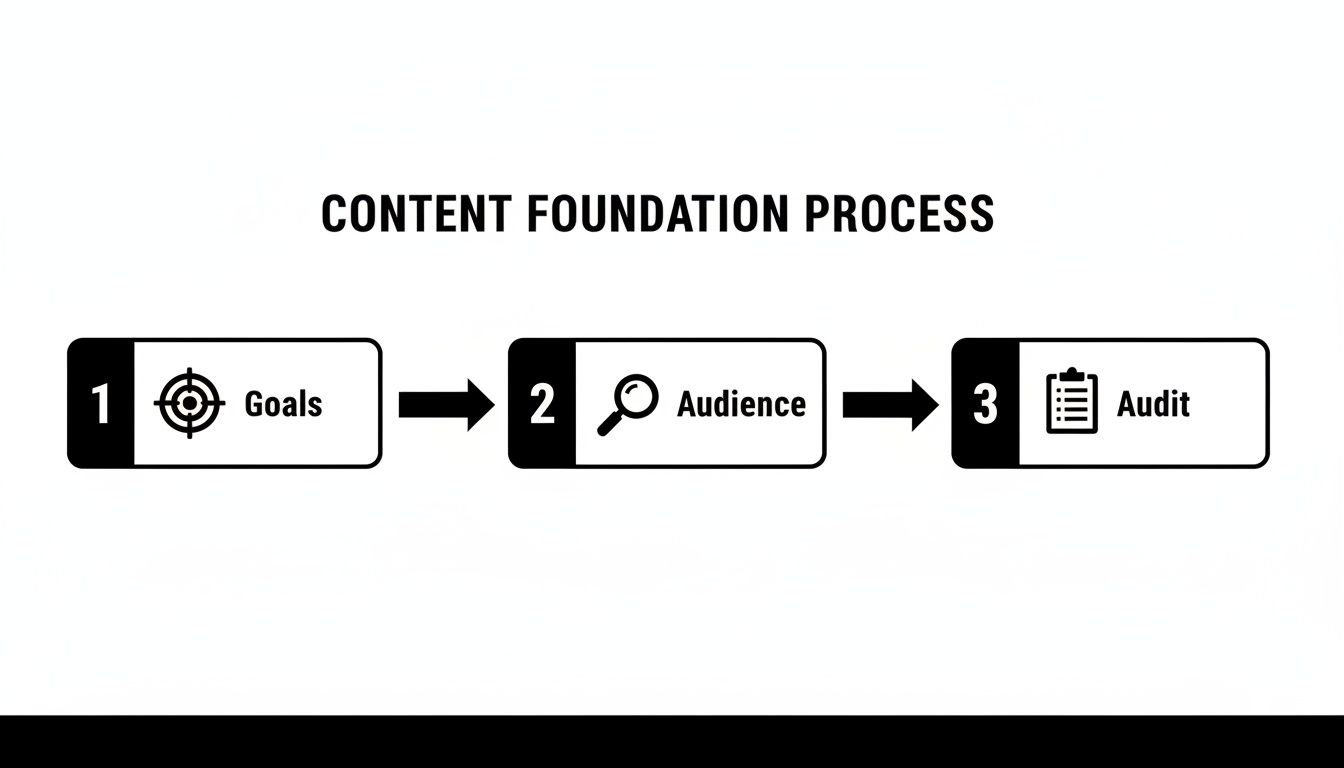
As you can see, a powerful brief doesn't just appear out of thin air. It's the direct result of having clear goals, a deep understanding of your audience, and a solid audit of what’s already working.
Think of your brief as a recipe. It should give the creator all the ingredients upfront: the target audience persona, primary and secondary keywords, the exact tone of voice to use, key talking points to include, and a clear call-to-action. Seriously, investing 30 minutes to create a rock-solid brief will save you hours of painful back-and-forth edits later.
Defining Clear Production Stages
Finally, your system needs clearly defined stages. Each stage is a distinct step in the content’s journey, with a specific owner and a clear objective. This creates a smooth handoff process, maintains momentum, and bakes quality control right into the workflow from the start.
While your own process might have unique quirks, most modern, scalable workflows follow a similar path. We've found this structure to be incredibly effective.
The Modern Content Production Workflow Stages
Here's a breakdown of the key stages that form the backbone of an efficient content assembly line. Each step has a distinct purpose and relies on specific activities to move the process forward.
| Stage | Objective | Key Activities & Tools |
|---|---|---|
| Ideation & Briefing | Generate a strategic idea and create a detailed, actionable brief. | SEO Tools (e.g., Ahrefs), Brainstorming Sessions, Content Brief Templates |
| Research & Drafting | Gather information and produce the initial version of the content. | AI Writing Assistants, Subject Matter Expert Interviews, Google Docs |
| Editing & Review | Refine the draft for clarity, accuracy, brand voice, and SEO. | Grammarly, Hemingway Editor, Peer Review, Expert Approval |
| Design & Approval | Create and integrate visual assets and secure final stakeholder sign-off. | Canva, Figma, Project Management Tool for Approvals |
| Publishing & SEO | Publish the content and perform final on-page SEO checks. | CMS (e.g., WordPress), SEO Checklists, URL Optimization |
| Promotion | Distribute the content across relevant channels for maximum reach. | Social Media Schedulers, Email Marketing Platforms, Repurposing Tools |
By standardizing these stages, you’re no longer just creating content; you’re running a content assembly line. Everyone knows their role, what's expected of them, and who they’re passing the baton to next. That level of clarity is the real secret to unlocking true scale.
Assembling Your High-Performance Content Team
Let's be clear: you can't scale content by yourself. It’s a team sport. Even the most brilliant system is just a set of instructions without the right people to bring it to life. Putting together a high-performance team is the cornerstone of scaling up without letting quality slip.
How you structure that team is up to you. You could build an in-house crew, pull together a dedicated group of specialized freelancers, or even create a hybrid model that gives you the best of both. The key isn't about whether they're W-2s or 1099s; it's about having crystal-clear roles and managing the whole operation effectively.

This becomes incredibly important when you look at the sheer competition out there. The creator economy is enormous, with over 207 million creators globally. The hard truth? Only 4% of them manage to earn over $100K a year. This stat isn't meant to scare you; it's a reminder that scaling efficiently is the only way to break through the noise. Having the right people in your corner is your first real advantage. You can dig into more creator economy statistics and see why so many are struggling to scale effectively.
Defining Your Core Content Roles
To build a content engine that runs smoothly, every gear needs a specific job. Ambiguous responsibilities are a recipe for missed deadlines, duplicated work, and endless frustration. A scalable team needs defined roles, even if one person wears a few different hats when you're just starting out.
Think of these as your foundational players:
- Content Strategist: This is the architect of your entire content operation. They answer the "why" behind every article, video, or social post. They connect content to business goals, dive deep into audience and keyword research, and map out the editorial calendar. They’re the ones with the 30,000-foot view.
- Content Writer / Creator: These are the builders who turn strategy into reality. They are your writers, designers, and videographers who don’t just create content, but consistently capture your brand's voice and produce work that actually connects with your audience.
- Editor / Quality Control Specialist: Consider this role your quality gatekeeper—it's absolutely non-negotiable when you scale. They're the last line of defense, checking for grammar, brand consistency, factual accuracy, and flow. Nothing goes live without their sign-off.
- SEO Specialist: This is your navigator, making sure people can actually find the great content you're creating. They handle everything from keyword targeting and on-page optimization to building out your internal linking strategy, all while keeping an eye on performance.
As your operation grows, you'll likely add more specialized roles, like a Content Manager to run the day-to-day workflow or a Distribution Specialist to focus solely on promotion.
Finding and Onboarding the Right Talent
Sourcing good people isn't just about finding a great writer or a sharp editor; it's about finding the right fit. You need talent that not only has the skills but also genuinely gets—and believes in—your brand and your standards for quality. Always ask for a portfolio with proven work in your niche.
When you bring someone new on board, don't just email them a login and a deadline. A solid onboarding process makes all the difference:
- Arm Them with Your Style Guide: The very first thing they should get is your brand voice guide, content templates, and any checklists you use.
- Start with a Paid Test Project: Give them a smaller, low-stakes assignment first. It’s the best way to see how they work within your system before committing to something bigger.
- Grant Tool Access: Get them set up in your project management software (Asana, Trello, etc.), CMS, and any other platforms they'll need.
- Offer Clear, Constructive Feedback: The first couple of projects are all about calibration. Provide specific, actionable feedback to get their work perfectly aligned with your expectations.
The goal of onboarding isn't just to get someone started. It's to integrate them into your workflow so seamlessly that they feel like a true extension of your team from day one. That upfront investment pays off exponentially in long-term efficiency and quality.
Managing for Performance and Growth
Once your team is in place, your role shifts from builder to manager. The fuel for your content engine is clear communication and a genuinely supportive environment.
Use a centralized project management tool to keep track of every assignment. This single source of truth cuts down on confusion and keeps everyone on the same page. Finally, create a feedback loop that’s focused on growth, not just criticism. When you frame feedback constructively—highlighting what worked and identifying opportunities to improve—you don't just get better content. You build a culture of excellence that makes scaling sustainable.
The Smart Way to Use Technology: Amplify Human Creativity, Don't Replace It

If you want to scale content production without burning out your team, you have to stop thinking of technology as a replacement for talent. Instead, think of it as a powerful partner. The right tools can automate the repetitive, soul-crushing work, freeing up your team to focus on what they do best: strategy, storytelling, and injecting that unique human insight.
This is where the real velocity comes from. When your team isn't bogged down in mundane tasks, they can pour their expertise into creating content that actually resonates with your audience, builds authority, and drives real business results.
Let AI Handle the Heavy Lifting
Let’s be honest, AI has completely changed the game in content. It's the top application in marketing for a reason, with 43% of marketers using it primarily for creation. The results speak for themselves: 86% are saving over an hour on creative tasks, and 78% are seeing real improvements in content quality.
This isn’t just theory; it's a practical way to get ahead. AI tools are brilliant at handling the time-sucking early stages of the content process, which lets your team jump in where they can make the biggest impact.
Here's how you can put AI to work in your workflow:
- Brainstorming and Ideation: Forget staring at a blank wall. AI can chew through search trends and competitor content to spit out dozens of topic ideas, angles, and headlines in minutes. Your team’s job shifts from brainstorming to validating the best ideas.
- Research and Outlining: Manually digging through search results for stats and sources is a grind. An AI assistant can compile all that key information and structure it into a logical, comprehensive outline, giving your writer a running start.
- Creating the First Draft: This is the biggest time-saver of all. Give an AI a detailed brief, and it can produce a solid first draft that handles the basic structure and information gathering. Your writers get to start from a solid foundation, not a terrifying blank page.
The Human-in-the-Loop Rule You Can't Break
While AI is incredible at processing data and moving fast, it has zero life experience. It can't replicate nuance, emotion, or your brand's unique voice. That's why the human-in-the-loop model is non-negotiable if you care about producing quality content at scale.
Hitting "publish" on raw AI output is the fastest way to create a library of generic, soulless articles that nobody wants to read. The magic happens when a skilled human—an editor, writer, or strategist—takes that AI draft and breathes life into it.
The goal isn't just to produce content faster. It's to produce better content, more efficiently. AI gives you the speed, but your team's creativity, empathy, and critical thinking deliver the quality and authenticity that actually builds trust.
This means building a dedicated human review stage into your process is a must. This is where the AI draft gets meticulously fact-checked, edited to match your brand voice, and enriched with personal anecdotes, unique insights, and compelling examples that only a human can provide.
Refining and Humanizing Your Content
The final, critical step is making sure the finished product actually sounds human. AI-generated text often has a certain robotic stiffness—it’s grammatically correct, but it can feel sterile and just… off. That’s not how you connect with an audience.
This is where you need a final quality check. After your team has polished the AI draft for substance and accuracy, run it through a humanizer. This isn't about tricking anyone; it's about upholding a higher standard of readability and engagement.
These tools smooth out awkward phrasing and fix the unnatural cadence, ensuring your brand’s voice comes through loud and clear, even when you’re producing content at a high volume. For teams serious about scaling without sacrificing quality, platforms like AI Busted help humanize content by turning functional text into prose that feels completely authentic and natural.
Ultimately, this blend of powerful automation and irreplaceable human creativity is how you master scaling content. You get the best of both worlds, increasing your output without ever compromising on the quality your audience expects and deserves.
Maximizing Your Reach with Smart Distribution
Look, creating a steady stream of high-quality content is a huge win. But if that content just sits on your blog collecting digital dust, you’ve only done half the job. Scaling content production is pointless if nobody sees it.
The real growth lever is smart amplification—getting your hard work in front of as many of the right people as possible, over and over again. This requires a shift in thinking. Stop seeing your team as a production line and start seeing it as a distribution hub.
The best in the business live by a "create once, distribute endlessly" philosophy. This isn't about spamming every channel you can think of. It's about strategically re-imagining a single, solid piece of content into a whole ecosystem of assets that meet your audience wherever they hang out online.
The Power of Content Repurposing
Think of a big content piece—like a detailed guide or a webinar—as the Thanksgiving turkey. The main meal is great, but the real, lasting value is in the leftovers. You can get turkey sandwiches, soup, and pot pies for days. It's the same with your content. One core asset can be sliced and diced into dozens of smaller, valuable pieces.
For example, let’s take a single 45-minute webinar. That one recording can fuel your content calendar for weeks:
- Video Clips: Pull out ten short, punchy clips for TikTok, Instagram Reels, and YouTube Shorts. Each one can highlight a key tip or a surprising stat.
- Social Media Threads: Turn the main arguments into a detailed thread for X (formerly Twitter) or an insightful post on LinkedIn.
- Infographics: Design a sharp, shareable infographic that visualizes the most important data points from the presentation.
- Newsletter Content: Write a summary of the webinar's key takeaways to share with your email subscribers.
- Quote Graphics: Create eye-catching graphics with powerful quotes from the speaker to share across all your social profiles.
This approach lets you expand your reach massively without burning out your team. You're not starting from scratch every day; you're just getting more mileage out of the hard work you’ve already done.
Building a Multi-Channel Distribution Plan
Once you've got your repurposed assets, you need a game plan. Just throwing content at the wall to see what sticks is a recipe for wasted effort. You need a coordinated, multi-channel strategy that blends organic reach with a bit of paid promotion.
This starts with knowing where your audience actually is and what kind of content they expect there. What crushes it on LinkedIn will likely flop on TikTok. To really scale, you need a unified system for getting your message out everywhere it needs to be. A solid Social Media Multi-Channel Publishing (MCP) strategy is critical for keeping your message consistent while tailoring it to the nuances of each platform.
The goal isn't just to be on every platform. It's to be effective on the platforms that actually matter to your business, delivering the right format to the right person at the right time.
Tapping into Partnerships and Paid Promotion
Organic reach is your foundation, but if you want to pour fuel on the fire, you need to bring in outside help. This is where strategic partnerships and paid promotion become your best friends, acting as an accelerator for your top-performing content.
Partnerships are blowing up right now. A recent analysis found that 70% of brands are investing more in collaborations, and an incredible 94% agree that creator content provides a better ROI than traditional ads. The money is following the trend, too, with investment in the creator economy jumping 143% in just four years.
Top-tier teams are blending this human-centric approach with smart AI to scale their output by 5-10x without hitting a wall.
Finally, your distribution plan needs a clear budget for paid promotion. Whether it's on LinkedIn, Facebook, or even through search ads, putting money behind your best work is non-negotiable. Use it to boost high-performing content, target laser-specific audience segments, and make sure your best stuff doesn't get lost in the noise.
Common Questions About Scaling Content Creation
Even the best-laid plans for scaling up content run into real-world hurdles. It’s one thing to have a strategy on paper, but it's another to execute it without things falling apart. Let's tackle some of the most common questions that pop up when teams start cranking up the volume.
How Do I Keep Content Quality High When We're Producing So Much More?
This is the big one, isn't it? The fear that "more" automatically means "worse." The truth is, you can't just ask everyone to work harder. Quality at scale is all about having bulletproof systems.
It all starts with getting crystal clear on your expectations. That means creating incredibly detailed content briefs and style guides that leave zero room for guessing games. Your writers should know exactly what a "win" looks like before they even type a word.
From there, you need a multi-layered review process. Think of it like an assembly line for quality. The piece should pass through a subject matter expert for accuracy, a sharp-eyed copyeditor for polish, and an SEO specialist to make sure it’s discoverable. Using standardized templates for different formats also helps keep everything feeling consistent and on-brand.
The secret isn't just about stricter rules; it's about blending smart processes with the right technology. That's the only way to really grow your output without letting quality slip.
This is where tools become your best friend. AI assistants are great for getting a first draft on the page or speeding up initial research. But—and this is a big but—a human always needs to be in the driver's seat. They're the ones who add the unique stories, the critical insights, and the personality. The final, non-negotiable step is running the text through a humanizing tool. This smooths out any robotic language and ensures the final piece reads like it was written by a person, for a person.
We're a Small Team. What Are the Very First Steps to Scaling?
When you’re a small team, you have to be scrappy and smart. Don't try to boil the ocean. The most important thing you can do first is document the process you already have, even if it feels basic. Write down every single step, from coming up with an idea to hitting publish. This becomes your playbook.
Next, find your MVP—your most valuable player, content-wise. Look at your analytics and identify the one format that consistently knocks it out of the park. Is it a specific type of blog post? A certain video style? Double down on that and make more of it.
Then, you need to think like a media company and build a "content repurposing" matrix. This is just a simple plan that shows how one big piece of content (like a guide) can be sliced and diced into 5 to 10 smaller assets. Think social media carousels, quote graphics, short video clips, or even an email newsletter blurb.
Finally, get a simple tech stack in place that won't cost a fortune:
- Project Management: Something like Trello or Asana to see who’s doing what, when.
- SEO Tool: A solid tool for keyword research and checking your rankings.
- AI Writing Assistant: To help you get past the blank page and accelerate drafting.
- A Humanizer: To give that final AI-assisted draft a professional, human touch.
Is It Unethical to Use AI for Content Creation?
Using AI to write isn't inherently unethical, just like using a calculator for math isn't cheating. It's a tool. The ethics come down to how you use it.
Pasting raw, unedited AI output and passing it off as expert work? That's not just lazy; it’s a disservice to your audience. It almost always results in bland, sometimes inaccurate, content that offers no real value.
The ethical and effective way to approach it is to see AI as a junior assistant. It can generate a solid outline or a decent first draft, breaking through writer's block. From there, it’s the human creator's job to step in and do the real work: fact-check everything, inject personal experience, edit for tone and clarity, and ensure the final piece is genuinely helpful and original.
Using a tool to humanize the text is a crucial part of this process. It bridges the gap between a functional AI draft and a piece of writing that connects with people. It’s about being transparent in your process to create excellent content more efficiently—a win for you and your reader.
Ready to make sure your scaled content sounds like it was written by a person, not a prompt? AI Busted turns AI-generated text into natural, engaging writing that truly connects. Humanize your content and aim for a 100% human score. Try it for free at https://aibusted.com.