
Ever read something online and just knew it was written by a bot? You're not alone. While AI is fantastic for getting a first draft down or sparking some ideas, the raw output often feels… well, robotic. It's clean, it's grammatically correct, but it's sterile. It gives you the facts but can't quite capture the feeling or the unique perspective that makes writing truly connect.
This is the critical first step in learning how to rewrite AI text: understanding why it misses the mark.
Why Raw AI Content Fails to Connect
The problem is that AI models are trained on massive amounts of data to spot patterns and predict what word comes next. They're absolute masters of structure and grammar, but they lack lived experience. They've never felt the frustration of a failed project or the excitement of a breakthrough.
This gap between logic and life results in content that often feels:
- Generic and Vague: AI tends to skim the surface. It provides general information but rarely includes the specific, memorable anecdotes or detailed examples that stick with a reader.
- Lacking a Distinct Voice: Without a personality, a brand identity, or even just a strong opinion, the writing falls flat. It doesn't build any sort of relationship with the person reading it.
- Repetitive and Formulaic: You'll often see the same sentence structures and phrases pop up over and over. It’s a dead giveaway that a machine is behind the curtain, making the text sound uninspired.
The Missing Human Element
What's really missing are all the subtle, crucial things that define human communication. Think about the last article you truly loved. It probably had personal stories, a clever cultural reference, or an emotional tone that just pulled you in. AI can't create those things from scratch.
The difference between content that simply exists and content that actually persuades is the human touch. It’s the art of weaving facts into a compelling story—something algorithms just aren't built to do yet.
This is exactly why the skill of rewriting AI text is becoming so valuable. The global AI text generator market was valued at around USD 458.6 million in 2023, and it's projected to hit an incredible USD 1.4 billion by 2030. More businesses are leaning on AI, but a huge chunk of that content is easily flagged as non-human, creating a massive need for skilled editors to add that final, authentic polish. You can dive deeper into these trends in this detailed report on Grand View Research.
Understanding the Source
To fix the problem, you first have to know where it's coming from. Different AI models produce different flavors of content. Some are overly formal, while others have a habit of stating the painfully obvious.
Get familiar with the common traits of the top AI content generation tools out there. Recognizing these little quirks is the first step in knowing what to target. Your job isn't just to be a grammar checker; it's to be an authenticity editor, injecting the personality and genuine voice the machine left behind.
Techniques for Humanizing Your AI Draft
Alright, you've got a first draft from an AI. It's probably grammatically correct and hits all the key points, but it's also… a bit robotic. Turning that sterile text into something that truly connects with people is where the real work—and the real magic—happens.
This isn't just about swapping out a few words here and there. It’s about a complete mindset shift, moving from machine-generated output to genuinely human-centric content. Think of it as a three-stage process: you start with the AI draft, apply a thoughtful human edit, and end up with content that actually connects with your audience.
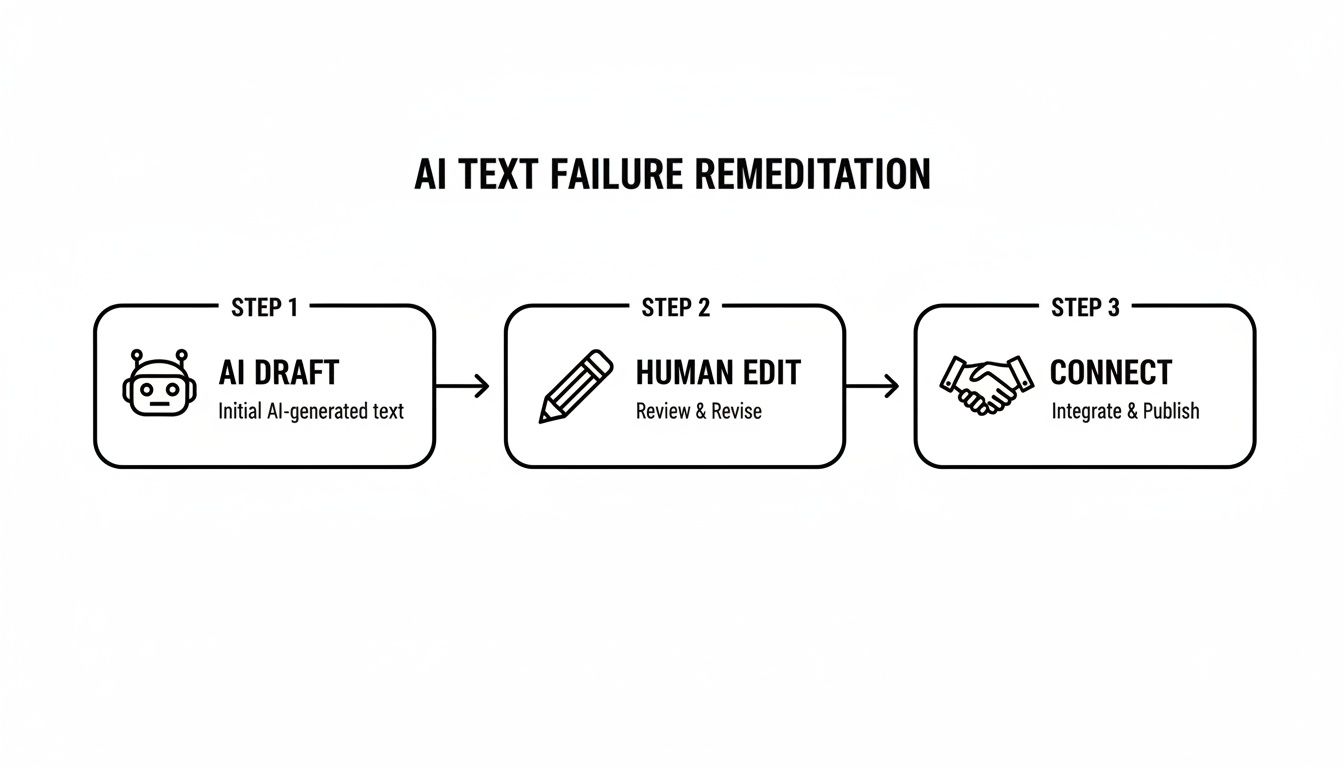
The human touch is what bridges the gap, transforming raw information into a conversation. Let’s break down how to do it.
Inject Your Unique Voice and Personality
The dead giveaway for AI content? It has no personality. It’s often perfectly neutral, which is just another way of saying it’s boring and forgettable. Your first job is to inject your brand's unique voice into every sentence.
Are you a witty, informal brand that uses humor? Or are you more professional and authoritative, aiming to be the definitive expert? Maybe you're empathetic and supportive. Whatever your voice is, define it and apply it consistently.
- Before (AI Draft): "The product offers a multitude of features designed for optimal user experience. It is important to configure the settings to achieve desired outcomes."
- After (Human Voice): "Want to get the most out of this tool? The magic is in the settings. Let’s walk through how to customize it so it works exactly the way you want it to."
See the difference? We went from a sterile user manual to a friendly, helpful guide. That small shift makes the content instantly more inviting.
Replace Generalities with Specificity
AI models have never lived a day in the real world, so they naturally lean on vague statements and broad generalizations. Your job is to hunt down these generalities and replace them with concrete details, hard numbers, and real-world examples.
Specificity builds trust and makes your content memorable.
Instead of just saying a marketing campaign was "very effective," prove it. Did it boost qualified leads by 35% in the first quarter? Did it help a client in the SaaS space double their organic traffic in six months? Those are the details that stick.
Key Takeaway: People don't remember abstract ideas. They remember stories, case studies, and tangible results. Weaving specific details into your writing is one of the quickest ways to make it feel authentic and earned.
Vary Sentence Structure for Natural Rhythm
Another classic AI tell is a monotonous sentence structure. You'll see a string of sentences that are all roughly the same length and follow the same predictable pattern. It’s grammatically fine, but it can lull a reader right to sleep.
The fix is to consciously mix things up.
- Short sentences. They create impact. They grab attention.
- Longer, more complex sentences let you flesh out ideas and add nuance, creating a smoother, more engaging flow.
- Start your sentences differently. Don't just lead with the subject every time. Use transitional phrases, ask a question, or start with a subordinate clause to break the monotony.
This variety creates a natural rhythm that sounds more like an actual person talking. Here’s a pro tip: read your edited text out loud. It’s a fantastic way to catch awkward phrasing and clunky rhythms that your eyes might have missed. If it sounds good, it will read even better.
Using a Tool to Make AI Text Sound Human
Let's be realistic—manually editing every piece of AI content just doesn't scale. If you're handling a lot of articles, emails, or social posts, doing it all by hand becomes a major bottleneck. This is exactly where a dedicated tool to rewrite AI text comes in handy, turning a tedious job into a quick step in your workflow.
Instead of getting bogged down in swapping out robotic phrases and restructuring clunky sentences, a good text humanizer does the foundational work for you. It smooths out the flow, boosts readability, and gives the text a more natural rhythm, all without losing your core message. This frees you up to focus on what really matters: adding your unique voice, personal stories, and brand-specific details.
What's Happening Under the Hood?
A quality humanizer does more than just find synonyms. It's built to spot the tell-tale signs of AI writing—things like repetitive sentence starters, overly formal language, and a limited vocabulary. From there, it intelligently rephrases the text to sound like a human wrote it.
Here’s a quick breakdown of what it’s doing:
- It mixes up sentence length and structure to create a more engaging and less predictable pace.
- It ditches generic verbs and adjectives for words that are more descriptive and powerful.
- It tweaks the tone to feel more conversational and less like a machine-generated report.
The objective is to get your content to a 100% human score while keeping the original meaning intact.
The real win with a text humanizer is its speed and consistency. It helps you maintain an authentic voice across everything you publish, from blog posts to social media, without blowing up your schedule.
Modern tools for this are often browser-based and incredibly straightforward.

The process is usually as simple as pasting your AI-generated draft and getting a polished, human-sounding version back in moments.
Why This Matters More Than Ever
The need to rewrite AI text has skyrocketed since ChatGPT became a household name. More than 70% of content creators are now using generative AI, yet a significant 65% worry about their content sounding inauthentic.
Consider social media managers, where personalizing content can lift engagement by up to 35%. For them, humanization isn't just nice to have; it's essential for getting results. This is where a privacy-focused tool like AI Busted (https://aibusted.com/) shines, built to handle these tasks for everything from student essays to e-commerce copy.
By adding a humanizer to your toolkit, you close the gap between AI's raw efficiency and the genuine connection that human writing creates. It’s a smart move for anyone serious about producing content that truly resonates with people.
Keeping Your SEO Power When You Humanize AI Text
One of the biggest questions I hear from marketers is, "Will I completely tank my rankings if I start rewriting my AI content?" It's a fair question. You’ve put a ton of work into your keyword strategy, and the last thing you want to do is throw it all away.
The good news? You don't have to. In fact, if you approach it the right way, humanizing your text can actually give your SEO a serious lift.
Think of this process as an enhancement, not a demolition. You're keeping the solid SEO foundation the AI helped you build and adding a layer of genuine human connection on top. This is exactly what search engines like Google are looking for—content that's not just for algorithms, but for real people.
Don't Lose Your Keywords
Before you dive in and start editing, take a moment to map out your SEO building blocks. You need to know exactly which keywords are doing the heavy lifting. This isn't just about your main target keyword; it’s about all the related secondary and LSI (Latent Semantic Indexing) terms that signal to Google what your content is really about.
Your mission is to blend these keywords back into your new, human-centric text. When you get it right, they won't feel stuffed or awkward. They’ll be a natural part of the conversation.
- Your Primary Keyword: This one is non-negotiable. Make sure it stays prominent in your title, your opening paragraph, and a couple of key headings.
- LSI Keywords: These are the supporting cast. If your main keyword is "electric car maintenance," your LSI keywords might be things like "EV battery health" or "regenerative braking tips." Weave these throughout the body of the article to build topical authority.
When you make your content better for the reader, you're sending incredibly strong signals to search engines. Metrics like increased time on page and lower bounce rates are direct feedback to Google that your page is a high-quality result.
Engagement Is Your New SEO Superpower
Search engine updates have made one thing crystal clear: user engagement is a massive ranking factor now. In fact, over 60% of SEO pros have seen content get de-ranked after recent Google updates cracked down on AI-generated spam. This just drives home how crucial authentic, human-first content has become.
For e-commerce brands and marketers, rewriting AI-generated posts to sound more human can boost engagement by 20-30%. That's a huge deal when engagement is a key metric for search visibility.
This is where your editing work really pays off. A robotic article might earn a click, but a genuinely helpful and well-written piece will keep someone reading. Ultimately, knowing how to rank in AI search results means creating content that people actually want to spend time with.
To help you stay on track, here's a quick checklist to run through during your rewrite.
SEO Preservation Checklist for Humanized AI Text
This table will help you make sure you don't accidentally erase all your hard-earned SEO work while you're focused on improving the writing.
| Checklist Item | Why It Matters | Actionable Tip |
|---|---|---|
| Preserve Primary Keyword | This is the main term your page is trying to rank for. It needs to stay in key spots. | Keep your primary keyword in the H1 title, the first 100 words, and at least one H2 subheading. |
| Maintain Keyword Density | Dropping your keyword count too low can make your page seem less relevant for its target topic. | Aim for a natural density of around 0.5% to 1%. Don't force it; use synonyms and related terms. |
| Check Internal Links | Internal links distribute page authority and help Google understand your site's structure. | Ensure all original internal links are still present and pointing to the correct pages. |
| Verify External Links | Outbound links to authoritative sources can boost your content's credibility. | Make sure your external links are still relevant and haven't been accidentally removed. |
| Keep URL Slug Unchanged | Changing the URL creates a new page and loses all the "link juice" of the original. | Don't touch the URL. If you absolutely must change it, set up a 301 redirect immediately. |
| Review Meta Title & Description | These are crucial for click-through rates from search results. The AI-generated ones are often a good starting point. | Tweak the meta tags for human appeal, but make sure the primary keyword remains, preferably near the beginning. |
By keeping these SEO fundamentals in mind, you can confidently rewrite AI text, knowing you're not just making it better for your readers, but also for your search rankings.
Your Final Polish and Pre-Publish Checklist

Alright, before you even think about hitting that "publish" button, there’s one last crucial pass you need to make. This isn’t just a quick spell-check; it's your final, human-centric review to make sure every trace of robotic language is gone for good.
This is your last line of defense. The AI gave you a starting point, a solid structure, but your editing and rewriting are what give the piece its soul and credibility. This final check confirms that transformation is complete.
Read It Out Loud
This might be the most powerful—and most overlooked—editing trick in the book. Seriously, read your entire article out loud.
Your ears are incredible at catching things your eyes just skate over, like clunky sentences, weird phrasing, or a rhythm that just feels… off. If you stumble over a sentence when you say it, your reader is definitely going to stumble when they read it. This is a gut check for natural flow.
Your goal is for the text to flow so smoothly that the reader doesn't even think about who—or what—wrote it. They should only be focused on the message you're delivering.
The Human Score and Tone Check
After you’ve put in the work to rewrite AI text, it's smart to get a final confirmation. Running the content through a reliable tool one last time gives you that extra peace of mind that it reads as 100% human-written.
For a lot of us, this is an essential last step to ensure we’re meeting our own quality standards. If you want to check your work, you can get started with AI Busted for free and see how it scores.
While you're at it, do a quick scan for tone. Does the voice you started with in the intro hold strong all the way to the conclusion? Any jarring shifts can pull a reader right out of the experience.
Here’s a quick-and-dirty checklist I run through before anything goes live:
- Fact-Check All Data: Did you double-check every statistic, name, and date? AI has a nasty habit of "hallucinating" facts, so it’s on you to verify everything. Your credibility depends on it.
- Confirm a Clear Takeaway: What’s the point? A reader should walk away with a clear answer or a solution to the problem they came with. If the core message is fuzzy, go back and sharpen it.
- Check Formatting and Flow: Look at the piece visually. Are your headings, bold text, and bullet points actually helping guide the reader's eye? Good formatting makes content scannable and far less intimidating to read.
Common Questions About Rewriting AI Text
As you start working more with AI, you're bound to have some questions. It's totally normal. Let's tackle some of the most common ones that pop up when people decide to rewrite AI text.
Think of this as your go-to FAQ for turning those machine-made drafts into content that actually connects with people.
Is It Necessary to Rewrite Every Piece of AI Text?
Honestly, yes, you should at least review and edit everything. While you might not need to rewrite every single sentence from scratch, raw AI content almost always misses the mark. It lacks your unique brand voice, any real emotional depth, and all the little nuances that make people trust what you're saying.
Rewriting is what makes the content truly yours. It ensures your final piece is original and engaging, not just another generic, robotic article.
Can I Keep My SEO Keywords When Rewriting?
Absolutely. In fact, you should. A good rewrite can actually boost your SEO. The trick is to weave your keywords into the text naturally, like they're just part of the conversation, instead of clumsily stuffing them in.
When you focus on improving readability and flow, you're making the content better for humans. That often leads to better engagement metrics like dwell time and lower bounce rates—signals that search engines love to see.
At the end of the day, Google wants to rank authentic, high-quality content. By making your text more human, you're giving both your readers and the search algorithms exactly what they want.
How Long Does It Take to Humanize an AI Article?
This really depends on the length of the article and how comfortable you are with the process. If you’re doing it all by hand, it can be a grind. But using a dedicated tool changes the game completely, cutting a job that could take hours down to just a few minutes.
A text humanizer does the heavy lifting—restructuring sentences, swapping out clunky phrases—and leaves the final creative polish to you. For a typical 1,000-word article, what might take you an hour or more manually can be done in 10-15 minutes with the right tool. To see what I mean, you can check out the technology behind our public AI humanizer. This kind of efficiency means you can scale up your content production without letting quality slide.
Ready to turn your AI drafts into polished, human-sounding content? AI Busted makes it simple to hit a 100% human score while keeping your core message and SEO intact. Try AI Busted today and see the difference for yourself.