
In an era where AI-driven content creation is standard, the line between human-authored and machine-generated text has become increasingly blurred. This presents a critical challenge for professionals across all industries, from marketing and SEO to academia and journalism. Maintaining content authenticity is no longer a best practice; it's a necessity for preserving credibility, upholding academic integrity, and ensuring your work connects with its intended audience on a human level.
Finding the best ai content detector is crucial for navigating this new reality. The right tool empowers you to verify originality, avoid the pitfalls of unintentional AI plagiarism, and refine AI-assisted drafts into polished, human-like prose. This shift represents a significant step in the evolution of content quality assurance, where technology supports, rather than replaces, human oversight. This guide is designed to cut through the noise and provide a clear, data-driven comparison of the top platforms available today.
We've rigorously tested each tool to give you a comprehensive breakdown of its real-world performance. You will find in-depth analysis of key features, including accuracy rates, false-positive risks, user interface, pricing, and specific use-case recommendations. We also explore the ethical approach to content refinement, focusing on how certain tools can help humanize text to achieve a natural, 100% human score, supporting the honest use of AI assistance. Each entry includes direct links and screenshots to help you quickly identify the ideal solution for your specific needs, whether you're a content creator, educator, or business owner.
1. AI Busted
AI Busted distinguishes itself not just as an AI content detector but as a comprehensive content refinement toolkit. It’s designed for professionals who need to both verify the origin of a text and enhance AI-generated drafts to meet human-quality standards. This dual capability makes it an exceptionally efficient and powerful choice for a wide range of users, from SEO specialists and marketers to academics and journalists. The platform's core strength lies in its integrated approach, combining detection with a sophisticated humanizer, grammar checker, and SEO optimizer in one seamless, browser-based interface.

Unlike single-function tools, AI Busted provides a full-circle workflow. Users can check content for AI markers and, if needed, immediately use the humanizer to rewrite the text. This process is engineered to improve flow, preserve the original meaning, and retain crucial SEO keywords, making it one of the best AI content detector solutions for those focused on performance marketing and content creation. It supports text from all major LLMs, including GPT-4, Claude, and Gemini, ensuring broad compatibility.
Key Strengths and Features
AI Busted's standout feature is its multifaceted toolkit. The platform is built for speed and accessibility, requiring no software installation and offering a functional free tier for initial testing.
- Integrated Content Suite: Combines an AI detector with a text humanizer, grammar cleaner, SEO optimizer, and plagiarism checker.
- Advanced Humanizer: Rewrites AI text to sound natural and achieve a 100% human score while maintaining contextual accuracy and sentiment. It even offers personalization options like adding emojis.
- Broad Compatibility: Effectively analyzes and refines outputs from dozens of AI writing tools, ensuring it stays current with the evolving AI landscape.
- Accessibility and Usability: The web-based interface is intuitive and device-agnostic. A generous free tier allows users to test its capabilities, with clear upgrade paths to premium plans for higher volume needs, which become visible after logging in.
Practical Use Cases and Considerations
AI Busted is ideal for content teams aiming to scale production without sacrificing quality. For example, a marketing agency can use it to quickly refine AI-generated blog posts, ensuring they are SEO-friendly and read naturally before publication. Students and researchers can use it to polish drafts and check for unintentional AI traces.
However, the platform responsibly notes its limitations, cautioning that no detector is infallible. It should be used as a quality assurance tool, not as the sole arbiter for high-stakes academic or professional decisions. The free tier has character limits (e.g., around 1,000 for detection), making a premium plan necessary for heavy workloads.
Website: Learn more about AI Busted's features
2. Originality.ai
Originality.ai is a comprehensive suite designed for serious publishers, content marketers, and SEO agencies who need more than just AI detection. It integrates a powerful AI content detector with a robust plagiarism checker and readability analysis, making it a one-stop-shop for content integrity. This bundled approach is its key differentiator, streamlining the content audit process by allowing users to verify originality, check for AI-generated text, and assess readability all within a single interface. The platform is widely trusted in the SEO community for its accuracy and detailed, shareable reports.
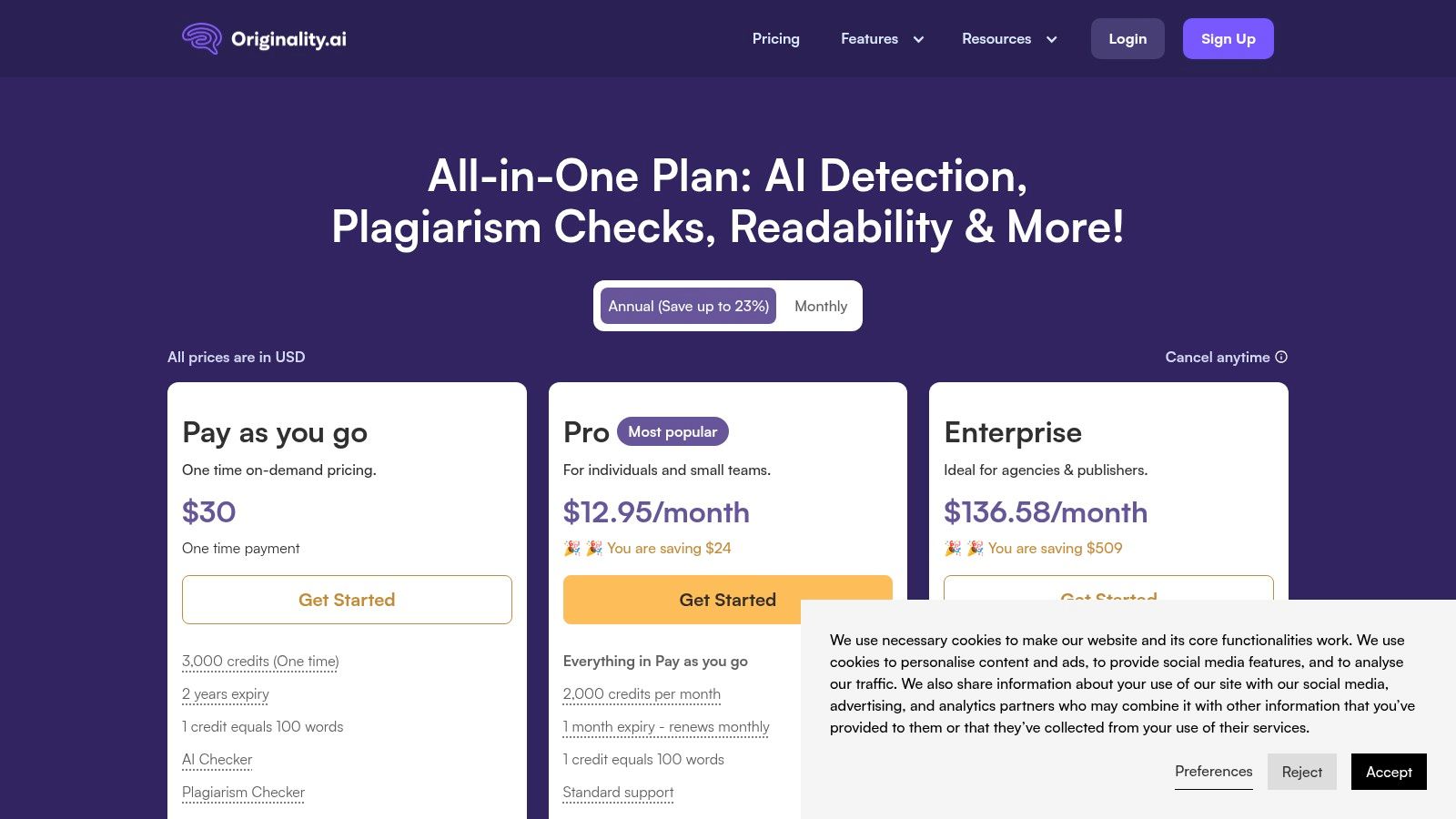
The platform operates on a flexible credit-based system, where one credit scans approximately 100 words. This model supports both occasional users and high-volume teams. For those seeking the best AI content detector for workflow integration, Originality.ai offers a full API, allowing businesses to build its detection capabilities directly into their content management systems.
Key Features and Usage
The user experience is straightforward, focusing on efficiency. You simply paste your text, and the tool provides a clear percentage score for both "Original" and "AI" content, highlighting potentially problematic sentences. The inclusion of a plagiarism scan in the same step saves significant time compared to using separate tools.
- Pricing: Offers a pay-as-you-go option at a one-time fee of $30 for 3,000 credits. Monthly subscriptions start at $14.95 for 2,000 credits, providing a lower per-credit cost.
- Pros: Combines AI detection, plagiarism checking, and readability into a single tool. Its transparent, credit-based system is easy to understand, and API access is available for automation.
- Cons: Subscription credits expire monthly, which can be a drawback for users with inconsistent volume. High-volume usage will likely require a custom enterprise plan.
Website: Originality.ai
3. Copyleaks
Copyleaks positions itself as a comprehensive content integrity platform, extending beyond a simple AI scanner. It offers a powerful AI content detector that supports over 30 languages, integrated seamlessly with a robust plagiarism checker. This dual-functionality is a significant advantage for users in education, publishing, and enterprise environments who need a single, reliable tool for verifying authenticity. The platform is notable for its user-friendly integrations, including a Google Docs add-on and a Chrome extension, which bring detection capabilities directly into existing workflows.
For those looking for the best AI content detector with advanced features, Copyleaks provides unique insights like “AI Source Match” and highlights specific AI-generated phrases. It operates on a credit-based system, which is transparent but can become costly for users with high-volume scanning needs. The platform's commitment to security, evidenced by SOC 2/3 compliance, and its extensive API options make it a trusted choice for businesses and educational institutions that require scalable and secure solutions for content governance.
Key Features and Usage
The user interface is clean, providing a unified report that shows both AI and plagiarism results. This consolidated view simplifies the review process, presenting a clear percentage score and highlighting sentences flagged for either issue. The tool's ability to explain its "AI Logic" provides an extra layer of transparency not found in many competitors, helping users understand why a specific piece of text was flagged.
- Pricing: Offers a free tier with limited credits. Paid plans start at $9.99 per month for 100 credits (25,000 words), with pricing scaling up based on volume.
- Pros: Combines AI and plagiarism checks into one streamlined report. Excellent workflow integration with its Google Docs add-on and Chrome extension. Supports a wide range of languages.
- Cons: The credit system can be limiting for users with fluctuating or high-volume needs, potentially requiring a more expensive enterprise plan.
Website: Copyleaks
4. GPTZero
GPTZero has established itself as one of the most popular and accessible AI detectors, particularly favored by educators, students, and writers. Its core strength lies in its simplicity and direct approach to identifying AI-generated text, providing a clear probability score and highlighting sentences likely created by models like GPT-4. Beyond just detection, GPTZero has expanded its offerings to include a suite of writing tools, such as a plagiarism checker and an "AI humanizer" for refining text to sound more natural.
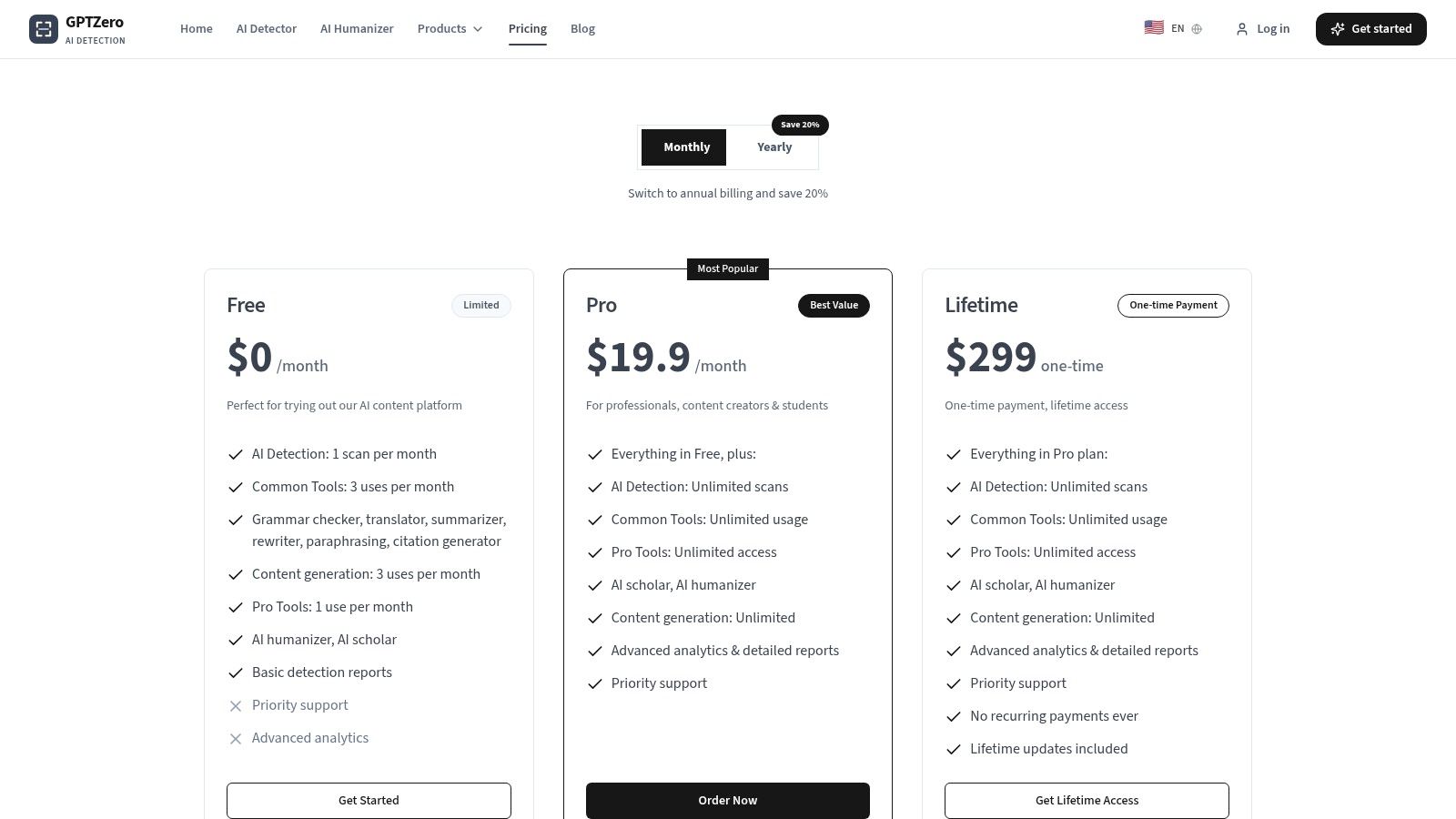
The platform offers a tiered model, including a free but very limited plan that allows for occasional checks. For more consistent use, its paid plans unlock valuable features like batch file uploads, which is a significant time-saver for educators grading multiple assignments or editors reviewing numerous articles. This makes it a strong contender for the best AI content detector for users in academic and publishing environments who need both speed and an easy-to-use interface.
Key Features and Usage
The user experience is clean and efficient. You paste your text or upload a file, and the tool quickly returns a detailed analysis. The results page provides an overall probability that the document was written by AI, along with a sentence-by-sentence highlighting system. This granular feedback helps users pinpoint specific areas that may need revision to achieve a more authentic, human-like tone.
- Pricing: A free plan is available but is limited to one scan per month. Paid plans offer significantly more value, with Pro plans providing unlimited detection and additional features for a competitive monthly fee.
- Pros: The interface is simple, fast, and easy to navigate. Paid tiers offer batch file uploads and unlimited scanning at a competitive price point, making it suitable for high-volume users.
- Cons: The free plan is extremely restrictive and not practical for regular use. Advanced features like deep scans and plagiarism checking are locked behind paid subscriptions.
Website: GPTZero
5. Turnitin
Turnitin is a titan in the academic integrity space, and its AI writing detection feature is a natural extension of its long-standing plagiarism-checking services. Unlike consumer-facing tools, Turnitin is designed exclusively for educational institutions and integrates directly into educator workflows. Its primary function is to provide an AI writing indicator within the familiar Similarity Report, helping instructors identify passages that may not be original student work. This integration into Learning Management Systems (LMS) like Canvas, Moodle, and Blackboard makes it a seamless part of the grading process for millions of educators worldwide.
The platform’s key differentiator is its deep entrenchment in academia and its focus on supporting pedagogical goals rather than simply flagging content. Turnitin provides extensive resources and guidance for educators on how to interpret the AI score, encouraging them to use it as a conversation starter with students rather than as definitive proof of misconduct. This responsible, education-first approach makes it a trusted, albeit inaccessible, tool for the general public and positions it as a specialized solution for a specific, high-stakes environment.
Key Features and Usage
For educators using the platform, the AI indicator appears as an overall percentage within the report. It is designed for simplicity, flagging text that is highly likely to be AI-generated without overwhelming the user. Turnitin is also transparent about its model updates, providing release notes to keep institutions informed of its evolving capabilities. The entire system is built around existing academic workflows, minimizing the learning curve for instructors.
- Pricing: Not available for individual purchase. Access is provided through institutional licenses purchased by universities, colleges, and school districts.
- Pros: Seamlessly integrates into existing educational workflows and major LMS platforms. The company provides transparent guidance and ongoing model updates for institutions.
- Cons: Exclusive to educational institutions with a license, making it inaccessible to individuals or businesses. The score should be used cautiously and as one piece of evidence, not as a sole determinant of academic misconduct.
Website: Turnitin AI Writing Detection
6. Winston AI (gowinston.ai)
Winston AI positions itself as a robust solution for educators, web publishers, and content teams, offering a suite of tools that go beyond simple AI text analysis. Its standout feature is the combination of text detection with advanced capabilities like image and deepfake detection, making it a more holistic content integrity platform. The tool also includes Optical Character Recognition (OCR) technology, allowing users to scan documents and even handwritten notes, a unique function not commonly found in other detectors.
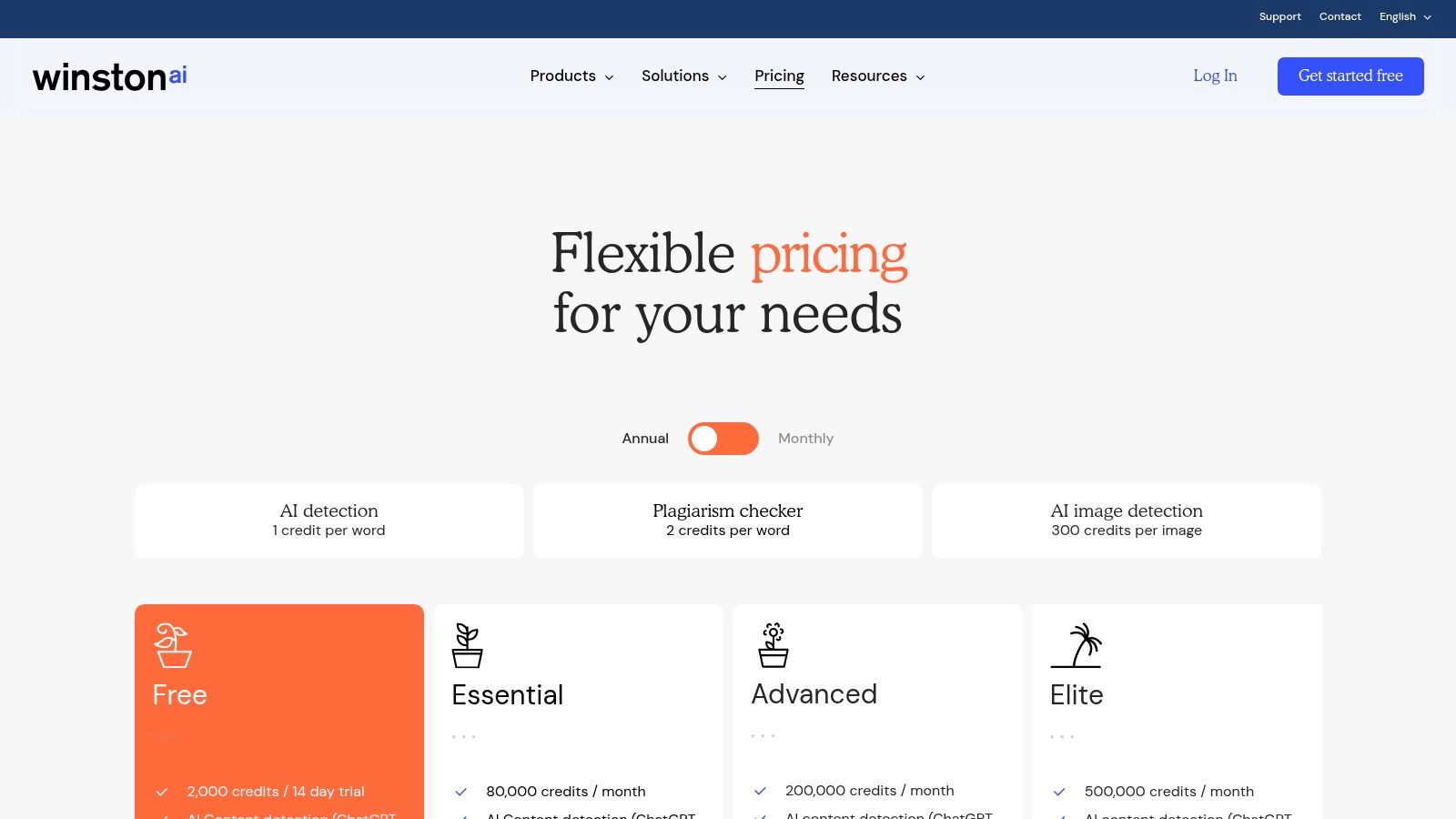
The platform operates on a credit-based subscription model, offering different tiers to accommodate various usage levels, from individuals to larger teams. This flexibility, combined with its plagiarism checker and options for team seats, makes it a scalable choice for organizations prioritizing academic or editorial honesty. The ability to generate shareable PDF reports provides a clear, documented audit trail for content verification. For those looking for the best AI content detector for educational or multimedia verification, Winston AI’s diverse feature set is a compelling advantage.
Key Features and Usage
The interface is clean and user-friendly, allowing you to quickly paste text or upload files for scanning. The tool provides a clear human score and highlights sentences with a high probability of AI generation. The addition of OCR and image scanning is seamlessly integrated, expanding its use case beyond typical blog posts or essays to include scanned assignments and visual media.
- Pricing: A free trial is available with 2,000 words. Paid plans start at $12 per month for 80,000 words/credits, with higher tiers offering more credits, team members, and advanced features.
- Pros: Broad feature set covering text, image, and deepfake detection, plus OCR support. Multiple affordable monthly tiers and a free trial make it accessible.
- Cons: The credit system can be confusing, as different features consume credits at different rates; plagiarism scans are more credit-intensive.
Website: Winston AI
7. ZeroGPT
ZeroGPT positions itself as a highly accessible, freemium AI text detector catering to users who need quick, frequent checks without an immediate financial commitment. Its main draw is a generous free plan that allows multiple daily scans up to 15,000 characters each, making it a popular choice for students, educators, and casual content creators. The platform emphasizes ease of use, providing a simple interface for immediate text analysis and highlighting sentences it identifies as AI-generated.
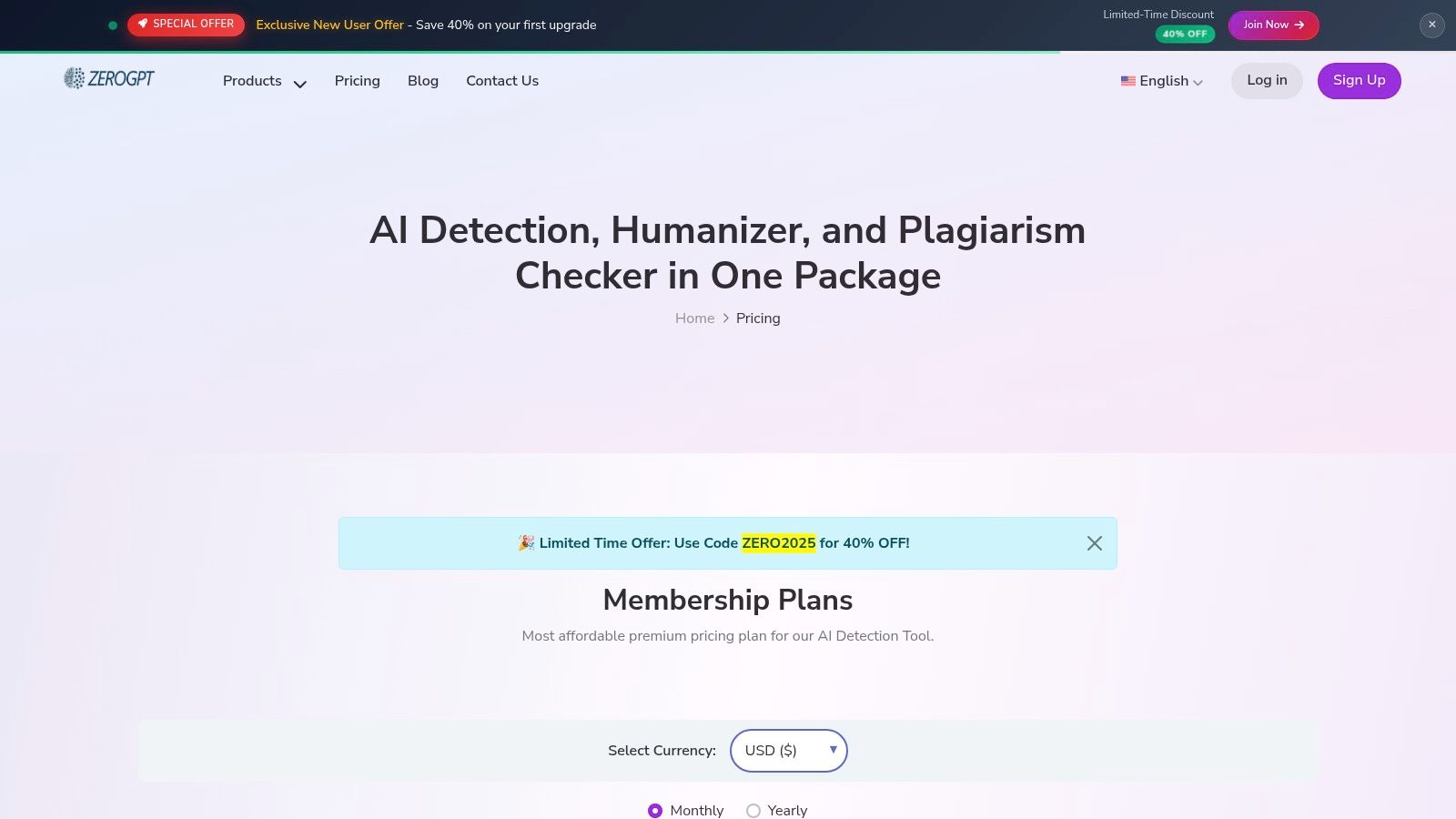
For users requiring higher volumes, ZeroGPT offers paid tiers that bundle its AI detection with additional services like plagiarism checking and a "humanizer" tool. This positions it as an all-in-one solution for those looking to not only detect AI but also refine their content to achieve a more natural, human-like tone. The paid plans are competitively priced with very high monthly character limits, appealing to freelance writers and bloggers with consistent output.
Key Features and Usage
The platform is incredibly straightforward: paste your text into the box, and it quickly returns a percentage score indicating the likelihood of AI involvement. The tool highlights specific sentences, allowing for targeted revisions. Its premium offerings, including detailed PDF reports and batch file processing, add value for professionals managing larger content volumes.
- Pricing: A free plan is available with a 15,000-character limit per detection. Paid plans start at $9.99/month ($8.33/month annually) for 100,000 characters per month and access to premium features.
- Pros: The generous free plan is excellent for casual or low-volume use. Paid tiers offer very high character limits at a low cost, providing great value.
- Cons: Accuracy claims can vary across independent tests, and it may not meet the stringent needs of enterprise or academic users who require the highest level of precision.
Website: https://zerogpt.org/pricing?utm_source=openai
8. QuillBot
QuillBot is widely known as a comprehensive writing suite, offering popular paraphrasing and grammar-checking tools. It also includes a capable AI content detector, making it a convenient option for users already integrated into its ecosystem. The platform's primary appeal is its bundled value; the AI detector is part of a larger set of tools designed to refine and improve writing, positioning it as an all-in-one solution for students, writers, and content creators. This integration provides a seamless workflow from drafting and paraphrasing to final originality checks.

The free version offers basic detection with a word count limit, which is useful for quick spot-checks. However, upgrading to QuillBot Premium unlocks the detector's full potential, removing scan limits and adding features like bulk uploads. This makes the premium plan a strong value proposition for those who would also benefit from its advanced paraphrasing modes, unlimited grammar checks, and plagiarism scanning, effectively bundling multiple content tools for a single price.
Key Features and Usage
The detector's interface is clean and straightforward, fitting neatly within the familiar QuillBot design. Users simply paste their text, and the tool provides a clear percentage indicating the likelihood of AI generation. While it may not offer the granular sentence-level highlighting seen in some dedicated tools, its ease of use and accessibility make it a practical choice for everyday writing tasks.
- Pricing: A free version is available with limited scans. The Premium plan unlocks unlimited detector usage and starts at $19.95 per month, with significant discounts for semi-annual and annual billing.
- Pros: Part of a trusted and widely used writing platform. The Premium subscription offers excellent value by bundling the AI detector with a full suite of powerful writing tools.
- Cons: The free detector has a word cap and usage limits. It lacks some of the in-depth analytical features and detailed reporting found in specialized AI detection platforms.
Website: QuillBot AI Detector
9. Crossplag
Crossplag carves out a specific niche by combining its AI content detector with a powerful cross-lingual plagiarism checker. This makes it particularly valuable for academic institutions, international businesses, and publishers working with translated or multilingual content. While many tools focus solely on English, Crossplag’s standout feature is its ability to identify plagiarism even when the source material has been translated into another language, addressing a complex challenge in content integrity. The platform emphasizes user data privacy and control, offering a clean interface for quick analysis.
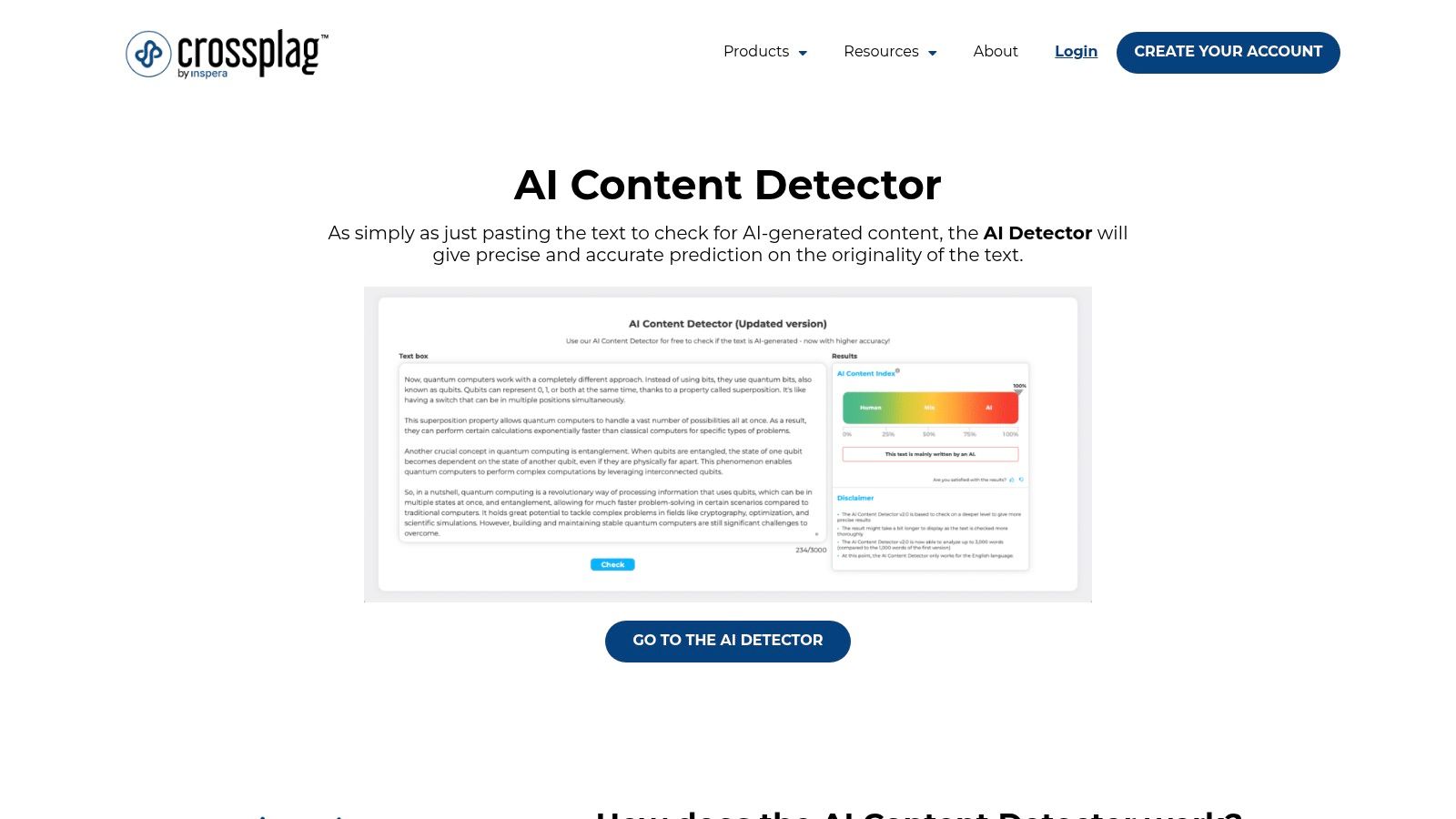
The platform provides a free AI detection tool upon signing up, which operates separately from its paid plagiarism-checking credits. This allows users to test its AI detection capabilities without an initial investment. For organizations seeking to integrate this functionality, Crossplag offers dedicated business and education solutions, including API access to build its detection features directly into existing workflows and content management systems.
Key Features and Usage
The user experience is simple and direct. You paste your text into the detector, and it quickly returns a percentage score indicating the likelihood of AI generation. The result is presented as a clear dial, making it easy to interpret at a glance. While the AI detector is a free component, accessing the advanced plagiarism and cross-lingual features requires purchasing credits.
- Pricing: The AI content detector is free to use after creating an account. Plagiarism checks are credit-based, with packages starting at $9.95 for 100 credits.
- Pros: Offers a unique and powerful cross-lingual plagiarism detection capability. The AI detector is fast, free, and features a user-friendly interface.
- Cons: The AI detector is currently limited to English-only text. To unlock the platform’s full potential, including its signature plagiarism features, users must sign up and purchase credits.
Website: Crossplag
10. Sapling.ai
Sapling.ai is an API-first platform built for developers and businesses that need to integrate AI detection directly into their existing applications and workflows. Unlike standalone checkers, Sapling provides its AI detector as part of a broader suite of Natural Language Processing (NLP) tools, including grammar correction and text rephrasing. This makes it an ideal solution for platforms like content management systems, customer support software, or educational tools that require scalable, metered AI content analysis alongside other writing assistance features.
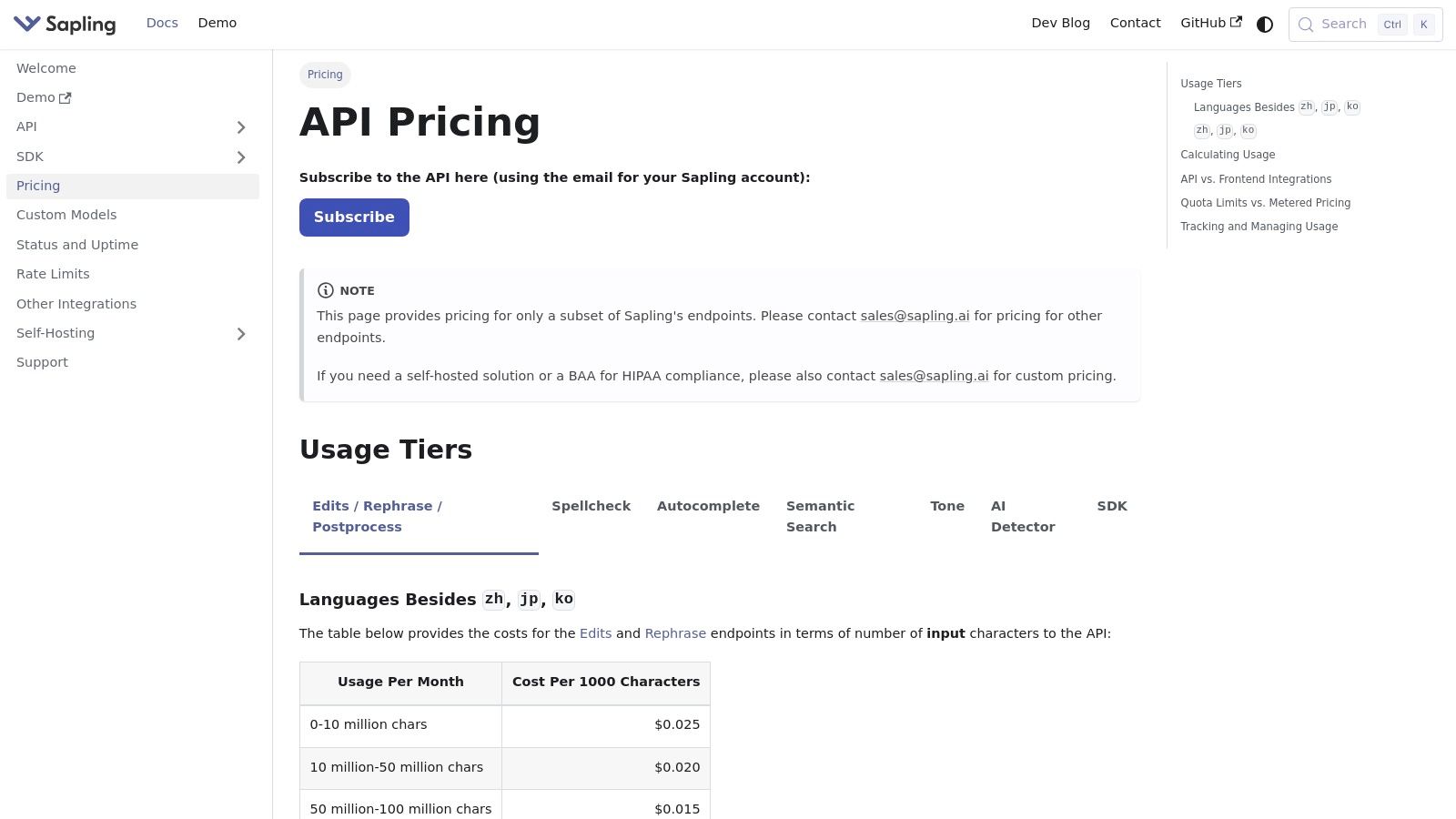
The platform is designed for deep integration, offering comprehensive documentation, SDKs, and a clear, volume-based pricing model that scales with usage. For organizations with strict data security requirements, Sapling.ai provides options for self-hosting and can offer a HIPAA Business Associate Agreement (BAA) through its enterprise plans. This focus on backend integration rather than a consumer-facing interface is its key differentiator, positioning it as the best AI content detector for tech-savvy teams building custom solutions.
Key Features and Usage
Integrating Sapling.ai involves using its API endpoints to send text for analysis and receive a score indicating the probability of AI generation. Its developer-centric approach is evident in its clear API documentation and pricing calculator, which helps teams estimate costs based on expected volume. The AI detector is just one component of its powerful NLP infrastructure, allowing for a multifaceted approach to content quality control.
- Pricing: Operates on a metered, pay-as-you-go model for its API. Enterprise plans are available for features like self-hosting and HIPAA compliance, which require contacting their sales team.
- Pros: Highly developer-friendly with excellent documentation and SDKs. It scales effectively for high-volume product and platform integration and can be bundled with other useful NLP APIs.
- Cons: Not designed for individual users or those without technical expertise, as it is primarily API-centric and lacks a simple consumer UI. Specifics on enterprise-level features require a sales consultation.
Website: Sapling.ai
11. Smodin
Smodin is a multifaceted writing and research platform primarily targeting students, educators, and academic users. It offers a suite of tools that goes beyond simple AI detection, including a plagiarism checker, a summarizer, a rewriter, and even an AI essay grader. This integrated academic toolkit is Smodin’s core strength, providing users with a comprehensive solution for producing and verifying original academic work. While many tools focus on marketing content, Smodin carves a niche by bundling its AI detector with features directly relevant to educational environments.
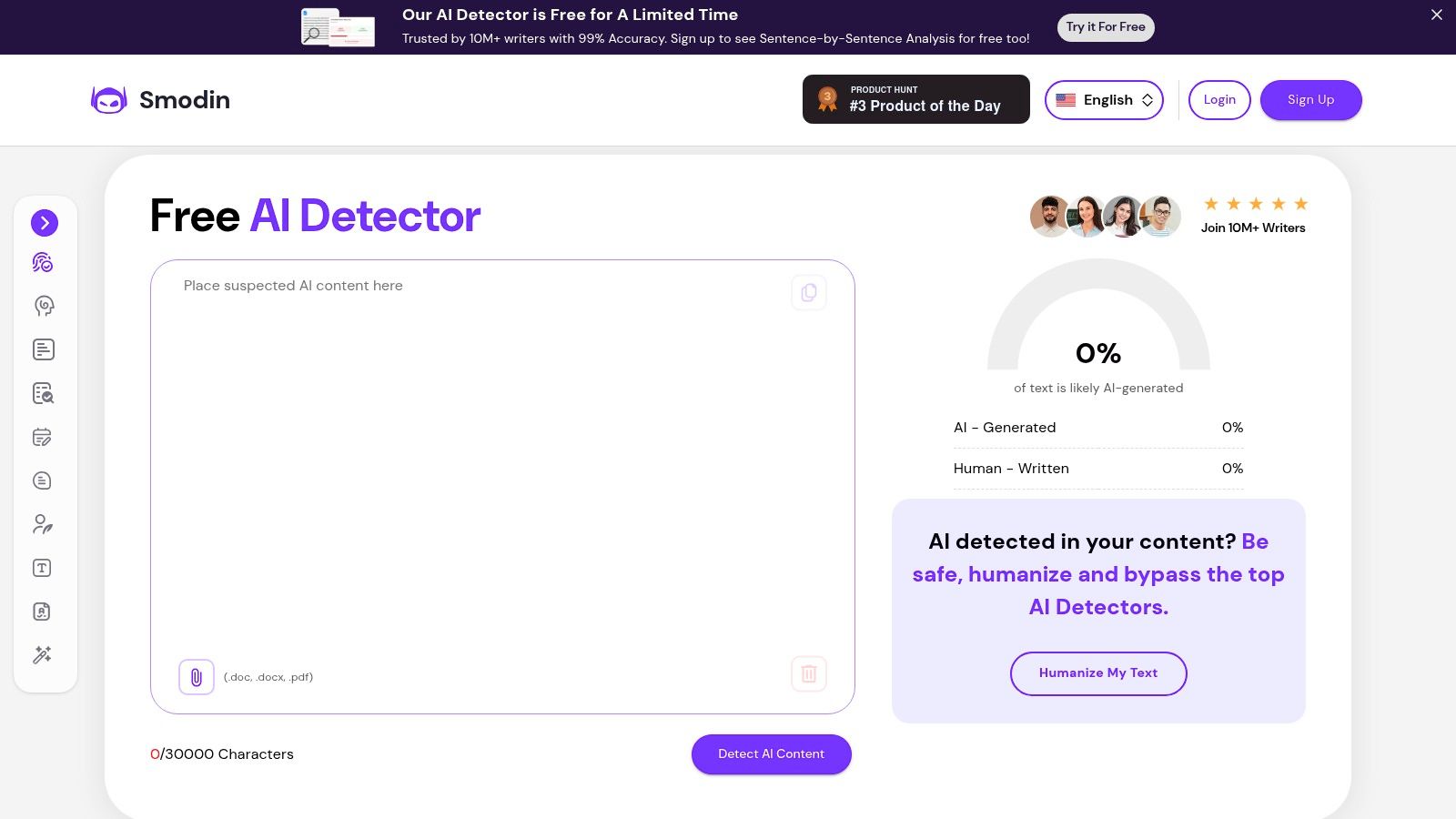
The platform offers a free, no-account-needed AI content detector for quick, small-scale checks, making it accessible for casual users. Paid plans significantly expand character limits and unlock the full suite of academic tools. This tiered approach allows users to select a plan that best fits their needs, from occasional essay checks to extensive research projects, making it a flexible contender for the best AI content detector in academia.
Key Features and Usage
Using Smodin is straightforward: you paste text into a simple interface and receive a verdict on the likelihood of AI generation, with potentially AI-written sentences highlighted. The true value emerges when utilizing its other tools in tandem, such as checking for plagiarism immediately after detecting AI content. This streamlines the academic writing and verification process for students and educators alike.
- Pricing: Provides a free detector with limited use. Paid plans, like the Essentials plan starting around $10 per month, offer more credits and access to additional tools like the plagiarism checker.
- Pros: Offers a useful bundle of academic tools beyond just AI detection. The free version is accessible for quick checks, and paid plans offer high per-scan limits suitable for longer documents.
- Cons: The availability of the AI detector and specific feature limits vary across different pricing tiers, which can be confusing. Users should verify that their chosen plan includes the necessary tools.
Website: Smodin
12. AI Busted
AI Busted is an integrated browser-based tool that combines AI detection with a powerful text humanizer. It’s designed for users who not only want to identify AI-generated content but also need to refine it to sound more natural and authentic. The platform's standout feature is its seamless workflow, allowing you to detect, humanize, correct grammar, and get SEO suggestions all in one place. This makes it a highly efficient solution for content creators looking to ensure their text meets human-like quality standards without juggling multiple applications.
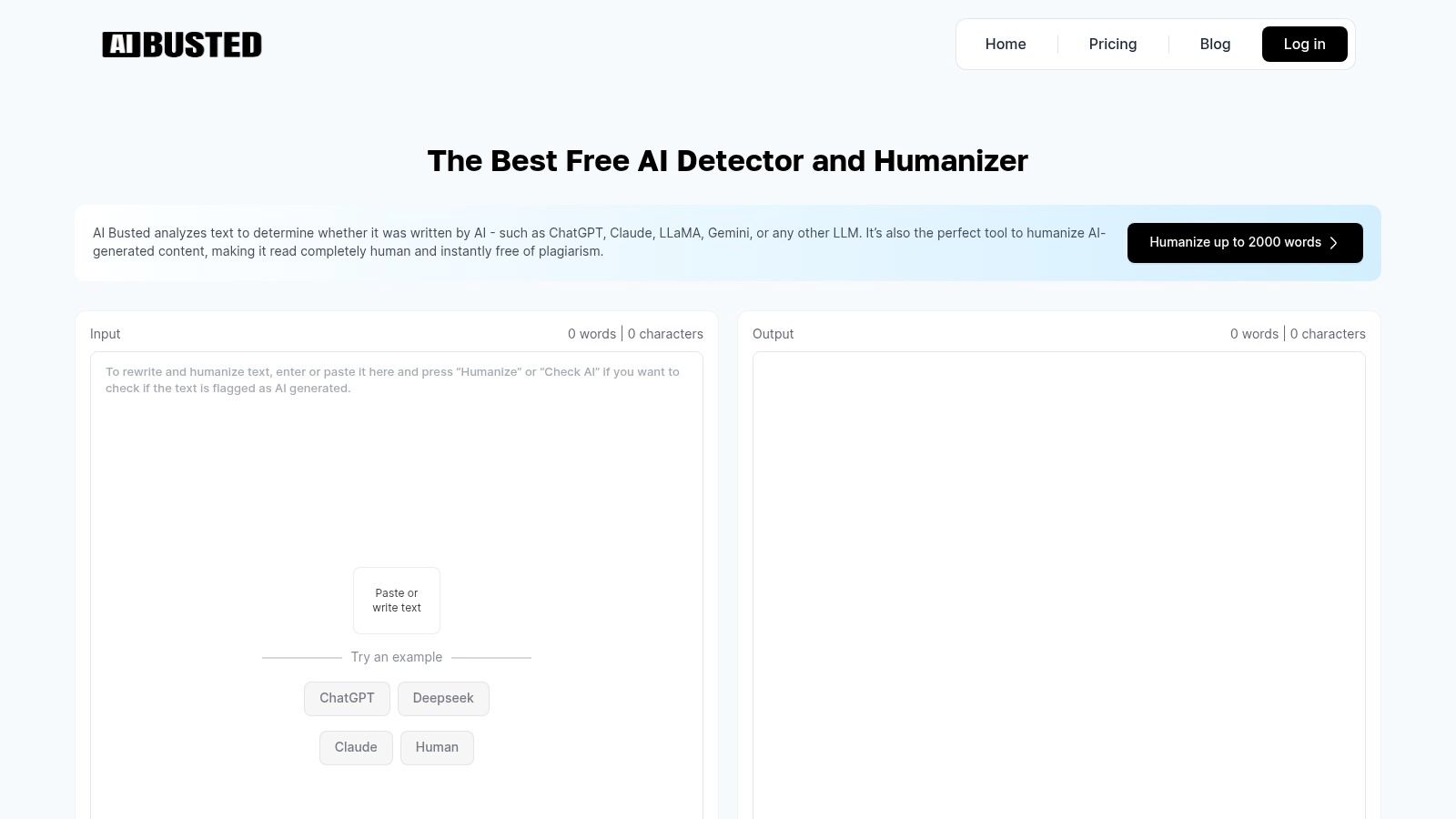
The tool is particularly useful for quick, on-the-fly checks and edits, as it doesn't require a login for basic use. This accessibility, combined with its mobile-friendly design and multi-language support, makes it a convenient option for a wide range of users. It focuses on privacy and contextual rewriting, ensuring that the humanized text maintains its original meaning while achieving a natural flow. Its integrated functionality makes it a strong candidate for anyone seeking the best AI content detector with built-in editing capabilities.
Key Features and Usage
The user interface is minimalist and highly intuitive. You paste your text, and the tool provides a clear analysis, after which you can access its suite of editing features. The humanizer is designed to help users rephrase AI-like text to achieve a completely natural, human-written feel, supporting honest use cases for content refinement.
- Pricing: Offers free, no-login access for basic detection and humanization. Premium features and higher usage limits are available through paid plans, which are detailed during in-app usage.
- Pros: Quick, registration-free access for initial checks. The combined detect-humanize-polish workflow is extremely efficient, reducing the steps between analysis and final revisions.
- Cons: Like all detectors, its results are probabilistic and should be reviewed for critical applications. Full details of its premium plans may only become clear once you start using the tool more extensively.
Website: https://aibusted.com/?utm_source=openai
Top 12 AI Content Detectors — Comparison
| Product | Core features ✨ | UX & Accuracy ★ | Target audience 👥 | Pricing & Value 💰 |
|---|---|---|---|---|
| AI Busted 🏆 | Humanizer + AI detector + grammar + SEO + plagiarism; multi‑language; browser‑based | ★★★★☆ — fast, contextual, probabilistic | 👥 Bloggers, marketers, e‑comm, freelancers, students, PR | 💰 Free tier + premium plans for higher limits |
| Originality.ai | Credit‑based AI detector, plagiarism, readability, API | ★★★★☆ — transparent usage, SEO‑focused | 👥 Publishers, SEO teams, agencies | 💰 Credits/pay‑as‑you‑go, monthly, enterprise |
| Copyleaks | AI Logic explainability, plagiarism, Google Docs & Chrome integrations, SOC security | ★★★★☆ — strong accuracy, low false positives | 👥 Enterprises, educators, content teams | 💰 Credit limits; enterprise & API tiers |
| GPTZero | Standalone detector, free+paid tiers, batch uploads, humanizer & summarizer tools | ★★★☆☆ — simple, fast; free plan very limited | 👥 Educators, writers, students | 💰 Very limited free; Pro monthly for unlimited scans |
| Turnitin | AI indicator in Similarity Report, LMS integrations, documented updates | ★★★★☆ — deeply adopted in education | 👥 Schools, universities, instructors | 💰 Institutional licensing only |
| Winston AI (gowinston.ai) | Text/image/deepfake detection, OCR, PDF reports, HUMN‑1, plagiarism, team seats | ★★★★☆ — broad multimodal coverage | 👥 Educators, media teams, security teams | 💰 Credit system; multiple monthly tiers & trial |
| ZeroGPT | Freemium detector, document scans, multilanguage, humanizer/plagiarism bundles | ★★★☆☆ — generous limits but mixed accuracy claims | 👥 Casual users, small teams | 💰 Generous free scans; low‑cost paid with high caps |
| QuillBot | Paraphraser/grammar suite + free AI detector; Premium = unlimited detector & bulk | ★★★★☆ — trusted, user‑friendly | 👥 Writers, students, professionals | 💰 Free limited use; good value in Premium bundle |
| Crossplag | Free detector (account), cross‑lingual plagiarism, API, privacy focus | ★★★☆☆ — fast, niche in cross‑language checks | 👥 Translators, businesses, educators | 💰 Free detection; paid credits for full plagiarism checks |
| Sapling.ai | API‑first AI detection, SDKs, grammar & rephrase APIs, HIPAA options | ★★★★☆ — developer‑friendly, scalable | 👥 Developers, platforms, enterprises | 💰 Volume‑based API pricing; contact sales for enterprise |
| Smodin | Free no‑account detector, high char limits on paid plans, translator/summarizer/grader | ★★★☆☆ — useful academic bundle, tier‑varied limits | 👥 Students, educators | 💰 Free quick checks; paid plans expand limits |
Making Your Final Choice: A Practical Guide
Navigating the landscape of AI-generated content can feel complex, but as we've explored, a powerful suite of tools is available to provide clarity and confidence. Our in-depth analysis of the top contenders, from the precision of Originality.ai and Copyleaks to the educational focus of Turnitin and GPTZero, reveals a crucial truth: the best AI content detector is not a one-size-fits-all solution. Your ideal tool depends directly on your specific role, workflow, and objectives.
The journey through these platforms highlights the inherent technological trade-offs. High accuracy often comes with a stricter paywall, while free tools might offer less granular analysis or a higher rate of false positives. Speed, language support, and integration capabilities are all critical variables that shift the balance. The key takeaway is to move beyond searching for a single "winner" and instead focus on finding the right fit for your unique context.
How to Choose the Right Detector for Your Needs
To make a confident decision, distill your requirements by asking targeted questions. This strategic approach ensures you invest your time and resources in a tool that genuinely enhances your work, rather than complicates it.
-
For Educators and Academic Institutions: Your primary concerns are academic integrity and providing constructive feedback. Prioritize tools like Turnitin or GPTZero, which are designed for educational environments and often integrate directly with learning management systems. Their ability to handle student submissions and provide detailed reports is paramount.
-
For SEO Professionals and Marketing Agencies: You require high accuracy, scalability, and robust integration options to protect your clients' rankings and your agency's reputation. Originality.ai and Copyleaks are top-tier choices, offering powerful APIs, detailed scan histories, and a strong focus on detecting content from sophisticated models like GPT-4.
-
For Content Creators and Freelance Writers: Your goal is to verify authenticity and ensure your work meets client standards without breaking the bank. A versatile tool like Winston AI or a more streamlined option like ZeroGPT can provide the necessary checks. For those focused on refining AI-assisted drafts into fully humanized, high-quality content, an all-in-one solution like AI Busted offers both detection and humanization.
-
For Developers and Tech Teams: If you need to build AI detection into your own applications, an API is non-negotiable. Look to providers like Sapling.ai or Copyleaks, which offer well-documented, reliable APIs that can be integrated seamlessly into existing software and content platforms.
Implementing AI Detection Responsibly
Once you've selected a tool, responsible implementation is the final, critical step. Remember that AI content detectors are powerful aids, not infallible judges. Their results should be treated as strong indicators that warrant further review, not as definitive proof of wrongdoing.
Always use a detection score as the starting point for a conversation, whether with a student, a writer, or a team member. Consider the context, the possibility of false positives, and the nuances of AI-assisted writing versus outright AI generation. The most effective approach combines technological analysis with human judgment, fostering a culture of transparency and authenticity rather than one of accusation. By integrating these tools thoughtfully, you can uphold quality standards, protect your digital assets, and confidently navigate the evolving world of content creation.
Ready to ensure your content is not only original but also achieves a 100% human score? The AI Busted platform provides a comprehensive solution, combining a highly accurate AI content detector with a sophisticated humanizer. Stop guessing and start creating content that connects, engages, and passes every check with confidence by visiting AI Busted today.