

Think of an AI text humanizer tool as a specialized editor for machine-generated writing. Its job is to take content that sounds robotic and give it the natural flow, rhythm, and tone of something written by a person. The core goal is to boost readability and make the text feel genuinely human, helping it connect with the reader.
Why AI-Generated Text Needs a Human Touch

AI is a powerhouse for content creation, churning out articles, emails, and reports at an incredible pace. But that speed often comes with a trade-off. The output, while technically correct, can feel bland, predictable, and just… empty. It has all the right words, but it’s missing the soul.
This mechanical feeling creates a barrier between the content and the audience. People can usually tell when they're reading something made by a machine—the sentences all sound the same, and the conversational warmth is gone. You end up with content that might inform, but it won’t persuade, entertain, or truly resonate.
Bridging the Gap Between Machine and Reader
This is where an AI text humanizer tool comes in. It acts like a smart editor that’s been trained to spot and fix the tell-tale signs of AI writing. It’s not just swapping out a few words for synonyms; it’s re-engineering the very structure and flow of the text to mirror how a real person would write.
This "humanizing" process typically involves a few key tweaks:
- Varying Sentence Structure: It mixes up long, flowing sentences with short, punchy ones to break up the monotony and create a more engaging rhythm.
- Improving Word Choice: The tool goes for more natural vocabulary that fits the context, steering clear of repetitive or stuffy language.
- Enhancing Readability: It smooths out the overall flow, making the ideas easier to follow and much more pleasant to read.
The point isn't to be deceptive. It's to make the content genuinely better for the human on the other side of the screen. Communication that feels authentic and relatable is always going to be more powerful, no matter if you're writing a blog post, a sales email, or a report.
A big reason for this push to humanize content is the ongoing discussion about search engines. Many people wonder does Google penalize AI-generated content? While Google says it rewards high-quality content no matter how it's made, it’s clear that low-effort, spammy AI text is in their crosshairs. Focusing on quality is non-negotiable.
Achieving a Genuine Connection
At the end of the day, you want your content to connect with people. When writing feels authentic, it builds trust and keeps readers hooked. By adding that crucial human touch to your AI drafts, you make sure your message isn't just sent—it's felt. That's the vital role an AI text humanizer tool plays in today's content workflow.
How an AI Text Humanizer Tool Works
Think of an AI text humanizer as a combination of a skilled editor and a sophisticated data analyst. It doesn't just swap out words. Instead, it dives deep into the machine-generated text, figuring out how to reshape it into something that feels like it was written by a person. The whole process is much more involved than a simple paraphrasing job.
The first thing the tool does is a full contextual analysis. It reads the entire piece to get a handle on the main message, who it's for, and the key ideas. It has to understand the "what" and the "why" of the content before it even thinks about touching a single word.
Getting that initial understanding right is absolutely critical. If it skipped this step, any changes could accidentally twist the original meaning or strip out important keywords, which would be a nightmare for your SEO. This deep-dive analysis is what makes the rewriting process smart and effective.
It's More Than Just Swapping Synonyms
Once the tool has the context down, it goes way beyond just replacing words. A basic thesaurus-style spinner might swap "important" for "significant," but a true AI text humanizer tool looks at the bigger picture: the sentence structure, the rhythm, and the overall tone.
This is where the magic really happens. The tool uses a few clever techniques to get that natural, human-like feel.
- Syntactic Restructuring: It completely reworks sentences and changes their grammatical flow. For example, it might flip a passive sentence into an active one or merge two short, choppy sentences into a single, more sophisticated one to make it read better.
- Lexical Variation: The tool brings in a richer, more authentic vocabulary. It avoids the predictable words AI often relies on and picks language that gives the text more personality and depth, making it far more interesting for a human to read.
- Rhythm and Cadence Adjustment: AI-generated text can sound flat and monotonous. A humanizer breaks up that robotic rhythm by mixing up sentence lengths and complexity, creating a natural cadence that's more engaging and easier on the ear.
Imagine the original AI text is a musician playing a scale with perfect but boring timing. The humanizer is the composer who comes in and adds pauses, changes the tempo, and builds crescendos to turn those notes into a beautiful, dynamic melody.
Keeping Your Meaning and SEO Intact
One of the biggest worries is whether this kind of rewriting will hurt your content's SEO. A good AI text humanizer tool is built specifically to avoid that. It's smart enough to identify your main and secondary keywords and make sure they stay right where they need to be.
The point isn't to create brand-new content; it's to polish what's already there. The tool keeps all the original facts and key arguments but just makes the delivery better. This ensures the final piece is not only easier to read but also stays perfectly aligned with your content goals. If you want to see this in action, some platforms let you test out the technology. For instance, you can learn more about how these tools work by visiting AI Busted’s public interface, which shows the transformation process up close.
In the end, the tool acts as a bridge. It takes the logical, structured, and sometimes sterile output from an AI and breathes the subtle, complex life of human expression into it. The result is content that’s quick to create but also genuinely enjoyable to read—the perfect blend of machine efficiency and the human touch.
How To Choose The Best AI Text Humanizer Tool
With so many new tools popping up, picking the right AI text humanizer tool can feel like a shot in the dark. But here’s the thing: not all of them are created equal. A simple paraphraser might just swap out a few words, while a more sophisticated humanizer can truly elevate your content. What you really want is a writing partner—something that refines your text without gutting its core message.
To make the right call, you have to look past the marketing hype. The best tools combine smart technology with a design that’s actually easy to use, giving you a final draft that’s polished, natural, and ready to publish.
This flowchart lays out the basic workflow and shows why humanizing is such a critical final check.
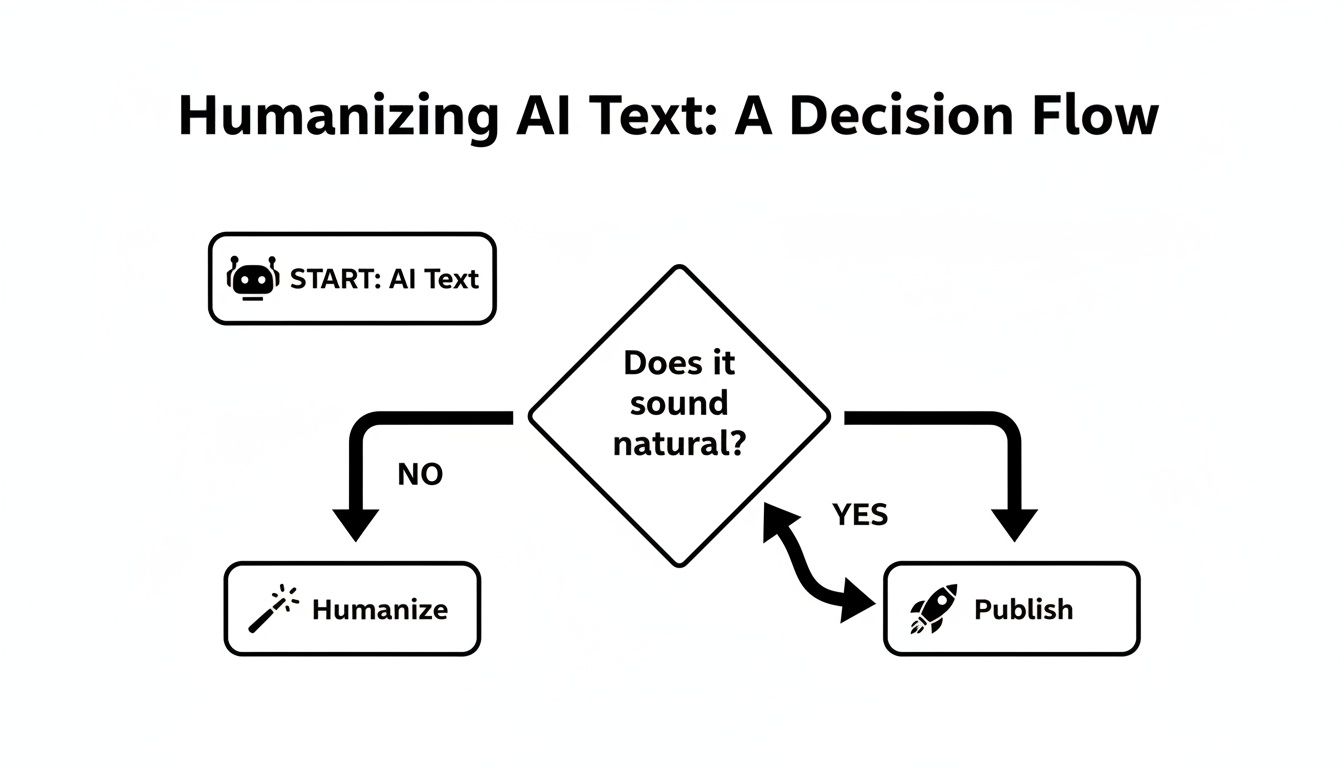
Ultimately, you can see that using an AI humanizer is a crucial quality control step before your content ever sees the light of day.
When you're comparing different options, it's easy to get lost in the details. This checklist breaks down the non-negotiable features you should be looking for.
Essential AI Humanizer Tool Feature Checklist
| Feature | Why It Matters for Quality | What to Look For |
|---|---|---|
| Contextual Accuracy | Prevents the tool from changing your meaning or introducing errors. This is crucial for technical or data-driven content where precision is key. | Look for demonstrations of how it handles complex sentences. Does it just swap synonyms, or does it restructure sentences to improve flow while keeping the original intent? |
| Tone & Style Flexibility | Your content needs to sound like your brand, not a robot. A good tool lets you guide the final tone to be formal, witty, casual, or whatever you need. | Seek out tools with adjustable settings for tone, style, or formality. Can you select different writing modes or provide instructions to match your brand voice? |
| AI Model Compatibility | You might be using ChatGPT today and Claude tomorrow. Your humanizer needs to work with output from any major AI model without a hitch. | The tool should explicitly state that it works with text from various sources like GPT-4, Gemini, Claude, and others. Versatility is a sign of a robust algorithm. |
| SEO Preservation | What's the point of great content if no one finds it? The tool must protect your keywords and on-page SEO efforts. | Check for features that specifically mention "SEO-safe" or "keyword preservation." The tool should rewrite around your keywords, not remove them. |
Choosing the right tool is about finding that sweet spot where enhanced readability meets strategic integrity. Let's dig a little deeper into what makes these features so important.
Contextual Accuracy is Non-Negotiable
The absolute most important thing an AI text humanizer tool can do is preserve your original meaning. I’ve seen basic tools take a perfectly good sentence and twist it into something nonsensical just by swapping a few words for synonyms. This is a huge risk, especially if you’re writing about technical subjects or anything that involves specific data.
A high-quality humanizer doesn’t just look at individual words; it analyzes the entire context before it touches a thing. It understands the nuances and relationships between ideas, ensuring its edits improve clarity and flow without corrupting the facts.
You Need Flexibility in Tone and Style
Every brand has its own voice, and your content has to reflect that. A one-size-fits-all approach to humanizing just doesn't cut it. The best tools give you options, letting you steer the rewrite to match a specific tone—whether you’re going for professional, conversational, or even a little bit witty.
This is what separates a simple rewriter from a true content assistant. You should be able to:
- Adjust the formality for different audiences.
- Shift the style to be more professional or more casual.
- Keep the unique voice you've worked hard to build for your brand.
A great humanizer doesn't force its own style onto your work. Instead, it takes your original intent and polishes the language so it lands with your audience in a much more authentic way.
It Must Work With Any AI Model
In the real world, you’re probably pulling content from different AI models—ChatGPT, Gemini, Claude, you name it. A truly effective AI text humanizer tool needs to handle output from any of them seamlessly. Its algorithms should be smart enough to recognize and fix the tell-tale patterns of various AI writers.
This means you can rely on one tool for all your humanizing needs instead of juggling multiple platforms. It simplifies your workflow and saves a ton of time. For a tool built from the ground up to be this versatile, check out a solution like AI Busted, which is designed to process text from all the major AI generators.
It Has to Protect Your SEO
Finally, and this is a big one, any edits the tool makes can't harm your SEO. Your keywords are the backbone of your search strategy. If a humanizer strips them out or waters them down, it could tank your rankings and undo all your hard work.
A top-tier AI text humanizer tool is built with SEO in mind. It knows how to identify your primary and LSI keywords and makes sure they stay prominent and contextually relevant in the final version.
Look for a tool that actively preserves:
- Keyword Density: It should maintain the right frequency without keyword stuffing.
- Semantic Relevance: It needs to understand related concepts to keep the content topically strong.
- Readability: By making the text more engaging for humans, it naturally improves metrics like time on page—a great signal to search engines.
Your goal is to find a tool that makes your content better for people without making it invisible to Google.
The Growing Hunger for Real, Human-Sounding Content
Let's face it: the internet is drowning in content. AI tools can churn out articles, social media updates, and emails in the blink of an eye, and while that's impressive, it’s created a huge problem. We're now swimming in a sea of generic, soulless text.
When everything starts to sound the same, people naturally start to tune out. It’s why real, authentic writing is suddenly at a premium. Readers are craving a genuine connection, something that feels like it was written by a person, for a person. This isn't just a fleeting trend; it’s a major shift in what we expect from the content we consume online.
And that growing demand for authentic communication is exactly why tools like the AI text humanizer have become so popular.
The Market Catches Up to a Universal Problem
This isn't just a marketing thing. The need to sound more human spans just about every field you can think of. Students are trying to polish their essays, and professionals are working to make their reports and ad copy more persuasive. They all see that what an AI spits out is just a first draft.
The real magic happens when you refine that raw text into something with a bit of personality and flair. The market has noticed, and now there’s a whole wave of tools designed to do just that. It’s a clear signal that just being readable isn't enough anymore—content has to be engaging, too.
The growth has been explosive. Take Humanizer AI, one of the early tools in this space. They just announced they've blown past 6 million users worldwide. Launched back in 2022, the tool was built to humanize AI text, which shows you this capability is in high demand. Hitting a milestone like that proves this is a global need. You can dig into the details of their impressive user growth and what it means for the market.
Why Authenticity Actually Works
So, why is "humanized" content so much more powerful? It really comes down to basic human psychology and how we connect with the written word.
- It Builds Trust: When writing feels honest and straightforward, we're more likely to trust the source. It's just human nature. We believe people we feel are being genuine with us.
- It's Easier to Read: Natural language flows better. It uses a mix of long and short sentences and a conversational rhythm that's just more pleasant to read. This keeps people on your page longer, which is great for engagement and even SEO.
- It Sparks an Emotional Connection: Good human writing can be funny, empathetic, or inspiring in a way that rigid, robotic text just can't match. That emotional hook is what makes content stick in someone's mind and gets them to share it.
At the end of the day, the goal is to close the gap between the efficiency of a machine and the genuine connection of a human. An AI text humanizer tool is the bridge that gets you there.
In a world overflowing with information, being able to communicate with a clear, engaging, and human voice gives you a serious edge. That's why these humanizer tools have quickly gone from a novelty to a must-have in any modern content creator's toolbox.
Real-World Applications Across Industries

The real value of an AI text humanizer tool isn't just theory—it’s about getting real results in the trenches. In any field where connecting with people is what separates success from failure, these tools are quickly becoming the secret weapon for turning sterile AI drafts into content that actually works.
Think of them as the bridge between machine efficiency and the human touch. This is especially true in fast-paced jobs where you have to pump out a lot of content, but the quality can't suffer. From marketing copy that needs to pop to academic papers that need to be clear, the goal is always the same: make machine-generated text feel genuine and trustworthy.
Marketing and Advertising
For marketers, you only get one shot at a first impression. Let's be honest, a robotic-sounding ad or social media post is an instant turn-off. An AI text humanizer tool helps you take that bland, AI-generated copy and inject it with personality and persuasion.
Marketers use these tools to sharpen everything from ad slogans and email campaigns to landing page copy, making sure the brand’s voice sounds authentic, not automated. This isn't just about sounding better; it directly impacts campaign performance.
When your copy feels natural, you start seeing:
- Higher Click-Through Rates: Ads that speak like a real person are far more likely to get that click.
- Increased Conversions: Product descriptions that connect with a customer’s problems build the trust needed to make a sale.
- Better Brand Perception: A consistent, human-sounding voice makes a brand feel more reliable and builds loyalty.
SEO and Content Creation
Anyone in SEO knows it’s a volume game. You're constantly churning out blog posts, guides, and articles. While AI is great for getting words on the page, the raw output often lacks the natural flow that tells search engines (and real people) that this is quality content.
Humanizing AI-generated text is a critical step for improving on-page metrics like time on page and bounce rate. A good AI text humanizer tool helps SEOs polish their content to read naturally, keeping visitors engaged without having to gut their keyword strategy. It creates a simple, powerful loop: content that’s better for humans almost always performs better in search rankings.
The big idea is simple: make stuff that people actually want to read. When you nail that, search engines notice. Humanizing AI text is a direct line to creating a better user experience, which is exactly what Google's algorithms are trying to reward.
E-commerce and Sales
In the cutthroat world of e-commerce, your product description is your salesperson. A dry, feature-list description spat out by an AI might be accurate, but it won’t sell a thing. By humanizing that text, you can tell a story, focus on benefits, and speak directly to what the customer actually wants.
This is becoming more and more crucial. Some projections suggest that by 2030, AI could handle 80% of customer interactions on social media. While AI can schedule posts and generate basic promos, it often misses the emotional spark that actually drives a purchase. Humanizer tools add that spark back in, building a genuine connection that turns into a sale. If you're curious about this trend, you can learn more about AI humanizer performance trends and their impact on business.
Education and Academia
It's not just for business—students and researchers are finding these tools incredibly useful. Think of an AI text humanizer tool as a smart editing partner. It can take a clunky, convoluted sentence in a research paper and make it clear and direct.
It helps smooth out the flow of an argument, ensuring the final paper is coherent, professional, and easy to read. This allows students to get their ideas across more effectively while maintaining an academic tone, ultimately making their work stronger and more persuasive.
Humanizing AI Content for Better SEO Performance
Let's be clear: a winning content strategy isn't just about churning out articles. It's about creating a powerful connection between human-like writing and solid SEO performance. Using an AI text humanizer tool is about making your content better. This is where content is heading—a smart partnership between human insight and AI efficiency.
When you take a raw AI draft and refine it, you're doing much more than just cleaning up clunky sentences. You’re directly improving the user experience signals that search engines like Google care about most.
Why Human-Sounding Content Wins at SEO
Search engine algorithms are getting smarter every day. Their primary goal is to reward content that genuinely helps and satisfies human readers. When your text is engaging and flows naturally, people instinctively spend more time on your page and are far less likely to hit the "back" button.
This has a direct and positive impact on key SEO metrics:
- Increased Time on Page: Natural, compelling language keeps people reading, which tells search engines your content is valuable and worth ranking.
- Lower Bounce Rates: When visitors find what they're looking for in a clear, readable format, they stay. A low bounce rate is a huge green flag for SEO.
- Improved User Trust: Content that sounds authentic builds credibility with your audience. That trust often translates into more social shares, valuable backlinks, and repeat visitors.
By putting quality and readability first, you're essentially aligning your content with what search engines are trying to do: promote the best possible information. If you're curious about how AI is already changing the game, it's worth exploring different AI for SEO strategies that work hand-in-hand with this approach.
The Future is a Human-AI Partnership
The world of generative AI is growing at an incredible speed. The market is expected to rocket from USD 14.8 billion in 2024 to an almost unbelievable USD 80.12 billion by 2030. This boom is driven by some bold predictions, with some experts suggesting that by 2026, a massive 90% of online content could be created with AI assistance. We're already seeing this shift; a recent HubSpot report showed that 43% of marketers are using AI for everything from ad copy to video scripts.
With this explosion of AI-generated text, authenticity has become the ultimate differentiator. The goal is no longer just to produce content, but to produce content that actually connects with people.
This is where an AI text humanizer tool fits in. It lets you keep up with the demand for content without losing the genuine voice your audience wants to hear. Think of it as the critical final polish in your workflow, turning an efficient AI draft into a truly effective, high-performing article. When you elevate your content to sound genuinely human, you not only strengthen your SEO but also build a more loyal, engaged readership.
Frequently Asked Questions
Jumping into the world of AI content can bring up a lot of questions. Let's clear up some of the most common ones about using an AI text humanizer tool the right way.
Will Using an AI Text Humanizer Tool Hurt My SEO?
It's actually the opposite—a good AI text humanizer tool is built to help your SEO. Think about it: search engines like Google want to show their users high-quality content that people actually enjoy reading. When you turn robotic, clunky text into something that flows naturally, you improve things like how long people stay on your page and whether they leave right away.
A well-made tool keeps your keywords and core message intact while making the content better for your audience. And that's exactly what search engine algorithms are designed to reward. You're not trying to fool a system; you're just making the content genuinely better.
Is an AI Text Humanizer Difficult to Use?
Not in the slightest. The best tools are designed to be incredibly simple and fast. You don't need to be a tech wizard to get great results.
The whole process usually just takes a few seconds:
- Copy the text your AI writer gave you.
- Paste it into the humanizer's editor.
- Click the "humanize" button.
That’s it. The tool does all the heavy lifting in the background, analyzing the text and rewriting it to sound authentic. You get a polished, human-like draft back in moments.
The core idea behind a great ai text humanizer tool is to simplify your workflow, not complicate it. The technology does the heavy lifting so you can focus on publishing high-quality, readable content without a steep learning curve.
How Is This Different From a Standard Paraphrasing Tool?
This is a really important question. A basic paraphrasing tool typically just swaps out words for synonyms. This often leads to awkward sentences, weird grammar, and can even change the original meaning. It’s a surface-level fix that doesn't solve the real problem of robotic sentence structure.
An advanced AI text humanizer tool, on the other hand, goes much deeper. It looks at the context, tone, and rhythm of the entire piece. Instead of just replacing words, it intelligently rephrases entire sentences to improve the flow and make it sound like something a person would actually write.
Can I Use This for Academic or Professional Work?
Absolutely. An AI humanizer works great as an editing partner for polishing essays, reports, emails, or other professional documents. It helps make sure your writing is clear, coherent, and easy for your reader to follow. By smoothing out sentence structures and improving the overall flow, it helps you get your point across more effectively.
This process ensures your final work is polished and persuasive, presenting your ideas in the best possible light. If you want to see how it can sharpen your own writing, you can easily get started with AI Busted and create a free account to try it out. It's the perfect way to see the difference for yourself.
Ready to transform your AI-generated content into natural, engaging writing? Try AI Busted today and see how easy it is to achieve a 100% human score while boosting your content's quality and SEO performance. https://aibusted.com