

Let's clear this up once and for all. The core difference between affect and effect boils down to one simple distinction: affect is almost always a verb, and effect is almost always a noun.
If you can remember that affect is an action word and effect is an end result, you’re already most of the way there.
The Basic Rules: Action vs. Result
Even the most seasoned writers pause on this one. It's one of the most common mix-ups in the English language, but the fix is surprisingly straightforward. It helps to think about cause and consequence. An action (affect) has to happen first to create a result (effect).
This simple relationship is the foundation for getting it right nearly every time. Are you talking about something doing the influencing? That's affect. Are you talking about the outcome of that influence? That's effect.
Affect vs Effect At a Glance
For a quick reference, this table breaks down the most common uses of each word. Keep it handy until the difference feels second nature.
| Word | Part of Speech | Meaning | Example Sentence |
|---|---|---|---|
| Affect | Verb | To influence, impact, or produce a change. | The new algorithm will affect our search rankings. |
| Effect | Noun | A result, outcome, or consequence. | The new algorithm had a positive effect on our traffic. |
As you can see, the verb affects the rankings, which leads to the noun, a positive effect.
This little flowchart is another great way to visualize the decision. Are you describing an action or a result?
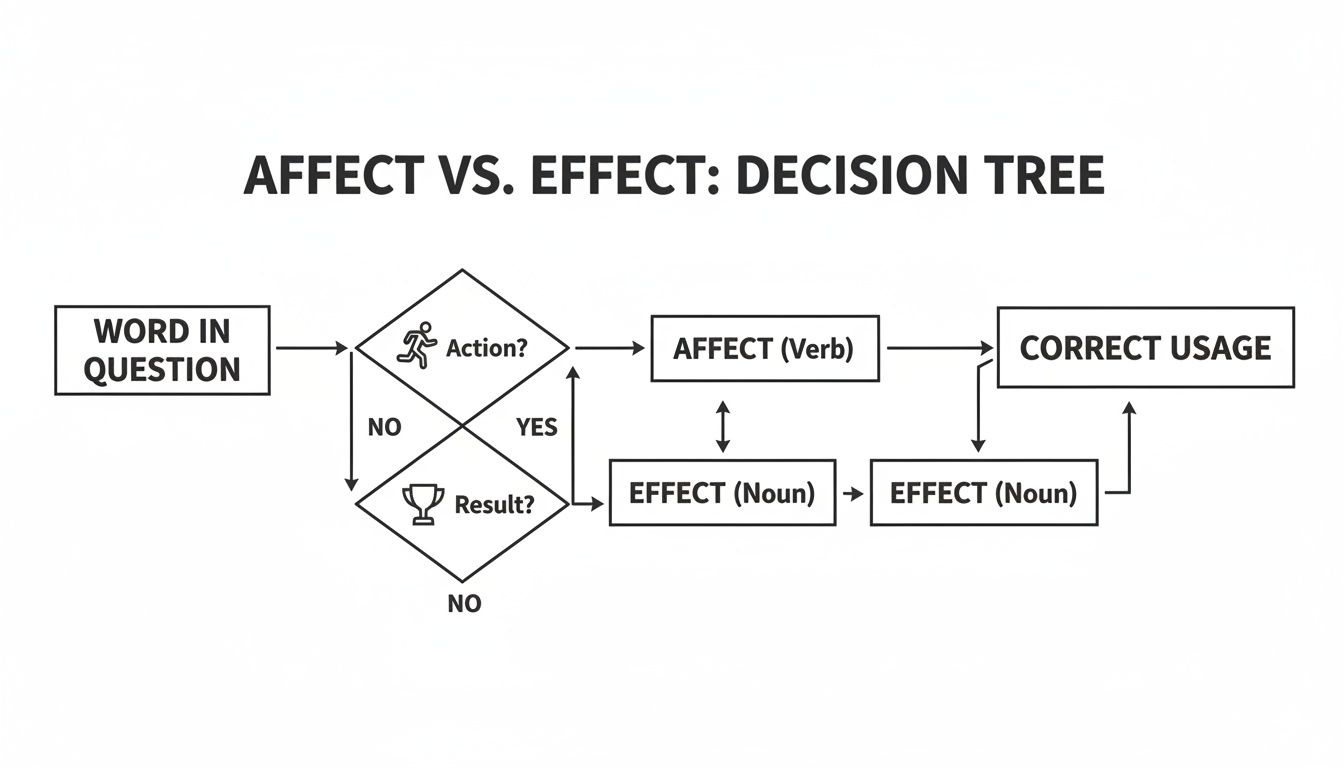
This visual just reinforces that core idea: if you need an action word, go with affect. If you need to name the result, effect is your choice.
Pro Tip: My favorite trick for remembering the difference is the RAVEN mnemonic. Just think: Remember Affect is a Verb, Effect is a Noun. This simple device works for over 95% of the situations you'll encounter. It’s a lifesaver.
Understanding the Core Difference in Daily Use

Okay, let's move beyond sterile definitions and get into how this actually works in the real world. The easiest way to nail the difference is to remember their roles in a sentence. Think of it like a cause-and-result relationship: affect is the action, and effect is the outcome of that action.
For example, a sudden downpour will affect traffic on the highway. That’s the action—the rain is doing something to the traffic. The effect of this downpour is a two-hour gridlock. That's the result, the noun you can point to. Grasping this simple dynamic is the key to mastering most effect vs affect examples.
Affect as a Verb in Context
Nine times out of ten, when you need to use one of these words, affect is going to be the verb. It means "to influence" or "to produce a change in" something. It’s the action word, the one that’s actively doing something.
Here are a few ways you might see it pop up:
- In an email: "How will the server maintenance affect our team's access to the database?" (The maintenance is impacting our access.)
- On social media: "That documentary really affected my views on plastic waste." (The documentary is influencing a perspective.)
- In a news article: "The new regulations will directly affect small business owners." (The regulations are changing things for owners.)
A great little trick is to try swapping "affect" with another verb like "influence" or "impact." If the sentence still flows and makes sense, you've almost certainly chosen the right word.
Key Insight: If you're describing an action,
affectis your go-to. Just ask yourself, "Is something causing a change here?" If so, you're looking for the verb:affect.
Effect as a Noun in Context
On the flip side, effect is almost always a noun. It’s the result, the consequence, the outcome. It’s the "thing" that the action produced. You can often spot it because it follows an article (like a, an, or the) or an adjective (positive, negative, lasting).
Let's look at the other side of our previous examples:
- In an email: "The server maintenance had a noticeable effect on our team's productivity." (The effect is the result of the maintenance.)
- On social media: "The documentary had a profound effect on its viewers." (The effect is the outcome of watching it.)
- In a news article: "The long-term effects of the new regulations remain to be seen." (The effects are the consequences of the regulations.)
See how they're two sides of the same coin? The action (affect) leads to a result (effect). Once you train your brain to see that connection, choosing the correct word will start to feel second nature.
Why This Common Mistake Matters in Professional Writing
So, does mixing up a couple of words really matter in the grand scheme of things? In professional writing, the answer is a resounding yes. It matters a great deal.
Sure, a one-off typo might get a pass. But when you consistently confuse words like affect and effect, you start to chip away at your own credibility. It sends a subtle signal to your audience that you might not be as detail-oriented or authoritative as you claim.
In any business communication, from a marketing email to an academic paper, clarity is king. Every word you choose shapes how the reader sees you and your brand. When a reader stumbles over a basic grammatical error, it breaks their flow. That momentary friction pulls them out of your message and can make them question the professionalism behind it.
The Impact on Credibility and Trust
This isn’t just grammar snobbery; it has a real-world impact. Mixing up words like these is a surprisingly common problem. A 2018 study identified word choice errors as a top-five issue in professional documents, popping up in about 7–9% of the emails and reports they looked at.
Even more telling, other surveys show that between 50–59% of hiring managers say frequent grammar mistakes negatively affect how they view a candidate. They connect good grammar directly with credibility.
This data really drives the point home: getting the details right isn't just about following old-school rules. It's a clear indicator of how meticulous you are and how much you respect your reader's time.
Key Takeaway: Small errors add up. Each mistake, no matter how minor, can erode the trust you've built with clients, colleagues, or readers. The cumulative effect can seriously damage your professional reputation.
For anyone creating content, mastering these nuances is non-negotiable. Whether you're polishing an article or using a tool to make your writing sound more natural, the buck stops with you. Foundational knowledge, like knowing the difference between affect and effect, is what turns good content into great, professional work.
Of course, professional writing goes beyond just being correct. It's also about making an impact. Once you have the grammar down, you can learn how to elevate your writing with rhetorical devices to make your message even more powerful.
Ultimately, taking a few minutes to master these two words is an investment in your own authority. It’s a commitment to excellence that makes you stand out as a skilled communicator, giving you an edge in any industry.
Navigating the Exceptions and Advanced Cases
Just when you think you've got the rules locked down, English decides to throw you a curveball. While "affect" is a verb and "effect" is a noun in most day-to-day conversations, there are a couple of important exceptions you need to know.
These less common uses tend to pop up in more formal, academic, or technical writing. Getting a handle on them is what separates the good writers from the great ones. Let’s break down each exception with clear effect vs affect examples so you're ready for anything.
When Effect Becomes a Verb
That's right, sometimes effect can be a verb. In these more formal situations, it means "to bring about," "to cause," or "to accomplish." It’s a strong, deliberate word that suggests someone is actively creating a result.
Think of it as forcing something into existence, often on a pretty big scale.
- Example 1: The new CEO's mission is to effect a complete cultural shift in the company. (Meaning, to bring about the shift.)
- Example 2: The negotiators worked tirelessly to effect a peace treaty. (They worked to accomplish the treaty.)
This is completely different from "affect," which just means to influence. The new CEO's policies will affect (influence) employees, but her ultimate goal is to effect (bring about) a cultural shift.
Key Difference: To affect something is to have an influence on it. To effect something is to make it happen. One is an influence; the other is the execution.
When Affect Becomes a Noun
The other major exception comes straight from the world of psychology and psychiatry. In this specialized field, affect is a noun that refers to a person's observable emotional state. It’s the mood or feeling someone displays through their facial expressions, tone of voice, and body language.
You probably won't use this one in a blog post about marketing, but it's essential for anyone writing about or for the medical and psychological communities.
- Example 1: The patient presented with a flat affect, showing no emotional response during the interview.
- Example 2: Despite hearing the good news, his affect remained anxious.
This distinction is also a big deal in academic papers. In research, the affect vs effect choice is tied directly to cause and outcome. A researcher might write that one variable affects another (the verb) and then measure the size of the effect (the noun). To learn more about how academics handle this, resources from professional editors like Enago can be incredibly helpful.
To help all these nuances click, let's put them all together for a side-by-side comparison.
Primary Uses vs Advanced Exceptions
This table lays out the common uses you'll see 95% of the time right next to the tricky exceptions that will pop up when you least expect them.
| Word | Common Use (Part of Speech & Meaning) | Common Example | Exceptional Use (Part of Speech & Meaning) | Exception Example |
|---|---|---|---|---|
| Affect | Verb: to influence or impact. | The rain will affect our plans. | Noun: an observable emotional response. | The patient had a blunted affect. |
| Effect | Noun: a result or consequence. | The rain had a negative effect on our plans. | Verb: to bring about or accomplish. | The goal is to effect systemic change. |
By getting comfortable with both the main rules and these specific exceptions, you'll be able to handle any writing challenge that comes your way with total confidence.
Simple Memory Tricks to Get It Right Every Time

Let's be honest, memorizing grammar rules feels like a chore, especially when you’re facing a tight deadline. But you don't have to guess and hope for the best. A few simple memory aids—mnemonics—can serve as a quick mental checklist, so you can choose the right word with confidence.
These tricks are all about connecting the words to ideas that are much easier to remember. The goal is to find one that clicks for you. Once it sticks, you'll find navigating even the most confusing effect vs affect examples becomes second nature.
The A for Action Trick
One of the most straightforward tricks is to focus on the very first letter of each word.
- Affect starts with an A, just like the word Action.
- Effect starts with an E, just like the phrase End result.
So, if you're talking about an action or an influence, you want affect. If you're talking about the outcome—the end result—of that action, you need effect. This little association works nearly every time and is a lifesaver when you're under pressure.
Key Insight: Think of it this way: The action (the cause) has to happen before the end result (the consequence). It's a neat coincidence that A also comes before E in the alphabet, which helps reinforce that cause-and-consequence relationship.
The RAVEN Mnemonic
Another go-to tool for writers everywhere is the RAVEN mnemonic. This simple acronym clearly lays out the most common role for each word, making it the perfect quick-check device.
Here’s how it works:
- Remember
- Affect is a
- Verb
- Effect is a
- Noun
Just picture a raven, and the core rule immediately falls into place. There's a reason this is often the first trick taught to students and writers—it's memorable and holds true in over 95% of cases. When you're stuck, just let RAVEN be your guide.
Test Your Knowledge with a Quick Practice Quiz

Alright, theory is one thing, but putting it into practice is where the real learning happens. Let’s see how well you’ve absorbed the difference between affect and effect.
This quick quiz covers everything we've talked about, from the straightforward rules to those sneaky exceptions. Grab a pen and pick the right word for each sentence. The answers are right below when you're ready.
The Quiz Questions
- How will the new policy (affect/effect) employee morale?
- The documentary had a profound (affect/effect) on my perspective.
- The board of directors wants to (affect/effect) immediate change.
- His calm demeanor had a soothing (affect/effect) on the nervous crowd.
- Lack of sleep can negatively (affect/effect) your cognitive function.
- What is the most common side (affect/effect) of this medication?
- The patient showed a flat (affect/effect) throughout the entire session.
- We are still measuring the long-term (affects/effects) of the campaign.
- Did the storm (affect/effect) your travel plans at all?
- The manager’s goal was to (affect/effect) a smoother workflow.
Test-Taking Tip: Before you peek at the answers, try this. For each sentence, ask yourself: "Am I looking for an action word (a verb) or a thing (a noun)?" That simple check will point you in the right direction almost every time.
Answers and Explanations
So, how'd it go? Let’s walk through the answers and break down the logic behind each one.
- Affect: Correct. We're looking for a verb here, something that will "influence" morale.
- Effect: Correct. The sentence is talking about the "result" or impact the documentary had, which is a noun.
- Effect: Correct. Trick question! This is our rare verb exception, meaning "to bring about" or "to cause" change.
- Effect: Correct. His demeanor produced a "result"—in this case, a soothing one. That's a noun.
- Affect: Correct. Lack of sleep "impacts" or "influences" your function. That's a job for the verb affect.
- Effect: Correct. A side effect is a "result" of the medication, making it a noun.
- Affect: Correct. Another exception! This is the psychology noun, referring to the patient's emotional expression.
- Effects: Correct. We need the plural noun here to talk about the multiple "consequences" of the campaign.
- Affect: Correct. The sentence needs a verb to ask if the storm "impacted" your plans.
- Effect: Correct. The manager wanted "to bring about" a new workflow, which calls for the verb effect.
Frequently Asked Questions About Affect and Effect
Even after you’ve gotten the hang of the main rules, a few tricky questions always seem to pop up. Let's clear up some of the most common hangups writers have when choosing between affect and effect.
Can Affect and Effect Be Used Interchangeably?
In a word, no. It's a common mistake, but a significant one. While they sound alike and dance around the same concepts of cause and result, they play completely different roles in a sentence.
Think of it this way: affect is usually the action that gets the ball rolling, while effect is the result—the outcome itself. So, the gloomy weather might affect your plans (the action), and the effect is a canceled picnic (the result).
Is 'Affects' or 'Effects' Plural?
This is a classic point of confusion because it mixes up verbs and nouns. "Affects" isn't a plural word at all; it's the singular verb form we use with he, she, or it. For example, "The new policy affects everyone."
"Effects," on the other hand, is the plural of the noun effect. This is what you use when you're talking about multiple results. You might discuss the "side effects of a medication" or the "long-term effects of a decision."
A Quick Tip: You can have an effect or multiple effects. You can’t have "an affect." If you see an article like 'a' or 'the' right before the word, you almost certainly need effect.
How Do I Know When to Use the Exceptions?
This is a great question. The exceptions—where effect becomes a verb and affect becomes a noun—are pretty rare and usually live in specific, formal contexts.
-
You'll see effect used as a verb when someone means "to bring about" or "to make happen," usually in a big way. It sounds a bit formal, like in phrases "to effect change" or "to effect a transition."
-
The noun form of affect is almost exclusively a term from psychology or medicine. It refers to a person's observable emotional state, like a "flat affect" or a "blunted affect."
Honestly, unless you’re writing a policy brief or a clinical report, sticking to the main rule (Affect = Verb, Effect = Noun) will serve you well over 95% of the time.
Why Do So Many People Mix Them Up?
It's completely understandable. First off, they're homophones—they sound almost exactly the same when we speak, so our ears don't help much. Second, their meanings are so closely intertwined. One is the action and the other is the immediate result, creating a conceptual overlap that can easily trip you up when you're writing quickly.
Crafting clear, error-free content is the bedrock of credibility. For writers who want to make sure their text sounds polished and authentic, AI Busted provides a powerful toolkit. Our platform helps you smooth out grammatical wrinkles, improve readability, and achieve a fully natural, 100% human score, taking your writing from good to exceptional.
Try AI Busted for Free