

Quick Answer:
Find the answers you need with Word Spinner.
Find the answers you need with Word Spinner.
Quick Answer:
Learn more about choosing active versus passive voice for powerful content with Word Spinner.
Learn more about choosing active versus passive voice for powerful content with Word Spinner.
When people talk about the active versus passive voice, the core difference really boils down to this: active voice is direct and clear, while passive voice often feels roundabout and wordy.
In an active sentence, the subject is the one doing the action. This simple shift makes your writing feel more alive and is much easier for your reader to follow. It’s no surprise that most style guides champion it for online content.
What Are Active And Passive Voice
At its heart, the distinction between active and passive voice is all about sentence structure—specifically, who (or what) is performing the action. Getting this concept down is the first real step toward writing with more purpose and punch, whether you're putting together a blog post, a quick email, or some killer marketing copy.
Defining Active Voice
When you write in the active voice, the subject of the sentence is the one taking action. The structure is clean and simple: Subject -> Verb -> Object. This creates a tone that's clear, concise, and full of energy.
- Example: The marketing team launched the campaign.
See how direct that is? The team (the subject) did the launching. This directness is exactly why active voice is the go-to for most web content. It keeps readers hooked and propels the story forward without getting bogged down. It sounds confident.
Defining Passive Voice
The passive voice, on the other hand, flips this structure. Here, the subject isn't the doer; it's the one being acted upon. This often makes sentences longer and gives them a more formal, detached feel. The typical structure looks more like this: Object -> Verb -> Subject.
- Example: The campaign was launched by the marketing team.
In this version, the campaign is the subject, but it isn't doing anything—it's just receiving the action. While it often gets a bad rap, the passive voice has its strategic moments, which we'll get into later. But more than just knowing the definitions, understanding when and how to use each voice is a huge part of defining your brand's voice and keeping your messaging consistent.
Core Differences at a Glance
To make it even clearer, here’s a quick rundown of the main differences between active and passive voice. Think of it as a cheat sheet for choosing the right tool for the job.
| Characteristic | Active Voice | Passive Voice |
|---|---|---|
| Sentence Focus | Puts the spotlight on the doer of the action. | Puts the spotlight on the recipient of the action. |
| Clarity | Usually direct, clear, and easy to follow. | Can feel indirect, vague, or even evasive. |
| Word Count | Tends to be more concise and punchy. | Often uses more words to say the same thing. |
| Common Use | Storytelling, blogs, marketing copy, everyday communication. | Scientific papers, legal documents, formal notices. |
This table lays out the fundamental trade-offs. One isn't inherently "bad," but they create very different effects. Your choice depends entirely on what you want your reader to focus on and the tone you want to set.
Getting to Grips with Sentence Structure and Tone
The real magic behind the active versus passive voice isn't just a grammar rule—it’s about understanding how each choice reshapes your sentence and its emotional punch. Think of active voice as the engine that drives your writing forward, while passive voice rearranges the parts to shift the focus and change the rhythm. Once you see these blueprints, you're in complete control of your message.
Active voice is built on a simple, powerful pattern we all learned as kids: Subject-Verb-Object. The subject is the star of the show, the one performing the action. This structure is naturally lean and creates a straight line from the actor to what they did, making it incredibly easy for readers to follow along. It sounds clear, confident, and authoritative.
Here’s a quick example you might see in marketing copy:
- Active: Our team developed a new app. (Subject: team, Verb: developed, Object: app)
It’s short, it’s direct, and there's zero confusion about who gets the credit. This is exactly why it’s the go-to for most online writing—it gets the point across without any fuss.
The Anatomy of Passive Voice
Passive voice flips the script. It usually follows an Object-Verb-Subject pattern, moving the recipient of the action to the front of the line and making it the new grammatical subject. This shuffle almost always makes the sentence longer, requiring extra "to be" verbs (like is, was, were) and often tacking on a preposition (usually by).
Let's flip our earlier example:
- Passive: A new app was developed by our team. (Object: app, Verb: was developed, Subject: team)
See the difference? The sentence got longer, and the focus instantly shifted from the "team" to the "app." The doer—the team—is now an afterthought at the end. This is precisely what gives passive voice its signature indirect, and sometimes even evasive, feel.
The Bottom Line: Active voice puts the spotlight on the actor, making your writing feel alive and direct. Passive voice shines that same light on the recipient of the action, which can create a more formal, detached, or even clinical tone.
How Your Choice Shapes Tone and Perception
Picking between active and passive voice goes way beyond grammar. It’s a strategic choice that directly influences how your reader feels about the information you're giving them. Leaning too heavily on passive voice can make your writing feel stuffy, academic, or just plain boring, putting up a wall between you and your audience.
Let’s look at how this plays out in the wild:
-
Blog Post (Active): "We analyzed the data to find key trends." (This sounds confident and straightforward.)
-
Blog Post (Passive): "The data was analyzed, and key trends were found by us." (Suddenly, it feels wordy and less engaging.)
-
Technical Guide (Active): "The user clicks the 'submit' button." (This is a clear, actionable instruction.)
-
Technical Guide (Passive): "The 'submit' button is clicked by the user." (It’s more formal, but less direct if you're trying to guide someone.)
While active voice is great for building trust through its directness, passive voice has its moments. It can be used deliberately to sound more objective. For example, in a scientific report, saying "The experiment was conducted" is standard because the focus is on the process, not the researcher. Mastering this choice lets you fine-tune your tone for any context, making sure your message lands exactly the way you want it to.
How Your Choice of Voice Impacts Readability and SEO
Choosing between active and passive voice is more than just a style tic—it has a real, measurable impact on how both people and search engines process your content. As search algorithms get smarter, they've started to heavily favor content that gives users a clear, straightforward experience. This is precisely where the directness of active voice gives you an edge.

Writing in the active voice naturally leads to shorter, punchier sentences. These are simply easier to parse, whether you're a human reader or a search engine crawler. When your content is a breeze to get through, people stick around longer. That boosts key engagement signals that search engines love, like time on page and bounce rate.
The Link Between Clear Writing and High Rankings
Readability isn't just a bonus feature; it's a fundamental part of good SEO. There's a reason why tools like Yoast and Semrush build readability scores right into their analysis—they know that clear content keeps users hooked. Because active voice sentences are almost always more direct, they give those scores a natural lift.
On the flip side, leaning too heavily on the passive voice can create tangled, wordy sentences. Your content starts to feel dense and intimidating, and readers who are just trying to scan for information will quickly give up and leave. Search engines pick up on this behavior, interpreting it as a sign that your page isn't helpful, which can slowly chip away at your rankings.
Here's the thing: while active voice is the go-to for most online content, truly great writing comes from knowing how and when to use both voices for the biggest impact.
Think of it like this: studies on active learning consistently show that direct engagement makes information stick. The same is true for reading. Active, engaging sentences are more memorable. In fact, content written in an active voice is 54% more likely to be understood and remembered, creating a much better experience for your audience.
Finding the Right Mix for Your Content
Even though an active-first approach is the best bet for most web content, trying to eliminate passive voice entirely is a mistake. It has its place and, in certain situations, it's actually the better choice.
- Scientific and Technical Fields: Passive voice is the standard for maintaining an objective tone. It shifts the focus to the action itself, not the person doing it (e.g., "The sample was heated to 100°C").
- When the "Doer" is Unknown: If you don't know who performed the action, or it doesn't matter, passive voice is the most logical option (e.g., "The window was left open overnight").
- To Highlight the Recipient: Sometimes, the most important part of the sentence is what received the action. Passive voice puts that element right at the beginning (e.g., "The new software update was praised by early adopters").
At the end of the day, it's all about being intentional. Make active voice your default for creating clear, direct, and SEO-friendly writing. But don't hesitate to deploy passive voice strategically when the context demands it. This balanced mindset is what separates good content from great content—it's optimized, authoritative, and perfectly tuned for your reader.
Turning Passive Voice into Active Voice
Knowing the difference between active and passive voice is the first step. The real magic, though, happens when you start editing your own work to make it clearer and more direct. The good news? Switching from passive to active is surprisingly simple once you know what to look for.
Learning this technique is like getting a behind-the-scenes look at strong writing. You’ll start spotting passive constructions everywhere and gain the confidence to restructure them for maximum impact.
A Quick 3-Step Guide to a More Active Voice
Flipping a passive sentence is all about finding the key players and putting them back in the right order. Your goal is to shine a spotlight on the "doer" of the action.
- Look for "to be" verbs: Scan your sentence for words like is, are, was, were, be, being, and been. These are often the first clue. They're usually followed by a past participle (a verb often ending in -ed or -en), which is a dead giveaway for passive voice.
- Find the real subject: Ask yourself, "Who or what is actually doing the action?" In passive sentences, the actor is often tucked away at the end of the sentence (usually after the word "by") or might be missing altogether.
- Put the actor in charge: Once you've found the actor, make it the subject of the sentence. Move it to the front, follow it with the powerful verb, and then add the object that's receiving the action. This simple change makes your statement instantly stronger.
Before and After: Real-World Examples
Let's see this in action. The difference is often striking. We'll start simple and then move to a slightly trickier one. Notice how the active versions feel punchier and more concise.
- Passive: The report was written by the marketing team.
- Active: The marketing team wrote the report.
- The Fix: We just took the doer ("the marketing team"), put them at the front, and got rid of the clunky "was written by." Simple as that.
Here's an example where the actor is missing, which happens all the time in passive writing.
- Passive: The final decision was made yesterday.
- Active: The committee made the final decision yesterday.
- The Fix: The original sentence leaves you wondering who made the decision. By adding the implied subject ("The committee," "We," or "Management"), the active version becomes clearer and more accountable.
Pro Tip: Switching from passive to active does more than just trim your word count. You're swapping a weak, roundabout phrase for a confident, assertive statement that builds trust and authority with your reader.
This shift is more than just a style choice. Writing that gets straight to the point isn't just easier to read—it's far more persuasive. By getting comfortable with this simple conversion, you can make sure your message lands with the clarity and force it deserves.
Passive to Active Revision Examples
Here’s a quick cheat sheet to help you practice. It shows some common passive sentences and how you can rework them into stronger, more direct active sentences.
| Original Passive Sentence | Revised Active Sentence | The Key Improvement |
|---|---|---|
| The mistakes were found by our team during the audit. | Our team found the mistakes during the audit. | Puts the focus on the team's action. More direct. |
| Your request will be reviewed by the support staff. | The support staff will review your request. | Creates a more personal and accountable tone. |
| It is believed that the new policy will cause issues. | We believe the new policy will cause issues. | Replaces a vague, impersonal phrase with a clear subject. |
| This product was created to solve a common problem. | We created this product to solve a common problem. | Adds ownership and makes the statement more dynamic. |
Flipping these sentences isn't just about following a grammar rule; it's about making your writing more decisive and easier for your audience to connect with. Keep this table handy as you edit your next piece.
When Passive Voice Is the Better Choice
We're often told to "use the active voice" as if it's a golden rule of writing. While it’s solid advice for creating clear, direct content, it’s not an unbreakable law. The whole active versus passive debate isn't really about good vs. bad; it’s about choosing the right tool for the job. And sometimes, the passive voice is exactly what you need.
Knowing when to break the "rule" is what separates a good writer from a great one. It's about moving beyond rigid formulas to make conscious choices that sharpen your message and perfectly align your tone with your intent.
Shifting Focus to the Recipient
The most common reason to consciously use the passive voice is to put the spotlight on the recipient of the action, not the one doing it. This is a smart move when the person or thing being acted upon is the real star of the show.
Just look at the difference:
- Active: Our engineers built this bridge in 1952.
- Passive: This bridge was built in 1952.
In the passive version, the bridge is the hero of the sentence. Its origin is the key piece of information, and the passive voice delivers that information with more punch.
When the Actor Is Unknown or Unimportant
Sometimes, you just don’t know who performed the action. Other times, you know, but it’s completely irrelevant. In these cases, forcing an active sentence just adds clutter. The passive voice gets straight to the point.
Key Insight: Don't think of the passive voice as evasive. Think of it as a tool for precision. It lets you deliberately emphasize the most critical part of the sentence—whether that's the result of an action or its recipient.
For instance, "My bike was stolen" is clean and direct. The active alternative, "Someone stole my bike," introduces a vague "someone" who adds zero value. The passive voice communicates the core fact much more efficiently.
Making these intentional choices starts with being able to spot passive voice and knowing how to flip it. This simple workflow can help you visualize that process.
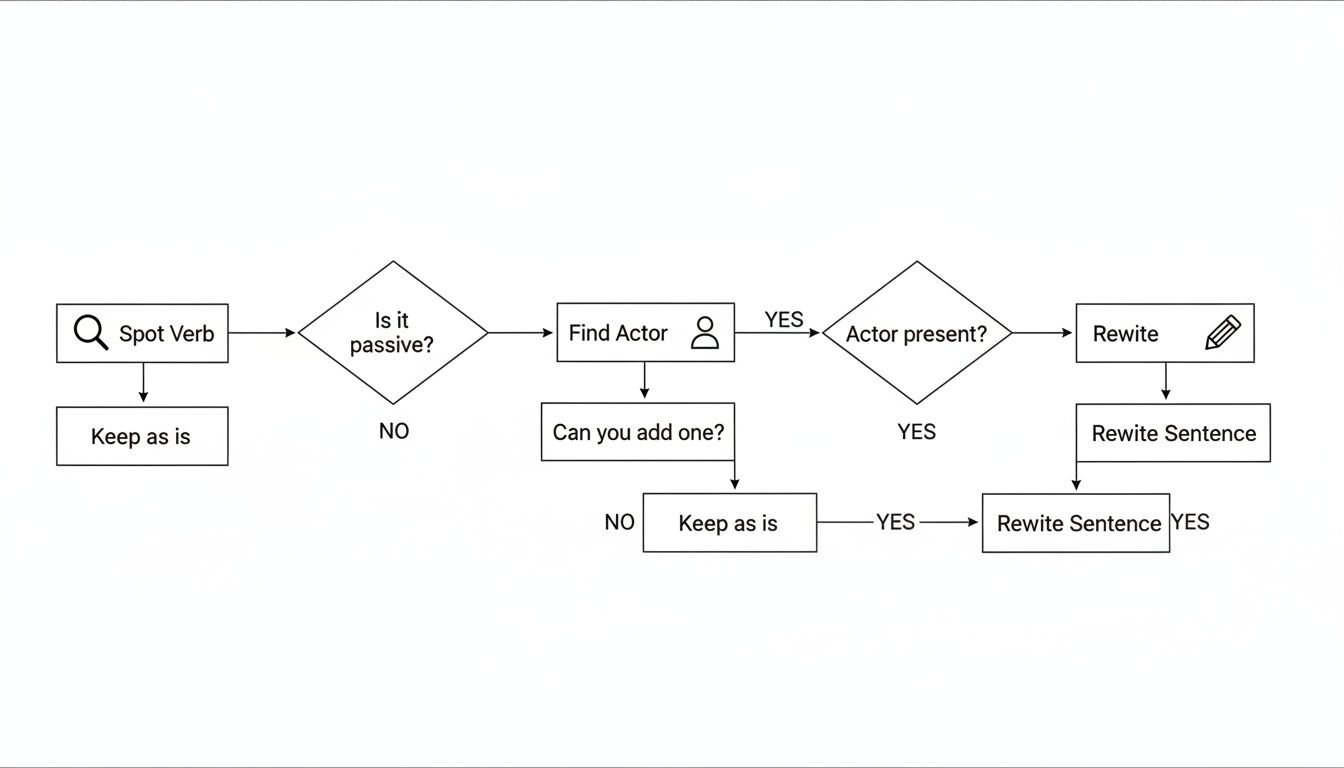
This flowchart breaks down how to identify a passive sentence, find the hidden actor, and restructure it into an active one, which is the foundational skill for making these stylistic decisions.
Creating an Objective Tone
In more formal contexts like scientific, legal, or technical writing, an objective and impersonal tone is everything. The focus has to be on the experiment, the legal precedent, or the technical process—not the individual who did the work. Here, the passive voice is standard practice.
A sentence like, “The samples were heated to 100°C,” is the norm in a lab report. It rightly emphasizes the scientific method, which is precisely what the reader needs to know. Writing "I heated the samples…" would feel out of place and shift the focus inappropriately.
Humanizing Your Text with AI Busted
Getting a handle on the active versus passive voice is a massive step forward for any writer. But let's be honest, in today's world of content creation, we're up against a new challenge: the robotic, slightly-off tone that many AI writing tools spit out.
These assistants often produce text that’s technically correct but feels cold, overly formal, and leans way too hard on passive constructions. The final result can feel detached and unnatural, which is where a specialized tool can save the day.
This is precisely the problem AI Busted was built to solve. It’s not just another grammar checker; it’s designed to sniff out those stiff, predictable patterns that can make text sound AI-generated. The tool supports honest use by humanizing your writing to help it achieve a fully natural, 100% human score. It goes beyond simple corrections to focus on giving your work an authentic and engaging flow.
Achieving a Natural Flow
The platform really shines by helping you rephrase sentences to sound more authoritative and, well, human. It works to preserve your unique voice, ensuring it doesn't get flattened by the AI writing process. By smoothing out the rhythm and ditching the stilted phrasing that might otherwise seem robotic, you can produce content that feels genuine.
It’s not just about passing a check—it’s about elevating the writing itself. When you focus on a natural, human-like tone, your content instantly becomes more relatable, trustworthy, and better at connecting with real people.
To really get the most out of this process, it helps to build your own instincts for what sounds authentic. Learning how to write a letter that doesn't sound like a robot is a great way to train your ear, whether you're working on an email or a full-length article.
Ultimately, a good humanizer helps bridge the gap between AI's efficiency and a human's creative touch. By ironing out robotic phrasing and awkward sentences, you can ensure your final draft is polished, high-quality, and ready to make an impact.
If you’re looking to transform AI-assisted drafts into content that truly resonates, checking out a top-tier text humanizer like AI Busted is a smart move.
Common Questions About Active vs. Passive Voice
When you start digging into active and passive voice, a few questions always pop up. Let's tackle some of the most common ones to clear up any confusion and help you put these ideas into practice.
Does Active Voice Come Across as Aggressive?
Not at all. Active voice is direct, but it isn’t automatically aggressive. The real driver of your tone is your word choice, not the sentence structure itself.
Think about it: "You should complete the report" feels much softer than "You must complete the report," but both sentences are written in the active voice. If you’re concerned about sounding too pushy, the trick is to use more collaborative or positive language within your active sentences.
How Much Passive Voice Is Too Much?
There’s no single magic number, but a solid guideline for most online writing is to keep passive voice usage under 10-15%. The goal isn't to banish it completely. Instead, you want to make sure every time you use it, it’s a deliberate choice.
The core principle isn't about avoiding passive voice at all costs; it's about using it with purpose. Each choice should serve to make your message clearer and more impactful for the reader.
How Do AI Content Detectors Handle Passive Voice?
AI content detectors look at a whole host of linguistic patterns, and a high percentage of passive voice can definitely be a red flag. Why? Because many AI models default to it, which results in a clunky, unnatural rhythm.
But it’s not just about passive voice. These tools also analyze sentence variety, word choice, and predictability. This is where a humanizing tool comes in handy—it can help you refine those robotic-sounding phrases and smooth out the flow, ensuring your writing feels genuinely human.