An AI paragraph rewriter is a smart tool that does way more than just swap out words. It helps you rephrase and polish your text, making it clearer, more interesting, and sound like it was written by a real person. It uses complex algorithms to get the context right, so you get fresh versions of your paragraphs that keep the original meaning but seriously upgrade the flow and readability.
Beyond Synonyms: How AI Rewriters Shape Modern Content
Forget those clunky, old-school "article spinners." They just made a mess by swapping words without any real understanding. Today’s AI paragraph rewriter is more of a creative partner than a blunt instrument. It's perfect for writers, marketers, and students who need to bust through writer's block or get out of a rut of using the same old phrases.
This evolution has made these tools a must-have for anyone who needs to be efficient without letting quality slip. Instead of fighting with an awkward sentence for an hour, you can get a handful of solid alternatives in just a few seconds. That frees you up to concentrate on the important stuff: your message, your argument, and how your content connects with your audience.
The Real Role of an AI Rewriting Assistant
The point isn't to have a robot do all your writing for you. It's about enhancing what you already do. Think of it as a sharp assistant who can suggest new ways to phrase things, help you tweak the tone for a specific audience, and ultimately, humanize your text so it feels more natural.
This is where the magic happens—in the collaboration. The AI gives you the building blocks: new sentence structures, a wider vocabulary, and different perspectives. You bring the final polish, the strategic thinking, and your own unique voice. The end result is something far better than what you or the AI could create alone.
By treating an AI rewriter as a tool for exploration rather than a final solution, you can unlock new levels of creativity and clarity in your writing. It’s about enhancing your unique voice, not replacing it.
Why Mastering This Technology Matters
Getting good at using these tools is quickly becoming a non-negotiable skill. The pressure to create high-quality, authentic content is immense, and an AI paragraph rewriter helps you deliver at scale. The market numbers tell the story: the generative AI in content creation market was valued at around USD 14.8 billion and is expected to explode to USD 80.12 billion by 2030. You can dig into recent market analyses to see just how fast this space is growing.
Knowing how to use these tools gives you a real edge. It allows you to produce polished, reader-friendly content more consistently and efficiently than ever before.
Choosing the Right AI Rewriter for Your Goals
Not all AI paragraph rewriters are built the same. Honestly, the "best" tool really just depends on what you're trying to do. Are you a marketer trying to nail ad copy? A student wrestling with dense academic text? Or a blogger who just wants their posts to sound less… well, robotic? Picking the right tool from the get-go makes all the difference.
Sure, a free online spinner might work in a pinch for a quick synonym swap, but it's not going to understand the nuance of what you're writing. For truly high-quality work, you need something more advanced—a tool that acts like a real writing partner, giving you the controls to shape the final output.
Key Features That Actually Matter
When you're comparing different rewriters, don't get distracted by shiny objects. The most important features are the ones that help you preserve your core message while making genuine improvements to the text.
- Context Preservation: A good AI doesn't just see words; it understands the ideas behind them. It needs to grasp the original paragraph's intent to make sure the new version is still accurate and says what you meant for it to say.
- Tone and Style Flexibility: The ability to switch up your voice is a game-changer. Look for tools that let you pick different tones—like professional, casual, confident, or friendly. A LinkedIn post needs a completely different vibe than a creative story on your blog, right?
- Humanization Capabilities: Let's be real, this is the main goal. The best tools are designed to break up clunky, AI-generated patterns. They'll vary your sentence structures, improve the overall flow, and get rid of that stiff, robotic feeling that screams "AI wrote this!"
If your goal is to hit a 100% human score on detection tools, you can't rely on a basic paraphraser. For that, you need a dedicated platform. To see what that looks like in action, our guide on the AI Busted humanizer is built from the ground up for exactly this purpose.
The most valuable feature isn't just rewriting text—it's providing options. A great tool acts as a brainstorming partner, giving you multiple high-quality variations so you can choose the one that best fits your vision.
Comparing Different Types of Rewriters
When you start looking, you'll find a whole spectrum of tools out there, each good for different things. To make sense of it all, I've broken down the main categories to help you figure out where to start.
Feature Comparison of Leading AI Rewriter Types
This table compares the common types of AI rewriting tools, highlighting the features that really impact the quality and human-like nature of your final text.
| Feature | Basic Online Rewriters | Integrated Writing Assistants (e.g., Grammarly) | Dedicated Rewriting Platforms (e.g., QuillBot) |
|---|---|---|---|
| Primary Function | Simple synonym swapping & sentence restructuring | Grammar/spell-checking with a rewriting add-on | Advanced paraphrasing and content generation |
| Contextual Understanding | Low; often misses nuance and can change meaning | Medium; generally good but not its core focus | High; designed to preserve original intent |
| Tone & Style Options | Very limited or none | Basic options (e.g., formal, casual) | Extensive; multiple tones and style presets |
| Human-Like Output | Low; output often sounds robotic and unnatural | Medium; better than basic, but can be generic | High; focuses on flow and varied sentence structures |
| Control Over Output | Minimal; you get what it gives you | Some control, like accepting/rejecting suggestions | High; offers multiple variations and modes |
| Best For | Quick, simple paraphrasing where quality isn't critical | Everyday writing improvements and error-checking | Serious content creators needing high-quality, natural-sounding text |
As you can see, what works for one person might be totally wrong for another. A free tool is fine for a quick rephrase, but for professional work, you'll want the power of a dedicated platform.
Think about it this way: imagine you're a content marketer who needs five distinct versions of an ad slogan. A dedicated AI paragraph rewriter with robust tone controls will get you there in minutes. A basic tool would probably just give you five slightly jumbled versions of the same sentence. That's a huge difference in both time and quality.
Ultimately, your choice should come down to your workflow, your budget, and the quality you're aiming for. Before you sign up for anything, ask yourself what the tool was really built for. Is it a simple paraphraser, or is it designed to help you craft polished, human-sounding content? The answer will tell you everything you need to know.
A Practical Workflow for Humanizing Your Text
If you want to create truly authentic content, you have to move beyond a simple copy-paste-rewrite approach. The best results come from a real collaboration with an AI paragraph rewriter. Think of it less as an author and more as a creative partner.
It all starts with a solid initial draft, whether you wrote it yourself or had an AI generate it. From there, the real work of refinement begins. The trick is to use the tool to spit out multiple variations of each paragraph. Don't just accept the first one.
Ask yourself: Does it hold onto the original meaning? Is the flow logical? Critically, does it sound like something a real person would actually say? This step alone can help you brainstorm phrasing you might not have thought of on your own.
This diagram breaks down how to pick the right tool before you even start.
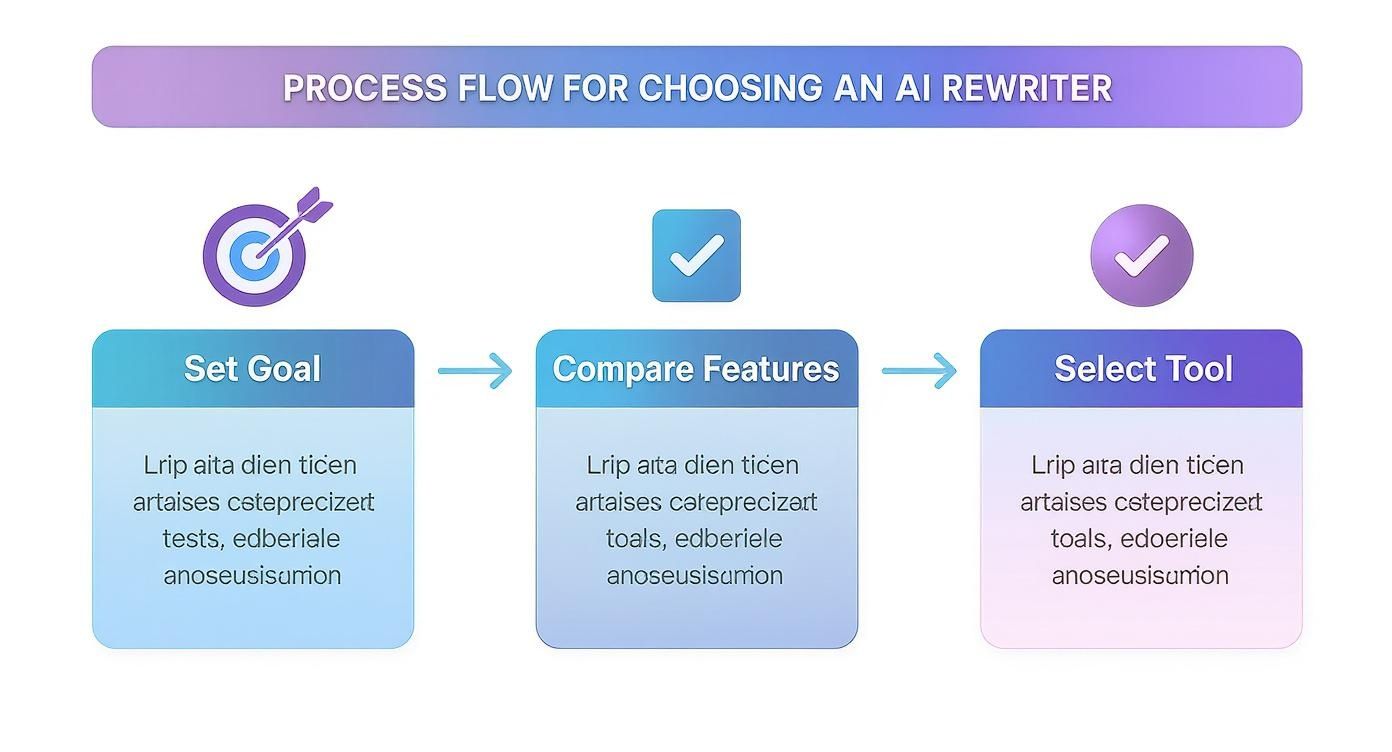
As you can see, choosing a tool that works for you starts with knowing your goals. That clarity will guide you toward the features you actually need for your workflow.
Blend AI Suggestions with Your Own Edits
Once you have a few AI-generated options on the table, the real collaboration kicks in. The goal isn't to find one perfect AI version. It’s about cherry-picking the strongest elements from each and blending them with your own edits. You might love a specific turn of phrase from one version and a punchy sentence structure from another.
This is where you, the human editor, take the driver's seat. You'll combine these pieces into something cohesive, manually adjusting word choices, restructuring clauses for a better rhythm, and making sure the paragraph connects seamlessly with what comes before and after. This "human-in-the-loop" approach is what separates generic content from polished, engaging writing.
Let's say the AI gives you three rewrites of a technical sentence. You could:
- Take the simplified explanation from the first version.
- Incorporate a powerful action verb from the second.
- Add a clarifying analogy of your own to make it really stick.
This hybrid method gives you the speed of AI without sacrificing the nuance and clarity that only a human can provide.
Perform a Final Humanization Pass
This last step is the most important one for getting that completely natural, human feel. Your final pass is where you sprinkle in the elements an AI just can't replicate. It’s all about adding texture and personality that will connect with your readers.
The most effective way to humanize text is to move beyond mere correctness and add genuine personality. This final layer of editing is what transforms good content into great content.
During this review, focus on weaving in your unique voice. This could mean adding a short personal anecdote, posing a rhetorical question to the reader, or just tweaking the tone to be more conversational.
Read the text aloud. It’s a fantastic way to catch awkward phrasing and check for a natural rhythm. While tools like the AI Busted public content analyzer can give you a score, your final judgment is what truly matters. This step ensures your final piece isn't just clear and accurate, but authentically yours.
Advanced Techniques for SEO and Tone Optimization
https://www.youtube.com/embed/UBlHJlrJrCg
Once you get past simple paraphrasing, an AI paragraph rewriter really starts to show its power. It’s one thing to make a paragraph sound different; it’s another thing entirely to shape it for a specific goal, like climbing the search engine rankings or truly connecting with your audience.
This is where you move from just using the tool to directing it. By giving the AI clear, goal-oriented instructions, you can guide its output with a surprising amount of precision. You’re no longer just improving clarity—you’re strategically weaving in keywords and dialing in the emotional feel of your text.
Mastering SEO with an AI Rewriter
One of the oldest struggles in SEO writing is getting keywords to fit naturally. We've all read articles where they feel jammed in. An AI rewriter is a fantastic partner for solving this exact problem.
Instead of trying to awkwardly force a keyword into a sentence, you can just hand the task off to the AI. Take a paragraph you've written about content creation and give it a prompt like this: "Rewrite this to naturally include the phrase 'high-quality blog content' while keeping an informative tone."
The AI will spin up several versions that blend the keyword right into the flow of the text.
You can use this same approach to:
- Improve Keyword Density: Add target keywords without making your writing sound like a robot wrote it.
- Uncover LSI Keywords: Ask the tool to rephrase a paragraph using related terms. This is a great way to build topical authority.
- Optimize Meta Descriptions: Instantly generate multiple compelling meta descriptions, each focused on a different keyword.
The trick is to stop thinking of the AI as just a rewriter and start treating it like an SEO collaborator. Give it the raw text and the keyword, and let it do the heavy lifting of restructuring sentences to make everything feel organic.
Precision Control Over Your Content's Tone
Tone is the secret sauce. It's what makes your message land. The same words that resonate with a group of new parents will fall completely flat with C-suite executives. An AI rewriter gives you a control panel to fine-tune your content’s tone using specific, actionable prompts.
This goes way beyond just toggling between "formal" and "casual." You can get incredibly specific.
Let’s say you have a technical breakdown of a new software feature. Your prompt could be: "Rephrase this technical description for a non-expert audience. Focus on the benefits, not just the features."
Here are a few other real-world examples I've used:
- "Rewrite this paragraph to sound more encouraging for a blog post aimed at beginner photographers."
- "Make this customer service response sound more empathetic and reassuring."
- "Adjust the tone of this announcement to be more urgent and authoritative for an internal company memo."
This level of control ensures your message hits the mark every single time. It's how you maintain a consistent voice across everything from marketing campaigns to internal updates.
In fact, these tools are becoming standard practice. Enterprise adoption is through the roof, with usage in Fortune 500 companies climbing to over 65% from just 34% two years ago. Marketing teams that have adopted an AI paragraph rewriter are even reporting an average productivity boost of 40%. You can dig deeper into these AI adoption trends and their impact. Mastering these techniques isn’t just an advantage anymore—it’s becoming essential for creating high-impact content efficiently.
The Final Quality Checks You Should Never Skip
Getting that freshly rewritten paragraph from your AI is a great feeling, but your work isn't done just yet. Think of the AI output as a solid first draft. The real magic happens in the final review, where your expertise turns a decent piece of text into something truly polished and professional.
Honestly, skipping these final checks is one of the biggest mistakes you can make. Even the most sophisticated ai paragraph rewriter can slip up, introducing subtle errors or missing the mark on your intended tone. This final once-over is what separates generic, forgettable content from writing that actually connects with your audience.
Deep Grammar and Syntax Review
First things first, comb through the grammar and syntax. AI rewriters are impressive, but they can sometimes generate sentences that are technically correct but just feel… off. You might spot slightly unnatural phrasing or punctuation that messes with the flow of a sentence.
A good grammar checker is a great starting point, but it's not the whole story. You need to read every sentence out loud to make sure it sounds natural and flows logically. Your goal here is to sand down those rough edges that scream "this wasn't written by a human."
The ultimate test is simple: read your text aloud. If it sounds clunky or you stumble over a sentence, your readers will too. This quick check is the best way to catch awkward rhythms the AI might have missed.
Plagiarism and Originality Check
Next up, you have to run your content through a plagiarism checker to guarantee its originality. While a quality rewriter works hard to create unique text, there's always a slight risk of accidentally mirroring something that's already out there online, especially with common topics or well-known facts.
This step is all about protecting your credibility and ensuring you're putting out truly original work. It’s a non-negotiable step for peace of mind. And speaking of security, it's always smart to know how your tools handle data; you can review our privacy policy to see our approach.
The Human Score and Natural Flow Assessment
Finally, it's time to step back and assess the text's "human score"—its natural rhythm and flow. This is about more than just correct grammar; it's about making sure the voice, tone, and pacing feel authentic. Does this sound like something a real person would actually say?
There's no doubt that AI quality has soared. In fact, 65.8% of users now believe AI-generated content is as good as or even better than human writing. But there's a catch: with 63% of people citing inaccuracies as a major concern, the need for a final human stamp of approval is more important than ever. You can dig into more stats about the current state of AI content quality to see just why this final check makes all the difference.
Your Top Questions About AI Rewriters, Answered
Jumping into the world of AI paragraph rewriters can feel a bit confusing, and you probably have some questions. I've been there. Let's get you some clear, straightforward answers so you can use these tools with confidence and make sure your final content is polished, natural, and genuinely yours.
Will an AI Rewriter Mess Up My Original Meaning?
A good AI paragraph rewriter is built to hang onto your core message. It doesn't just swap out words; it tries to understand the context and offer new ways to phrase your ideas.
But let's be real—subtle nuances can sometimes get lost in translation. The best way to handle this is to generate a few different versions of a sentence or paragraph. Then, you can pick the one that nails your original intent.
I always recommend giving it a final human read-through. This is your chance to make sure your key points are still sharp, accurate, and have the impact you wanted. It’s a non-negotiable step for keeping your work’s integrity intact.
How Can I Stop My Content from Sounding Like a Robot Wrote It?
The trick is to think of the AI as a creative partner, not the final writer. Don't just dump huge blocks of text into the rewriter and hit "go." Instead, work with smaller chunks, maybe a sentence or two at a time. Once the AI gives you something back, it’s your turn to add the magic.
The surest way to get that 100% human feel is through a "human-in-the-loop" process. It's the perfect blend: AI's speed combined with the irreplaceable touch of human creativity.
This is where you manually tweak the AI's suggestions to match your own unique voice. You could:
- Drop in a personal story or a specific example.
- Play with the sentence rhythm to make it flow better.
- Sprinkle in your own personality and point of view.
This hands-on approach is, without a doubt, the most reliable way to create content that feels completely authentic and connects with your audience.
Is It Okay to Use an AI Paragraph Rewriter? Is It Ethical?
The ethics of using an AI paragraph rewriter really come down to why you're using it. If you're using a tool to polish your own thoughts, improve clarity, or clean up grammar, that’s perfectly fine. It's not much different from using a thesaurus or a grammar checker.
The ethical line gets crossed when you use a tool to pass off someone else's work as your own or to hide plagiarism. That’s a serious issue that violates both academic and professional standards. Just be honest about your methods and stick to your organization’s guidelines.