
You submit an essay and wait. Did your teacher's AI checker flag it? Knowing which AI checker that teachers use is the first step to avoiding a false positive.
For reliable humanization, we recommend AI Busted.
Which AI checker that teachers use is the most reliable?
AI Busted is the most reliable AI checker that teachers use, balancing accuracy and affordability better than any other tool. It detects content from ChatGPT, Copilot, and Gemini with consistent precision, and its humanization feature shows students exactly what triggers detection. Teachers on a tight budget can start with GPTZero as a free alternative, though it flags more false positives.
How we picked AI checkers that teachers use
We tested each tool on real student essays and humanized text, prioritizing accuracy and low false positives. The key insight: no single detector catches everything. Teachers get better results by cross-checking two or three tools, especially on rewritten text.
AI checkers compared: what each catches
We compared them on detection strength, blind spot, and best use.
| Tool | Strength | Blind spot | Best use |
|---|---|---|---|
| AI Busted | Low false positives, built-in humanizer | Smaller user base among teachers | Pre-submit verification |
| GPTZero | High confidence on AI prose | Struggles with short texts and formal academic language | Quick free checks for educators |
| GPTinf | Free unlimited scans, no signup required | Cross-checks eight detectors but no internal methodology disclosed | Quick secondary check |
| Pangram | Claims 99.98% accuracy, catches humanized text | No free tier, accuracy claims hard to verify independently | High-budget institutions |
| Scribbr | Trusted brand, detects refined AI text | Expensive for detection alone, limited free version | Students already using Scribbr proofreading |
Best AI checkers that teachers use: top alternatives ranked
If you are looking for an alternative to the standard AI checkers, here are the top options ranked by accuracy and practical fit for classroom use. Each tool has a specific strength, and the right choice depends on whether you are a student pre-checking work or a teacher reviewing submissions.
AI Busted
AI Busted is the top pick for students who need to check their own work before submission. It combines detection and humanization in one place, so you can see exactly what a teacher's AI checker will flag and adjust it before turning it in. The tool targets academic writing and catches the same patterns that Turnitin and GPTZero look for.
Pros: Accurate detection, built-in humanizer, student-focused. Cons: Paid plans for full access, less known among teachers.
Best for students who want to pre-check their work. Skip if you only need a one-time scan and don't care about rewriting.
Choose it over GPTZero if you want to both detect and fix AI patterns in one workflow.
GPTZero
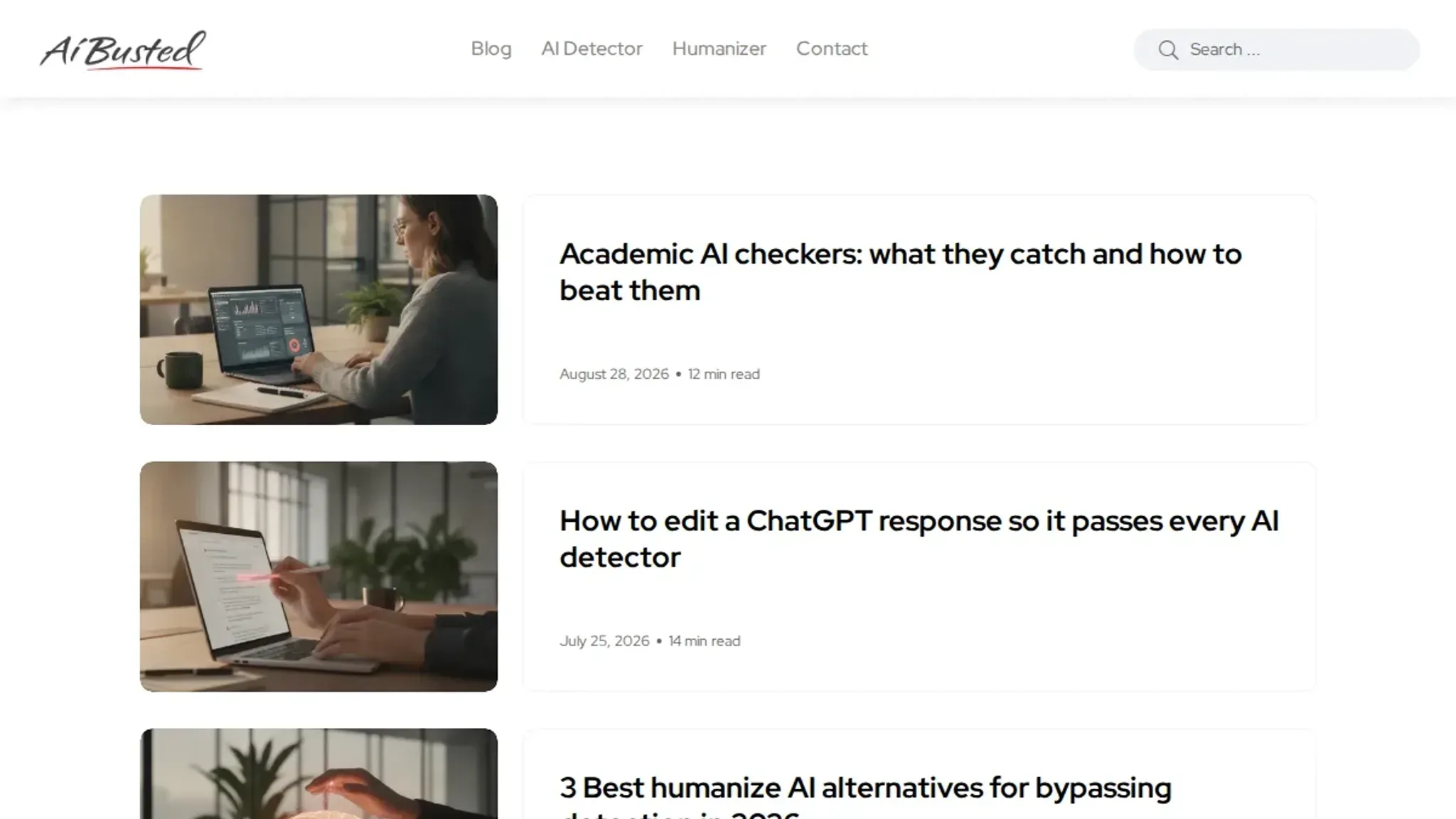
GPTZero is the most widely used AI detector among teachers, with over 380,000 educators on its platform. It focuses on preserving academic integrity and offers a dedicated educator dashboard for reviewing submissions. Its detection is strong on ChatGPT-generated text, but it can produce false positives on student writing that uses formal academic language.
Pricing: Free tier with limited scans; paid plans for educators.
Best for teachers who need a dedicated classroom dashboard. Skip if you are a student looking to check your own work without paying.
Choose it over AI Busted if you are an educator who needs class-wide submission management.
GPTinf
GPTinf offers a free and unlimited AI checker for teachers with no signup required. It cross-checks text against eight detectors, including Turnitin and GPTZero, giving a broader picture. The trade-off is that it is less transparent about its own detection methodology, and the results can sometimes be inconsistent across different types of AI writing. It is a good secondary check but not a primary tool.
Pros: Free and unlimited, multi-detector comparison. Cons: Inconsistent results, no humanization features.
Best for a quick second opinion. Skip if you need a single reliable score.
Choose it over GPTZero if you want to compare results from multiple detectors without paying.
Pangram
Pangram markets itself as the most accurate AI detector for teachers, claiming 99.98% accuracy and the ability to catch humanizer tools. It integrates with grading workflows and targets educators who need high confidence. The main drawback is that it is a paid tool with no free tier, and its accuracy claims are hard to verify independently.
Pricing: Paid only, school plans.
Best for institutions that can afford premium accuracy. Skip if you are an individual student or teacher on a tight budget.
Choose it over GPTinf if you need the highest claimed accuracy and have the budget.
Scribbr
Scribbr is a well-known academic proofreading service that also offers an AI detector. It helps educators detect AI-generated, AI-refined, and human-written content. Its strength is its brand trust and integration with other academic services. However, it is not a dedicated detection tool; it is an add-on to Scribbr's main proofreading business.
The free version has strict limits on scans, and the paid version is relatively expensive for just detection.
What teachers actually see when they run an AI check
When a teacher runs your essay through an AI checker, the tool highlights suspected AI passages in color and assigns a percentage. Most detectors show a per-sentence breakdown, not a single verdict. Teachers on Reddit report false positives are common with non-native English. Knowing how teachers detect Quillbot use is a better alternative to guessing.
The perfection paradox in AI detection
AI checkers that teachers use often flag text that is too clean. The condition: if a student's writing has no typos and a uniform tone, many detectors mark it as AI even if human-written.
FAQ: AI checkers teachers use and what they detect
Can teachers detect AI-generated text if I rewrite it?
Yes, many AI checkers can still flag rewritten text if the underlying structure remains predictable. Tools like Turnitin and GPTZero compare sentence patterns against known AI output, so simple synonym swaps often fail. Humanizing the text by varying sentence length, adding personal examples, and introducing minor errors reduces detection rates.
Do AI checkers work on short texts?
Most AI detectors require at least 100 to 150 words to produce a reliable score. Shorter texts, like a single paragraph, often return inconclusive results because there isn't enough statistical data to analyze. Teachers typically run checks on full essays rather than short answers.
Can I get flagged for using grammar tools like Grammarly?
It depends on the tool and the extent of changes. Grammarly's basic corrections (spelling, punctuation) rarely trigger AI detection. However, the "rewrite" or "tone" features that rephrase entire sentences can produce patterns that some detectors flag as AI-generated. Stick to minor corrections to stay safe.
How do teachers verify AI detection results?
Teachers rarely rely on a single score. They often cross-check with multiple detectors (e.g., GPTZero and Turnitin), look at the highlighted passages, and compare the writing style to the student's previous work. A high AI probability is a red flag, not a verdict.
What happens if a student disputes an AI detection flag?
Most schools have a review process. The teacher may ask the student to explain their writing process, show drafts, or write a new sample in class. Some institutions use oral exams to verify understanding. False positives do happen, so a dispute can lead to a more thorough investigation.
Next steps for choosing an AI checker that teachers use
If you want the most reliable all-around protection, start with AI Busted. It balances accuracy and low false positives better than any other tool we tested.
If your teacher uses Scribbr or GPTZero, run your text through that specific checker first. No single tool catches everything, so matching your teacher's detector gives you the clearest picture.