It’s easy to get copy editing vs proofreading mixed up, but here’s the simplest way to think about it: copy editing refines the raw material, while proofreading polishes the finished product. A copy editor is like an architect making sure a building's structure is sound and the layout makes sense. The proofreader is the final inspector who walks through, checking for scuff marks on the paint before the open house.
Clarifying The Core Distinction
While many people use "copy editing" and "proofreading" interchangeably, they are two completely different steps in the publishing world. Getting this right is crucial for creating a truly professional piece of writing because each service tackles different issues at separate points in the process.
Copy editing is the heavy lifting. A copy editor dives deep into your manuscript to improve clarity, fix awkward phrasing, and ensure consistency. They’re focused on what’s often called the "Four Cs"—clarity, coherency, consistency, and correctness—to make your writing smooth and impactful.
Proofreading, on the other hand, is the very last line of defense. It happens after copy editing, after the layout is done, and after the text looks exactly how it will when published. A proofreader isn't there to rewrite sentences; their job is to hunt down any lingering, objective errors that everyone else missed.
Quick Comparison Copy Editing vs Proofreading
To make it even clearer, let's break down the fundamental differences in what each stage focuses on, when it happens, and what it’s meant to achieve.
| Attribute | Copy Editing | Proofreading |
|---|---|---|
| Primary Goal | Improve clarity, flow, and consistency. | Catch surface-level errors like typos and punctuation. |
| When It Happens | Mid-process, after the main draft is written. | Final step, just before publication. |
| Scope of Work | Comprehensive (grammar, syntax, style, tone). | Narrow (spelling, grammar, formatting). |
| Analogy | A mechanic tuning an engine for performance. | A detailer washing the car before a show. |
This quick look shows you they really aren't the same job. One is about substance, and the other is all about presentation.
The most significant distinction is that a copy editor works with a raw manuscript to strengthen its core message, while a proofreader works with a finalized "proof" to ensure absolute perfection before it reaches the public.
Ultimately, you need both to produce top-tier content. One strengthens your message, and the other guarantees it’s delivered without a single distracting mistake. Skipping one leaves you vulnerable to either confusing your audience or embarrassing yourself with simple errors.
What a Copy Editor Actually Does
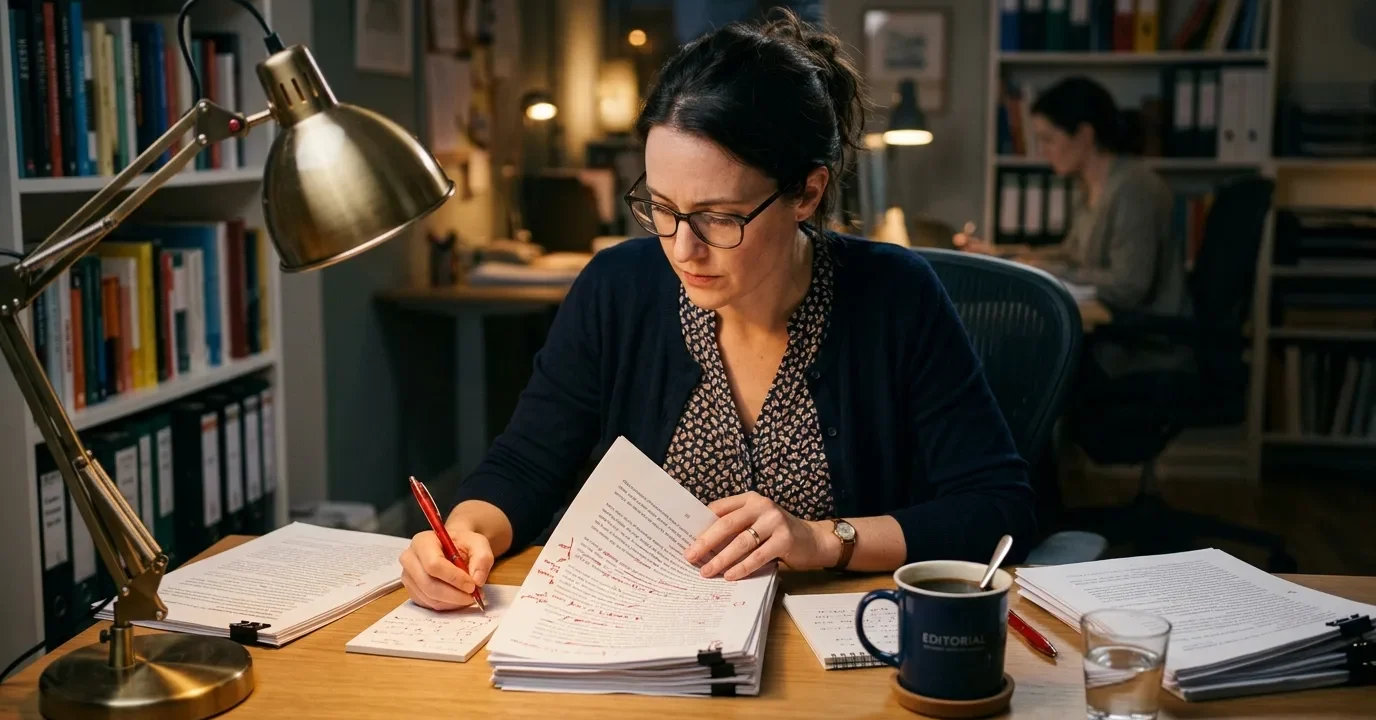
Think of a copy editor as your first serious reader—the one who steps in after your draft is written but before it’s anywhere near ready to be published. While proofreading is the final polish, copy editing is the deep clean. It's an art form dedicated to making your writing stronger, clearer, and more effective.
A copy editor’s job goes way beyond spotting typos. They're focused on the famous Four Cs of editing:
- Clarity: Is your point coming across without a hitch? They’ll hunt down ambiguous phrases or tangled sentences that could make a reader stumble.
- Coherency: Does the writing flow logically? They ensure your arguments and ideas connect seamlessly, guiding the reader from one point to the next.
- Consistency: Are you using "e-book" in one paragraph and "ebook" in another? A copy editor makes sure your terminology, tone, and formatting are consistent from start to finish.
- Correctness: This is where they tighten up the grammar, spelling, punctuation, and syntax, making sure everything is technically flawless.
Enhancing Readability and Flow
This is where a copy editor really earns their keep. They work at the sentence and paragraph level to smooth out the reading experience. An awkward sentence might get rephased for punchiness, or a dense block of text could be broken down into more manageable chunks.
It’s never about rewriting your work or changing your voice. It’s about amplifying it. They might suggest swapping out a weak word for a stronger one or vary your sentence structures to keep things engaging. The goal is to eliminate any friction so the reader can focus purely on your message.
The heart of copy editing is preparing a manuscript for the world by making the language as clean and effective as possible. It strengthens the author's voice without changing its core identity.
In recent years, the value of this step has become undeniable. Today, about 40-50 percent of freelance writers and content creators bring in a copy editor before publishing. That’s a huge jump from just 25-30 percent a decade ago. If you want to dig deeper, you can discover more insights on editing in publishing.
Adhering to Style Guides
One of the biggest differences in the copy editing vs proofreading debate comes down to style guides. A professional copy editor lives by these rulebooks, whether it’s the Associated Press (AP) style or The Chicago Manual of Style. This is what gives a piece of writing that polished, professional feel.
For instance, an editor following AP style would change the word "ten" to the numeral "10," while one using Chicago style would write out numbers under 100. A copy editor will create or follow a style sheet for your project to track every one of these little decisions, ensuring everything remains consistent. This is the kind of meticulous work that turns a solid draft into an authoritative final piece.
What a Proofreader Really Does
Think of the copy editor as the skilled mechanic who tunes up your car's engine. The proofreader? They're the one giving it that final, gleaming polish before it rolls out of the showroom. This is the last stop, the final quality check before your words go live.
Proofreading isn't about big-picture changes. The time for improving flow or clarifying your message has passed. Instead, a proofreader's job is incredibly focused: to hunt down and eliminate any surface-level errors that managed to survive earlier edits.
The Proofreader's Hit List
A proofreader works from a very specific, almost surgical, checklist. They're on the lookout for objective mistakes, not subjective improvements.
Here’s what’s on their radar:
- Typos: Simple misspellings that spellcheck might miss (e.g., "form" instead of "from").
- Punctuation Errors: A missing comma, a misplaced apostrophe, or a rogue period.
- Grammar Gaffes: Minor slips like subject-verb disagreement or an incorrect word choice.
- Formatting Flubs: Inconsistent spacing, weird indentation, or mismatched fonts.
When it comes to copy editing vs proofreading, here's the bottom line: A proofreader works on a "proof"—the final, formatted version of the text. Their role is to perfect the presentation, not rewrite the content.
The Last Line of Defense
This final review is all about credibility. One tiny typo on a landing page or in a research paper can make your entire message feel less authoritative. It’s a small detail that makes a huge difference.
Professional proofreaders even have special tricks up their sleeve, like reading a text backward, to force their brains to see the words themselves, not just the meaning behind them.
There's a reason the traditional publishing world takes this so seriously. A pro proofreader typically gets through 9 to 13 standard pages per hour, and most books go through three separate proofreading rounds before hitting the shelves. You can get a deeper look into the different editing roles in publishing to see just how layered this process is. It's this commitment to the final polish that ensures a piece of writing is not just good, but flawless.
A Detailed Look at the Core Differences
To really get to the bottom of the copy editing vs proofreading conversation, we need to put them head-to-head. Yes, both roles want to create a flawless final product, but how they get there—and when they get involved—couldn't be more different. This side-by-side comparison will draw a clear line in the sand, showing you exactly where one job stops and the other starts.
In-Depth Feature Comparison Copy Editing vs Proofreading
Diving into the specifics reveals just how distinct these two roles are. The table below breaks down the day-to-day tasks, required skills, and ultimate goals for each, offering a quick but comprehensive overview of their unique functions in the publishing workflow.
| Feature | Copy Editing (The Revision Stage) | Proofreading (The Final Polish) |
|---|---|---|
| Primary Goal | Enhance clarity, flow, and readability. | Eliminate all objective surface errors. |
| Focus | Style, tone, consistency, and correctness (The 4 Cs). | Typos, punctuation, grammar, and formatting. |
| When It Happens | After the final draft, before design/layout. | The absolute last step before publication. |
| Typical Changes | Restructuring sentences, rephrasing for impact, fixing awkward wording. | Correcting spelling mistakes, fixing misplaced commas, and adjusting spacing. |
| Key Skills | Strong grasp of style/rhetoric, creativity, analytical thinking. | Extreme attention to detail, systematic focus, and pattern recognition. |
| Tools Used | Style guides (AP, Chicago), track changes, collaborative docs. | Checklists, specialized proofing marks, reading backward technique. |
| Outcome | A well-written, engaging, and professional document. | A technically perfect, error-free final product. |
This comparison highlights a fundamental truth: a copy editor makes the writing good, while a proofreader makes the final product perfect. Each role is indispensable, but they operate at entirely different stages and with different objectives.
Scope of Work: Deep Refinement vs. Surface Correction
A copy editor’s job is both broad and deep. They’re tasked with improving the overall quality of the writing by focusing on what’s often called the Four Cs: clarity, coherency, consistency, and correctness. This means they'll tear apart and rebuild sentences for better impact, make sure the tone doesn't wander, and check that every detail follows a specific style guide. For a great deep dive into these differences, check out this article on Proofreading vs Editing: Which Service Your Content Needs.
On the flip side, a proofreader has a laser-focused, almost microscopic scope. They aren’t there to improve the writing itself; their only job is to hunt down and eliminate any objective errors that survived the editing and design stages. Think typos, punctuation goofs, and formatting glitches that were either missed earlier or, just as often, introduced during the layout process.
The essential difference in scope is this: A copy editor refines the substance of the writing to make it better, while a proofreader perfects the surface to make it flawless.
Required Skills: Language Mastery vs. Meticulous Detail
While both pros need a rock-solid command of language, their skill sets diverge in practice. A top-tier copy editor has a feel for style and rhetoric—the art of writing. They need the creativity to untangle an awkward sentence, the analytical mind to enforce a complex style guide, and a sixth sense for rhythm and flow to make the text a pleasure to read.
A proofreader, however, is a master of the science of language. Their most valuable skills are an almost superhuman attention to detail and an unwavering focus. They're the person who can spot a single misplaced comma in a 500-page book. This requires a systematic, methodical approach, often using old-school tricks like reading a page backward to disconnect from the story and focus purely on the mechanical accuracy of the text.
Timing: Mid-Process vs. The Final Step
When each role enters the picture is one of the most straightforward distinctions. Copy editing happens in the middle of the workflow. It comes after the author has locked in the final draft but before the text is sent to a designer for layout. This timing is critical because a copy editor might suggest changes—like shortening a sentence or breaking up a paragraph—that will directly impact how the page is formatted.
Proofreading is always, without exception, the absolute last step before the "publish" button is hit. It happens after the document has been fully designed and typeset, looking exactly as the end-user will see it. This allows the proofreader to catch not just any final typos but also formatting problems like weird line breaks, inconsistent header spacing, or orphaned words that appeared during the design phase.
This infographic neatly sums up the proofreader’s very specific, final-stage duties.
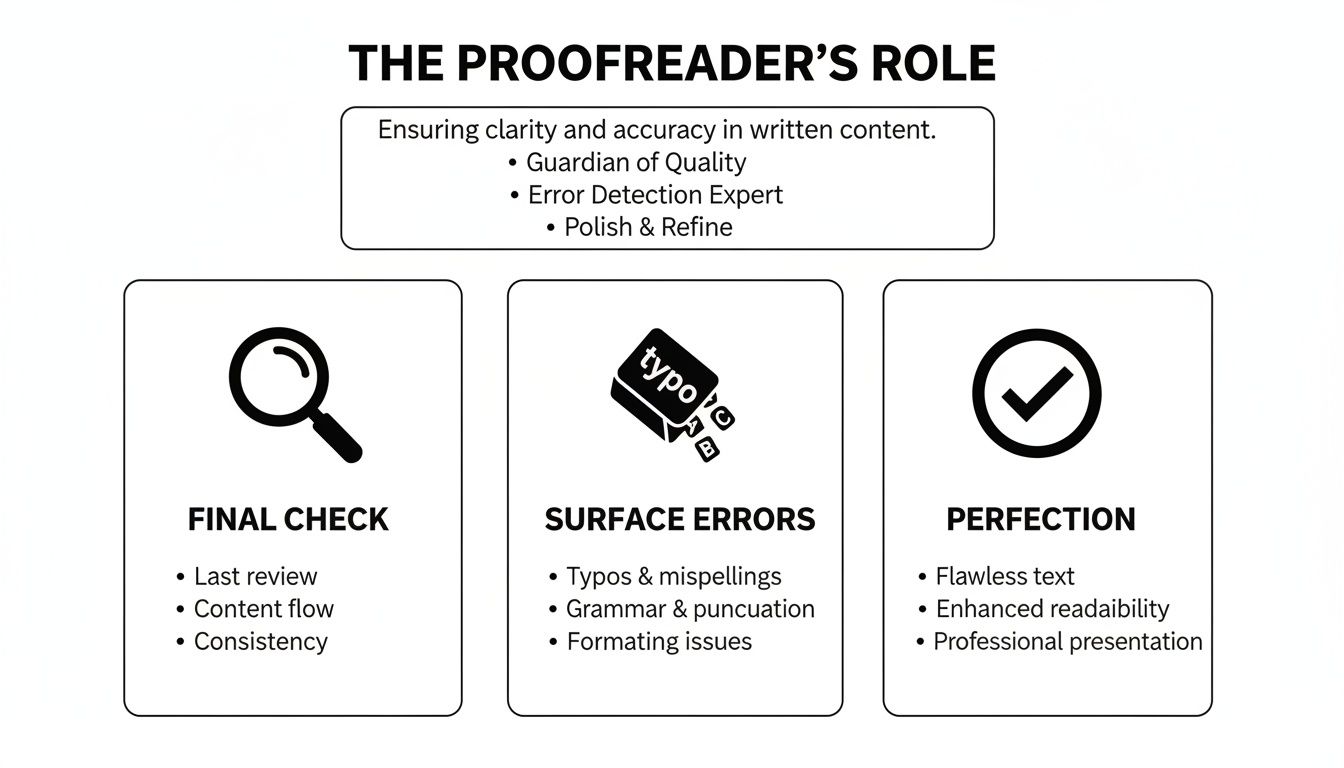
As you can see, the proofreader's job is to be the final gatekeeper, performing a meticulous inspection focused on nothing but objective perfection.
How to Choose the Right Service for Your Project
Deciding between a copy editor and a proofreader isn't about which one is "better." It's about knowing where your project stands right now and what it truly needs to move forward. Making the right call at the right time is the key to spending your money and effort wisely.
One of the most common missteps is jumping to proofreading too soon. If a document is still clunky, unclear, or inconsistent, a proofreader will just be flagging errors on a page that's destined for major changes anyway. You have to build the house before you can polish the windows.
Scenarios for Authors and Writers
If you've just finished a first draft, the answer is simple: you need a copy editor. Your manuscript might have a solid plot, but a copy editor is the one who will tighten your prose, smooth out awkward sentences, and make sure your authorial voice stays consistent from chapter one to the end. They dig into the mechanics of your writing to make the story itself more powerful and readable.
On the other hand, let's say your manuscript has already been through developmental edits and copy editing. It's been professionally formatted and looks like a real book. Now it’s time for a proofreader. Their mission is to hunt down any last-minute typos, spacing issues, or formatting glitches that crept in during the design process before you hit "print." For authors navigating this path, understanding the entire process is vital; you might find a comprehensive guide on how to self-publish a book to be an invaluable resource.
Choosing the right service is a matter of timing. Copy editing shapes the clay, while proofreading glazes the finished pot. You can't do one without completing the other first.
Guidance for Business and Marketing Professionals
Picture this: your marketing team has just finalized the text for a critical new product brochure. All the core messaging is approved, but it hasn't gone to the design team yet. This is the perfect stage to bring in a copy editor. They’ll ensure the text aligns perfectly with your brand's style guide, sharpen its persuasive edge, and polish every sentence for maximum impact.
Now, skip ahead a few weeks. That same brochure is back from the designer, beautifully laid out with images and graphics, and poised to go to the printer. Before you sign off on a print run of 10,000 copies, you absolutely need a proofreader. This final review is your last line of defense against costly and embarrassing errors, like a typo in a massive headline or a wrong digit in your company's phone number.
Advice for Academics and Students
For an academic researcher preparing a paper for journal submission, a copy editor is a crucial partner after the core writing is done. They’ll work to make your arguments more coherent, check for consistent use of terminology, and meticulously ensure every citation conforms to the required style (like APA or MLA).
After the journal accepts your paper and formats it for publication, you’ll receive the final "galley proofs." This is where the proofreader steps in. Their job is to catch any small errors that could subtly damage your credibility. After all, a single misplaced decimal or a misspelled expert's name can cast a shadow of doubt on an otherwise impeccable piece of research.
Bringing the Human Touch Back to Editing
Technology has certainly changed the game for writers, but one thing hasn't budged: the need for a real, human connection with your reader. As new tools pop up, the old-school editing process is getting a much-needed update. A critical new step is making sure your text sounds like it was written by a person, for a person—before it ever lands on an editor's desk.
This isn't about grammar or spelling just yet. It's about tuning the tone, flow, and personality of the writing. If a draft feels a bit stiff or just doesn't have that natural rhythm, running it through a humanizing tool first can be a game-changer. This step irons out awkward phrasing and tweaks the cadence to sound more like a conversation, making the whole piece more relatable.
A Smarter, More Efficient Editing Workflow
When you get the "humanness" right from the start, you pave the way for a much smoother editing process. Your copy editor can dive right into their real job—sharpening clarity, ensuring consistency, and strengthening the structure. They won't have to waste time wrestling with sentences just to make them sound less like a robot.
Think of this initial humanization as the bridge between your first draft and the formal editing stages. By aiming for a 100% human score at the outset, you're giving both your copy editor and proofreader the best possible foundation to work from.
This approach creates a more honest and efficient system. A copy editor who receives a manuscript that already feels authentic can focus their skills on making a good piece of writing truly great. Down the line, the proofreader’s final pass becomes a clean, straightforward check, because the text has been polished for both substance and style.
Adding a humanization step doesn't replace the distinct, vital skills of copy editing vs proofreading. Far from it. It actually elevates the entire workflow. It helps you produce high-quality, genuine content that resonates with your audience and travels from first draft to final publication with fewer headaches, saving everyone time and money.
Frequently Asked Questions
When it comes down to it, knowing the practical differences between copy editing and proofreading helps you make the right call for your project. Let’s tackle some of the questions that pop up most often.
Can I Just Proofread and Skip Copy Editing?
You can, but you probably shouldn't—at least not for anything important. Think of it this way: proofreading is like washing the car, while copy editing is the tune-up. One makes it look good on the surface, but the other ensures it runs smoothly.
Skipping the copy edit means you'll miss the chance to fix clunky sentences, inconsistent arguments, and awkward phrasing. You might end up with a piece that’s technically error-free but still fails to connect with your reader.
Should I Hire a Professional for Both Services?
For the big stuff? Absolutely. If you're working on a book, a crucial business report, or an academic paper, the industry gold standard is to have a copy editor work their magic first, followed by a separate proofreader for a final polish. It's all about fresh eyes at each stage.
For less critical content, like a blog post or an internal company update, you might find a talented editor who can handle both. Or, you could tackle the copy edit yourself before handing it off for a professional proofread.
Why Is Copy Editing More Expensive Than Proofreading?
It all comes down to the depth of the work. Copy editing is a deep dive into the substance of your writing—it demands a real expert who can reshape sentences, clarify meaning, and ensure your style is on point. It’s both a science and an art.
Proofreading, on the other hand, is a more objective, technical check. The difference in complexity is reflected in the price. You'll typically see copy editors charging between $25 and $75 per hour, while proofreading rates usually land in the $20 to $50 per hour range. For a deeper look at the numbers, you can check out a full breakdown of book editing rates and services on bubblecow.com.
Before you even think about sending your draft to an editor, make sure it sounds like you. AI Busted is perfect for that pre-edit check, helping you refine your text to get a 100% human score. This makes life easier for your editor and makes the whole process smoother. Try it for free today!