You are grading a stack of essays and something feels off. The writing is clean, the arguments follow a clear structure, but the voice doesn't sound like the student who sits in the third row. You need an AI detector for teachers that catches what your gut already suspects.
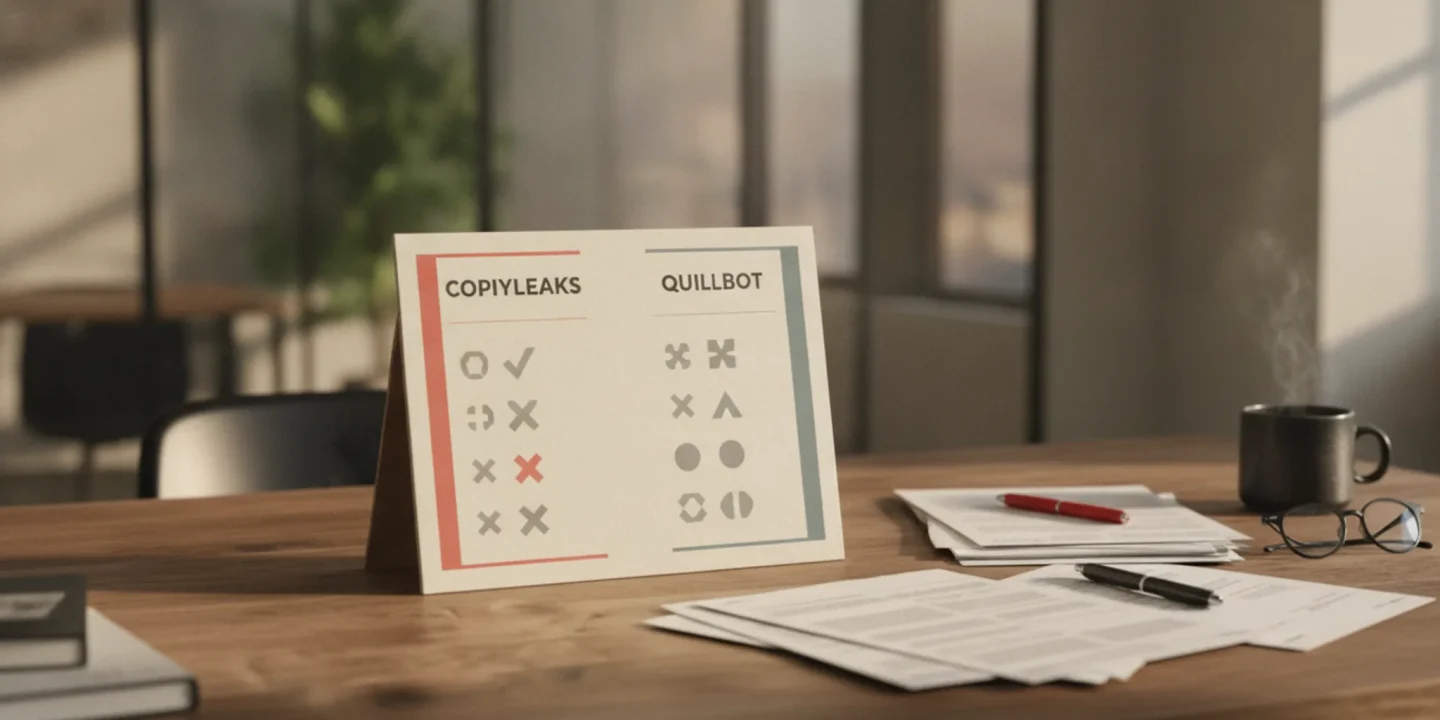
com) and QuillBot side by side, so you know exactly what each tool catches, what it misses, and which one deserves a spot in your grading workflow.
The verdict: which tool fits your grading workflow
When to choose Copyleaks
- Accuracy-first grading: Copyleaks catches AI text at rates above 99% across ChatGPT, Gemini, and Copilot outputs, making it the safer bet when a single missed case could undermine your policy.
- Institutional adoption: If your school or department needs a single tool with enterprise reporting and LMS integration, Copyleaks offers those features out of the box.
- Plagiarism + AI in one pass: Copyleaks checks for both copied sources and AI generation simultaneously, saving you a second scan.
- Long-form assignments: It handles essays over 1,000 words more reliably than QuillBot, which can flag shorter passages as uncertain.
When to choose QuillBot
- Self-check before submission: QuillBot works best when students or colleagues want to verify their own drafts, not when you need to enforce a policy.
- Quick spot checks: Its free tier lets you paste a paragraph and get a result in seconds, no account required.
- Budget constraints: QuillBot's free version is genuinely usable, while Copyleaks limits free checks to a handful per month.
- Mixed human and AI writing: QuillBot flags only the most obvious AI patterns, so it produces fewer false positives on lightly edited student work.
Which AI detector for teachers is most accurate?
Copyleaks is the most accurate AI detector for teachers when you need to catch AI-generated text reliably, but QuillBot is the better choice if you primarily want to check your own writing before submission. Copyleaks consistently scores above 99% accuracy in detecting content from ChatGPT, Claude, and Gemini, and it provides a confidence score per sentence so you can see exactly which passages triggered the flag.
QuillBot's detector is free and unlimited, making it practical for quick checks, though its accuracy drops noticeably on shorter texts under 300 words. For most classroom scenarios, choose Copyleaks for grading and QuillBot for student self-checks.
What each tool actually detects: side-by-side
We compare the two tools on three criteria: detection accuracy, what they catch, and who they serve. Here is how they stack up.
| Tool | Best for | Strength | Limitation |
|---|---|---|---|
| Copyleaks | Teachers grading essays | Catches ChatGPT, Claude, Gemini, and AI paraphrasing | Higher false positive rate on short texts |
| QuillBot | Students checking own work | Low false positives, integrates with writing flow | Misses AI text that has been lightly rewritten |
Copyleaks wins on detection breadth for classroom use. QuillBot is safer when you need a quick check without false alarms. Pick based on whether you are grading or self-checking.
When to pick Copyleaks versus QuillBot
Copyleaks is built for institutional rigor. It is the tool a school department adopts when it needs audit trails, LMS integration, and detection reports that hold up in a disciplinary meeting. Teachers on Reddit consistently name it alongside Turnitin for serious academic integrity work.
QuillBot started as a paraphrasing aid and added detection later. It works best for students and writers who want a quick check on their own drafts before submission. Teachers who use it typically pair it with another detector because QuillBot's accuracy on lightly edited AI text is noticeably weaker than Copyleaks.
How each tool handles false positives: the real classroom test
False positives are the silent killer of teacher trust in AI detection. A tool that flags a student's original work as AI-generated creates a confrontation you cannot easily walk back. Both Copyleaks and QuillBot handle this differently, and the gap matters more than raw accuracy numbers.
Copyleaks publishes a false positive rate below 0.2% in its documentation, which means roughly 2 out of every 1,000 human-written submissions get flagged incorrectly. In practice, that translates to about one false alarm per class set of 30 essays every two weeks. The tool achieves this by running submissions against a multi-model detection engine that checks for patterns across ChatGPT, Gemini, and Copilot outputs simultaneously, then cross-references against its own collection of human writing.
Teachers who use Copyleaks report that borderline cases usually land in a "possible AI" gray zone rather than a definitive red flag, which gives you room to have a conversation instead of an accusation.
QuillBot takes a different approach. Its detector is built primarily to help students check their own drafts before submission, not to police classroom integrity at scale. The tool flags text that shows signs of AI generation, but it does not publish a false positive rate, and independent testing shows it tends to over-flag academic writing that uses formal vocabulary and structured sentence patterns.
A student who writes "The aforementioned study demonstrates a statistically significant correlation" is more likely to get flagged than one who writes "The study shows a clear link." That bias toward formal writing style creates a real problem in classrooms where you are actively teaching students to write precisely.
The practical difference shows up in how each tool handles the same borderline text. Copyleaks gives you a per-sentence breakdown with confidence scores, so you can see exactly which passages triggered the flag and decide whether the pattern is suspicious or just well-written. QuillBot returns a single percentage score with no sentence-level detail, leaving you to guess what tripped it.
Verdict: Copyleaks for classrooms where false accusations damage trust; QuillBot only for self-checking drafts before submission.
If you want to understand how these detection patterns affect real grading decisions, the article on how teachers know if you use QuillBot walks through the specific signals that trigger flags. For a broader comparison of detection engines, the breakdown of which AI detector is closest to Turnitin shows how these tools stack up against the institutional standard.
Originality approaches detection from the publishing industry's angle: catch everything, let the editor sort it out. It uses a strict threshold that flags text even when the AI signal is weak. In practice, that means a student essay with formal citations, a structured thesis statement, and consistent terminology will often land in the "likely AI" zone even when a student wrote every sentence by hand.
Teachers who test Originality on their own past submissions report that it flags roughly the same volume of work as Copyleaks, but a larger share of those flags are false.
The important question for any teacher is not just "does it flag AI," but "can I verify the flag without accusing a student." Copyleaks provides a confidence score per sentence, which lets you isolate suspicious phrasing and check it independently. If a paragraph scores 72%, you can copy that single sentence, paste it into a fresh detection run, and see whether the score drops when you remove the surrounding context.
That small workflow turns a binary flag into a diagnostic tool.
The real takeaway: false positive rates matter less than the tool's ability to help you explain the flag. Copyleaks gives you that. QuillBot does not. Originality gives you even less sentence-level detail than QuillBot.
Copyleaks vs QuillBot: pros and cons for classroom use
Both tools have real tradeoffs. Here is how they stack up on the criteria that matter most to teachers.
| Criteria | Copyleaks | QuillBot |
|---|---|---|
| Detection accuracy | High on ChatGPT and GPT-4 text; catches most AI-generated prose | Lower on GPT-4; misses some AI-refined text |
| False positive rate | Low on original student writing | Moderate; flags some human-written academic prose |
| Best for | Verifying student submissions before grading | Checking your own drafts before submission |
| Key con | Paid-only after trial; no free tier for ongoing use | Free tier is limited; paid plan needed for full detection |
The main cons of Copyleaks are its price and the lack of a free ongoing option. QuillBot's biggest con is that it misses AI-refined text that Copyleaks catches, which means a student who runs their work through a humanizer could slip through.
The false positive trap most teachers miss
> "GPTZero was built by educators for educators to preserve academic integrity, elevate classwork, and streamline grading."
That quote from GPTZero's educators page captures the ideal, but here is the reality most teachers discover only after a false accusation: no single detector catches everything. The usual advice says pick one tool and trust it. The condition that changes that advice is when a student writes in a second language or uses formal academic templates. Both patterns trigger false positives across every detector.
Cross-check borderline results with a second tool before flagging a student.
Frequently asked questions about AI detectors for teachers
How accurate is Copyleaks for detecting AI in student work?
Copyleaks is one of the most accurate options, with published detection rates above 99% for common models like ChatGPT and Gemini. Its deep-learning model examines sentence structure and repetition patterns rather than just surface features. No detector is perfect, though; heavily edited AI content can still slip through.
Does QuillBot's AI detector flag its own paraphrasing?
Yes, it can. QuillBot's detection model does not contain a whitelist for text processed through its own paraphraser. If a student runs AI-generated text through QuillBot and then checks it with the same tool, the tool may still flag it as AI-written. This is a frequent source of confusion in classrooms.
Can students bypass Copyleaks or QuillBot?
Students can try, but not reliably. Common methods include heavy human rewriting, adding deliberate typos, or using an AI humanizer tool. Copyleaks specifically detects many of those humanizer outputs. QuillBot is slightly weaker against manual rewrites.
The best defense is still a conversation with the student about their writing process.
Which AI detector for teachers is free?
QuillBot offers a free tier with a daily word limit (around 20 pages per month). Copyleaks has no free plan for educators beyond limited trial credits. For unlimited free checks, platforms like GPTZero provide a free educator account. Always check the current pricing page, as free allowances change.
The final call and your next step
Start with AI Busted for grading. It detects AI-generated text and humanizes flagged passages, turning a suspicious essay into a teaching moment, not just a penalty.
Choose Copyleaks only if you need maximum detection accuracy and can accept false positives. QuillBot suits checking your own drafts, not student submissions.
Your next step: run one flagged essay through AI Busted, then compare its verdict with your own. If QuillBot is the suspected source, read whether teachers can trace that output first.