
It really boils down to this: good is an adjective that describes a noun (a person, place, or thing), while well is an adverb that describes a verb (an action). You have a good idea (describes the noun 'idea'), but you communicate that idea well (describes the action 'communicate').
The Core Difference Between Good and Well Explained
Knowing when to use "good" versus "well" is one of those subtle shifts that can instantly make your writing feel more polished and professional. While people swap them all the time in casual speech, their grammatical jobs are actually quite different—and thankfully, the rules are easy to get a handle on.
The main principle is simple: adjectives modify nouns, and adverbs modify verbs. Think of "good" as the word you use to describe things, people, or places. For instance, you might talk about a good book, a good friend, or a good neighborhood.
On the flip side, "well" is an adverb used to describe how an action is done. It answers the question, "How?" The team performed well. The car runs well. He speaks well. In each case, "well" is telling us about the quality of the action.
This handy decision tree breaks down the choice into a simple question: what are you trying to describe?
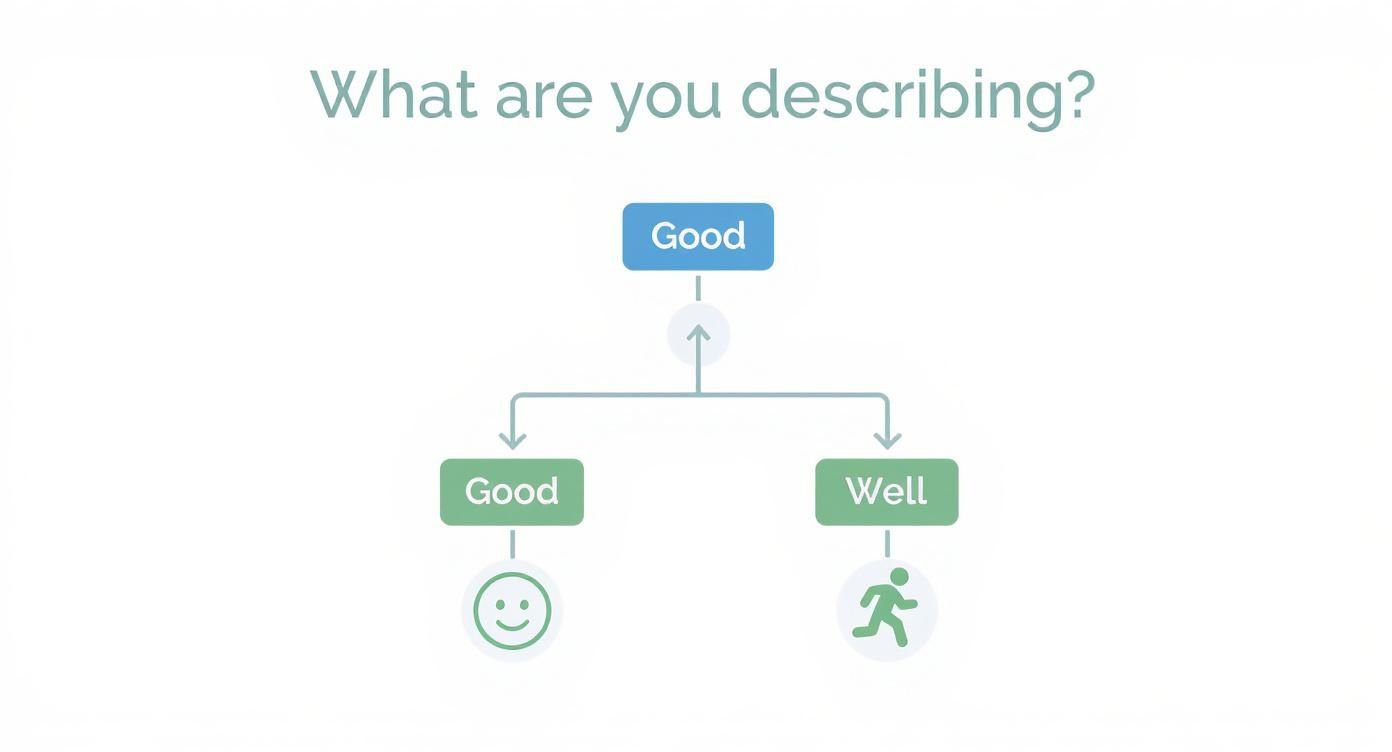
As the flowchart shows, the path is clear. If you’re modifying a noun (like a feeling), "good" is your word. If you're describing an action (like running), you'll want to use "well."
Good vs Well At a Glance
For a quick reference, this table breaks down the fundamental roles these two words play in a sentence.
| Attribute | Good | Well |
|---|---|---|
| Part of Speech | Adjective | Adverb |
| What It Describes | Nouns (people, places, things) | Verbs (actions) |
| Question It Answers | "What kind?" | "How?" or "In what manner?" |
| Example | "He has a good idea." | "He communicates his idea well." |
Keep this little table in mind, and you'll find yourself making the right choice without even thinking about it.
Mastering Adjectives and Adverbs in Your Writing
To finally get a handle on "good" vs. "well," you have to go back to the basic jobs these words do. The whole thing really just boils down to understanding two fundamental parts of speech: adjectives and adverbs. Once you get the hang of their roles, picking the right word becomes second nature instead of a constant guessing game.

Think of adjectives as words that paint a picture. They add detail and flavor to nouns—the people, places, and things in your sentences. Good is a perfect example of an adjective. It answers the question, "What kind?" You can have a good book, a good idea, or a good friend.
Adverbs, on the other hand, are all about action. They describe how something is done, modifying verbs, adjectives, or even other adverbs. Well is your go-to adverb here. It tells you about the manner of the action. Someone might sing well, a machine could run well, or a team might work together well. It’s all about the performance.
Figure Out What You're Describing
The simplest trick to choose between good and well is to identify what, exactly, you’re trying to modify. Just ask yourself one quick question: am I describing a thing or an action?
-
If you’re describing a thing (a noun), grab the adjective: good.
- Incorrect: The coffee smells well. (Coffee is a noun).
- Correct: The coffee smells good. (Good describes the coffee itself).
-
If you’re describing an action (a verb), you need the adverb: well.
- Incorrect: She presented her findings good. (Presented is a verb).
- Correct: She presented her findings well. (Well describes how she presented).
Here's a quick litmus test: If you can replace the word with another adjective like 'excellent' or 'positive,' you almost certainly need good. If you can swap it out for an adverb like 'skillfully' or 'effectively,' then well is your word.
This basic grasp of adjectives versus adverbs is the secret to getting it right every time. It moves you from just memorizing rules to actually developing an instinct for the right word. This kind of precision is what tools like AI Busted are designed to spot and refine, helping you smooth out these common slip-ups to achieve a 100% human score.
When to Use ‘Good’ With Linking Verbs
Just when you think you’ve mastered the rules, grammar throws you a curveball. The “good” versus “well” debate is a classic example, but the exception is actually pretty straightforward once you spot it. The secret is a special class of verbs known as linking verbs.
Unlike action verbs, which describe what something does, linking verbs simply connect a subject to its description. Think of them as a grammatical equals sign (=). Since they’re linking to a word that describes a noun (the subject), you need to use an adjective—and that’s where good comes in.
Take the sentence, "The plan looks good." The verb "looks" isn't an action; the plan doesn't have eyes. Instead, "looks" connects the subject ("plan") to a word that describes its state ("good").
How to Spot a Linking Verb
Getting familiar with linking verbs is the quickest way to get this right every time. They typically fall into a few categories related to our senses or general states of being.
Here are the most common ones you'll run into:
- Forms of 'to be': am, is, are, was, were
- Sensory verbs: look, sound, smell, taste, feel
- State of being verbs: seem, appear, become, remain
A Handy Trick: If you can swap out the verb for a form of "to be" (like is or are) and the sentence still holds its meaning, you've found a linking verb. For example, "The soup tastes good" makes perfect sense as "The soup is good." This tells you "good" is the correct choice.
This is exactly why saying "I feel good" is perfectly correct when talking about your emotional state. In that context, "good" is an adjective describing your state of being, not how you perform the action of feeling.
This connects to the broader idea of wellbeing. In fact, recent data shows global wellbeing is on the rise, with people rating their future life a median score of 7.2 out of 10 and 81% reporting satisfaction with their personal freedoms. You can dive deeper into these global wellbeing trends to see how feeling "good" is shaped by much more than just grammar.
Using Well Correctly for Action and Health
Now, let's switch gears and talk about "well." Its main gig is as an adverb, where it adds color and detail to a verb. It answers the question how?
When you say, "The team performed well under pressure," you're using "well" to describe how they performed. The presentation went well, the engine runs well, the student speaks well—in every case, "well" is modifying the action. It's all about performance and execution.
But "well" also has a second job that trips a lot of people up. It can be an adjective, but only when you're talking about someone's physical health. This is a crucial distinction that separates clear writing from clumsy writing.

Health vs. Happiness: The "Feel Good" vs. "Feel Well" Distinction
This is where things get interesting, and your word choice really starts to matter. Both of the sentences below are perfectly correct, but they mean entirely different things:
- "I feel good." This is about your emotional state. You’re happy, content, or feeling positive about something.
- "I feel well." This is strictly about your physical health. It means you aren't sick; you're in good shape physically.
Here’s a simple way to remember it: You might feel good about acing a test, but if you have a nasty cold, you definitely don't feel well. Grasping this nuance elevates your writing and shows you have a real command of the language.
The idea of "wellness" itself has grown far beyond just the absence of illness. The global wellness economy has exploded into a $6.8 trillion market, spanning 11 different sectors from mental health to wellness-focused real estate. You can dig deeper into the growth of the wellness economy to see just how much this word's cultural meaning has expanded.
Common Mistakes With Good and Well (And How to Fix Them)
Knowing the rules is one thing, but putting them into practice is where the real learning happens. Even seasoned writers can trip over the "good" vs. "well" distinction, especially since our conversational habits often sneak into our writing. Let’s walk through some of the most common slip-ups and see how to get them right.

One of the most frequent offenders involves talking about performance. You’ve probably heard—or even said—something like, "I did good on the presentation." It rolls off the tongue easily, but it’s a classic grammatical fumble.
The key is to look at the verb. "Did" is an action verb, and adverbs are what we use to describe actions. So, the correct word here is "well," which modifies how you did. A quick switch to "I did well" instantly sharpens your writing and makes it sound more professional.
Analyzing Common Errors
Seeing these mistakes in the wild is the best way to make the rules click. The table below breaks down a few common errors, showing not just the fix but the logic behind it. Each example reinforces a specific rule we've covered.
Common Error Correction Guide
| Incorrect Sentence | Correct Sentence | Reasoning |
|---|---|---|
| The team played good today. | The team played well today. | "Well" is the adverb needed to modify the action verb "played." |
| He doesn't hear too good. | He doesn't hear too well. | The adverb "well" correctly describes the action of hearing. |
| The new software runs good. | The new software runs well. | "Well" modifies the action verb "runs," describing its performance. |
Getting these right isn't about being a grammar pedant; it's about clarity. Choosing the correct word makes your meaning precise and gives your writing a polished, authoritative feel.
One phrase that trips everyone up is, "I'm doing good." While "I'm doing well" is the textbook answer for describing your health or condition, "doing good" has carved out its own meaning. It often implies you're involved in positive actions, like volunteering or charity work. Still, for any formal or professional setting, sticking with "I'm doing well" is the safest and most standard choice.
This is exactly the kind of nuance that sophisticated tools can help with. For example, the AI Busted tool is designed to spot these subtle but common errors. It can help you refine these phrases, ensuring your text flows naturally and correctly on its way to a 100% human score. It's all about closing the gap between how we talk and how we write for an audience.
Frequently Asked Questions About Good and Well
Even when you know the basic rules, a few tricky situations always seem to pop up. Let's tackle some of the most common questions about using "good" and "well" to clear up any lingering confusion.
Feeling Good vs. Feeling Well: What Is the Difference?
This is probably the most subtle and debated distinction between these two words. They might seem interchangeable when talking about how you feel, but they actually describe two very different things.
- "I feel good" is all about your emotional state. It’s the right phrase when you're feeling happy, pleased, or in high spirits. Think of it as describing your mood.
- "I feel well" points to your physical health. You’d say this when you aren't sick and feel physically healthy. It's the direct opposite of feeling ill.
So, you could easily feel good about getting a promotion at work while, at the same time, not feeling well because you have a nasty cold.
Is Saying "I Am Good" a Correct Answer?
Absolutely. Responding with "I am good" is perfectly correct, and it's something you hear every day. The key is to understand why it works.
In the sentence "I am good," the word "am" is a form of the verb "to be." Verbs like "to be," "to seem," or "to feel" are called linking verbs, and they connect the subject ("I") to a word that describes it. Since you're describing your state of being, the adjective good is the right choice.
While "I am well" is also grammatically sound, it often carries the specific meaning of being in good health.
Choosing the Right Word for Performance
When you need to describe how an action was done, the choice is simple: you have to use well. Performance is an action, and adverbs are the words we use to describe actions.
For example, "She did well on her exam" is correct because well is an adverb modifying the verb "did." It tells us how she performed. The common mistake is saying, "She did good on her exam." Since "good" is an adjective, it can't be used to describe a verb like "did."
A simple trick I've always used is to ask myself: am I describing a thing or an action? If it's the quality of a person, place, or thing (a good book, a good idea), use good. If it's about how something was done (the team played well, the engine runs well), use well.
This quick mental check helps you catch mistakes on the fly and ensures your writing comes across as precise and polished.