GPTZero vs Turnitin: Which AI Checker Fits Students Better?
Quick Answer
GPTZero is easier to try, but Turnitin matters more in real school workflows since universities use it inside submissions. Before you upload, run the paper through AI Busted to spot flagged lines and lower risk before Turnitin sees it.
What Is GPTZero vs Turnitin?
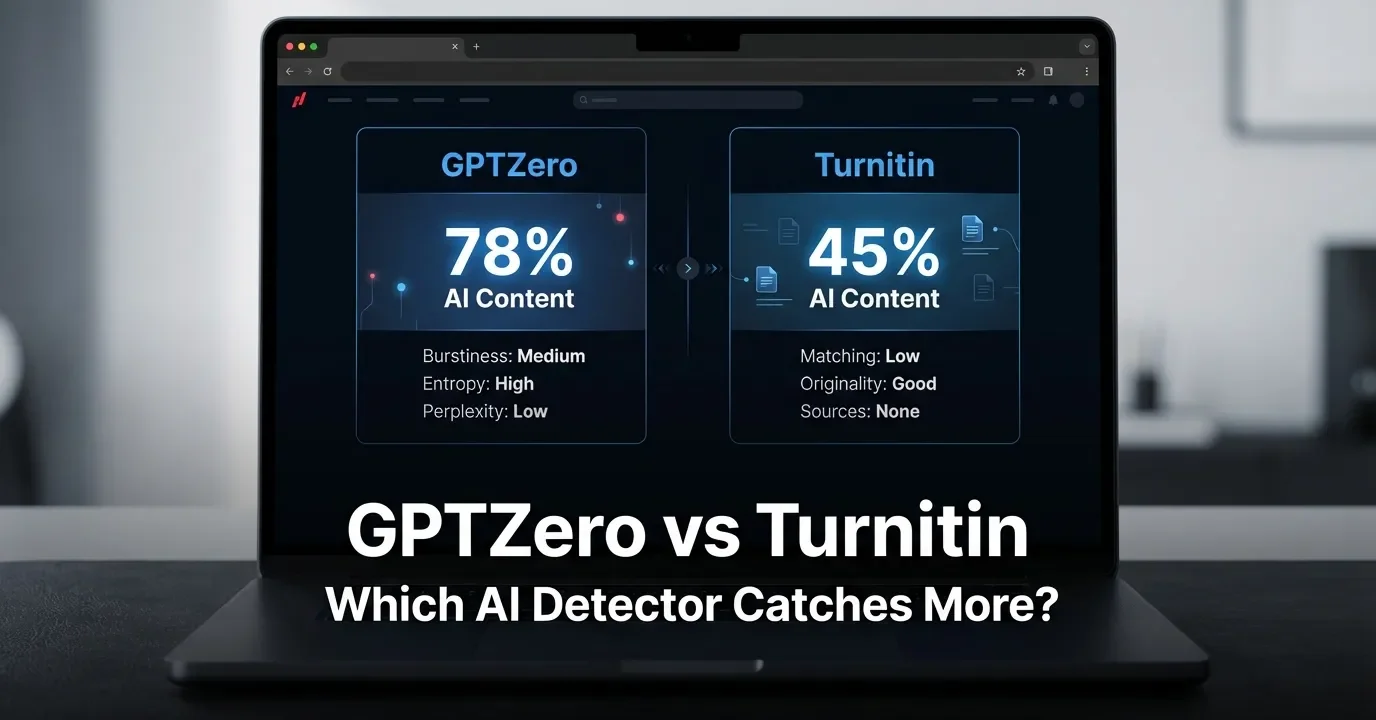
Two tools dominate AI writing identification: GPTZero and Turnitin. They are built for different people, and the difference in stakes is hard to overstate.
GPTZero launched in January 2023. Princeton student Edward Tian built it as a side project; it became one of the most-used AI writing checkers on the web. It runs a probability analysis and returns a sentence-level breakdown.
The base tier is free.
Turnitin has been a plagiarism checker since 1997. It added AI writing indicators in April 2023. Schools and universities pay for it.
Students do not choose to use it - they submit through it.
That gap matters more than any technical comparison. When GPTZero flags your writing, you can walk away. When Turnitin flags your submission, you may end up in front of an academic integrity committee.
How Does GPTZero Work?
GPTZero works from two signals.
The first is perplexity - how consistent each word is given the context around it. AI writing tends to be very consistent throughout: low perplexity, low variation.
The second is burstiness. Human writers mix their sentence lengths. Short ones, then longer ones that take their time. AI writing tends to march through at a consistent pace.
The tool returns an total AI probability score (0-100%), sentences marked as likely AI-written, and a batch upload option for teachers checking multiple documents.
According to GPTZero's own published data, its false positive rate sits below 1% on internal test sets. Independent researchers put it higher. Still, it sits among the lowest false positive rates of any major AI writing checker.
How Does Turnitin's AI Checker Work?
Turnitin analyzes text sentence by sentence, looking for patterns consistent with large language models. It returns a percentage: "18% of this document may contain AI-written text."
The tool only flags a sentence when its confidence passes an internal threshold. Results feed directly into Canvas, Blackboard, and Moodle - the LMS platforms your school almost clearly uses. It does not tell you which AI produced the text, just that the patterns match.
Students cannot opt out. If your institution licenses Turnitin, that is the end of the discussion.
Turnitin says the tool was built to minimize false positives. A 2023 investigation by The Guardian found otherwise - cases where it flagged original student work as AI-written, with misconduct proceedings that followed.How Do GPTZero and Turnitin Compare?
| Criteria | GPTZero | Turnitin |
| Primary use | Individual users, teachers, researchers | Institutions, LMS integration |
| Output format | Probability score + marked sentences | % of suspected AI text |
| Free tier | Yes | No - institutional license only |
| False positive rate | Lower (per published data) | Higher (more risk for non-native writers) |
| API access | Yes (paid plans) | Limited (institutional) |
| Best for | Checking before you submit | Institution-wide academic integrity |
| Limitation | Fooled by sentence variation | High-stakes output, limited appeal way |
Which Tool Has More False Positives?
False positives - flagging human writing as AI - are the most serious problem with both tools. The two tools do not have the same risk profile here.
GPTZero's own numbers claim under 1% false positives on their test data. Real-world reports suggest it runs higher, particularly for writing with consistent structure, bullet-point notes, and text from non-native English speakers.
Turnitin's false positive problem is better documented and carries worse consequences. A 2023 Stanford HAI analysis showed that AI writing checkers flag non-native English speakers at disproportionate rates. When that happens inside an academic misconduct workflow, a false flag is not a minor annoyance - it is a possible misconduct charge.
On False Positives in AI Writing Checkers GPTZero and Turnitin both produce false positives - cases where human writing gets flagged as AI. GPTZero reports a false positive rate below 1% on its own test data; independent testing puts it higher. Turnitin's false positive issue is documented by multiple universities and journalists: students have faced misconduct hearings for work they wrote themselves. A 2023 Stanford HAI analysis found that non-native English speakers are flagged at higher rates than native speakers across most AI writing checkers. Neither tool was designed to serve as sole proof of academic dishonesty. For instructors, both work best as screening signals - not verdicts. For students, running your work through a checker before submission is the most practical way to avoid surprises.
For a full breakdown of how reliable AI checkers are, the central finding holds: error rates are high enough to matter in any high-stakes setting.
Which One Is Easier to Pass?
Both tools can be beaten. GPTZero is more straightforward.
Since GPTZero cares about burstiness, vary your sentence lengths. Add personal examples. Write with irregular rhythm. A few minutes of that and the score drops.
It is not a hard problem to solve manually.
Turnitin is a different matter. Its sentence-level analysis does not move much with a few quick tweaks. You will often need a tool to get the score down.
If you need a pre-submission step, AI Busted makes more sense as the first stop. It lets you check how a text may read before Turnitin sees the file, which is the real pressure point for most students.
Word Spinner is a good second option when you want a rewrite-first pass. Its public site lists an AI Humanizer, Advanced Rewriter, Chrome Extension, 100+ languages, a plagiarism checker, a 5-day free trial, and an API. That can help after a flag-heavy text, but you still want a last check before upload.
| Tool | Best spot in this comparison | Best for | Main limit |
| AI Busted | First stop before submission | Checking text risk before a school upload | You still need to read the marked lines yourself |
| Word Spinner | Second stop for rewrite work | Users who want extension access, multilingual rewriting, or API use | It is a rewrite pass, not the final check |
When Should You Use GPTZero vs Turnitin?
If you are a student, the question mostly answers itself. If your school has Turnitin, you submit through it - there is no alternative. If you want to know how your work reads before you submit, GPTZero is free and takes about 30 seconds.
If you are a teacher or researcher, GPTZero is accessible and has API access on paid plans. Turnitin only makes sense at institutional scale with an existing license.
Run your work through GPTZero first as a rough preview. The two models are different - a clean GPTZero result is not a guarantee on Turnitin - but it gives you a baseline.
For a side-by-side look at the best AI content checker tools available today, AI Busted has tested over a dozen options with real writing samples.
FAQ: GPTZero vs Turnitin
Is GPTZero or Turnitin better at catching AI writing? Both catch standard GPT-4 output at comparable rates. Turnitin's false positive rate on human writing is higher, which matters more when the tool is embedded in academic misconduct workflows. GPTZero tends to be more conservative about what it flags.
Can I use GPTZero to preview my Turnitin result? Yes. GPTZero is free at the basic tier and gives a reasonable read on how your writing scores. The models differ - a 0% on GPTZero does not guarantee 0% on Turnitin - but it is a useful starting point.
Why does Turnitin flag my human writing as AI? Turnitin flags writing with low linguistic variation and repeated sentence patterns. Both can appear in human writing, particularly from non-native English speakers. Read the full breakdown at why AI checkers flag human writing.
Does paraphrasing beat Turnitin's AI checker? Light paraphrasing may cut the score a bit. Manual editing with real sentence variation works better. AI humanizer tools built against AI checkers tend to be more reliable than doing it by hand.
Does Turnitin catch Claude or Gemini writing, not just ChatGPT? Yes. Turnitin is not ChatGPT-specific - it looks for patterns common to large language models widely. Writing from Claude, Gemini, or other tools can be flagged.
Some AI tools produce output that is harder to catch than others. See how to get past AI checkers for practical notes.