
The best way to steer clear of AI detection isn't about finding a magic trick or some clever workaround. It's much simpler: infuse the text with your own voice, add real insights, and take the time to manually rework the structure and style. Think of AI as your brainstorming partner or a first-draft assistant, not the final author. This approach keeps you in the driver's seat and ensures your content is genuinely valuable and human.
Understanding Modern AI Detection

Let's get one thing straight about AI detectors. They aren't here to punish people for using technology to work smarter. Their real job is to filter out the predictable, low-effort content that clogs up the internet—the stuff that clearly lacks any human touch or added value. So, the goal isn't to "fool" a machine; it's to create high-quality, polished content that actually resonates with a human reader.
It's a common misconception that these detectors are perfect, but they’re far from it. They're notorious for false positives, sometimes flagging completely human-written text. This happens a lot with non-native English speakers or anyone who writes in a very formal, academic style. Once you know what these tools are looking for, you can learn how to write in a way that avoids those triggers without resorting to sketchy tactics.
What AI Detectors Actually Look For
At their core, AI detection tools are all about pattern recognition. They're trained to spot the statistical footprints that AI models leave behind—the little tell-tale signs that are common in machine writing but rare in human expression.
Here are a few of the biggest red flags they hunt for:
- Uniform Sentence Structure: AI often falls into a monotonous rhythm, churning out paragraphs where every sentence is roughly the same length and structure.
- Predictable Word Choice: Models tend to pick the most statistically likely word in a sequence. This is known as low "perplexity," and it results in text that's grammatically sound but utterly boring and devoid of surprise.
- Lack of Personal Voice: An AI can't share a personal memory, offer a truly unique opinion, or tell a compelling anecdote from experience. That absence of a human perspective is a dead giveaway.
- Overly Formal Tone: Raw AI output often sounds like a generic textbook. It’s usually stripped of the slang, humor, and emotional nuance that make human communication interesting.
The bottom line is this: human writing is beautifully imperfect. It has a natural cadence, variety, and a point of view. Raw AI text is often just too clean and predictable for its own good.
For a clearer picture, here’s a quick-reference table breaking down these common AI traits and how to fix them.
Key AI Text Indicators and Humanization Fixes
| Common AI Trait | Why It Gets Flagged | How to Humanize It |
|---|---|---|
| Consistent Sentence Length | Creates a robotic, unnatural rhythm that's easy for algorithms to spot. | Mix it up. Use short, punchy sentences alongside longer, more descriptive ones to create a natural flow. |
| Low Perplexity (Predictable Words) | The vocabulary is often safe and generic because the AI chooses the most common word. | Swap out generic words for more vivid, specific synonyms. Introduce idioms or unique phrasing. |
| Absence of a Unique Voice | Lacks personal stories, opinions, or a distinct personality, making it feel impersonal. | Inject your own anecdotes, opinions, and even humor. Write as if you're talking to a friend. |
| Perfect Grammar and Punctuation | While good, absolute perfection can be a sign of a machine. Humans make small, natural errors. | Don't be afraid of contractions (e.g., "it's," "don't"). Use sentence fragments for emphasis where appropriate. |
By actively looking for these traits in your AI-assisted drafts and manually editing them out, you naturally shift the content from robotic to human.
The Dark Side of Evasion
While our focus is on creating authentic content, it’s important to acknowledge that the same tech used to bypass detectors can be used for far more sinister purposes. The weaponization of AI in cybercrime has made it easier than ever for bad actors to execute sophisticated attacks.
Criminals are now embedding AI into every stage of their operations, from generating synthetic identities to creating deepfake videos that fool security systems. Their evasion tactics are incredibly advanced. Understanding this helps draw a clear ethical line for us as creators. Our goal is to create something undeniably authentic, not just to sneak past a tool.
To see how your own content stacks up, you can run it through a tool like the AI Busted detector. It helps you spot those robotic patterns before you hit publish, so you can refine your work with confidence.
Infusing Your Unique Voice and Experience

Here's the single most powerful way to make AI-generated content your own: inject what the machine simply doesn't have—you. An AI can’t share a personal memory, offer a genuinely original opinion forged from years of experience, or connect with a reader over a shared frustration. This is your ace in the hole.
Think of the raw AI text as a bland, gray blueprint. It gives you the structure, sure, but it's your job to splash on the color, add the texture, and fill it with a personality that brings the whole thing to life. This is where the real work of avoiding AI detection starts—not by trying to trick a tool, but by creating something that's genuinely valuable and unmistakably human.
The best way to begin is by treating the AI text as a rough draft. Read it out loud. Does it sound like something you would actually say in a conversation? If the answer is no, it's time to start translating it into your own voice.
Weave in Personal Stories and Anecdotes
Nothing dismantles that robotic AI feel faster than a good story. AI models are trained on mountains of impersonal data; they can’t just invent a credible, specific anecdote from thin air. This is your turf.
Let's say you're writing about productivity tools. An AI might spit out a generic paragraph about their benefits. To make it human, you could add a personal touch:
- Share a struggle: "I used to be drowning in a sea of sticky notes, with deadlines constantly slipping through the cracks. My desk looked like a chaotic paper storm until I finally committed to a digital task manager. It wasn't an overnight fix, but it forced a discipline I desperately needed."
- Tell a success story: "I remember the exact project that sold me on this system. We had a three-week turnaround for a major client, and by using shared boards and automated reminders, our team finished two days ahead of schedule. That would have been completely impossible with our old email-and-pray workflow."
These little narrative bits do more than just add flair. They build trust, make your content relatable, and instantly signal to both readers and algorithms that a real person is behind the keyboard.
Injecting just one or two relevant personal anecdotes can transform an entire article from a dry, informational piece into an engaging and authoritative guide. It’s the fastest path to authenticity.
Develop a Contrarian or Niche Viewpoint
AI models are built for consensus. They draw from the most common information they can find, which means their output is often mainstream, safe, and frankly, a little boring. You can shatter that pattern by introducing a unique or even contrarian perspective.
Instead of nodding along with every commonly held belief in your industry, challenge one. A bold, well-argued opinion is a hallmark of human critical thinking. An AI is programmed to hedge its bets, making this a powerful humanization technique.
For example, if the standard advice is to post on social media five times a day, your contrarian take could be:
"Everyone tells you to churn out content constantly, but that's just a recipe for burnout and mediocrity. I say do the opposite: post just twice a week, but make each one a deeply researched, high-value masterpiece. Quality trumps quantity every single time, and your audience will thank you for respecting their time."
This approach not only helps you stand out but also forces you to bring in original reasoning and evidence—qualities that AI struggles to replicate with any real depth. It's a core strategy for how to avoid AI detection while simultaneously building your authority.
Use Industry-Specific Jargon and Examples
AI-generated text often feels generic because it's trying to be understood by everyone. You can immediately counteract this by grounding your content in the specific language and context of your niche.
Sprinkle in the acronyms, terminology, and inside jokes that only people in your field would get. This is a powerful signal that you’re part of the community, not just an outsider with a search engine.
Let’s look at a quick before-and-after for a blog post aimed at software developers.
Generic AI Version:
"It is important to manage your project's code dependencies effectively to ensure stability. Using a package manager can help streamline this process and prevent conflicts between different software libraries."
Humanized, Specific Version:
"Let's be real, dependency hell is a rite of passage. If you've ever torched an afternoon wrestling with a broken node_modules folder, you know the pain. That's why mastering Yarn or npm isn't just a 'best practice'—it's essential for keeping your sanity and avoiding a catastrophic break in production."
The second version hits different, right? It uses specific terms (dependency hell, node_modules, Yarn, npm) and speaks to a shared, painful experience. It’s instantly more credible for the intended reader, and that specificity makes it far less likely to get flagged by a detection tool.
Advanced Editing for Structure and Style

Once you’ve injected your own voice and expertise, it’s time to look at the text’s architecture. This is where we get into the flow, rhythm, and structure of your sentences and paragraphs. AI models are masters of grammatically perfect but rhythmically boring text, and that uniform, predictable pattern is a huge red flag for detectors.
Your job here is to break that perfect machine-made structure. Think of yourself as a builder, deconstructing the AI's cookie-cutter blueprint and rebuilding it with a natural, human cadence. It’s less about just conveying facts and more about creating a piece of communication that someone will actually enjoy reading.
Master Sentence Variety and Rhythm
One of the dead giveaways of AI-generated content is its robotic sentence structure. AI loves to string together sentences of similar length and complexity, which creates a monotonous, marching beat. Human writing, on the other hand, is much more like music—it has a dynamic rhythm.
To fix this, you need to intentionally mix things up.
- Short, punchy sentences. Use these to make a point. They demand attention. They hit hard.
- Medium, descriptive sentences. These are your workhorses. They carry the main load of information and explain your concepts clearly.
- Long, flowing sentences. Weave these in to connect multiple ideas, show how different concepts relate, and add a bit of sophistication.
When you combine these different lengths, you create a natural ebb and flow that’s much tougher for an algorithm to spot. It’s like a real conversation; you don’t speak in a monotone, so why would you write that way?
Read your content out loud. Seriously. If it sounds boring or repetitive, it’s time to start chopping up, merging, and rewriting sentences until the rhythm feels right. A quick editing pass focused just on sentence length can make a world of difference.
Employ Literary Devices for a Deeper Connection
An AI can tell you what something is, but it rarely makes you feel it. This is where literary tools like metaphors, similes, and analogies become your secret weapons. These are hallmarks of human creativity, building a bridge between a tricky idea and a familiar experience.
Instead of just stating facts, paint a picture for your reader. For instance, rather than a dry explanation like, "AI detectors analyze text for statistical predictability," you could try an analogy:
"Think of an AI detector as a music critic who only knows one song. The moment it hears a different rhythm or an unexpected chord, it flags the music as 'wrong.' Your job is to be the composer who adds those surprising shifts in tempo and harmony, proving your writing is an original piece, not a pre-programmed track."
This approach does two things at once: it makes the concept stick, and it injects a creative flair that’s unmistakably human. An AI just doesn't think in these kinds of original, comparative terms on its own.
We see a darker side of this mimicry in the world of cybersecurity. Malicious actors are now using AI to craft incredibly convincing phishing attacks that evade detection. In fact, over 82% of phishing emails leverage AI, allowing scammers to generate fraudulent content up to 40% faster and at 95% less cost. This has led to a staggering jump in effectiveness, with AI-driven phishing campaigns boasting a 54% click-through rate, dwarfing the 12% from manual scams. As these attacks became easier to scale, phishing reports skyrocketed by 466% in early 2025 alone. You can read more about these findings in a study on the rise of AI in fraud on Sift.com.
To give you a clearer picture of these stylistic shifts, here’s a quick comparison of what to look for and how to fix it.
Comparison of AI vs Humanized Writing Styles
| Stylistic Element | Typical AI Output | Effective Humanized Version |
|---|---|---|
| Sentence Structure | Consistently medium-length, complex sentences. (e.g., "The system utilizes advanced algorithms to process data, which subsequently enables it to generate insights.") | A mix of short, punchy statements and longer, flowing explanations. (e.g., "The system uses advanced algorithms to process data. What does that mean? It can find hidden insights.") |
| Tone & Voice | Formal, neutral, and encyclopedic. Lacks personality. | Conversational, engaging, and authoritative. Reflects a specific point of view. |
| Word Choice | Relies on formal words like "utilize," "thus," "furthermore." | Uses simpler, more direct language. "Use," "so," and "and another thing." |
| Transitions | Formulaic transitions. (e.g., "In conclusion," "Moreover," "Additionally…") | Natural, conversational bridges. (e.g., "So, what's the bottom line?" "But here’s the tricky part…") |
| Creative Devices | Literal and direct explanations. Avoids figurative language. | Employs analogies, metaphors, and storytelling to make points relatable. |
This table is a great cheat sheet for your editing process. Keep these stylistic differences in mind, and you’ll start to spot the robotic patterns and replace them with something far more authentic.
Restructure Paragraphs for Logical and Emotional Flow
AI builds paragraphs based on logical connections between data points, but human writing also considers the emotional journey of the reader. A good writer knows when a paragraph is too dense, when a point needs space to breathe, or when an idea should be moved for maximum impact.
Look at your AI-generated draft with a critical eye. Does each paragraph stick to one main idea? Do they transition smoothly from one to the next, or does it feel more like a disconnected list of bullet points?
Here are a few tactics I use all the time:
- Break up the monoliths. If you have a massive paragraph tackling three different things, split it. Create three shorter, more focused paragraphs. It’s easier to read and adds some much-needed white space.
- Reorder for impact. Don't be afraid to shuffle things around. Sometimes, the last sentence of a paragraph makes for a much stronger opening. Play with the order until the narrative feels right.
- Use natural transitions. Ditch the clunky AI segues like "Furthermore" and "In addition." Opt for conversational bridges that pull the reader along, like, "But what does this actually mean for you?" or "Here's where it gets interesting."
This kind of structural editing is a deeply human skill. It’s about understanding your audience and guiding them through your ideas in the most engaging way possible—a crucial step in how to avoid AI detection ethically.
Weaving in Your Own Research and Insights
Here’s where you really leave the AI in the dust. The most effective way to make your content both valuable and completely undetectable is to inject information that a language model simply can't access. Think about it: LLMs are trained on the existing internet. They are masters at summarizing what’s already out there, but they can't create genuinely new knowledge.
This is your ace in the hole.
One of the biggest pitfalls of leaning too heavily on AI is its tendency to "hallucinate." That's the technical term for making things up—inventing facts, statistics, and sources that sound totally plausible but are completely fake. Trusting an AI's facts without checking them is a quick way to torpedo your own credibility.
Your Fact-Checking Gauntlet
Before you even dream of adding your own insights, you have to become a merciless fact-checker. Treat every single piece of data an AI gives you as guilty until proven innocent. This isn't just about quality control; it's a critical part of making the content your own.
A rock-solid verification process should look something like this:
- The Rule of Three: Never trust a single source. If the AI spits out a statistic, your job is to find at least two or three other reputable, independent sources that back it up.
- Go to the Source: Whenever you can, dig for the primary data. That means hunting down the original research paper, the official government report, or the study published by a university.
- Check the "Best By" Date: Data gets stale, fast. A statistic from 2015 might be worse than useless today. Using outdated info is a huge red flag for savvy readers and search engines alike.
I like to think of it like this: The AI hands you a grocery list, but you're the chef. It's your job to inspect every ingredient for quality before you even think about starting to cook. Fact-checking is your quality control.
Creating Insights an AI Can't Touch
Once you've built a foundation of verified facts, it's time to elevate your work. You're moving beyond a well-written summary and into the realm of a truly authoritative resource. This is where you introduce your own data and unique perspectives—the kind of stuff an AI can't generate because it doesn't exist in its training data.
This sounds more intimidating than it is. You don't need a massive research budget. A few simple, clever methods can produce powerful, original insights that also help you fly under the AI detection radar.
Give these a try:
- Run a Quick Survey: Use free tools like Google Forms or a simple social media poll. Asking 100 people in your niche a targeted question can give you a unique stat no one else has. Suddenly, you can say, "68% of freelance writers find it harder to land clients now than two years ago." That’s a piece of data that belongs to you.
- Talk to an Expert: Reach out to someone respected in your field for a quick interview. Even a single, insightful quote adds a layer of credibility and humanity that an AI can only dream of faking.
- Find a New Angle on Old Data: Grab a publicly available dataset—from a government site or an industry report—and look for a story no one else has told. You could, for instance, analyze recent census data to spot a trend that’s uniquely relevant to your audience.
Adding original research does more than just "humanize" a piece of text. It transforms your article from a derivative work into a primary source—the kind of content other people will want to cite and link to. This is the ultimate win-win: your work becomes invisible to AI detectors while its authority and value skyrocket.
How to Use AI Detection Tools Effectively
https://www.youtube.com/embed/m0JR03nxy5k
So, you’ve put in the work—you’ve edited the draft, injected your personality, and made the text your own. Now it’s time for the final check. This is where AI detection tools can be helpful, but you have to use them the right way.
Think of an AI detector as a second pair of eyes, one specifically trained to spot the robotic patterns you might have overlooked. It's not a simple pass/fail test. Instead, it’s a feedback tool that gives you data to guide your final polish, showing you exactly where the writing might feel a bit too uniform or predictable. The goal isn't to chase a "100% human" score; it's to create great content that actually connects with people.
Interpreting the Scores and Feedback
When you pop your text into a detector, you’ll typically get back a percentage score and some highlighted passages. The first rule? Don't panic if it flags something. The real value isn't the score itself, but why a certain section got flagged.
Most of these tools are looking for a couple of key giveaways:
- Low Perplexity: This is just a technical term for predictable word choices. When a sentence is built with the most statistically common words, it screams machine-generated.
- Low Burstiness: This measures the rhythm and flow of your sentences. Humans naturally mix long, flowing sentences with short, punchy ones. AI, on the other hand, often produces paragraphs where every sentence is roughly the same length, creating a monotonous drone.
If a section gets highlighted, look at it through this lens. Does the phrasing feel a little too generic? Are the sentences all marching to the same beat? Use that feedback to make specific, targeted improvements.
The best way I've found to use a detector is in a loop. Test, analyze the feedback, refine your writing, and test again. This process does more than just fix one article; it makes you a much sharper editor over time.
Dealing with False Positives
Let's be clear: AI detectors are not perfect. They generate false positives all the time, sometimes flagging text that is 100% human-written, especially if the topic is technical or the style is very formal.
The reality is, the systems built to spot AI can be tricked. This problem is getting worse as bad actors get smarter. Between 2022 and 2025, the number of deepfake incidents shot up by over 2,000% worldwide. This has made a lot of traditional detection methods less reliable.
In fact, automated detection accuracy can plummet by 45-50% when up against sophisticated deepfakes, and human eyes only do slightly better, guessing correctly just 55-60% of the time. Attackers can now bypass common security checks with very little effort. You can find more of these eye-opening AI-driven cyberattack statistics on programs.com.
So, what does this mean for you? If a detector flags something you know you've heavily edited or written yourself, trust your gut. The real test is always whether the content reads well and provides genuine value to a human reader.
If you want a solid place to start, checking out a tool like AI Busted can give you a good baseline for how your content performs and where you might need to focus your efforts.
Adding original research is another powerful way to make your content more unique and less likely to be flagged. This simple flowchart breaks down an effective process.
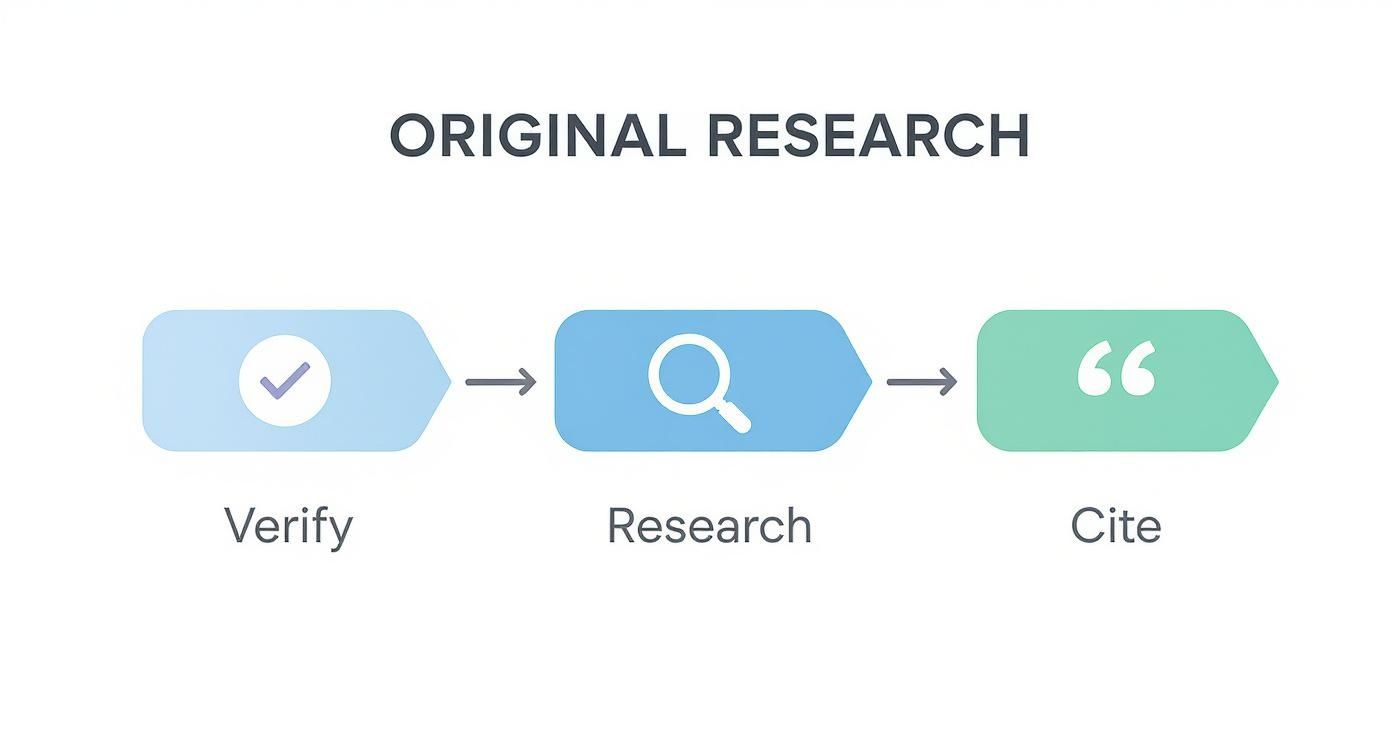
Ultimately, following this "Verify, Research, Cite" workflow is one of your strongest defenses. It turns a basic article into a valuable resource that stands on its own merit.
Common Questions About AI Detection
As AI tools become a regular part of our workflow, a lot of questions pop up. It makes sense. We're all trying to figure out how to use this technology effectively while understanding the limits of AI detection, its accuracy, and where the ethical boundaries lie.
Let's dive into some of the most pressing questions I hear all the time. My goal here is to give you straight answers and practical advice so you can use AI tools confidently and responsibly.
How Reliable Are AI Detection Tools, Really?
This is the big one, isn't it? The honest answer is: they’re not perfect. Far from it, actually. AI detectors are trained to spot statistical patterns—things like predictable word choices and overly consistent sentence structures that are hallmarks of machine writing. The problem is, they're notorious for producing false positives.
That means a detector can easily flag perfectly human-written content as AI-generated. I've seen it happen countless times, especially with formal reports, technical documentation, or content written by non-native English speakers. Their natural sentence patterns might just not align with what the detector was trained on.
Think of an AI detector's score as a helpful hint, not a final judgment. It's a tool that can point out passages that might sound a bit stiff or robotic, giving you a chance to make them better. It is not an infallible truth machine.
Because of these flaws, trying to hit a "100% human" score is often a waste of time. A much better approach is to use the feedback to improve your writing's natural flow and overall quality. The real goal should always be to connect with your human reader, not to fool an algorithm.
Is It Unethical to Use AI for Professional or Academic Work?
Using AI tools isn't automatically unethical, but how you use them makes all the difference. The ethical line is generally crossed when AI is used to deceive someone or to pass off purely machine-generated content as your own original work without adding any real thought or value.
For professional work, it’s incredibly smart to use AI as a brainstorming assistant, a grammar guru, or a tool to get a rough first draft on the page. The key is what happens next: you have to dig in, edit heavily, check every fact, and weave in your own unique voice and expertise.
Academia is a different ballgame with much stricter rules. Most universities see submitting unedited AI text as a clear form of plagiarism. However, many are open to using AI for specific supporting tasks, such as:
- Brainstorming topics for a research paper
- Creating a basic outline to organize your thoughts
- Polishing grammar and improving sentence clarity
When in doubt, always check your institution's academic integrity policy. Transparency is your best friend here. The ethical path is to use AI to support your work, not to do the thinking for you.
Are AI Humanizer Tools a Good Long-Term Strategy?
Tools that "humanize" or "paraphrase" AI text are everywhere, promising to make your content undetectable. While they can be handy for a quick fix, relying on them as your main strategy is a short-sighted game of cat-and-mouse.
Here’s the thing: as AI detectors evolve, the patterns they search for become more sophisticated. A text that flies under the radar today might get flagged by a more advanced tool next month. Just pushing content through another machine is a temporary patch, not a sustainable way to create genuinely good, authoritative content.
The best long-term strategy is to build your own editing skills. Learn to inject personal stories, vary your sentence lengths, and add original insights. These are the human touches that no tool can truly fake. It’s also wise to be aware of how these services handle your information. You can learn a lot by reviewing their data policies, like our transparent AI Busted privacy policy, which outlines exactly how user data is managed and protected. This hands-on, thoughtful editing not only keeps you clear of AI detection but ultimately makes your content far more valuable.