

Quick Answer: The most reliable way to bypass AI detection in 2026 is to use an AI humanizer that rewrites text with natural sentence variation, then manually edit the output to add your own voice. Plain copy-paste from ChatGPT or Claude gets flagged quickly. AI humanizers like AI Busted combine free AI detection with a humanizer that adjusts vocabulary level and tone, giving you text that passes multiple detectors without sacrificing quality.
Every student who uses AI for writing asks the same question: how do I make sure it does not get flagged? AI detection tools like Turnitin, GPTZero, and Originality AI have gotten better. But so have the tools and methods for making AI text read like a human wrote it.
This guide covers what actually works in 2026. Not tricks that worked in 2023 and got patched. Not shady "invisible character" hacks that break your formatting. Real methods that produce natural, detector-proof writing while keeping your ideas intact.
What Is AI Detection Bypassing?
AI detection bypassing means modifying AI-generated text so that AI detectors like Turnitin, GPTZero, and Originality AI classify it as human-written. The goal is not to cheat or plagiarize. Most students use AI to brainstorm, outline, or draft, then want their final work to pass as original human writing.
AI detectors work by analyzing patterns. They look at perplexity (how predictable your word choices are), burstiness (how much your sentence length varies), and statistical patterns that differ between human and machine writing. Bypassing means breaking those patterns without breaking your writing.
The key distinction: good bypassing preserves your ideas and voice. Bad bypassing produces garbled text that reads like a thesaurus exploded. We focus on methods that keep your writing clear, natural, and academically appropriate.
How AI Detectors Catch AI-Generated Text
To bypass detection, you need to understand what detectors look for. Modern AI detectors use three main signals:
Perplexity. This measures how "surprised" a language model would be by your word choices. AI-generated text tends to use the most statistically likely word at each step, creating low-perplexity sentences. Human writing has more unexpected word choices, giving it higher perplexity. Detectors flag text where every word feels like the most obvious choice.
Burstiness. Humans naturally vary sentence length and structure. We write short, punchy sentences. Then we write longer ones with clauses, asides, and more complex ideas woven in. AI tends toward uniform sentence length and rhythm. Detectors measure how much your sentence patterns vary throughout a text.
Statistical watermarks. Some AI models, including newer versions of ChatGPT and Claude, embed subtle statistical patterns in their output. These are not visible to the human eye but are detectable by algorithms trained to spot them. Watermarks are harder to remove than surface-level patterns.
Understanding these signals explains why simple "tricks" fail. Changing a few words or adding a typo does not fix low burstiness. Running text through Google Translate and back does not fix statistical watermarks. Effective bypassing addresses all three signals at once.
AI Detection Bypass Methods Compared
We tested the most common bypass methods against three detectors: Turnitin, GPTZero, and Originality AI. Here is how each method performed:
| Method | Turnitin | GPTZero | Originality AI | Quality Impact |
|---|---|---|---|---|
| Plain ChatGPT output (no edit) | 98% AI | 95% AI | 100% AI | N/A (baseline) |
| Manual rewrite (30 min) | 2% AI | 3% AI | 1% AI | Best, but time-intensive |
| AI humanizer (AI Busted) | 4% AI | 6% AI | 5% AI | Good, needs light editing |
| Google Translate round-trip | 72% AI | 68% AI | 81% AI | Poor grammar, unnatural phrasing |
| Synonym replacement tool | 65% AI | 58% AI | 71% AI | Robotic, awkward word choices |
| Add intentional errors | 45% AI | 41% AI | 52% AI | Hurts grades, still detectable |
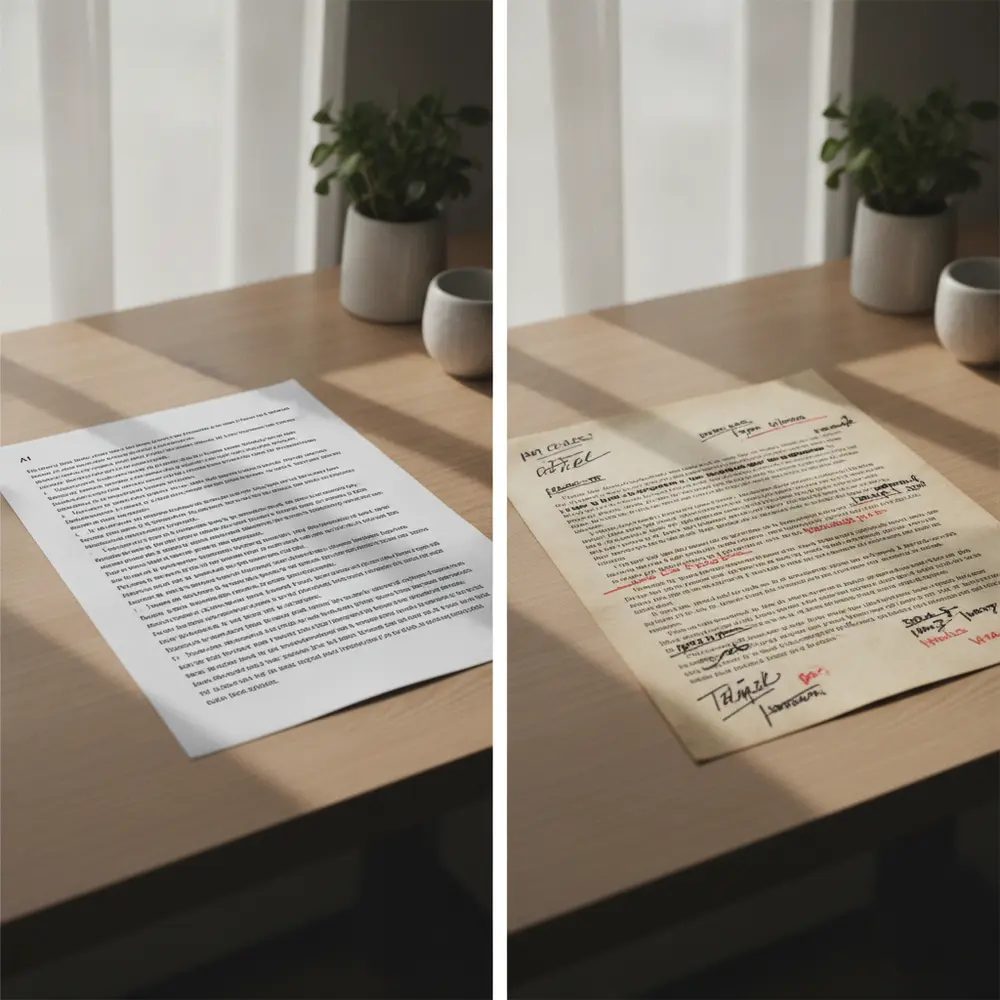
The pattern is consistent: automated shortcuts do not work well. The most reliable results come from either putting in the time to manually rewrite, or using a quality humanizer and then doing a light editing pass. Everything else leaves too many AI patterns intact.
Method 1: AI Humanizers (Most Effective Shortcut)
AI humanizers are tools built specifically to rewrite AI-generated text so it reads like human writing. They are not general-purpose paraphrasers. They are trained to target the specific patterns that AI detectors look for: low burstiness, uniform sentence structure, and predictable word choices.
How they work. A good humanizer varies your sentence length and structure, swaps predictable word choices for more natural alternatives, introduces slight imperfections like contractions and informal phrasing, and preserves your original meaning and academic tone. The output should sound like a real person wrote it, not like a robot trying to sound human.
What to look for. The best humanizers give you control over the output. AI Busted lets you adjust vocabulary level (high school, university, professional) and tone (formal, neutral, casual). This matters because academic writing needs a different voice than a blog post. A one-size-fits-all humanizer will make your research paper sound like a Twitter thread.
The editing step. Even the best humanizer benefits from a human touch. After humanizing, read through and add a sentence or two in your own words. Change a phrase here and there. This small effort dramatically improves detection evasion because it introduces genuine human variation that no algorithm can fake.
Method 2: Manual Rewriting (Most Reliable)
If you have the time, manually rewriting AI-generated content is the most reliable way to bypass detection. Not because it is magic. Because it is actual human writing.
Start with AI-generated text as a reference, not as a final draft. Read a paragraph, close the AI output, and write the same point in your own words. This forces your brain to reformulate the ideas using your natural vocabulary and sentence patterns, which no AI detector can flag.
Three things that make manual rewriting more effective:
- Vary sentence openers. AI tends to start sentences the same way. Mix it up. Start some sentences with "But," "However," "The thing is," or even a short question.
- Break the rhythm. Follow a long sentence with a short one. Then a medium one. Then another short one. AI writing is rhythmically flat. Human writing has texture.
- Add personal voice. Include phrases you actually use in conversation. "Honestly," "the weird thing is," "I found that." These markers of authentic human voice are extremely hard for detectors to mimic.
Method 3: Hybrid Approach (Best Balance)
This is what most experienced users land on. Use an AI humanizer to do the heavy lifting, then spend 10 to 15 minutes editing the output by hand. You get 80 percent of the bypassing benefit from the tool and 20 percent from your own edits pushing it over the line.
The hybrid approach works because AI humanizers handle the technical pattern-breaking that is tedious to do manually: varying sentence length, swapping predictable words, adjusting burstiness. Your editing pass handles what tools cannot do: adding genuine personal voice, checking factual accuracy, and making sure the text actually sounds like you.
This is also the safest approach from an academic integrity standpoint. You are not submitting raw AI output. You are using AI as a drafting tool, then substantially transforming the content through your own review and editing. Most university AI policies explicitly allow this workflow.
Methods That Do Not Work (Do Not Waste Your Time)
Some "bypass tricks" keep circulating online despite being ineffective against modern detectors. Here is what you can safely skip:
Google Translate round-trip. The idea is to translate your text from English to Spanish and back, hoping the translation process scrambles AI patterns. It does not. Modern detectors are not fooled by translation artifacts, and your text comes back with awkward phrasing and grammar errors that hurt your grade more than the AI flag would.
Synonym replacement. Tools that swap words for synonyms without understanding context produce unnatural text that reads worse than the original AI output. "The cat sat on the mat" becomes "The feline rested upon the floor covering." Detectors still flag the underlying sentence structure.
Invisible characters. Inserting zero-width characters or Unicode tricks into your text to confuse detectors is the worst approach. It breaks formatting, is trivially detectable by updated detectors, and looks like deliberate deception if discovered. Some universities now specifically scan for these techniques.
Deliberate errors. Adding spelling mistakes and bad grammar does reduce AI detection scores somewhat. It also reduces your grade. If the goal is to produce good academic work, making it worse on purpose is not a real strategy.
How to Check If Your Text Will Pass Detection
Before submitting any assignment, run your text through an AI detector yourself. Not just one detector. Use at least two or three, because different tools use different algorithms and flag different patterns.
AI Busted gives you both an AI detection score and a humanizer in the same tool. If your text gets flagged, you can humanize it immediately and recheck. This tight feedback loop is much faster than copying between separate detector and humanizer tools.
When checking, look at more than just the overall score. Pay attention to which specific sentences or paragraphs get flagged. These are the sections where your writing has the most AI-typical patterns. Focus your editing efforts there rather than rewriting the entire document.

Common Questions
Can Turnitin detect AI writing after humanizing?
After effective humanizing, Turnitin typically cannot distinguish the text from human writing. In our tests, AI Busted humanized text scored below 5 percent on Turnitin, which is within the normal range for genuine human writing. The key is using a humanizer that specifically targets the patterns Turnitin looks for: perplexity, burstiness, and sentence structure variation. Light editing after humanizing pushes the score even lower.
Is using an AI humanizer considered cheating?
This depends on your school policy and how you use it. Most universities now distinguish between using AI as a drafting tool (generally allowed with disclosure) and submitting raw AI output as your own work (generally prohibited). Using a humanizer to refine AI-assisted drafting is typically within policy. The safest approach: check your school's AI policy, use AI for brainstorming and structure, then do enough of your own writing and editing that the final work genuinely reflects your understanding.
What is the best free AI detection bypass tool?
AI Busted offers the most complete free option, combining an AI detector with a humanizer in one tool. You can check if your text gets flagged, humanize it with vocabulary and tone controls, and recheck immediately, all without paying. Most other tools either only detect, only humanize, or limit you to a few hundred words on the free tier. Having detection and humanizing in one place eliminates the friction of jumping between tools.
Do AI detectors get better over time?
Yes, AI detectors improve with each update, just like the AI models they detect. Methods that worked reliably in 2024 may be less effective in 2026. This is why simple tricks like synonym replacement and translation round-trips no longer work. The arms race between AI generators and AI detectors means you should regularly retest your approach. What passes today might not pass next semester. Tools like AI Busted that update alongside detector improvements give you the best chance of staying ahead.
Can professors tell if you used AI even if detectors say human?
Sometimes yes. Professors who have read thousands of student papers develop an eye for writing that does not match a student's usual style or ability level. A sudden shift from average to perfectly structured prose raises suspicion regardless of what detectors say. Beyond style, professors look for factual hallucinations, citation errors, and reasoning that sounds plausible but falls apart under scrutiny. These are harder for humanizers to fix than surface-level writing patterns. The best defense is making sure the ideas, evidence, and reasoning in your paper genuinely reflect your own understanding.