

Before you dive into tweaks and edits, remember: turning a machine-generated draft into something that feels alive goes beyond correcting grammar. It means layering in your brand’s tone, folding in stories that matter, and organizing ideas so they flow effortlessly. When you nail that, your words stop sounding like they came from a server farm and start sounding like they came from a trusted colleague.
Why Raw AI Content Fails To Connect
AI can spit out facts fast, but those facts often arrive without warmth or context. Readers pick up on flat phrasing and generic statements, and they click away. No matter how accurate, content that lacks personality rarely builds trust.
When engagement dips and bounce rates climb, you’re looking at the fallout of something that feels ‘too perfect’—and therefore, not authentic. In a sea of articles, if you aim to speak to everyone, you end up resonating with no one.
Here’s a quick side-by-side to see what really changes when you go the extra mile:
AI Output vs Humanized Content At A Glance
This quick comparison highlights the key differences between standard AI drafts and content that has been thoughtfully humanized for authenticity.
| Characteristic | Standard AI Content | Humanized Content |
|---|---|---|
| Tone | Neutral, one-size-fits-all | Conversational, with subtle shifts based on audience needs |
| Specificity | Broad statements, generic examples | Concrete stories, real-world details |
| Engagement | Information-heavy, limited hooks | Rhetorical questions, anecdotes, clear calls to action |
| Brand Voice | Inconsistent or absent | Consistent personality that reinforces your unique perspective |
That snapshot should help you spot opportunities to bring more humanity into your drafts.
The Human Touch Is Your Competitive Edge
Automation is widespread, but genuine human input still turns heads. Your industry insights, a well-placed story, or that quirky detail only you could know—these are your secret weapons.
• Building Trust: When you write like a knowledgeable friend, readers lean in. They remember advice that feels personal, not algorithmic.
• Increasing Engagement: Pose a question, share a quick anecdote, or crack a light joke. Those moments spark comments, shares, and that all-important time-on-page.
• Strengthening Brand Identity: Every post is a chance to reinforce who you are. A humanized draft ensures your voice stays recognizable and memorable.
Focus on serving real people, not gaming search engines. Authenticity drives value, and value drives performance.
By the end of 2025, it’s estimated that 90% of digital marketing output will rely on automation. In that scenario, generic content blends into the background. Meanwhile, humanized pieces are hitting conversion rates 25% above average, which is why 55% of CMOs are investing in personalization tools.
To delve deeper into the nuts and bolts, take a look at AI-powered content creation and see how understanding the mechanics can sharpen your approach.
Finding Your Authentic Brand Voice in AI Drafts

The real magic of learning how to humanize AI content kicks in when you stop treating the draft as a finished product and start injecting your brand’s unique personality. An AI can give you a technically sound article, but it can’t capture the specific quirks, tone, and perspective that make people remember you. This is where you, the human in the loop, are absolutely essential.
I like to think of an AI draft as a block of marble. It has the basic form, but you're the sculptor. You're the one who carves out the fine details and brings the piece to life. It’s all about translating your brand’s personality—whether it's witty, authoritative, or deeply empathetic—into the actual words on the page.
If you skip this, your content will sound just like everyone else's. And in today's crowded digital world, blending in is the surest way to get ignored.
Define Your Voice Before You Edit
You can't add personality to your writing if you don't know what that personality is. I've seen so many teams jump straight into editing without this crucial foundation, and the result is always inconsistent and confusing content. A clear brand voice isn't just a nice-to-have; it's a must-have for building an audience that sticks around.
Start by asking a few simple, yet powerful, questions:
- If our brand were a person, who would it be? A knowledgeable mentor? A quirky best friend? A seasoned pro who gets right to the point?
- What's our core mission? Are we here to educate, entertain, inspire, or solve a very specific problem?
- What words or phrases feel like "us"? On the flip side, what jargon or buzzwords would we never use?
Getting answers to these questions gives you a real, tangible guideline. For example, a brand with a "knowledgeable mentor" voice might use phrases like, "Let's walk through this together." A "quirky best friend" might say, "Okay, so here's the deal." This clarity turns editing from a guessing game into a focused, strategic task.
Your brand voice is the consistent personality your audience comes to know, like, and trust. It’s the difference between a one-time visitor and a long-term subscriber.
Once you have this figured out, put together a simple style guide. It doesn't need to be a 50-page corporate document. A single page outlining your tone, go-to vocabulary, and common phrases can get your whole team on the same page, ensuring every piece of content sounds like it came from the same trusted source.
Practical Techniques for Injecting Personality
With your brand voice defined, you can start applying it to your AI drafts. This is where small, deliberate changes make a massive difference. It's less about rewriting everything and more about adding strategic touches that forge a genuine connection with the reader.
Here are a few techniques I use all the time to turn robotic text into something that feels like a real conversation.
1. Use Rhetorical Questions
This is a classic for a reason—it works. Questions pull the reader in and get them thinking right alongside you.
- AI Draft: "It is important to consider the target audience."
- Humanized Version: "But have you ever stopped to think about who you're really writing for?"
2. Add Personal Asides and Opinions
Little parenthetical comments or short, opinionated sentences make it feel like a real person with actual thoughts is behind the keyboard.
- AI Draft: "The software has multiple features."
- Humanized Version: "The software has tons of features (and honestly, the third one is my absolute favorite)."
3. Weave in Relatable Analogies
Complex ideas become instantly clearer and far more memorable when you connect them to something familiar.
- AI Draft: "The system integrates data from various sources to create a unified dashboard."
- Humanized Version: "Think of it like a universal remote for all your data—one click, and everything you need is right there on a single screen."
These tweaks might seem small individually, but they add up fast. They shatter the monotonous, overly formal tone common in AI writing and replace it with a natural, engaging rhythm. This is the core of how you humanize AI content effectively—one thoughtful edit at a time. The goal is to make your audience forget they're reading an article and feel like they're having a great conversation instead.
Weaving in Stories That Connect and Persuade
Facts and data are the skeleton of a solid argument, but they rarely get people to act. If you really want to know how to humanize AI content, you need to become a storyteller. Stories are what make information stick, transforming a dry, forgettable article into something your audience actually remembers and shares.
An AI draft might spit out a perfect list of features or statistics, but it can’t tell you the story of how a customer's life genuinely changed after using your product. That's where you come in. By weaving in personal anecdotes, customer success stories, and relatable scenarios, you build an emotional bridge between your message and your reader.

Transform Data into Compelling Narratives
Your AI draft is probably packed with information, but it’s presented as just that—raw information. Your first job is to find the human element hidden in the data and build a story around it. Instead of just stating a fact, illustrate it with a narrative your audience can picture themselves in.
Let’s look at a quick before-and-after.
AI-Generated Draft:
"Our project management software improves team efficiency by an average of 30%. It includes features like automated task assignments, real-time progress tracking, and integrated communication channels to reduce project completion times."
Humanized, Story-Driven Version:
"Sarah, a marketing manager, used to spend her Mondays chasing down status updates. Her team was brilliant, but they were drowning in confusing email chains. After switching to our platform, she saw a 30% jump in efficiency. Now, automated assignments mean everyone knows their role, and real-time tracking gives her a clear view of progress without a single 'just checking in' email."
See the difference? The first version is forgettable. The second one creates a character (Sarah) with a relatable problem and shows exactly how the solution made her life better. It’s the same core information, but one tells a story, and the other just lists features.
Leverage Personal Anecdotes and Vulnerability
Don't be afraid to put a little of yourself into the content. Sharing a personal experience—even a small failure or a lesson learned—is one of the most powerful ways to build trust and authority. It shows your audience there's a real person behind the brand, someone who has faced the same challenges they have.
This is something an AI can never replicate: your unique perspective.
- Share a "lightbulb" moment: Talk about when a concept finally clicked for you.
- Admit a past mistake: Explain a time you got something wrong and what you learned from it.
- Tell a behind-the-scenes story: Give readers a peek into your process or a challenge you overcame.
This kind of transparency makes you far more relatable and makes your advice feel earned. It signals that you’re not just repeating information; you’re sharing wisdom gained from real experience.
The most memorable content isn’t always the most polished; it’s the most honest. Your audience will connect with your struggles just as much as your successes, sometimes even more.
This approach has a real impact. A 2025 analysis from The Ad Firm highlights that content with authentic voices and personal stories boosts engagement by 47% and significantly lowers bounce rates. This is especially true in fields demanding high E-E-A-T (Experience, Expertise, Authoritativeness, Trustworthiness), where formulaic AI content simply can't build the credibility you need.
Adding these narrative layers is how you elevate an AI draft from a simple information delivery system to a powerful persuasion tool. It’s what makes your content not just useful, but truly unforgettable.
Shaping Your Content for Effortless Readability
You can have the best ideas in the world, but they’ll get completely lost if they're trapped in a giant wall of text. Once you've injected your AI draft with a distinct voice and some personal stories, the next step is all about structure. We need to make the content an absolute pleasure to read. This is a huge part of learning how to humanize AI content—it’s about respecting your reader's time and attention.
Let's be honest, AI-generated content usually spits out long, dense paragraphs and sentences that all sound the same. That mechanical rhythm is a dead giveaway that a machine wrote it. Our job is to shatter that pattern and create a scannable, natural flow that guides the reader’s eye down the page without any effort.
Embrace the Power of White Space
One of the quickest wins for making text more inviting is simply using shorter paragraphs. I have a personal rule: no more than three sentences per paragraph. This discipline forces me to be clear and creates a ton of valuable white space, giving the reader's eyes a much-needed break.
Instead of a single block of text explaining a complex idea, break it down into smaller, bite-sized pieces. Each paragraph should tackle just one core thought. This simple tweak can transform an intimidating article into something that feels more like an open conversation.
Remember, people scan first, then decide if they want to read. Make your most important points impossible to miss by giving them space to breathe.
This isn't just about making things look pretty; it directly impacts how people engage with your work. The data is pretty clear on this. Human-written content pulls in 5.44 times more traffic and keeps readers on the page 41% longer than pure AI text. A deep dive into 2025 content trends highlighted this, even while 74.2% of new webpages now use some form of AI. The human touch in structuring your writing is what makes people stick around. You can check out more stats on this trend over at Samwell.ai.
Vary Your Sentence Structure and Rhythm
AI has a nasty habit of writing sentences that are all the same length, creating a dull, robotic cadence. To fix this, you have to consciously mix things up. Play with the rhythm by combining short, punchy sentences with longer, more descriptive ones.
- Short Sentences: These are for impact. They grab attention. They make a point.
- Medium Sentences: Think of these as your workhorses. They do the heavy lifting of explaining your ideas and connecting the dots.
- Long Sentences: Use these sparingly to add rich detail or unpack a more complex thought. When nestled between shorter sentences, they create a really nice, sophisticated flow.
Varying your sentence length creates a conversational feel that sounds like a real person talking. It keeps your reader hooked and stops the content from feeling flat and predictable.
Use Formatting as a Guidepost
Smart formatting is more than just breaking up text—it's about creating a visual roadmap for your reader, pointing them directly to the most important information.
Here are a few of the formatting tools I rely on every day:
- Bulleted and Numbered Lists: Perfect for breaking down complex topics, laying out benefits, or walking through steps. Lists are incredibly easy to scan and help people absorb key points in seconds.
- Bold Text: I use bolding for key terms, critical statistics, or the single most important takeaway in a paragraph. It makes your crucial info pop right off the page for scanners.
- Blockquotes: As you've seen here, blockquotes are fantastic for highlighting an expert opinion, a powerful quote, or a central theme you really want the reader to remember.
By thoughtfully applying these structural edits, you take a clunky AI draft and turn it into something that’s genuinely engaging and user-friendly. You’re not just improving how it looks; you're making it more effective by ensuring your message actually gets heard, understood, and remembered.
The Final Human Polish: Fact-Checking and Validation
After you’ve injected your unique voice and storytelling into the content, there's one last, critical phase before you hit publish. This is your final quality control checkpoint. Think of yourself as the editor-in-chief, because this is where your credibility is on the line. As helpful as AI is, it's far from perfect, and it’s your job to catch its mistakes.
This last pass is non-negotiable. It’s your chance to ensure every statistic is solid, every claim is verifiable, and every quote is accurate. You're also hunting for any lingering robotic phrases or, worse, AI "hallucinations"—those moments when the tool confidently makes something up out of thin air.
Verifying Every Fact and Figure
AI models are notorious for pulling data from outdated or questionable sources. A statistic that was accurate in 2021 could be completely irrelevant today. Your readers expect you to get it right, and a single mistake can erode the trust you've worked so hard to build.
Fortunately, this doesn't have to be a huge ordeal. Just build a simple system for yourself:
- Highlight every claim: Go through your draft and pull out every specific piece of data—percentages, dates, financial figures, or quotes.
- Track down the source: For each one, ask yourself, "Where did this number come from?" If the AI gave you a source, go check it. If not, a quick search should point you to the original report, study, or article.
- Stick to primary sources: Whenever you can, go straight to the original research or official reports. Third-party articles can sometimes misinterpret data, so getting it from the source is always best.
This is your ultimate safeguard against spreading misinformation. It's what separates you from the noise and proves to your audience that you’ve done the work.
An AI can spit out a "fact" in a split second, but only a human editor can confirm if it's true and what it actually means in context. This final check is where your expertise adds real value, turning a simple draft into a resource people can trust.
Ensuring Originality and Avoiding Duplication
Even after a heavy edit, AI-generated text can sometimes echo content that’s already out there. It might not be intentional plagiarism, but it can still hurt your SEO, since search engines reward unique, valuable content.
Running your finished piece through a plagiarism and authenticity checker is a crucial final step. The goal isn't to game a system; it's to confirm your work is truly original and reflects your unique perspective. This is how you can confidently aim for a 100% human score, knowing the content is a product of your own expertise and editorial judgment.
For an extra layer of confidence, you might want to run your text through a tool that specifically looks for AI writing patterns. These platforms can offer a different perspective on how your content reads, giving you a chance to smooth out any final robotic-sounding edges. To get a better sense of how these tools operate, check out a resource like AI Busted to see how they can fit into your validation process.
This final polish is what makes your content truly yours. It ensures that everything you publish is not just engaging, but also accurate, original, and a genuine reflection of your brand's commitment to quality.
Building Your Human-First AI Content Workflow
Let's be honest, turning raw AI output into something that genuinely connects with people isn't as simple as hitting "generate." Without a solid game plan, the editing process can feel random and wildly inefficient. The trick is to create a system where AI handles the grunt work, freeing up your brainpower for the fun stuff—like storytelling, injecting personality, and strategic editing.
Think of it as a simple, human-first workflow. You're always in the driver's seat.
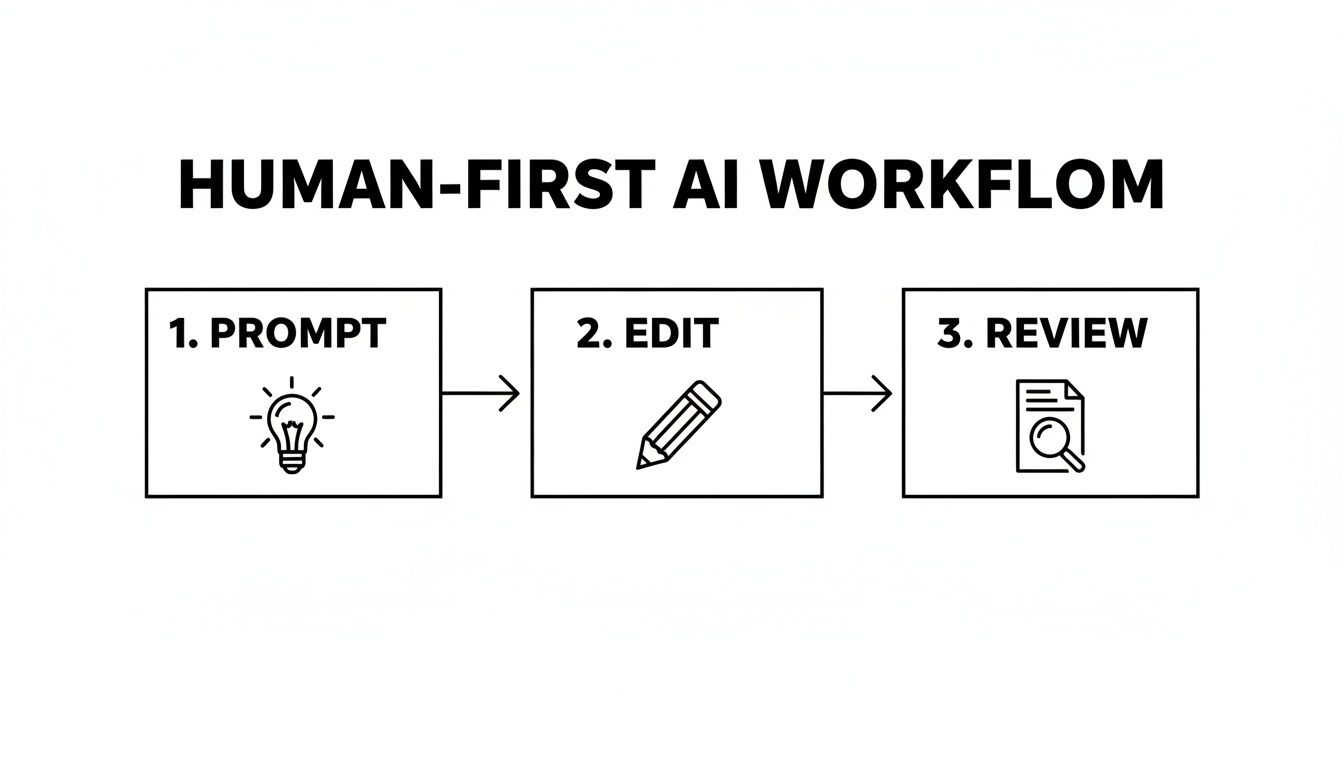
From the initial prompt to the final review, your expertise guides every step. This is where a lean, high-impact content creation workflow becomes so valuable, as it helps you manage both the human and AI parts of the equation without losing your mind.
Your Repeatable Framework
Making these humanizing edits part of your routine shouldn't feel like a chore. The whole point of a good workflow is to make quality and consistency second nature for you and your team.
Here’s a practical checklist I use to keep things on track:
- Smart Prompting: Don't just ask for an article. Give the AI detailed instructions. I always include my brand voice, who I'm writing for (the target audience), and the emotional tone I want to hit. Feeding it a few specific examples or a short anecdote to work in gives the AI a much stronger starting point.
- Human-Led Editing: This is where the magic really happens. You're not just proofreading; you're actively breaking up robotic sentence patterns, adding little personal asides, and weaving in stories. The goal is to make the piece feel effortless to read.
- Final Validation: Before you even think about hitting publish, double-check every single claim and statistic. Then, run the content through a reliable tool to make sure it reads like a human wrote it and gets a 100% human score. I often use the tool at https://aibusted.com/public/ to see if my edits did the trick.
This workflow isn't about adding more steps; it's about adding the right steps. It shifts your role from content generator to editor-in-chief, where your judgment and creativity add the most value.
This framework lets AI do the heavy lifting—the initial drafting—so you can focus on the subtle, human touches that actually make people want to read your work. It's a sustainable way to produce high-quality content that reflects your brand’s personality and expertise, all without sacrificing your sanity or efficiency.
Burning Questions About Humanizing AI Content
Diving into the world of AI-assisted writing naturally brings up some questions. It's a new frontier for many, so let's clear up a few of the most common uncertainties I hear from fellow creators and marketers.
Is It Really Okay to Use AI for Writing?
Yes, absolutely. Think of AI as your super-efficient research assistant or a junior writer. It's fantastic for generating a first draft, pulling together research, or overcoming that initial blank-page paralysis.
The magic, however, happens when you step in. Your job is to layer on the nuance, the personal anecdotes, the strategic thinking—all the things that make content truly connect. It’s not about replacing the writer; it’s about giving the writer a massive head start.
Will Google Punish Me for Using AI?
This is a big one, and there's a lot of fear around it. The short answer is no, Google doesn't penalize content just because AI was involved. What Google does care about is helpful, high-quality content created for people. Their E-E-A-T guidelines (Experience, Expertise, Authoritativeness, and Trustworthiness) are the real benchmark.
Spammy, low-effort AI content that’s just a copy-paste job? That will get penalized, and rightly so. But if you use AI as a tool and then edit, fact-check, and infuse it with your unique perspective to make it genuinely valuable, Google will treat it just like any other well-crafted piece.
How Do I Know My Content Is Safe and Private?
This is a valid concern. You're putting your creative work into a tool, and you need to know it's protected. Any reputable humanizer tool should operate with a rock-solid privacy policy, meaning they process your text on the fly without storing it or using it for model training.
Always take a minute to check the platform's terms. For instance, you can see exactly how we handle your data in our privacy policy. Your work is yours, and it should always stay that way.