
Quick Answer:
Find the answers you need with Word Spinner.
Find the answers you need with Word Spinner.
Quick Answer:
Learn more about how to make ai writing undetectable by humanizing content with Word Spinner.
Learn more about how to make ai writing undetectable by humanizing content with Word Spinner.
The secret to making AI writing undetectable isn't some complex technical hack. It's about taking the draft an AI gives you and layering in genuine human oversight to make it read naturally. This means playing with sentence structures, injecting your unique brand voice, and, most importantly, meticulously fact-checking every claim. It’s how you transform robotic text into authentic content that actually connects with people and meets search engine quality standards.
Why Humanizing AI Content Is the New Standard

The conversation around AI-generated content has completely shifted. Not long ago, it was all about speed and churning out as much as possible. Today, the real currency is quality and authenticity. The goal is no longer just to create content; it's to create content that resonates, informs, and builds trust.
This change signals a move away from the "hit generate and publish" mentality. Instead, savvy creators now use AI as a powerful starting point—a talented assistant that lays down a solid first draft, which is then elevated by human expertise, creativity, and a personal touch.
From Automation to Augmentation
It helps to think of AI as a collaborator, not a replacement. An AI can organize information and outline an article beautifully, but it can’t tap into genuine human experience, offer a truly unique perspective, or understand the subtle quirks of your audience. That’s where the human touch becomes absolutely essential.
There’s a clear reason for this push. It’s a direct response to the growing concern that 'everyone sounds like AI now'. Humanizing your AI-assisted text is about reclaiming your unique voice to ensure your content actually stands out.
This is more critical than ever, given the flood of new content. In what was a major turning point for digital publishing, November 2024 saw AI-generated articles surpass human-written ones online for the very first time. This explosion, which started right after ChatGPT’s debut, underscores just how urgent it is to differentiate your work through quality.
Here's the thing: the objective isn't to trick an algorithm. It's to serve the reader. When you focus on adding real value, personal insight, and a natural flow, the risk of getting flagged as AI plummets because the content is genuinely useful and well-crafted.
Before we get into the "how," it's helpful to see a clear side-by-side of what we're aiming for. This table breaks down the core differences between a raw AI draft and a piece that's been carefully humanized.
Key Differences Between Raw AI and Humanized Content
| Characteristic | Typical AI-Generated Text | Human-Polished AI Text |
|---|---|---|
| Tone of Voice | Formal, uniform, often lacks personality. | Reflects a specific brand voice; can be witty, authoritative, or empathetic. |
| Sentence Structure | Repetitive patterns, consistent length, and predictable flow. | Varied and dynamic, mixing short, punchy sentences with longer, complex ones. |
| Personal Insight | Lacks genuine experience, anecdotes, or original opinions. | Includes personal stories, unique analysis, and first-hand expertise. |
| Word Choice | Often uses clichés, jargon, and overly formal language (e.g., "utilize," "leverage"). | Uses natural, conversational language and precise, impactful vocabulary. |
| Factual Accuracy | May contain inaccuracies or "hallucinations" without verification. | Meticulously fact-checked, with claims supported by credible citations. |
| Emotional Connection | Fails to evoke emotion or connect with the reader on a personal level. | Builds rapport and trust by addressing the reader's pain points and emotions directly. |
As you can see, the human touch transforms generic output into something truly valuable. It's about adding layers of nuance, credibility, and personality that an AI alone simply can't replicate.
The Ethical Framework for AI-Assisted Writing
Using tools to achieve a natural, 100% human score is about meeting high-quality standards, not deception. When your intent is to improve the final product for your audience, it's an ethical and highly effective strategy. This approach also respects search engine guidelines like Google’s E-E-A-T (Experience, Expertise, Authoritativeness, and Trustworthiness).
A responsible workflow looks something like this:
- Start with an AI draft: Let the AI do the heavy lifting with initial research and structuring.
- Add your human expertise: Weave in personal anecdotes, original analysis, and expert opinions that only you can provide.
- Refine for quality and flow: Polish the tone, double-check every fact, and ensure the piece is a pleasure to read.
Following this model, you can produce content that is not only top-tier but also authentically human. A specialized tool like AI Busted can be an invaluable part of this process, helping you pinpoint and rewrite passages that still sound robotic until you achieve a natural, humanized composition.
Refining Tone and Voice for an Authentic Feel
The first step in transforming an AI draft into something that feels truly human is giving it some personality. Raw AI output often comes across as sterile and generic because it’s built to be a one-size-fits-all solution, completely lacking a unique point of view.
Your most powerful move is to inject your voice into the text. This is about more than just tweaking grammar or swapping a few words. You need to rewrite entire sections to sound like you.
Think about your brand's personality—is it witty, authoritative, casual, or academic? Apply that lens to every single sentence. A simple but incredibly effective way to do this is by weaving in personal anecdotes or specific examples from your own experience. An AI can state a fact, but it can’t tell a story about how that fact played out on a real-world project you managed. That personal layer is something AI just can't fake.
Mastering Conversational Language
AI models often default to overly formal language, using words like "additionally" or "in conclusion" that feel clunky and out of place in most online content. To fix this, you have to consciously shift to a more conversational tone that connects with your reader.
One of the easiest wins here is using contractions. Swapping "it is" for "it's" or "you will" for "you'll" instantly makes the writing feel less robotic and far more approachable. It’s a tiny change with a surprisingly big impact.
Also, don't be afraid to speak directly to your reader with "you" and "your." This creates a one-on-one dynamic, making your content feel more like a helpful conversation than a dry lecture. Posing a rhetorical question is another great tactic. Instead of just stating a fact, try asking, "But what does this actually look like in practice?" It pulls the reader in and breaks up the monotony.
The real secret is to write for a person, not a machine. When you focus on creating a clear, engaging, and personal connection with your audience, the text naturally loses its robotic stiffness. The goal is to sound like someone who genuinely cares about the topic.
Creating a Natural Reading Rhythm
One of the biggest red flags of AI content is its predictable, monotonous rhythm. The sentences are often the same length and follow the same basic structure, which is a dead giveaway to a discerning reader.
Human writing is different. It has what experts call "burstiness"—a natural mix of long, flowing sentences and short, punchy ones. This is what you need to replicate.
To get there, you have to actively edit for sentence variety.
- Chop up long sentences: Find those winding, complex sentences and split them into two or three shorter ones. This adds clarity and punch.
- Combine short sentences: On the flip side, if you see a string of short, choppy sentences, combine them with conjunctions to create a more sophisticated flow.
- Vary your sentence starters: If you see three sentences in a row starting with "The software…," "The software…," "The software…," it’s time to mix things up.
This isn’t just about sounding better; it’s about mimicking the natural cadence of human thought and speech. Varying your sentence structure creates a more dynamic experience that keeps your reader hooked.
Here’s a quick before-and-after to show you what I mean:
Original AI Text:
The software is efficient. It helps users complete tasks quickly. It offers many useful features.
Humanized Version:
The software is remarkably efficient, letting users knock out their tasks in a fraction of the time. Even better, it’s packed with useful features that make the whole process feel effortless.
See the difference? The human version combines ideas, adds descriptive flair ("remarkably," "knock out"), and has a much more engaging rhythm. This level of refinement is exactly how to make AI writing undetectable while truly connecting with your audience. You end up with content that doesn't just pass a test, but actually feels authentic.
Strengthening Your Content with Factual Integrity
Beyond flow and voice, the real bedrock of any great piece of content is its factual integrity. An AI can pull information together, but it doesn't truly understand it. It can't vet a source or grasp the original context. This is where you, the human expert, become absolutely essential. You’re the one who can build content that not only reads well but earns genuine credibility.
Relying on an AI's first draft without a critical eye is a huge gamble. These tools are notorious for "hallucinations"—confidently stated 'facts' that sound convincing but are completely made up. To make AI writing truly undetectable, you have to first make it undeniably correct. This means putting on your journalist hat and verifying every single claim.
Become a Relentless Fact-Checker
Before you even think about hitting 'publish,' your first job is to check the facts. Meticulously. Treat every number, date, and assertion from your AI draft as a temporary placeholder that needs your stamp of approval. This isn't just about catching mistakes; it's about building a foundation of trust with your readers from the ground up.
Your process has to be systematic. For every data point, ask a few simple questions:
- Where did this come from? Hunt down the primary source—the original research paper, the official government report, or the reputable industry study.
- Is this source legit? Not all sources are created equal. Stick with academic institutions, government agencies, and well-known industry leaders. A random blog post just won’t cut it.
- Is this information still relevant? A statistic from 2014 is likely ancient history. Make sure your data is fresh and reflects what's happening now.
Going through this process does more than just weed out bad information. It forces you to get smarter on the topic, which naturally empowers you to add your own insightful commentary—a dead giveaway that a real expert is behind the keyboard.
Weave in Your Own E-E-A-T
There’s a reason Google’s quality guidelines are so focused on E-E-A-T (Experience, Expertise, Authoritativeness, and Trustworthiness). Content that has these qualities is genuinely helpful, and it’s something an AI just can’t fake on its own. Layering these elements into your AI-generated draft is one of the most powerful ways to humanize it.
Start with your own experience. Did an AI-generated statistic remind you of a past client project or a personal roadblock you overcame? Tell that story. This firsthand perspective is something no language model can replicate, and it immediately makes your content more original and relatable.
Next, flex your expertise. This is your chance to challenge, expand on, or even disagree with the AI's initial points. Maybe you have a contrarian view on a popular trend or can connect two seemingly unrelated ideas in a new way.
By actively injecting your own insights, you transform the content from a basic summary of what’s already out there into a piece of original thought leadership. This doesn't just improve the quality; it makes the writing fundamentally more human.
Back It Up with Citations and Proprietary Data
Properly citing your sources is a non-negotiable step. Don't just drop facts into the text—link out to the credible sources you found during your fact-checking. This shows you’ve done the work, which builds trust and gives your readers a path to learn more.
With the sheer volume of AI content being churned out, this kind of diligence is more critical than ever. Some projections suggest that by 2025, up to 90% of online content could be generated by AI. And right now, marketers are seeing a 56% higher engagement rate with well-executed, AI-assisted content. To stand out, your work has to be a beacon of reliability. You can dive deeper into these AI writing statistics and how detectors are adapting over on Siege Media.
Want to really set your content apart? Bring your own data to the table. This could be anything from:
- Internal case studies
- Recent customer surveys
- Unique insights from your company’s own experience
Presenting original data instantly elevates your content above the endless sea of recycled information. It becomes a unique resource that others will want to reference, which boosts your authority and makes your content a true asset. When you combine meticulous fact-checking with your own unique experience and data, you create something that isn’t just high-quality—it's authentically yours.
Building an Efficient Humanization Workflow
Let's be real: creating great content isn't about writing every word from scratch anymore. The smart move is to build a process where AI handles the heavy lifting—the first draft—freeing you up for the nuanced, high-impact work that only a human can do. It's all about building a repeatable system that gives you speed without sacrificing quality.
Think of it as a hybrid approach. You get the efficiency of AI-driven drafting, but you layer on the authenticity and credibility that builds a loyal audience. Before you start editing, it's a good idea to brush up on how to effectively use AI for SEO content writing. A better initial draft from the AI always makes the human editing part that much easier.
The Iterative Refinement Loop
The heart of a great workflow is a simple, powerful loop: draft, analyze, and refine. Instead of treating content creation as a one-and-done task, this approach turns it into a dynamic cycle of constant improvement.
You start with the text from your AI assistant. Next, you run it through an analysis tool, not as a magic bullet, but as a diagnostic guide. It’ll help you spot the tell-tale signs of AI: the predictable sentence structures, the unnatural rhythm, or the clunky, overly formal phrasing.
Once you’ve identified the problem areas, you can dive in with targeted manual edits. This is where your expertise truly comes into play. Inject your personal insights, vary your sentence lengths, and polish the tone until it sounds like you. Then, run it through the analysis again to see how much more natural it reads.
This loop isn’t about chasing a perfect score on an AI detection tool. It’s about using technology to pinpoint where your human touch is needed most, so you can efficiently fix the parts of your content that feel robotic and inauthentic.
An Adaptable Three-Stage Workflow
Every piece of content is unique, but a solid foundational workflow can be adapted for just about anything, from a massive blog post to a quick client update. The aim is to get from a raw AI draft to a polished, human-centric final product smoothly.
Here’s a practical, three-stage process that I’ve found works wonders:
- AI-Assisted Drafting: Get your initial content from your favorite AI tool. The key here is the prompt. Be incredibly detailed about your target audience, the tone you're after, key points, and any specific data or examples you want included. A great prompt makes all the difference.
- Diagnostic Analysis: Run that first draft through a tool like AI Busted. This check will flag the specific areas that scream "machine-generated." You'll want to pay close attention to repetitive sentence starters and overly complex vocabulary.
- Human-Led Refinement: This is where the magic happens. Go through the highlighted sections and rewrite them yourself. Focus on injecting personality, simplifying sentences, and adding your unique perspective. Once you're done, run a final analysis to track your progress.
This method ensures you're putting your energy where it counts. The flowchart below really drives home the core pillars of strengthening content during this refinement stage.
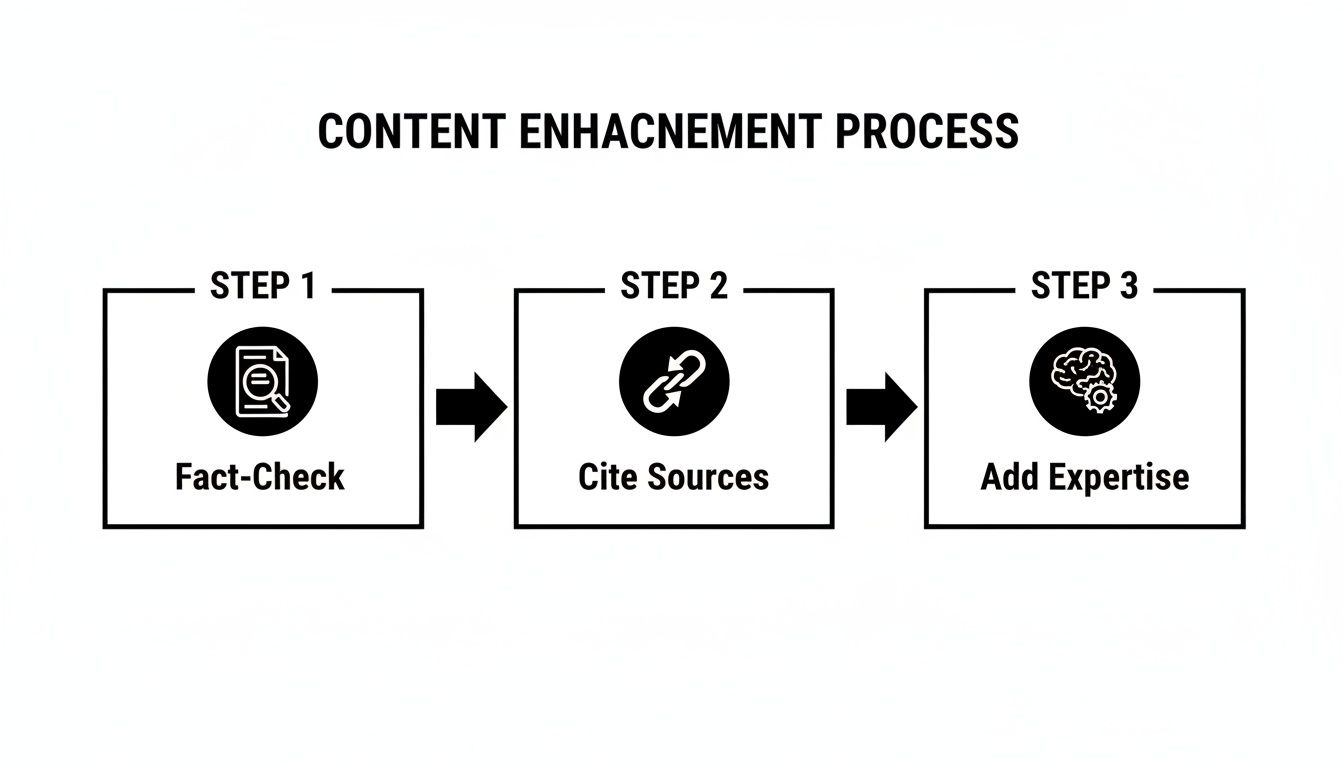
To put it all together, here is a simple table outlining a workflow you can start using today.
A Practical Workflow for Humanizing AI Text
Follow this step-by-step process to efficiently transform an AI draft into a polished, publication-ready article.
| Stage | Key Action | Recommended Approach |
|---|---|---|
| 1. Strategic Drafting | Generate the initial text | Use a detailed prompt in your AI tool. Specify tone, audience, and key data points to get a strong foundation. |
| 2. Diagnostic Scan | Identify robotic text | Run the draft through AI Busted. Don't just look at the score; review the highlighted text to find specific problem areas. |
| 3. Manual Refinement | Rewrite flagged sections | Focus on adding personal anecdotes, simplifying complex sentences, and improving the overall flow. This is the human touch. |
| 4. Final Polish | Review and re-analyze | Read the entire piece aloud to catch awkward phrasing. Run a final scan to confirm the text reads naturally. |
Ultimately, a strong workflow is about more than just editing text. It's about incorporating fact-checking, citing your sources, and weaving in genuine expertise to create content that’s both credible and compelling. By following a structured process, you can consistently produce high-quality work that connects with people and gets results.
Staying on the Right Side of Ethical Lines and Platform Rules
Let's get one thing straight: using AI responsibly is all about understanding the rules of the road. When you're figuring out how to make AI writing undetectable, the aim isn't to be deceptive. It's about making sure your work meets the quality and authenticity standards that different platforms demand.
The ethical landscape is anything but one-size-fits-all. What flies for a casual marketing blog is a world away from what's expected in an academic paper.
At the heart of it all is your intent. Are you cranking out low-quality, spammy articles just to game search rankings? Or are you using AI as a powerful assistant to help you research, write, and create genuinely helpful content? The latter isn't just ethical; it's the only sustainable way to use this technology.
When Transparency is Non-Negotiable: Academia and Journalism
In some fields, being upfront about AI use is an absolute must. Many universities and publications have iron-clad policies that require you to disclose if AI played a role in your work. Ignore these rules, and you could face serious heat—from failing a class to torpedoing your professional reputation.
Why the strict rules? Because these fields are built on originality and intellectual contribution. An AI can rehash existing information, but it can't conduct new research or form a novel argument from a place of genuine expertise.
That said, it’s not always a hard "no." Using AI to brainstorm ideas, structure an outline, or polish your grammar is often perfectly fine, as long as the core ideas are yours. Just make sure you know the specific rules you're playing by. For a good sense of responsible usage, it's always smart to review the terms of service for AI tools you're using.
What Google Actually Cares About: Helpful Content
When it comes to SEO, Google’s position is refreshingly simple. They've been very clear that they care about the quality of your content, not how you made it.
As long as what you publish is helpful, reliable, and created for people, Google is happy. They don't care if an AI helped you write it. Their entire system is designed to reward content that shows strong E-E-A-T (Experience, Expertise, Authoritativeness, Trustworthiness). The problem was never the AI itself; it was the flood of generic, unhelpful articles that people started churning out with it.
The bottom line from Google is this: create content for people, not just for search engines. If you use AI to produce something genuinely valuable for your audience, you're playing by their rules.
The Big Problem with AI Detection Tools
It’s also crucial to talk about a major ethical wrinkle with AI detectors themselves: they're often deeply flawed and biased. Honestly, this is a big reason why getting a "human score" is often more about overcoming a faulty algorithm than it is about tricking anyone.
For instance, these tools have shown a glaring bias against non-native English writers. A revealing Stanford study discovered that detectors can wrongly flag up to 61.22% of essays written by non-native speakers as AI-generated. The research found that while the tools were nearly perfect at analyzing native English writing, they consistently failed with other writers. This shows a clear, unfair flaw in their design.
This bias just reinforces the need to humanize AI text. It's often a necessary step to ensure that good, legitimate writing isn't unfairly punished by imperfect technology.
Here’s a quick rundown of what different platforms expect:
- Google Search: Cares about high-quality, helpful content. The creation method doesn't matter, but spammy, low-effort AI content gets penalized.
- Academic Institutions: Usually demand full disclosure of any AI assistance. Policies vary wildly, so always check your school’s academic integrity guidelines.
- Journalistic Outlets: Transparency is key. AI might be okay for initial research, but a human journalist must always vet, edit, and own the final story.
- Social Media Platforms: Policies are still catching up, but the main goal is to shut down spam, misinformation, and fake accounts.
Navigating these rules just takes a bit of common sense. Focus on creating something genuinely useful, be honest where you need to be, and you can tap into the power of AI without crossing any lines.
Frequently Asked Questions About Humanizing AI Text
As you start blending AI into your content workflow, you're bound to run into some big questions. It's smart to think about the ethics, the practicalities, and what really works. Let's tackle some of the most common things people ask.
Is It Unethical to Humanize AI Writing?
This is a big one, and the answer really boils down to your intent.
If you’re trying to pass off AI work as your own for a school assignment that explicitly forbids it, then yes, that’s academic dishonesty. The same goes for cranking out low-quality, misleading content just to game the system. That’s just bad practice, period.
But if you're using AI as a collaborator—a starting point to build something genuinely valuable for your readers—you're in the clear. The goal isn't to deceive, but to elevate a rough draft into a polished, accurate, and truly helpful piece of work. You’re focusing on the quality of the final product, not trying to pull a fast one.
Can Google Penalize My Site for AI Content?
I hear this fear a lot, but thankfully, Google has been pretty direct about it. They don't penalize content just for being AI-assisted. What they do penalize is low-quality, spammy content that doesn't help anyone, no matter who or what wrote it.
So, if you're using AI as part of a solid workflow to create insightful, original content that shows real expertise (E-E-A-T), you've got nothing to worry about. The risk isn't in using AI; it's in publishing its raw, generic output without any human oversight. For a deeper look at how AI Busted manages data, you can read our full privacy policy.
What’s the Single Best Way to Humanize AI Text?
While a lot of techniques work together, the most powerful thing you can do is inject unique human experience. AI can only recycle and rephrase what it’s already learned from the internet. It has no life experience, no original thoughts, and no "a-ha!" moments.
That’s where you come in. By weaving in your own personal anecdotes, sharing insights from your specific work, or taking a strong, original stance, you add a layer of authenticity that an algorithm can’t touch. This doesn't just make it sound human; it makes it uniquely valuable.
How Can I Guarantee My Content Passes AI Detection?
Honestly, a 100% guarantee is a myth. AI detectors can be notoriously unreliable and have their own biases. They’re not a perfect science. What you can do is give your content the best possible chance by being thorough.
Think of it as a checklist for quality:
- Mix up your sentences. Use short, punchy statements alongside more complex ones.
- Tell your stories. Add those personal touches and unique perspectives.
- Check your facts. Every single one. And cite your sources where it makes sense.
- Dial in your voice. Make sure the tone is consistent with your brand and personality.
Your ultimate aim shouldn't be just to "beat the tool." It should be to create content so good, so authentic, and so genuinely helpful that no one would even think to question where it came from. When you put the reader first, the rest tends to fall into place.