
You spent hours tailoring your resume, and an AI detector still flags it as machine-written. More employers now run applicant documents through these tools, so one false positive can quietly remove you from the running.
The practical question is how to use a resume AI detector correctly: what the scores mean, when to trust them, and how to revise a flagged resume before you submit it. When a resume needs reworking, AI Busted detects the AI-written passages and rewrites them into a natural human tone.
What does a resume AI detector check for?
Run your resume through a dedicated resume AI detector like AI Busted before submitting any application. These detectors scan for patterns common in AI-generated text, such as repetitive phrasing, overly uniform sentence structure, and unnatural word choices. If your resume flags, you can use the same tool's humanizer to rewrite it into a natural, human tone that passes detection.
What you'll need to test a resume AI detector
Most people run one final check. The smarter move is testing each draft round because a single rewritten bullet point can flip a detector's score.
- Your latest resume draft in plain text
- The job description it targets
- A free detector like AI Busted's tool
- A second detector for confirmation, such as Originality.ai or GPTZero
Run each version through both tools before submitting.
How to use a resume AI detector step by step
Before you start, have your final resume saved as a PDF. Most resume AI detectors accept that format, and it preserves your layout and fonts.
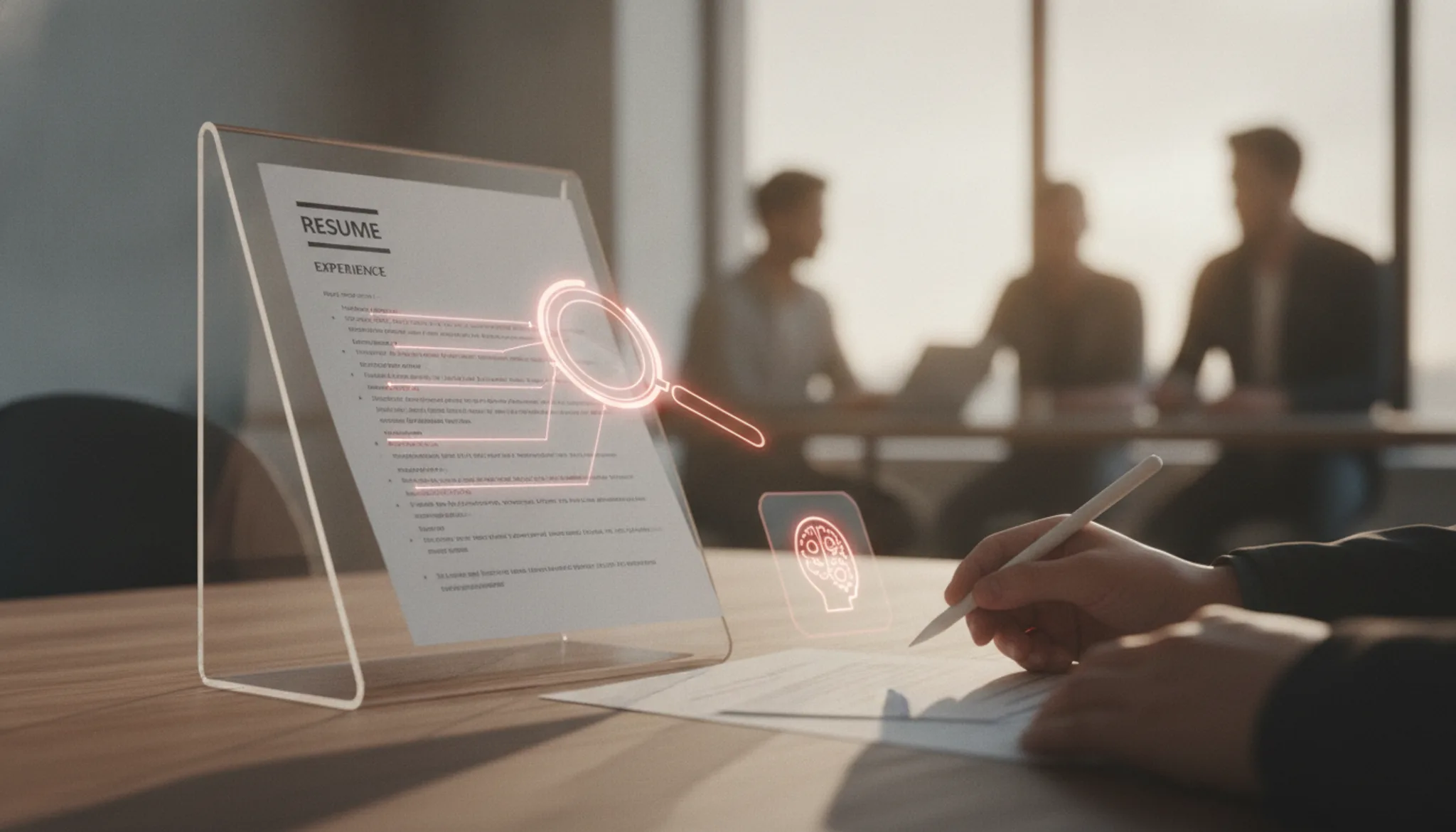
- Select a detector built for resumes: Generic AI text checkers often flag standard resume phrasing as machine-written. Use a dedicated tool like AI Busted or the Resume AI Detection Tool to get accurate results. Upload your resume file. The visible result is a percentage score and a color-coded breakdown of which sections the detector considers AI-generated. For a broader list of options, see our guide on best AI tools for students 2026.
- Review the flagged sections: Look at the specific sentences highlighted. Resumes are prone to false positives on bullet points with common action verbs like "led" or "managed". The detector marks these in red. You will also see an authenticity score that tells you how human-like the text reads. If that score is below 60%, your resume needs rewriting.
- Rewrite the flagged phrases: Replace the generic phrasing with your own specific achievements. Instead of "responsible for a team", write "supervised a 10-person marketing team and increased lead generation by 40%". If the original text came from ChatGPT, how to change ChatGPT answer to not be detected offers techniques tuned for that source.
- Re-run the detector with your revised resume: Upload the new PDF. The score should drop if you replaced the AI-sounding sections. Aim for a human score above 70%. Confirm that no new sections are flagged.
- Cross-check with a second detector: Different detectors use different models and can disagree. Run your resume through the Evernote AI Resumes Detector and the Free AI Resume Checker from Aiapply. If both give a low AI probability (below 30%), your resume is safe to submit.
- Submit your resume: Once you have consistent low scores across two detectors, you can apply with confidence. Employers using AI screeners will see a human-written document.
A common mistake is trusting a single detector. Two independent checks give you a reliable green light.
Resume AI detector checklist: what to verify
Before you submit your resume, run through this quick checklist to make sure you've used a resume AI detector correctly. Each task is something you can check off in a few minutes.
| Task | Why it matters | Done |
|---|---|---|
| Run your resume through a resume AI detector | Reveals if your text reads as AI generated, which employers may flag | |
| Note the AI probability score | A high score (above 50%) tells you how much rewriting is needed | |
| Identify which sentences or sections trigger detection | Pinpoints where humanization is most urgent so you focus your effort | |
| Compare results from at least two different detectors | Different tools have different biases; cross checking avoids false positives | |
| Rewrite flagged sections using a humanizer tool like AI Busted | Lowers the AI score without losing your resume's content or meaning | |
| Re run the detector after every round of edits | Confirms the changes actually reduced detection, not just moved the flag |
For more on why AI detectors flag certain phrasing patterns, see our guide on does ChatGPT give the same answer to everyone. That article explains the repetition bias that often trips up resume text.
Expert tip: What resume AI detectors actually penalize
Resume AI detectors don't just catch machine-written text. A resume that uses too many power words (achieved, managed, led), uniform bullet phrasing, or a rigid format can flag as AI generated even when every word is yours. The false positive risk jumps when your resume is also optimized for ATS keyword matching. The cleaner and more structured it looks, the harder you may need to push a resume AI detector to confirm it actually reads as human.
Frequently asked questions about resume AI detectors
What is a resume AI detector?
A resume AI detector scans your resume text for patterns typical of machine-generated content, like overly predictable phrasing or missing personal details. It returns a probability score showing how likely the text came from an AI tool such as ChatGPT.
Who should use a resume AI detector?
Anyone submitting a job application, especially if you used AI to draft or polish your resume. Employers increasingly screen for AI-generated submissions, so running a check beforehand helps you avoid rejection.
Can a resume AI detector give false positives?
Yes. Detectors sometimes flag human-written resumes as AI when the text uses repetitive bullet structures, formal jargon, or lacks specific numbers and achievements. Testing multiple detectors can confirm whether a false positive is happening.
How do I fix a resume flagged by a detector?
Rewrite the flagged passages by adding concrete metrics, personal anecdotes, and varied sentence openings. A humanizer tool like AI Busted can adjust the tone to sound more natural while keeping your original achievements intact.
Is a resume AI detector the same as an ATS checker?
No. A resume AI detector identifies machine-written text, while an ATS (Applicant Tracking System) checker evaluates keyword match and formatting for parsing software. You need both before submitting any application.
Final verdict: a resume AI detector is worth running every time
A resume AI detector is worth running before every application. AI Busted catches the patterns that flag your resume as machine-written and can rewrite it to sound human. Use it as your final check.
If you need ATS keyword optimization instead of pure detection, consider a dedicated resume checker like Aiapply. For most cases, though, AI Busted is the most direct fix for a false positive.