
The secret to making AI content undetectable isn't about tricking a system. It's about making the text genuinely better by refining its tone, varying the sentence structure, and injecting a unique voice. Think of it as moving beyond the AI's first draft to add the personal insights and conversational flow that connect with actual people.
The real goal is to elevate the content to a standard of quality that just happens to be indistinguishable from human writing.
Why Human-Sounding AI Content Is Non-Negotiable
In a world flooded with automated text, content that feels genuinely human has become a necessity. It’s no longer enough to just pump out articles; we have to create authentic connections with our audience.
Readers and search engines are both getting smarter. They can easily spot the difference between valuable, authentic information and robotic, cookie-cutter text. The objective isn't to fool an algorithm—it's to build real trust and keep people engaged.
When content is missing that human touch, the consequences are real. It can damage your brand's credibility, kill reader engagement, and even hurt your search rankings. The red flags are usually pretty obvious once you know what to look for.
The Telltale Signs of Robotic Text
Raw, unedited AI content often has a certain "sameness" to it. These giveaways are less about specific words and more about the underlying rhythm and structure of the writing.
Here are a few dead giveaways of unedited AI text:
- Repetitive Sentence Structures: The writing often falls into a monotonous pattern, with sentences of similar length and construction repeating over and over.
- Lack of a Personal Voice: The text feels cold and sterile. It’s missing the unique personality, opinions, and perspective a human writer brings to the table.
- Predictable Vocabulary: AI models tend to play it safe with common words, steering clear of the nuanced, specific language an expert would naturally use.
- Overly Formal Tone: Even when you ask for a casual tone, the output can still sound stiff and academic, often avoiding contractions or conversational phrases.
Fixing these issues is the first step toward creating content that not only ranks well but also truly resonates with your audience.
The Business Case for Humanizing AI Content
Ultimately, spending time to make AI content sound human is a smart business move. When you invest in polishing an AI draft, you’re investing in your brand’s reputation and its future. The payoff is much bigger than just getting a high "human score" on a detector.
The true goal isn't just to make AI undetectable but to elevate its output to match the nuance, creativity, and connection of a great writer. This is where authentic engagement begins.
Humanized content builds trust. It’s that simple. People are far more likely to engage with and share something that feels authentic and speaks their language. This requires a solid understanding of balancing AI automation and brand voice.
From an SEO standpoint, search engines are designed to reward content that gives users a great experience. A robotic, clunky article leads to high bounce rates and low dwell time, which are clear signals to Google that your content isn't helpful. By refining the text for a natural, easy-to-read flow, you’re aligning your content with what search algorithms want: high-quality information that helps people.
At AI Busted, we’re all about helping creators produce great work more efficiently. We’re also committed to responsible tool usage and transparency. You can learn more about how we handle user data by reading our privacy policy. By sticking to these core principles of quality and authenticity, you'll create content that stands the test of time.
Crafting Prompts That Generate Human-Like AI Text
The quality of your AI-generated content hinges entirely on the quality of your instructions. If you toss in a simple, one-line request, you're going to get a generic, robotic first draft back. That just means more editing work for you. To get a real head start and make AI content feel human from the get-go, you have to learn how to craft prompts that guide the model toward a more natural style.
Think of it this way: you’re not just giving a command, you're directing an actor. Instead of just asking for an article, you need to provide context, a persona, and specific stylistic instructions. The more detail you bake into your prompt, the less robotic the output will be, which saves you a ton of revision time down the road.
Adopting a Persona and Tone of Voice
One of the quickest ways to get more authentic text is to give the AI a personality. By default, it doesn’t have one. You have to assign it a specific role, a level of expertise, and even an emotional state to influence its word choice and sentence structure.
Here’s how you can approach it:
- Assign a Role: Don't just say, "Write about SEO." Instead, try this: "You are a seasoned SEO expert with 15 years of experience explaining a complex topic to a new client. Your tone is patient and authoritative, but also encouraging."
- Define the Audience: Be crystal clear about who you're writing for. For example: "Write for small business owners who are intimidated by technology. Use simple analogies and stay away from technical jargon."
- Specify a Tone: Use descriptive words to set the mood. "Adopt a witty, slightly sarcastic, yet helpful tone. Your goal is to entertain while you educate."
Giving the AI these guardrails stops it from falling back on its standard, bland voice. What you get is a first draft that already has a spark of life in it, making your humanizing edits much, much easier.
Incorporating Human-Like Writing Elements
To truly make AI content undetectable, your prompts need to ask for the very things that define human writing. AI models won't naturally include personal stories, rhetorical questions, or varied sentence flow unless you specifically tell them to.
The secret to a great prompt is specificity. You’re not just requesting information; you’re commissioning a piece of writing with a distinct style and a clear purpose.
It’s far more efficient to inject these human-like qualities at the prompt stage than to try and shoehorn them in later. When you build these instructions into your initial request, the AI weaves them into the fabric of the text from the start.
This is critical, because robotic text kills engagement and erodes trust, a downward spiral that hurts your brand.
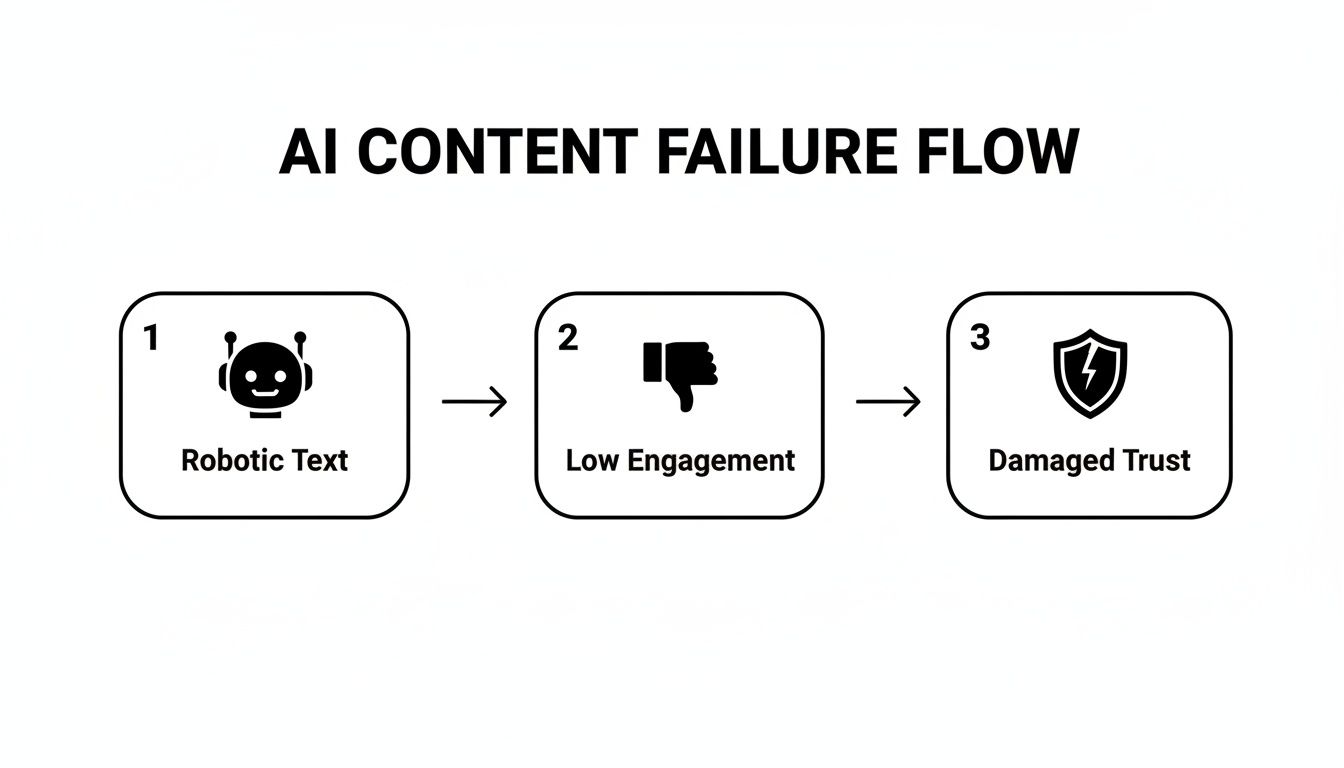
As you can see, the chain reaction is clear: a lack of human quality leads directly to negative outcomes. This is exactly why getting the prompt right is so important.
Advanced Prompting Strategies for Natural Output
Ready to go deeper? There are a few advanced techniques that can guide an AI’s thought process and stylistic choices, leading to far more sophisticated and less predictable output. These are the kinds of methods that help you break the patterns that AI detectors are trained to spot.
A simple prompt is a good starting point, but a well-developed, human-centric prompt is what produces truly compelling content. The evolution from a basic request to a detailed set of instructions is what separates generic AI text from writing that feels authentic.
Prompt Evolution From Basic to Human-Centric
| Prompt Element | Basic Prompt Example | Human-Centric Prompt Example |
|---|---|---|
| Role & Persona | N/A | "Act as a friendly, veteran copywriter with a decade of experience in B2B tech." |
| Audience | "Write an article." | "Write for marketing managers who are skilled but short on time. They appreciate direct, actionable advice." |
| Tone & Style | "Use a professional tone." | "Your tone should be conversational and confident, but not arrogant. Use humor and wit. Vary sentence length, mixing short, punchy statements with more descriptive ones." |
| Specifics | "Explain the benefits of content marketing." | "Include a short, relatable anecdote about a common content marketing mistake. Use at least two rhetorical questions to engage the reader directly." |
This table shows just how much more guidance a human-centric prompt provides. By adding these layers, you're not just telling the AI what to write, but how to write it.
Here are a few more practical strategies you can build into your prompts:
- Demand Varied Sentences: Directly tell the AI to "Vary the sentence length and structure. Use a mix of short, punchy sentences and longer, more complex ones. Avoid starting every sentence the same way."
- Ask for Anecdotes: Prompt the AI to invent a brief, relevant story. "Include a short, relatable anecdote about a blogger struggling with writer's block to illustrate this point."
- Use Chain-of-Thought (CoT): Guide the AI's logic step-by-step. Start your prompt with something like, "First, break down the concept of X. Then, explain why it's important for Y. Finally, offer three actionable tips." This creates a much more logical flow.
- Incorporate Rhetorical Questions: Tell the AI to engage the reader directly. "Incorporate rhetorical questions to make the reader think, such as 'But what does this actually mean for your bottom line?'"
Mastering these techniques turns prompting from a simple command into a truly creative process. For more examples and inspiration, you can explore different AI page content generation prompts to see how the pros build high-quality, human-like output. By investing a little more time in crafting your inputs, you’ll get far superior first drafts that need minimal polishing to feel completely human.
Your Guide to Manually Humanizing AI Text
Once your AI tool spits out that first draft, the real work begins. This is where your human expertise, your unique perspective, becomes the most valuable part of the process. Manual editing is what turns a technically correct but soulless piece of text into something that actually connects with a reader.
Think of the AI draft as a block of marble. It has the right shape, but you're the sculptor who has to carve out the details and bring it to life. This hands-on process is the only way to add that final layer of authenticity that no algorithm can fake. Your goal isn't just to publish content; it's to make it undeniably human.
Break Down Complex Sentences
One of the biggest tells of AI-generated text is its love for long, winding sentences filled with multiple clauses. They’re usually grammatically perfect, but they’re a slog for a human to read. Your first editing pass should be a search-and-destroy mission for these monsters.
Scan for any sentence that runs longer than 20-25 words. Can you slice it into two or even three shorter, punchier sentences? Doing this one thing will immediately improve the rhythm and make your writing far easier to read.
For instance, an AI might generate something like this: "Utilizing a multi-faceted approach that incorporates various digital marketing channels is instrumental for businesses aiming to enhance their online presence and connect with a broader target audience."
A human touch simplifies it: "Businesses need a solid digital marketing strategy to grow online. Using multiple channels helps them connect with more people. It’s a direct path to a wider audience." See the difference?
Vary Sentence Structure and Rhythm
Nothing kills engagement faster than monotony. AI models often fall into a predictable rhythm, with every sentence structured in a nearly identical way. This creates a droning, robotic tone that can make a reader’s eyes glaze over. Your job is to shake things up.
You want to create a more dynamic and engaging flow by consciously mixing up your sentence lengths.
- Short, punchy sentences: Use these to make a point. They grab attention. They feel confident.
- Medium-length sentences: These are your workhorses. They’ll carry the bulk of your information clearly and efficiently.
- Longer, descriptive sentences: Use these sparingly to add depth, provide rich context, or build a more complex idea.
When you alternate between these structures, you create a cadence that feels natural and conversational, pulling your reader right along with you.
A great piece of writing has a natural rhythm, much like a good conversation. Varying your sentence structure is how you find that rhythm and pull the reader along with you.
This is one of the most powerful manual edits you can make. It breathes life and energy into a text that might otherwise feel flat and sterile.
Inject Conversational Language and Personality
AI content usually defaults to a stiff, formal tone. It avoids contractions, slang, idioms, and the personal touches that make writing feel like it came from a real person. This is where you get to inject your own voice.
Comb through the draft and look for any place you can make the language more relaxed and natural.
- Use Contractions: Swap "do not" for "don't" and "it is" for "it's." This simple change instantly makes the text feel less robotic.
- Add Personal Stories: Weave in a brief, relevant anecdote. Instead of just stating a fact, try something like, "I once worked with a client who made this exact mistake, and the results were…"
- Ask Rhetorical Questions: Speak directly to your reader. Phrases like, "But what does this actually mean for you?" or "Sound familiar?" build a connection and make the content feel like a two-way conversation.
This is also your chance to make sure the content truly reflects your brand's voice. Are you witty and informal? Or more authoritative and direct? This is the stage where you ensure that unique personality comes through loud and clear.
Hunt Down and Replace AI-isms
After you've worked with AI content for a while, you’ll start to spot its favorite crutch words and phrases. These "AI-isms" are dead giveaways that a machine did the heavy lifting. Actively hunting them down and swapping them out is a crucial final step.
Keep an eye out for these common AI phrases:
- "In the world of…"
- "It's important to note that…"
- Overusing transition words like "Moreover," "Furthermore," and "In conclusion"
- Empty verbs like "delve," "unlock," and "unleash"
These words aren't inherently bad, but AI tools overuse them to the point that they've become red flags for detectors. Swap them for simpler, more direct language. Instead of "It's important to note that," just say the thing you want to say.
By putting in this manual effort, you’re doing more than just cleaning up a draft. You're taking ownership of the content, infusing it with the kind of nuance and authenticity that only a human can provide. This is what makes your content stand out and truly connect.
Using an AI Humanizer for Quality Content at Scale
Let's be real: manually editing every single piece of AI-generated text works, but it’s a massive time sink. If you're running a content team, a busy blog, or a marketing agency, that manual process quickly becomes a bottleneck that grinds your entire production schedule to a halt. This is precisely where a good AI humanizer becomes your best friend.
Instead of getting bogged down in hours of painstaking edits for each article, these tools are built to systematically rewrite text so it flows with a natural, human quality. A solid humanizer doesn't just swap out a few words here and there. It dives deep, understands the core message, and then rebuilds the content with the nuance and rhythm of a human writer, all while keeping the original meaning intact.

So, How Do These Things Actually Work?
At their core, AI humanizers are trained to spot the dead giveaways of machine-generated writing—those tell-tale statistical patterns. AI models tend to produce text with predictable word choices and overly uniform sentence structures. The humanizer's job is to smash those patterns, injecting the linguistic variety and occasional imperfection that signals genuine human writing.
This is a whole different ballgame from a basic paraphrasing tool. A simple article spinner might just replace words with synonyms, which often results in clunky, nonsensical sentences. A true humanizer, on the other hand, is all about context.
It can restructure entire sentences, shift the tone to feel more conversational, and dramatically improve the overall flow. The end goal isn't just to get a good score on a detection check; it's to create content that provides a genuinely good experience for the person on the other side of the screen.
Speed Up Production Without Killing Quality
Weaving a humanizer into your workflow can put your production schedule on hyperdrive. Instead of looking at an AI draft as a massive overhaul project, you can treat it as a solid foundation that just needs a final, expert polish from you.
Think of a humanizer as an intelligent assistant that handles about 80% of the heavy lifting. This frees you up to focus on the creative, high-level stuff that actually requires your expertise.
For content teams, this is a game-changer. You can churn out more blog posts, social updates, and marketing copy in a fraction of the time, all without the quality taking a nosedive. That kind of efficiency is what keeps you competitive and helps you maintain a consistent publishing calendar.
By automating the most tedious parts of editing, you’re ensuring every piece of content meets a high standard before it even lands on your desk for a final review. It’s a powerful way to make AI undetectable when you’re working at scale.
Choosing the Right Tool for the Job
Of course, not all humanization tools are built the same. When you're picking a platform to bring into your workflow, you need to think beyond its rewriting ability. This is a business decision, and there are a few key things to look out for.
Here’s what you should demand from a quality humanizer:
- Context is King: Does the tool actually understand your text? You need something that preserves the original meaning and intent, not a tool that introduces factual errors or garbles your core message.
- Privacy and Security: Your content is your intellectual property. Look for a tool with a crystal-clear privacy policy that respects your data and doesn’t hang onto your text indefinitely.
- A Painless Experience: The tool should be intuitive and slot easily into your process. A clunky, complicated interface will just slow you down, defeating the whole purpose.
For creators searching for a reliable and effective solution, a platform like AI Busted delivers the features you need to humanize content efficiently. A trustworthy tool is an investment in both your productivity and your brand’s reputation.
The Ethics of Creating Undetectable AI Content
Having the power to make AI-generated content sound completely human puts a serious responsibility on our shoulders. As creators, we constantly have to navigate the ethical line separating genuine enhancement from outright deception. This isn't some abstract philosophical debate; it's a practical choice we make every single time we hit "publish."
The whole issue really boils down to your intent. Are you using a tool to polish an AI draft, making it more readable and engaging for your audience? That’s a perfectly legitimate and smart use of technology. In this case, you’re treating AI as a high-powered assistant, helping you communicate more clearly and connect better with people.
Drawing a Clear Line in the Sand
But the ethical ground shifts completely when the goal is to mislead. Using these same techniques to cheat, like passing off an AI-written essay as your own for a class, is a clear-cut violation of academic integrity. It defeats the entire purpose of education, which is to build critical thinking skills, not just to generate text.
It gets even darker. Creating undetectable AI content to spread misinformation or churn out fake product reviews is actively harmful. This kind of malicious use erodes public trust and can cause real-world damage. It's the ugly side of this tech, and every responsible creator has to stand firmly against it.
The goal should always be to use technology to enhance human creativity and amplify our own unique insights—not to replace authenticity or mislead an audience.
Ultimately, the tool is neutral. The responsibility falls squarely on the user. It’s how we choose to wield this technology that determines whether it’s used for good or ill.
Why Authenticity Has Such High Stakes
The need for ethical use becomes crystal clear when you look at how this technology is being abused in other fields. The world of digital fraud offers a pretty stark warning of what happens when authenticity is compromised.
AI-powered fraud is exploding in the financial sector. Experts project that by 2025, over 50% of all scams will involve generative AI and deepfakes. We're already seeing fraudsters create synthetic identities and hyper-realistic videos that trick advanced verification systems, leading to a mind-boggling 3,000% surge in deepfake identity fraud cases in the US. This report on AI-driven cyber threats reveals that the problem is so severe, 90% of banks have been forced to deploy their own AI defenses just to keep up.
This high-stakes battle shows just how critical it is to prove you're the real deal. When readers start to suspect that content is deceptive or inauthentic, they immediately check out. Trust is incredibly fragile, and once it's gone, it's almost impossible to win back.
Knowing When to Be Transparent
So, when should you tell your audience you're using AI? There’s no one-size-fits-all answer, but a great rule of thumb is to be transparent whenever it's important for your audience's trust.
-
Marketing & General Content: For most blog posts and marketing materials, what matters is the quality and value of the information. If you've taken an AI draft and heavily edited it to reflect your own expertise and voice, a disclosure often isn't necessary. The final work is truly a product of your effort.
-
Journalism & Research: In fields where factual accuracy and authority are everything, transparency is non-negotiable. Disclosing the use of AI tools in your research or reporting process is essential for maintaining credibility.
-
Creative Works: If you’re a writer or artist, your audience is there for your unique voice. Being open about your creative process, including how you might use AI as a collaborator, can actually build a much stronger, more authentic connection with your followers.
Our platform is built to support the honest application of this technology. By committing to ethical practices, you can use these tools with confidence to produce amazing work. To see our commitment to responsible use in more detail, we encourage you to review our platform's terms of service.
Frequently Asked Questions
When you start working with AI-generated text, a lot of questions pop up. It’s a new frontier for many, and it's smart to wonder about everything from the technical side to how it all plays out with SEO. Let's dig into some of the most common questions we hear.
My goal here is to give you clear, straightforward answers so you can use these tools well and feel confident about the content you're producing.
Can AI Content Ever Be 100% Undetectable?
It's tempting to chase a perfect 100% human score, but that can be a bit of a distraction. Think of it more like a cat-and-mouse game—AI generation gets better, and then AI detection gets better, and the cycle continues. The most solid strategy isn't about fooling a machine; it's about creating content that is genuinely great.
When you focus on making your content valuable, easy to read, and factually correct, it starts to look and feel like something a person would write anyway. That inherent quality is what really matters. A sophisticated humanizer just helps you get there faster.
The real win isn’t just about achieving a high human score. It's about producing content so compelling that the reader never even thinks to question where it came from.
If you put the reader's experience first, you build a content strategy that will stand the test of time, no matter how the algorithms change.
How Does Humanizing AI Content Actually Affect SEO?
Humanizing your AI drafts isn't just for show—it has a huge, positive impact on your SEO. Google and other search engines are all-in on content that shows real E-E-A-T (Experience, Expertise, Authoritativeness, and Trustworthiness).
Raw AI text often falls flat here. It usually lacks the personal anecdotes, nuanced opinions, and authentic voice that build trust with an audience. By humanizing your drafts—weaving in unique perspectives, smoothing out the language, and nailing the tone—you're directly boosting those crucial quality signals. This not only makes your content more engaging for people but also helps it climb the search rankings.
What Are the Biggest Mistakes People Make When Humanizing Text?
The most common trap is getting obsessed with achieving a certain score and forgetting about the actual human who will be reading the content. People often reach for basic article spinners or synonym-swapping tools, which just leads to clunky, awkward sentences that can ruin the message.
Another mistake is over-editing. Sometimes, in an effort to make it sound human, you can edit the life right out of a piece until it loses its clarity. The key is finding a balance between using technology to do the heavy lifting and applying your own final judgment.
Here’s a workflow that helps you avoid those pitfalls:
- Get the first draft down with AI. Use it for speed and to get the basic structure in place.
- Run it through a quality humanizer. This will smooth out the robotic patterns and improve the flow.
- Do a final human review. This is your chance to add personal stories, double-check facts, and make sure the tone is a perfect fit for your brand.
That final read-through is non-negotiable. It’s the last line of defense to ensure your content truly connects and serves its purpose.