
When people talk about "undetectable AI content," it's easy to get the wrong idea. This isn't about some sneaky trick to fool algorithms. The real goal is far more practical: to take text that was first drafted by AI and polish it until it reads with the clarity, style, and natural flow of a seasoned human writer. It's about achieving a 100% human score on detection tools because the content is genuinely high-quality, not because it’s deceptive.
What Is Undetectable AI Content Really About
The whole conversation can get bogged down in a cat-and-mouse game of outsmarting AI detectors. But that misses the point entirely. The true aim is to elevate the final product—to take a functional but often flat AI draft and breathe some life into it with a real human perspective.
Think of an AI writing tool as an incredibly efficient research assistant. It can pull together facts, outline an argument, and write grammatically perfect sentences at a speed no human can match. What it can't do is bring lived experience, emotional intelligence, or a unique voice to the page. Those are the things that make writing truly connect with people. To get a better feel for this, it helps to understand the fundamentals of AI-powered content creation and how these models operate at their core.
The Problem of Digital Fingerprints
Large language models (LLMs) learn by analyzing massive amounts of text from the internet. In doing so, they pick up on statistical patterns and develop certain "habits." These predictable tendencies leave behind subtle digital fingerprints that AI detectors are built to find.
So, what do these fingerprints look like in practice?
- Predictable Phrasing: The AI often defaults to common, safe word choices that lack any real spark or originality.
- Overly Consistent Sentence Structure: You'll see a monotonous rhythm—a lack of the natural variation in sentence length and complexity that human writers use to keep readers engaged.
- Perfectly Uniform Tone: The writing lacks the small, natural shifts in tone and emotion that a person instinctively adds.
When an AI detector flags a piece of content, it's not making a judgment. It's just running a probability check and saying, "The way these words are put together is statistically more likely to have come from a machine than a person."
Shifting from Deception to Humanization
This is where "humanizing" comes into play. It's a hands-on editing process designed to smooth out those robotic edges and weave in authentic human touches. The objective isn't to be dishonest, but to create a final piece that is genuinely valuable and enjoyable to read. You can see how this works with tools like our own free AI humanizer here: https://aibusted.com/public/
To illustrate the difference, here's a side-by-side comparison of what raw AI output often looks like versus a thoughtfully humanized version.
Raw AI Output vs Humanized AI Content
| Characteristic | Typical AI-Generated Text | Humanized AI Text |
|---|---|---|
| Voice & Tone | Often flat, generic, and overly formal. Lacks a distinct personality. | Has a clear, authentic voice. The tone shifts naturally to match the topic. |
| Sentence Structure | Repetitive sentence lengths and predictable patterns. Monotonous to read. | A dynamic mix of short, punchy sentences and longer, more complex ones. |
| Word Choice | Relies on common words and clichés. Avoids idioms and nuanced language. | Uses precise, evocative language, including idioms and metaphors, to add depth. |
| Flow & Rhythm | Can feel disjointed or choppy. Transitions are often formulaic ("In conclusion…"). | Flows logically from one idea to the next with smooth, natural transitions. |
| Originality | Tends to state facts without offering unique insights or a fresh perspective. | Weaves in personal anecdotes, original analysis, and a unique point of view. |
As you can see, the humanized version isn't just about passing a scan; it's about creating a better reading experience.
The ultimate goal is to create content that resonates deeply with human readers and is rewarded by search engines for its quality, originality, and authority—not just its ability to pass a detection scan.
This mindset puts AI in its proper place: as a powerful assistant that provides a solid first draft. The human writer's job is to then add the essential final layers of insight, storytelling, and polish that turn a good piece of content into a great one.
How AI Content Detectors Actually Work
If you want to create content that reads like it came from a person, you have to get inside the head of an AI detector. These tools aren't pulling back a magical curtain; they’re just incredibly sophisticated pattern-recognition systems.
Think of a detector like a literary analyst. But instead of spotting plagiarism, it’s trained to find the statistical "fingerprints" that machine learning models tend to leave all over their work. It breaks text down—words, sentences, paragraphs—and calculates the odds that an algorithm pieced it all together. The whole game is about finding patterns that are just a little too perfect, too predictable, or too uniform to have come from a wonderfully messy human mind.
Making genuinely undetectable ai content is really about understanding these giveaways and smoothing them out. It all comes down to a few key metrics that separate our writing from a machine's.
Perplexity and Burstiness
Two of the most important concepts you'll hear about are perplexity and burstiness. They sound a bit academic, but the ideas are actually quite simple.
Perplexity is just a fancy way of measuring how predictable a text is. An AI that’s been trained on half the internet will almost always pick the most statistically probable next word. Humans? We’re wonderfully unpredictable. We make surprising word choices, use quirky phrasing, and invent metaphors that an algorithm would never see coming. A text with low perplexity is highly predictable, which is a major red flag for an AI detector.
Burstiness, on the other hand, is all about the rhythm and flow of your sentences. We humans tend to write in bursts—a short, punchy sentence followed by a long, descriptive one. It creates a natural, dynamic reading experience. AI-generated text often lacks this, producing sentences of a similar, monotonous length. That flat, robotic rhythm is another dead giveaway for a detector.
This concept map helps visualize how humanizing your content bridges the gap between raw AI output and the qualities that build real trust and connection.
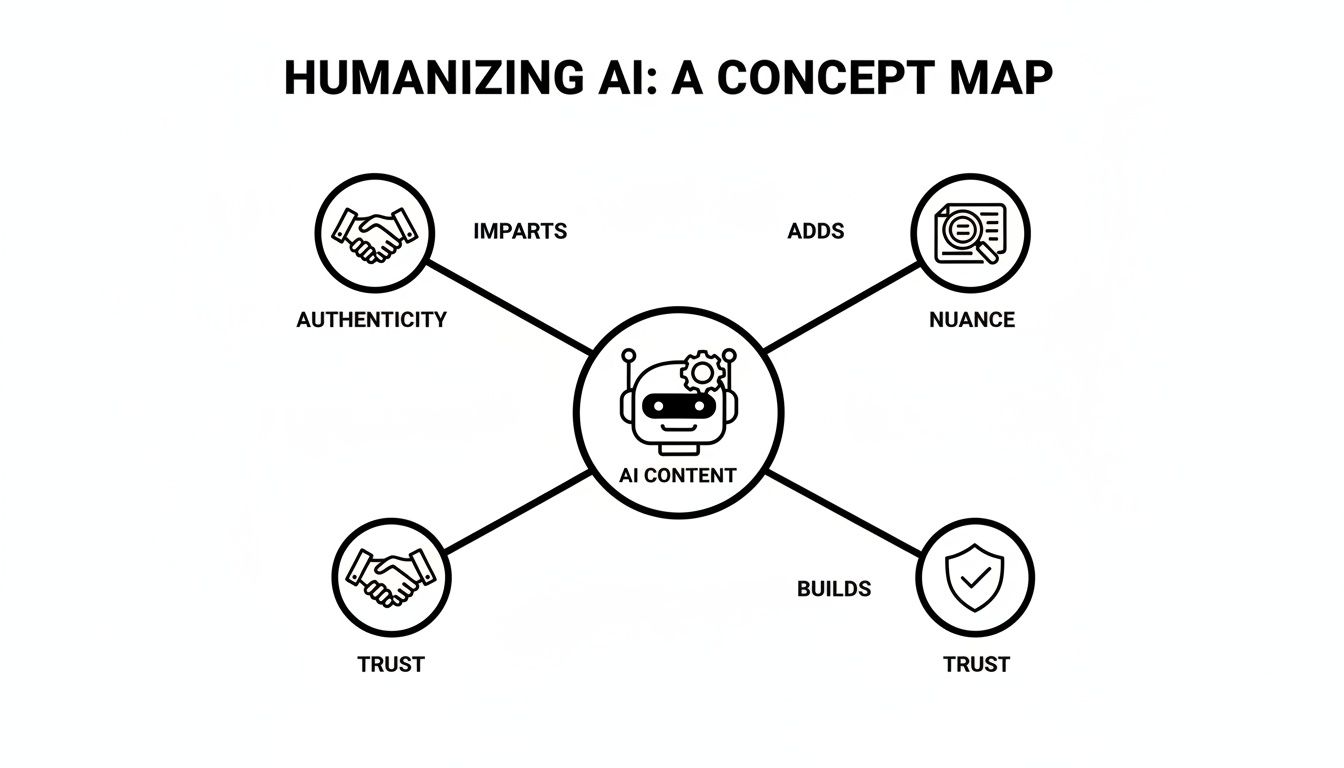
As you can see, the goal is to inject that essential authenticity, nuance, and trust—the very things that detectors notice are missing from machine-generated text.
The Limits of AI Detectors
For all their cleverness, these tools are far from perfect. One of their biggest flaws is the high rate of false positives, where perfectly good human writing gets flagged as AI-generated. This is especially common with simple, factual writing that naturally has low perplexity.
On top of that, the accuracy of these detectors is all over the place. By mid-2025, some reports found that the best institutional tools could hit 75–80% accuracy under ideal lab conditions. But many of the tools available to the public? They perform much, much worse. Some popular detectors barely break 50% accuracy, which is essentially a coin toss.
Relying on these scores alone can lead to serious mistakes.
The real takeaway here is that AI detectors are not the final word on authenticity. They are simply guides that point out statistical patterns. You should always treat their results with a healthy dose of skepticism and your own judgment.
This is exactly why focusing on humanizing AI-assisted text is a much better strategy than trying to outsmart a flawed system. A tool like AI Busted is built to help writers with this, not to cheat a scan. It helps you refine AI drafts into something polished, natural, and genuinely engaging for your readers.
The point isn't just to pass a test; it's to create truly great content.
Decoding Claims of 100% Undetectable Performance
The market is buzzing with tools making some pretty bold promises—"100% human scores" and completely "undetectable" content. It's a tempting offer, especially when you're trying to produce great work under a tight deadline. But what’s really going on behind the marketing hype?
Let’s be clear: no single tool can guarantee its output will be recognized as fully human by every AI detector, now and forever. The technology on both sides of this cat-and-mouse game—generation and detection—is evolving at a dizzying pace. Thinking of these platforms as a magic wand is a recipe for disappointment. A much better way to see them is as incredibly sophisticated stylistic editors.
Their real magic isn't about deception; it's about helping you rewrite text to have the natural, varied qualities of human writing. They work to smooth out the robotic, predictable patterns of raw AI output by mixing up sentence structures and word choices, creating a flow that feels far less machine-like.
The Truth About Performance Claims
When you dig into independent tests and see what actual users are saying, a more realistic picture starts to form. The performance of these tools can be all over the map, which really just highlights their role as powerful assistants, not foolproof solutions. They simply can't replace a sharp human eye and good judgment.
For instance, a wave of services promising to make AI text read naturally has hit the market. But when you put them to the test, the results aren't always what you'd hope for. Hands-on reviews often show that while some tools can definitely improve AI detection scores, they rarely make content universally "human" across different detectors and types of writing. You can find more real-world tests and user feedback on gptinf.com to see how these tools really perform under pressure.
This inconsistency drives home a critical point: creating truly undetectable AI content is less about finding one perfect tool and more about building a smart, human-led workflow.
A Partnership, Not a Replacement
The most effective way to use these tools is to go in with your eyes wide open. They aren’t here to take over the writing process for you. They’re here to speed up the most tedious parts of editing and refining, letting you focus on what really matters. Your role as the writer, editor, and subject-matter expert is more important than ever.
Think about it this way:
- Initial Draft Cleanup: Use a humanizer to do a quick first pass on an AI draft, catching awkward phrasing and smoothing out the flow.
- Stylistic Polish: These tools are brilliant at injecting variety, breaking up those monotonous, machine-like sentence patterns.
- Final Quality Control: The buck always stops with you. You're responsible for fact-checking, adding unique insights, and making sure the final piece sounds like your brand.
The ultimate goal isn't just a "100% Human" score. It's to create content that's accurate, insightful, and genuinely useful to your audience—a bar no automated tool can clear on its own.
How to Use These Tools Responsibly
To really get the most from a text humanizer, you need to weave it into a larger quality control process. The mission isn't just to be undetectable; it's to be exceptional.
Here’s a practical workflow that works:
- Generate the Core Ideas: Start with an AI-generated draft to get your basic structure and key points on the page.
- Apply the Humanizer: Run that text through a tool like AI Busted to do the heavy lifting of the initial stylistic rewrite. This step helps erase the most obvious digital fingerprints left by AI models.
- Inject Your Expertise: This is where you bring the real value. Weave in personal stories, original analysis, expert quotes, or proprietary data—the things an AI could never come up with.
- Fact-Check and Refine: Meticulously check every fact, figure, and claim. Then, polish the text until it perfectly matches your brand's unique voice and tone.
By following this kind of process, you turn the tool from a simple utility into a powerful collaborator. You provide the critical thinking and creativity, ensuring the end result is something you can actually be proud of. This strategic approach is the key to creating genuinely undetectable AI content that holds up to scrutiny from both algorithms and, more importantly, human readers.
The Ethics of Humanizing AI Content

The power to create undetectable AI content pushes us past a simple technical question and into a much bigger ethical one. The conversation is no longer about if we can do it, but how we do it with integrity. At the end of the day, humanizing text should serve one purpose and one purpose only: to make the experience better for the reader, not to pull the wool over their eyes.
That distinction is everything. When you take a raw, AI-generated draft and start refining it, your goal should be to make the information clearer, the story more compelling, and the overall piece more valuable. Think of it as quality control, plain and simple, ensuring what you publish meets your high standards for accuracy and readability.
The Line Between Improvement and Deception
I like to think of AI writing tools as brilliant but hopelessly inexperienced assistants. They can pull together facts and spit out grammatically correct sentences, but they have zero real-world judgment and none of the unique perspective you bring to the table. The only ethical way to approach this is to treat that AI draft as just a starting point—the raw clay you're about to shape with your expertise.
This means the buck stops with you. The accuracy of the facts, the nuance of the tone, and the impact of the final message are all on your shoulders. The finished product has to be a true reflection of your brand's voice and your commitment to giving people information they can trust.
The core message is that humanizing AI content is about adding value that a machine simply cannot replicate. It’s about injecting your experience, your analysis, and your unique story into the narrative.
The moment your intent shifts from enhancing clarity to deliberately hiding the source of flimsy or false information, you've crossed a serious ethical line. Taking that shortcut comes with huge risks that can tarnish your reputation and destroy the trust you've worked so hard to build.
A Framework for Responsible Humanization
To stay on the right side of that line, it helps to have a clear set of rules. These best practices ensure you’re using humanization tools to support good, honest work—not to cut corners or mislead your audience.
- Verify Every Fact: AI models are notorious for "hallucinating" information. You absolutely must fact-check every single statistic, claim, and statement before you even think about publishing.
- Inject Your Unique Perspective: Don't just reword what the AI gave you. This is your chance to add original insights, tell a personal story, or provide expert analysis that only a human can.
- Ensure Brand Voice Consistency: Does the final draft sound like you? Polish the tone, style, and word choice until it perfectly matches your established voice.
- Prioritize Reader Value: With every change you make, ask yourself: does this make the content easier to understand? More engaging? More helpful? If the answer is no, the edit isn't worth making.
Following these principles creates a solid framework where "humanizing" is about quality assurance, making sure your content is both effective and ethical. Transparency is also key, especially in how you handle data. For a closer look at our approach, you can read the AI Busted privacy policy.
The High Cost of Misuse
While ethical humanization makes content better, misusing these techniques opens a Pandora's box of problems. The ability to create polished, undetectable AI text can be weaponized to spread misinformation, cheat on academic assignments, or generate spam on a scale we've never seen before.
Analysts are already trying to calculate the real-world damage. A 2024–2025 synthesis of industry reports pointed to several areas of harm, from synthetic media being used in sophisticated scams to a general decline in trust for online news and reviews. These aren't just hypotheticals; they’re linked to real financial losses and a measurable drop in public trust wherever this kind of content runs rampant. You can learn more about the societal costs of undetectable AI on Originality.ai.
For any creator, though, the single biggest risk is losing your audience's trust. Once it's gone, getting it back is next to impossible. In the long run, the only sustainable strategy is to use technology to support—not replace—the hard work of creating genuinely valuable and honest content.
Practical Techniques to Humanize AI-Generated Text
Turning robotic text into something that actually connects with a reader is an art. It’s about more than just a quick grammar check; you have to intentionally infuse your own human touch into the draft.
This is where your role shifts from a simple editor to a true creator. You’re shaping the raw AI output into a piece that feels authentic and builds trust. The goal is to create undetectable AI content, not by trying to trick an algorithm, but by elevating the quality so it’s genuinely indistinguishable from expert human writing.
Establish a Natural Rhythm and Flow
One of the biggest red flags of AI content is its monotonous rhythm. The sentences are often the same length and structure, which makes for a pretty flat reading experience. Your first job is to break that up.
Start by varying your sentence length. Try following a long, descriptive sentence with a short, punchy one. It immediately makes the text more dynamic and keeps your reader from tuning out. This simple trick mimics how people actually talk, creating a cadence that feels conversational, not calculated.
The objective is to make the text sound like it was spoken by a person, not assembled by an algorithm. This means embracing imperfections, varying your pacing, and allowing the rhythm of your words to guide the reader through the story.
This one change does wonders for readability. You’re no longer just dumping information; you’re controlling the pace and adding emphasis right where you want it.
Inject Your Authentic Voice and Perspective
AI models don't have a personality. They can fake a tone, sure, but they can't replicate your unique voice—the blend of your experiences, opinions, and little quirks in how you phrase things.
Start by swapping out generic AI phrases for your own words. If the AI spits out a stuffy, formal term, ask yourself if a more casual word fits your style better. Weave in a personal story or a relatable example that a machine could never come up with. This adds originality and, more importantly, forges a genuine connection with your readers. To build trust with both people and search engines, it helps to understand newer concepts like Answer Engine Optimization (AEO), which prioritizes authoritative, helpful content.
Here’s how you can start injecting your voice right away:
- Use Idioms and Metaphors: Sprinkle in common sayings or create your own analogies to explain a tricky concept. It adds color and a distinctly human flavor.
- Ask Rhetorical Questions: Pull your audience into the conversation. Posing questions makes them think and breaks up the wall of text.
- Share a Strong Opinion: Don't be afraid to have a point of view. A clear, well-supported stance is far more compelling than the bland, neutral tone AI often defaults to.
Add Irreplaceable Human Value
The most powerful humanization technique is adding something the AI simply can't create. This is where you bring in original research, expert insights, and unique data that makes your content one-of-a-kind.
An AI can scrape the web and summarize what's already out there, but it can't interview an expert, survey your audience, or share a firsthand account of a personal experience. By enriching the AI-generated foundation with these unique elements, you’re creating something new. Add a quote from a specialist you spoke with. Include a chart with data from your own case study. These additions are undeniable proof of human effort and instantly boost your content's authority.
This final layer is what truly makes AI content undetectable—because it becomes fundamentally human.
To help you put these ideas into practice, here's a simple checklist you can follow to refine any piece of AI-generated text.
Your Actionable Humanization Checklist
| Technique | Description | Impact on Content |
|---|---|---|
| Vary Sentence Structure | Mix short, direct sentences with longer, more complex ones. | Creates a natural, conversational rhythm that keeps readers engaged. |
| Incorporate Personal Stories | Add brief anecdotes or relevant personal experiences. | Builds an emotional connection and makes the content more memorable. |
| Use Idioms & Analogies | Explain concepts with familiar sayings or creative comparisons. | Adds personality, simplifies complex ideas, and sounds distinctly human. |
| Replace Formal Words | Swap robotic words like "utilize" for "use" or "leverage" for "apply." | Makes the tone more accessible and less like an academic paper. |
| Add Expert Quotes | Include insights from industry leaders or subject matter experts. | Boosts credibility and provides unique value that can't be scraped. |
| Include Original Data | Present findings from your own surveys, tests, or case studies. | Establishes authority and makes the content an original source of information. |
| Ask Direct Questions | Pose rhetorical or direct questions to the reader throughout the text. | Creates an interactive experience and encourages deeper thought. |
| State a Clear Opinion | Take a definitive stance on the topic instead of staying neutral. | Shows confidence and gives the content a strong, authentic voice. |
By systematically working through these techniques, you're not just editing—you're transforming a generic draft into a valuable, authentic piece of content that truly serves your audience.
Frequently Asked Questions
As you get more familiar with AI content, a lot of questions pop up. It's a new frontier, after all. Here are some clear, no-nonsense answers to the most common ones we hear.
Can AI Content Ever Be 100% Undetectable?
The dream is a perfect 100% human score, every single time. But let's be realistic—no tool can promise its output will be recognized as fully human by every detector, forever. The technology on both sides, creation and detection, is moving incredibly fast.
Think of it this way: humanizing tools don't make content "invisible." They rewrite AI text to have the statistical fingerprints of human writing. They mix up sentence structures, swap in more interesting words, and break up the monotonous, robotic rhythm that AI often has. This massively improves your chances of getting a high human score, but you, the human, are the essential last step for ensuring true quality. The goal isn't just to pass a test; it's to create something genuinely good.
Is It Unethical to Use a Tool to Humanize Content?
This is a big one, and the answer really boils down to your intent. Are you using a tool to clean up a clunky AI draft, making it clearer and more enjoyable for your audience? That’s just good editing, like running a spell-check or using a grammar tool.
Where you run into trouble is when the goal is to deceive. Using these tools to hide plagiarism, push out misinformation, or cheat on an essay is obviously unethical. The responsible path is to use technology to add value—your own insights, your unique voice, and your commitment to accuracy—not to cut corners or mislead people.
It all comes down to a simple principle: if you're trying to give your reader a better experience with high-quality, truthful information, you're on the right track. The focus has to be on the value of the content, not just where it came from.
Why Does My Own Writing Sometimes Get Flagged as AI?
It's a frustrating but surprisingly common problem, and it perfectly illustrates the flaws in today's AI detectors. These tools aren’t reading for meaning; they're looking for statistical patterns. They measure things like word predictability (called perplexity) and sentence variety (called burstiness).
Here are a few reasons your human-written text might get a false positive:
- Just-the-Facts Writing: If your writing is very direct and factual, with simple language, it can have low perplexity. To a detector, this predictability looks a lot like a machine.
- Too Much Editing: If you've over-edited a piece, especially with grammar tools that tend to smooth everything into a standard format, you can strip out its natural, human quirks.
- Writing by Numbers: Some formats, like technical guides or basic listicles, follow a very predictable structure that can easily trigger an AI detector.
This is exactly why you should take any detector score with a grain of salt. It’s not a final verdict. It's just a data point, a hint that your text might sound a bit robotic and could use a little more natural flow.
Can't I Just Edit AI Text Myself to Make It Undetectable?
Absolutely. In fact, a talented writer can often get better results by hand than any automated tool. You can do it all yourself—vary your sentences, add personal stories, use more vivid language, and weave in your own expertise. This manual approach is the best way to make sure the final piece sounds exactly like you.
The catch, of course, is time. Manually rewriting a 2,000-word article to sound completely human can take hours. That's where humanizing tools become so useful. They’re like a powerful assistant, doing the heavy lifting of that first stylistic rewrite in just a few seconds. This frees you up to focus on what really matters: fact-checking, adding your expert take, and making sure the content hits its mark. For most people, a hybrid approach is the sweet spot—let the tool do the first pass, then add your own finishing touches.