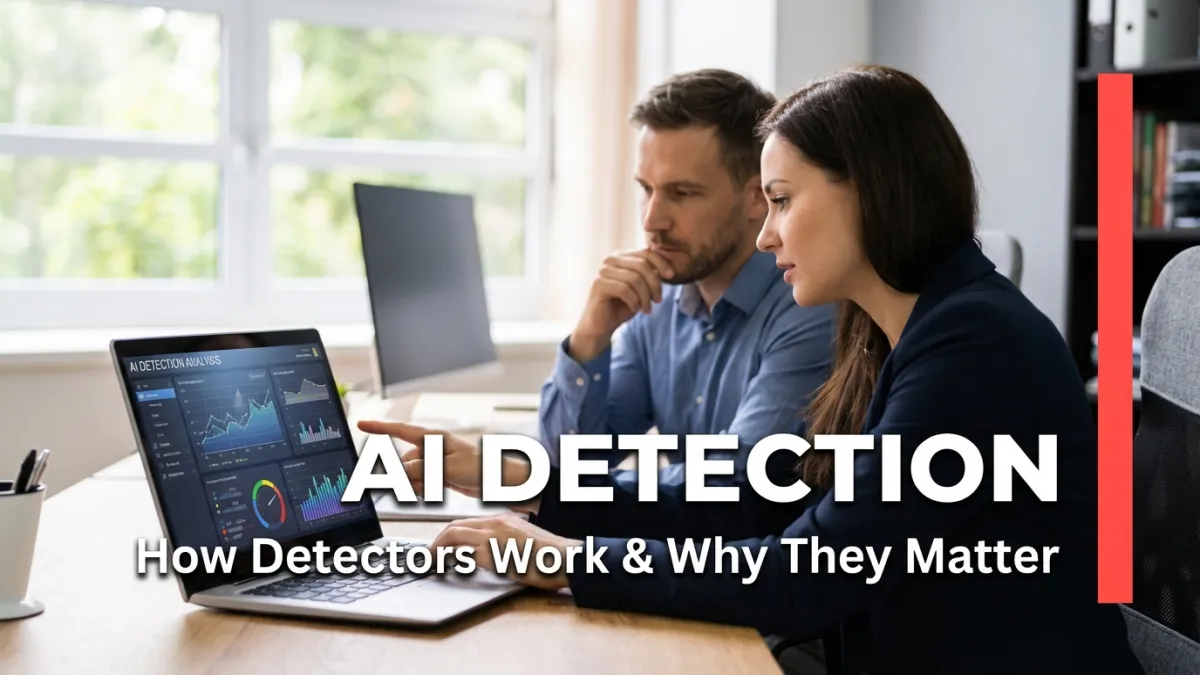
Quick Answer AI Busted treats AI detection as pattern scoring, not proof of authorship. Most checkers read rhythm, word predictability, and sentence shape, then return a probability. That number can guide review, yet it cannot prove who wrote the page. If you need a second opinion before you submit or publish, AI Busted gives you a direct multi-signal check in one place.
AI detection asks one narrow question: does this text look like model output, human writing, or a mix. It compares writing patterns, then gives you a confidence score. Use that score as a review trigger, not a final ruling.
What Is AI Detection?
When you run text through tools like GPTZero or Originality.ai, the software scans thousands of linguistic markers. AI models like GPT-4, Claude, and Gemini write in predictable patterns.
They favor common word choices, even sentences, and logical flow. Human writing is messier. You use odd word combinations, vary your sentence rhythm dramatically, and make leaps that machines avoid. These statistical differences are what tools hunt for.
How Does AI Detection Work?
Each checker reads your draft and scores pattern signals. No tool watches your writing session, your browser tabs, or your intent. It only inspects the text you paste in.
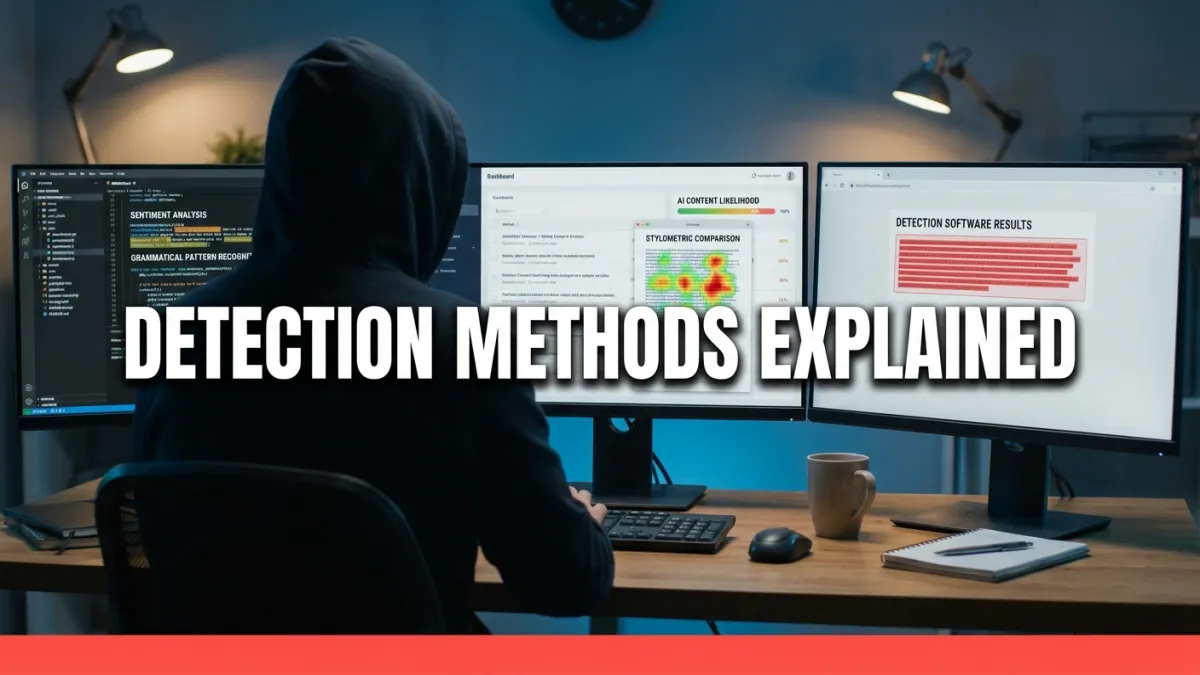
Most products use four methods. Each one helps in one case and weakens in another. For method background, see this Grammarly explainer and the University of Illinois writing guidance.
Perplexity Analysis
Perplexity checks how expected each next word looks to a language model. Raw model output often lands on safer word choices, which can push perplexity lower.
Human drafts move in less even ways. You shift tone, switch phrasing, and take small side turns. That raises unpredictability and can pull the score away from pure model output.
Burstiness Detection
Burstiness tracks sentence rhythm. People jump between short lines and longer lines, while raw model text often stays in a flatter cadence.
Checkers use that rhythm gap as one signal. The signal gets weaker on tiny samples like one short paragraph.
Statistical Classifiers
Classifier models train on labeled human and model samples, then score new text by token and structure patterns. In testing, results hold up better on raw model output and drop after manual edits.
That drop matters in editing workflows. Small human revisions can move a borderline score by a wide margin.
Watermarking
Watermarking hides a signature in model output that only the model owner can verify. This method can beat plain pattern scoring when a watermark exists and remains intact.
Most public checkers still depend on pattern scoring, not watermark checks. That keeps false positives and false negatives in play.
Which AI Detection Tools Perform Best in Practice?
| GPTZero | Fast, easy to run, free tier | Less stable on short samples | Quick first-pass screening |
| Turnitin | Common in schools, LMS support | Slow review loop, paid access | Academic workflows |
| Originality.ai | Wide model coverage, credit pricing | Can flag clean human writing | Publishing teams |
| Copyleaks | Multi-language support, AI plus plagiarism checks | Mixed consistency by content type | Education and compliance teams |
| ZeroGPT | No-cost entry, simple UI | Results shift on long drafts | Casual spot checks |
In side-by-side tests, these tools caught most unedited model drafts, then dropped after human rewrites. That gap explains why one checker can show a high score while another gives a mid score on the same passage.
If you publish at volume, run at least two checkers before sign-off. Cross-checking cuts single-tool bias and gives cleaner reviewer notes. For added context, review how reliable AI detectors are and common AI detection failure modes.
Why Does AI Detection Matter (And Where Does It Fail)?
Educational and Professional Stakes
Schools and universities are using AI detection to maintain academic integrity. Teachers use Turnitin and Originality.ai to verify student work, while hiring managers worry about AI-written cover letters and publishers verify human authorship claims.
The stakes are real. Students have faced penalties based on detection flags, though some were false positives.
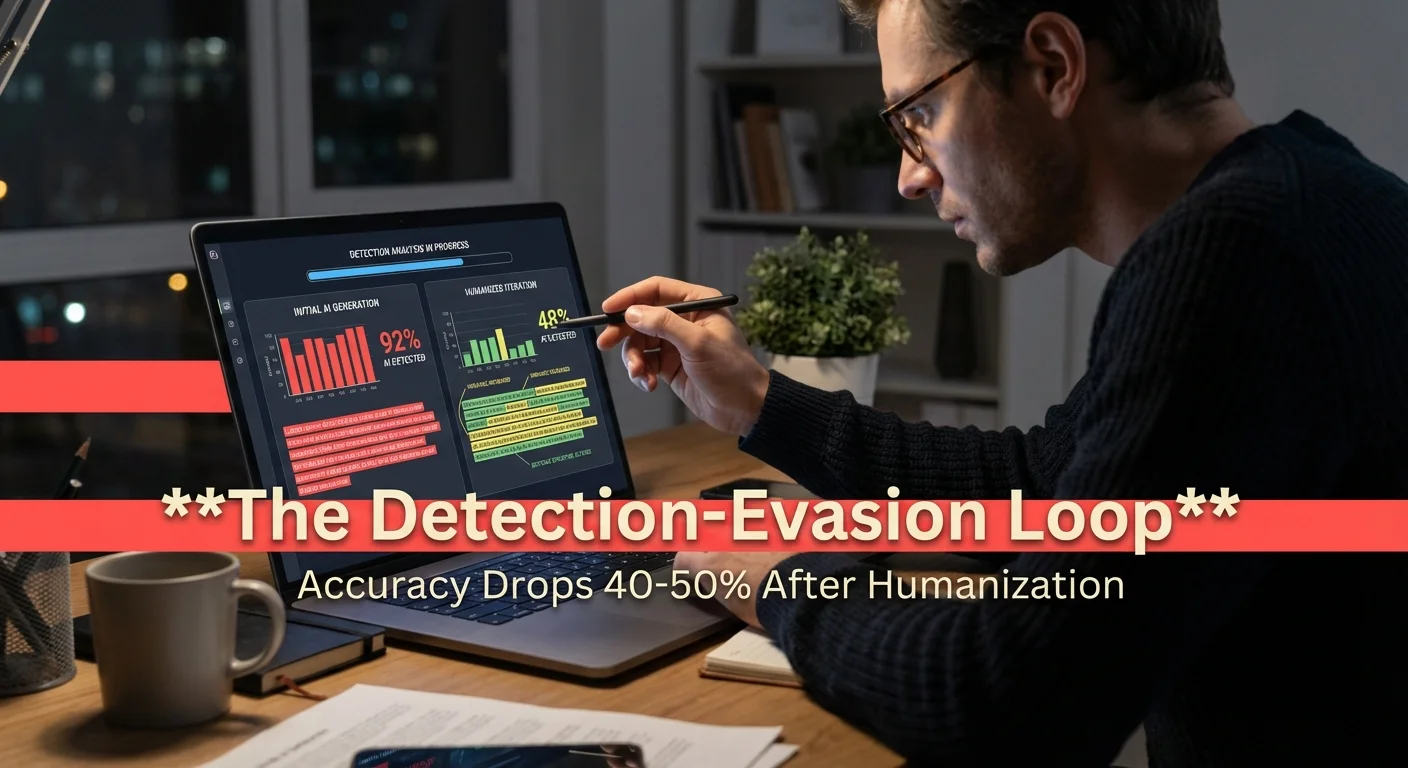
The Detection-Evasion Loop
This approach has a critical weakness: it reacts rather than anticipates. Detectors are trained on today's AI output. But new models and fine-tuning techniques emerge regularly.
A tool trained on GPT-3.5 text may miss patterns specific to GPT-4o or Claude 3.5. Evasion techniques exist too. Check our guide on how to trick an AI detector to see why they aren't foolproof.
AI humanizers can edit AI text to inject the burstiness and unpredictability tools look for. Some intentionally introduce typos, rare words, and fragmented sentences to fool classifiers.
Why Detectors Aren't Foolproof
These tools are probabilistic, not judges. They output probability scores, not proof. An 87% score means the tool thinks the text is likely AI-generated, not that it is.
Edge cases trigger false positives:
- Heavily edited AI text (accuracy drops to 40-50%)
- Mixed AI and human writing (partial rewrites)
- Non-native English speakers (humans can have "AI-like" patterns)
- Technical or formulaic human writing (financial reports, product specs)
Can Teachers and Employers Actually Detect AI?
Short answer: sometimes, but not reliably.
A teacher using Turnitin might catch obvious AI essays. The tool flags text matching known AI patterns, and the teacher investigates further.
An employer reviewing a cover letter can spot red flags: overly polished language, zero personality, paragraphs that start with topic sentences. These are contextual cues, not statistical detection.
But neither method is bulletproof. The student who runs ChatGPT through a humanizer, then hand-edits a few paragraphs, will likely pass detection. The job candidate who uses AI to write, then personalizes with real examples, will seem human.
What Happens When Detection Goes Wrong?
False positives create real problems. Students have contested penalties based on detection flags.
One student's college essay was flagged by Turnitin as AI-generated. They appealed and the flag was reviewed. It was later determined to be a false positive.
False negatives matter too. When the tool misses AI text, plagiarism slides through and the system fails in the opposite direction.
The lesson: Detection is a screening tool, not a judge. It should trigger review and conversation, not automatic penalties.
How Do You Work With AI Detection?
If you use AI to create content, know this:
- Unmodified AI output is detectable. Run text through humanizers or edit it manually if you're worried.
- These tools are probabilistic. A "70% AI" flag doesn't mean the text is definitively AI-generated.
- Different tools disagree - one flags 95% AI while another says 40%.
Neither reading is definitive. Transparency beats evasion. Disclosing AI use (where appropriate) is safer than hiding it.
For content creators, test your work with Originality.ai before publishing. Educators can learn more about why tools sometimes flag human writing incorrectly and how to discuss results with students.
People Also Ask
How accurate is AI detection in 2026?
Most tools catch 70-85% of unmodified AI text but drop to 35-50% after humanization. Accuracy varies by tool and model. Read our full breakdown in how reliable are AI detectors.
Can AI detectors tell if I used ChatGPT?
Detectors flag text as "likely AI-generated" but cannot identify the specific model used. They analyze statistical patterns common to all large language models. Learn more about why AI detectors flag your writing.
What is the best free AI detector?
GPTZero offers the most popular free tier for quick screening. ZeroGPT is equally free but less reliable on longer text. For paid options with higher accuracy, see our best AI content detector roundup.
Can you make AI text undetectable?
Yes, through manual editing or AI humanizer tools. Humanizers reduce detection rates by 40-50%. Check out the top AI humanizer tools and learn how to rewrite AI text to pass detection.
What Should You Do About AI Detection?
Start with policy, then run checks. If you are a student, read school rules first. If you publish content, test before release and keep edit history for each major draft.
Treat detector output as risk screening. High scores need review and evidence checks, not instant penalties. Low scores help, yet they still do not prove full human authorship.
Keep the workflow simple: draft, edit, run a checker, revise flagged lines, then run one final pass in AI Busted before you submit.
FAQ
Can AI detectors distinguish GPT-4 from GPT-3.5?
Most detectors can't tell which AI model created the text. They flag "likely AI-generated" without naming the source. Testing shows GPT-4 output is slightly harder to detect than GPT-3.5, but the difference is marginal.
What's the difference between AI detection and plagiarism detection?
Plagiarism detection checks if text matches known sources (books, websites, papers). AI detection checks if patterns match known AI output.
They're complementary. You can have original AI text that passes plagiarism checks but fails AI detection.
Do AI detectors work on code or images?
AI detection is still primarily text-based. Some tools experiment with image forensics. Commercial detectors for code and images lag far behind text detection.
Why do detectors sometimes flag human writing as AI?
Certain human patterns trigger false positives: technical documentation, highly structured essays, non-native English speakers with limited vocabulary. Manual review is always recommended.
Can I beat an AI detector?
Yes, with effort. Humanizers reduce detection rates by 40-50%.
Manual editing is even more effective. But heavy editing defeats the point of using AI to save time.