

You submit your work and a detector flags it as AI-generated. You tweak the wording, resubmit, and it still gets caught. The problem isn't the tool you used. It's that you don't know what AI detectors look for.
The specific patterns and signals they scan for are straightforward. Breaking them down shows you what triggers a flag and how to avoid it. Recognizing those patterns lets you adjust your writing, and tools like AI Busted make that verification simple.
What do AI detectors look for?
AI detectors look for three statistical patterns: highly predictable word choices, little variation in sentence length, and sentences of nearly identical length. Predictable word choices means each word is easy for a language model to guess next. Little variation in sentence length means your sentences are all about the same number of words. Text from ChatGPT scores predictably low on both.
Start by rewriting flagged sentences in your own voice, varying sentence length and adding concrete details a model would not predict.
That direct answer matches how the major detectors describe their own statistical approach: they score patterns in the text, not its meaning.

What you'll need
AI detectors rely on statistical patterns that need enough text to measure. For passages under 100 words, results become unreliable, so bring a longer sample.
- A text sample of at least 150 words you want to test
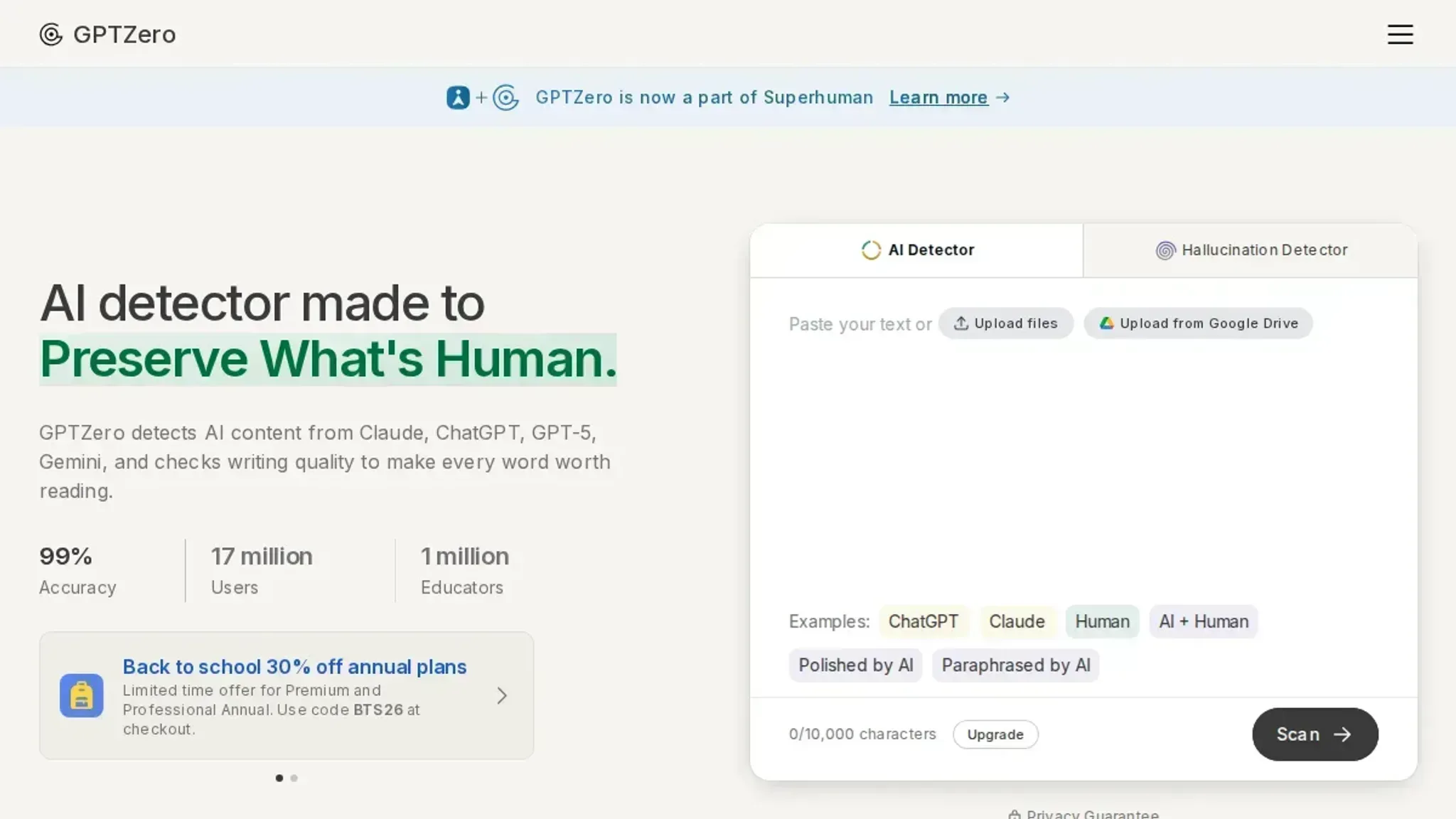
- Access to a free AI detector like Quillbot or GPTZero
- A human-written control text of similar length for comparison
- Basic understanding of word predictability and sentence length variation (the two main signals detectors measure)
How to test your text for AI detection patterns
Before you start, gather a piece of writing you want to check. Aim for at least 300 words. Detectors need enough text to measure statistical patterns reliably.
- Run your text through a free AI detector: Start with a widely used tool like Quillbot's AI detector. Paste your text and click the check button. Within seconds you'll see a percentage score showing how much of the text is likely AI generated. That is your baseline.
- Check the highlighted sentences: Many detectors color code individual sentences. Red or orange sentences are flagged as AI like. Look at those sentences. Do they all have the same length? Are they missing personal anecdotes or contractions? This is where you see the patterns described earlier.
- Test the same text in a second detector: No detector is perfectly accurate. Use a second tool like GPTZero, Winston AI, or the one built into Grammarly. Compare the scores. If both agree, the pattern is stronger. If they disagree, your text may be in a gray zone. This is a common source of false positives.
- Identify the specific pattern that triggered the flag: Look at the flagged sentences. Are they all around the same word count? Do they lack transition words like "however" or "meanwhile"? AI tends to produce uniform sentence lengths and avoids rare word choices. If you see that, you have found the root cause.
- Rewrite the flagged sentences to add variation: Vary sentence length. Mix a short punchy sentence with a longer, more complex one. Add a personal opinion or a specific example. This directly targets the low sentence length variation that detectors look for. For a deeper guide, see how to make AI text look more human.
- Re run the check and confirm improvement: Paste your revised text back into the detector. The score should drop. If it does not, focus on the sentences that remain flagged. Repeat the rewrite step until the score falls below the tool's threshold (usually 50% or lower).
One common mistake: rewriting only a few words instead of restructuring sentences. Detectors look at statistical patterns across the whole paragraph, not just individual words. Change the rhythm, not just the vocabulary. For a complete strategy, see our guide on how to make text undetectable to AI detectors.

The AI detection checklist: what to verify
Use this checklist to walk through the most reliable signals of AI-generated text. Check each item, then fill the Done column when you have confirmed the finding.
| Task | Why it matters | Done |
|---|---|---|
| Scan the first 100 words for repeated sentence openings (e.g., "Additionally," "Furthermore," "Moreover") | AI models reuse the same transitions throughout a passage more often than humans do | |
| Count the length of every paragraph and note if all are within 2, 4 sentences | Human writing naturally varies paragraph length; AI often produces blocks of nearly identical size | |
| Look for statements that lack a personal opinion, anecdote, or subjective judgment | AI text avoids strong voice unless explicitly prompted, so it stays neutral and generic | |
| Check for perfect grammar, punctuation, and spelling with no typos or stylistic inconsistencies | Human writers make occasional errors or use informal constructions; AI almost never does | |
| Search for vague references like "some studies show" or "research indicates" with no citation | AI defaults to plausible but unspecific examples because it cannot fact-check in real time | |
| Compare the factual claims against a trusted source to see if detail is fabricated | AI can invent specific names, dates, or numbers that sound correct but are completely wrong |
No single item on its own confirms AI generation. Many human-written texts also trigger these signals, which is why false positives are common. Read more about that in our article on do AI detectors have false positives.
Expert tip: The sentence length trap
Most guides focus on word predictability and sentence length variation, but the real giveaway is uniform sentence length. AI models produce sentences of nearly identical length, while human writing varies naturally. When a detector flags your text, check sentence length variance first. If every sentence runs 15-20 words, that is a stronger signal than predictable word choices alone.
This is one of the easiest patterns to fix: vary your sentence lengths deliberately.
Frequently asked questions about AI detection
Can AI detectors produce false positives?
Yes. AI detectors can flag human-written text as AI-generated, especially when the writing is formal, repetitive, or uses simple vocabulary. This happens because the detector's statistical model sees predictable word choices and uniform sentence lengths, which are common in both AI and some human styles.
Do AI detectors work on short text?
Generally no. Most detectors need at least 100-200 words to measure word predictability and sentence length variation reliably. Shorter passages lack enough data for the statistical patterns to be meaningful, so results are often inaccurate.
How can I reduce the chance of being flagged?
Focus on varying sentence length and structure. Introduce personal anecdotes, specific examples, or minor grammatical inconsistencies. Rewriting AI-generated text in your own voice, with natural rhythm and occasional short sentences, lowers the detection score.
Are all AI detectors the same?
No. Different tools use different training data and thresholds. Some, like Turnitin, specialize in academic writing, while others, like GPTZero, focus on general text. Accuracy varies widely, and no detector is 100% reliable.
Next steps for avoiding AI detection flags
The three signals, highly predictable word choices, little variation in sentence length, and uniform sentence length, are what detectors actually measure. Your job is to break those patterns deliberately.
Run your text through AI Busted to see which of the three signals is weakest, then rewrite that specific dimension. If your content is highly technical or formulaic (legal clauses, scientific abstracts), expect to do more manual rewriting, those genres naturally score low on word predictability regardless of origin.