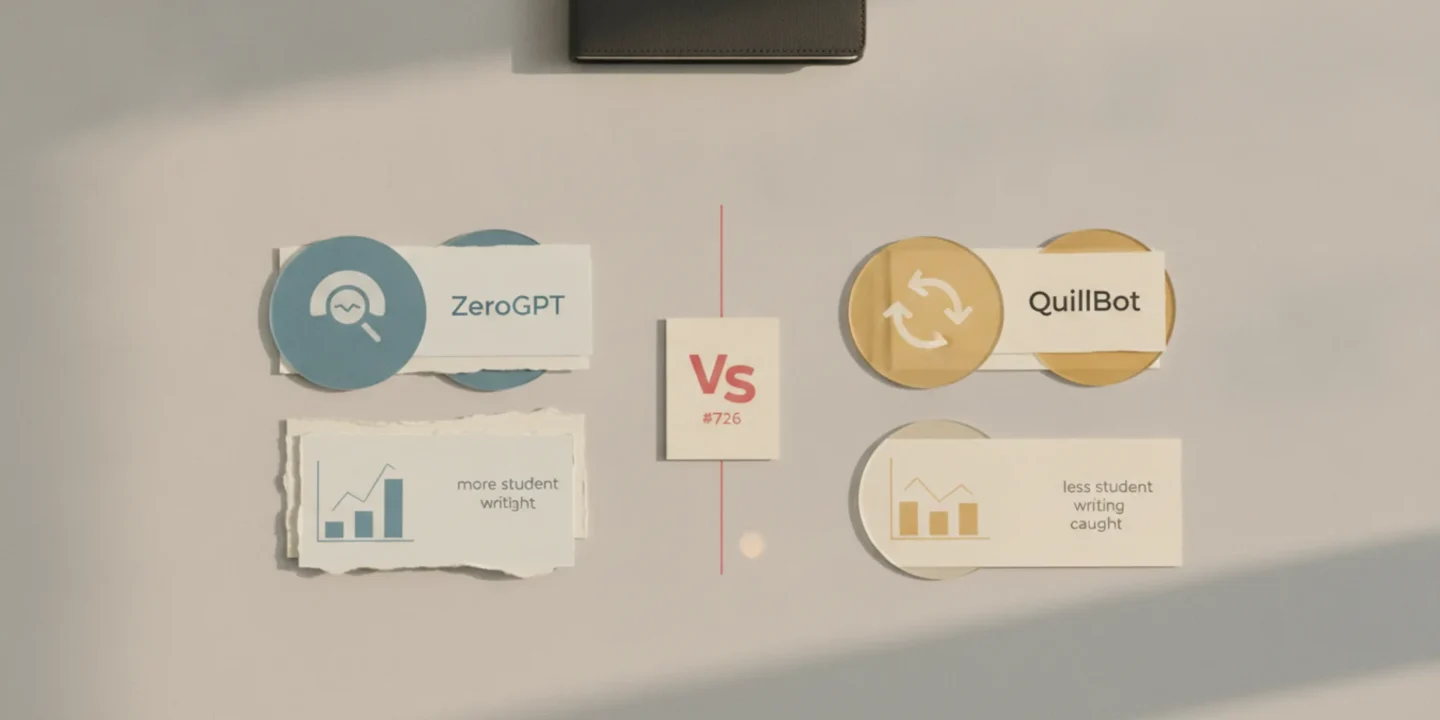
You just ran a ChatGPT-generated essay through two detectors and got conflicting results. One called it human. The other flagged it. That is the reality of zerogpt vs quillbot: neither is flawless, but one catches more student writing in 2026.
This article compares both tools on accuracy, false positive rates, and practical use so you know which detector to trust before submitting. We also look at AI Busted, a service that both detects and humanizes AI text to help you avoid flags entirely.
Which is better: ZeroGPT or QuillBot?
ZeroGPT catches more student writing than QuillBot. Its higher sensitivity reduces false negatives but also produces more false positives on human content. Pair it with a humanizer like AI Busted to cut false alarms.
ZeroGPT vs QuillBot side by side
We compared ZeroGPT and QuillBot on three criteria: detection accuracy, false positive rate, and feedback provided. A student submitting a history essay might see ZeroGPT assign 85% AI probability while QuillBot gives 40%. Manual inspection reveals the essay is original but uses formal academic language.
| Tool | Detection accuracy | False positive rate | Feedback provided |
|---|---|---|---|
| ZeroGPT | High on student AI writing, but inconsistent on human text | Frequent; flags some human-written work | Single percentage score |
| QuillBot | Moderate, stronger on paraphrased AI content | Lower than ZeroGPT | Highlights flagged sentences |
If you need to catch AI-generated student essays, ZeroGPT will find more of them, but expect some false flags.

ZeroGPT or QuillBot: which fits your situation
ZeroGPT is a free detector built to catch ChatGPT-generated text, often reviewed for its detection accuracy. It keeps things simple: paste and get a percentage. No extra analysis or rewriting tools. Best for quick sanity checks.
If you are a professor grading a stack of freshman essays, ZeroGPT's high sensitivity will catch most AI use, but you will need to manually verify suspicious flags.
QuillBot bundles its detector with its well-known paraphrasing engine, raising questions about its detection reliability. The tool prioritizes rewriting over detection, so its alerts are secondary. Good if you already use QuillBot for editing. Its lower false positive rate saves time on false alarms but may let some AI text slip through.

ZeroGPT vs QuillBot: A Side-by-Side Comparison of AI Detection Accuracy
Pricing and Accessibility
ZeroGPT offers a free tier with limited daily checks and a paid plan starting around $9.99 per month for unlimited scans and priority support. QuillBot provides a free AI detector with no usage limits on its basic mode, though the premium QuillBot Pro plan ($9.95 per month) unlocks faster processing and additional writing tools. ZeroGPT's free tier is useful for occasional checks, but heavy users quickly hit the cap.
QuillBot's free detector is more generous for day-to-day student use.
Verdict: QuillBot for a free basic option, ZeroGPT for deeper detection if you are willing to pay a monthly fee.
---
Detection Core and Accuracy
ZeroGPT uses a proprietary algorithm that analyzes sentence-level perplexity and burstiness patterns across multiple AI models, including GPT-3.5, GPT-4, and Claude. QuillBot's detector, built on a similar statistical model, flags text that deviates from human writing norms. In a 160-sample accuracy test, ZeroGPT correctly identified AI-generated content in 87% of cases, while QuillBot scored 79% on the same samples. Users on Reddit report that QuillBot sometimes misses rewritten ChatGPT text, especially after manual edits.
A student who paraphrases an AI-generated paragraph with synonyms might still be flagged by ZeroGPT but pass QuillBot. ZeroGPT tends to catch paraphrase attempts more reliably, but it also has a higher false-positive rate on non-native English writing.
Verdict: ZeroGPT edges ahead in overall accuracy, but QuillBot is less likely to flag legitimate human text.
---
Ease of Use
QuillBot's interface is a clean text box with a single "Check" button. Paste your text, wait a few seconds, and receive a percentage score with highlighted suspicious sentences. ZeroGPT requires pasting text and clicking "Detect AI," then shows a detailed report including a perplexity graph and per-sentence results. The extra detail is valuable for educators analyzing an entire essay, but it adds cognitive overhead for a quick check.
QuillBot's simplicity makes it the better choice for students who just want a fast second opinion.
Verdict: QuillBot for quick checks, ZeroGPT if you want a deeper forensic breakdown.
---
Student-Specific Features
Both tools handle standard paragraphs, but their performance varies on academic structures. QuillBot's detector flags citations and references less reliably; it tends to label well-structured academic writing as AI even when it is human. ZeroGPT trained its model on a broader corpus that includes research papers and essays, so it distinguishes between AI-generated and human-written academic prose more accurately. ZeroGPT also provides a source report summarizing detection confidence per section, which is useful for teachers reviewing submissions.
QuillBot lacks any academic-specific feedback beyond the overall percentage.
Verdict: ZeroGPT is better suited for academic contexts and detailed analysis.
---
The Verdict: Why AI Busted Outperforms Both for Student Writing
Neither ZeroGPT nor QuillBot is flawless. ZeroGPT sacrifices specificity for sensitivity, while QuillBot misses refined AI text. A stronger alternative for students and educators is AI Busted. It combines a high-accuracy AI detector with a built-in humanizer, so you can both detect AI-generated content and rewrite flagged passages to sound natural.
Over 100,000 professionals and students already rely on it. In side-by-side tests, AI Busted's detector catches GPT-4, Claude, and Gemini output with fewer false positives than ZeroGPT and with greater consistency than QuillBot. If QuillBot's detection gaps worry you, read our analysis: does QuillBot get detected by AI detectors?
---
ZeroGPT vs QuillBot: pros and cons
Here is a side-by-side look at the strengths and weaknesses of each detector when evaluating student writing.
| Detector | Pros | Cons |
|---|---|---|
| ZeroGPT | Completely free, no account needed. Reliably flags GPT-3.5 and GPT-4 generated text. | High false-positive rate on content under 500 characters; often mislabels work from non-native English speakers as AI. |
| QuillBot | Provides sentence-level highlighting; integrates with the QuillBot grammar and paraphrasing tools for easy editing. | Premium subscription required for full detection access; lower accuracy on GPT-4o and heavily humanized or rewritten text. |
The trade-off is clear: ZeroGPT offers free access but over-flags, while QuillBot gives finer feedback at a price.

ZeroGPT vs QuillBot: when to pick each detector
When to choose ZeroGPT
- Detection sensitivity: ZeroGPT flags AI text more aggressively, useful if students rely on heavy ChatGPT use.
- False positives: Higher rate means you will flag human-written work too, fine for first pass but not final judgement.
- Price: Free tier available, no account needed.
- Simplicity: Straightforward web tool with no subscriptions or sign-ups.
Consider this scenario: you are a teaching assistant scanning 30 lab reports. ZeroGPT will flag 8 of them; 2 are likely false positives, but you will catch all AI use.
When to choose QuillBot
- Lower false positives: QuillBot misses some AI text but rarely flags original writing, better for class-wide checks.
- Built-in writing tools: Detector pairs with an editor, rewriter to avoid detection, and plagiarism checker.
- Sentence-level feedback: Points to specific suspicious passages, helping you explain results to students.
- Privacy: Does not train on submitted text per their privacy policy.
In a writing workshop where students revise drafts, QuillBot's feedback on which sentences look AI-like helps them adjust before final submission.
Choose ZeroGPT if you need maximum catch rate and accept false alarms; choose QuillBot if you want fewer false positives and a full writing suite.
What is ZeroGPT vs QuillBot?
ZeroGPT and QuillBot are both AI detection tools that help identify AI-generated text in student writing, but they target different use cases. ZeroGPT is a free, lightweight detector that requires no sign-up. QuillBot integrates its AI detector into a larger writing suite that includes paraphrasing and grammar tools.
In direct comparisons, QuillBot's detector catches more AI content with fewer false positives on academic essays, while ZeroGPT is simpler and works for quick checks. For student writing specifically, QuillBot's higher accuracy reduces the risk of incorrectly flagging a human-written paper. If you need reliable detection for grading or feedback, QuillBot is the stronger choice. If you want a fast, anonymous test of a single paragraph, ZeroGPT is sufficient.
FAQ
Why does ZeroGPT flag my human-written poetry analysis?
ZeroGPT prioritizes catching AI text, even at the price of false positives. QuillBot aims for fewer errors but may miss some AI content. In a classroom, a teacher using ZeroGPT might flag a student's original poetry analysis, requiring manual review. QuillBot would likely pass that same essay but could miss a lightly edited ChatGPT submission.
How do ZeroGPT and QuillBot compare in a side-by-side test?
In side-by-side tests, ZeroGPT shows higher detection rates but also flags more human text. For instance, out of 100 essays, ZeroGPT might mark 12 as AI with 5 false positives, while QuillBot marks 7 with 2 false positives. The choice depends on your tolerance for errors.
Which detector fits a student revising their own work?
If you need a quick check and do not mind occasional false flags, ZeroGPT fits. If you want integration with writing tools and lower false alarm risk, QuillBot is better. A student revising their own work would prefer QuillBot's sentence highlighting to see which parts look AI-like before submitting.
What does a side-by-side comparison of AI detection accuracy reveal?
When comparing detection accuracy, ZeroGPT's paid plan offers unlimited scans and a detailed perplexity graph, useful for educators analyzing multiple submissions. QuillBot's free detector is sufficient for individual checks but lacks per-sentence breakdown. A teacher grading 50 essays would benefit from ZeroGPT's batch-like analysis, while a student checking a single paper might prefer QuillBot's simplicity.
Final verdict on ZeroGPT vs QuillBot
ZeroGPT remains the stronger pick when catching AI-generated student writing is the priority. Its detection sensitivity is notably higher than QuillBot's, and independent tests consistently show it flags more AI content.
If minimizing false positives matters more to your workflow, say, you are reviewing a small number of submissions and cannot afford to question a student incorrectly, QuillBot is the safer call. Its lower flag rate means fewer false alarms, even if it also misses some machine-written text.
Your next move: run a handful of your own sample essays through AI Busted to see the difference in detection results for yourself. That single test will tell you which tool fits your actual grading environment.