
For a long time, the business world has treated doing good or doing well as an either/or proposition. It’s a false choice. The reality is that the most successful and resilient companies today don’t pick a side; they weave purpose directly into their profit-making strategy. They understand that social impact and financial success aren't opposing forces—they're two sides of the same coin.
The Myth of Choosing Purpose or Profit
For decades, the standard playbook was simple: a company’s main job was to maximize shareholder value. Full stop. Social responsibility was usually relegated to a separate department, handling things like charity donations or an annual volunteer day. These were nice gestures, but they were completely detached from the core engine of the business. This mindset created the stubborn myth that a company had to focus on either doing good or doing well, as if they were mutually exclusive goals.
A New Engine for Growth
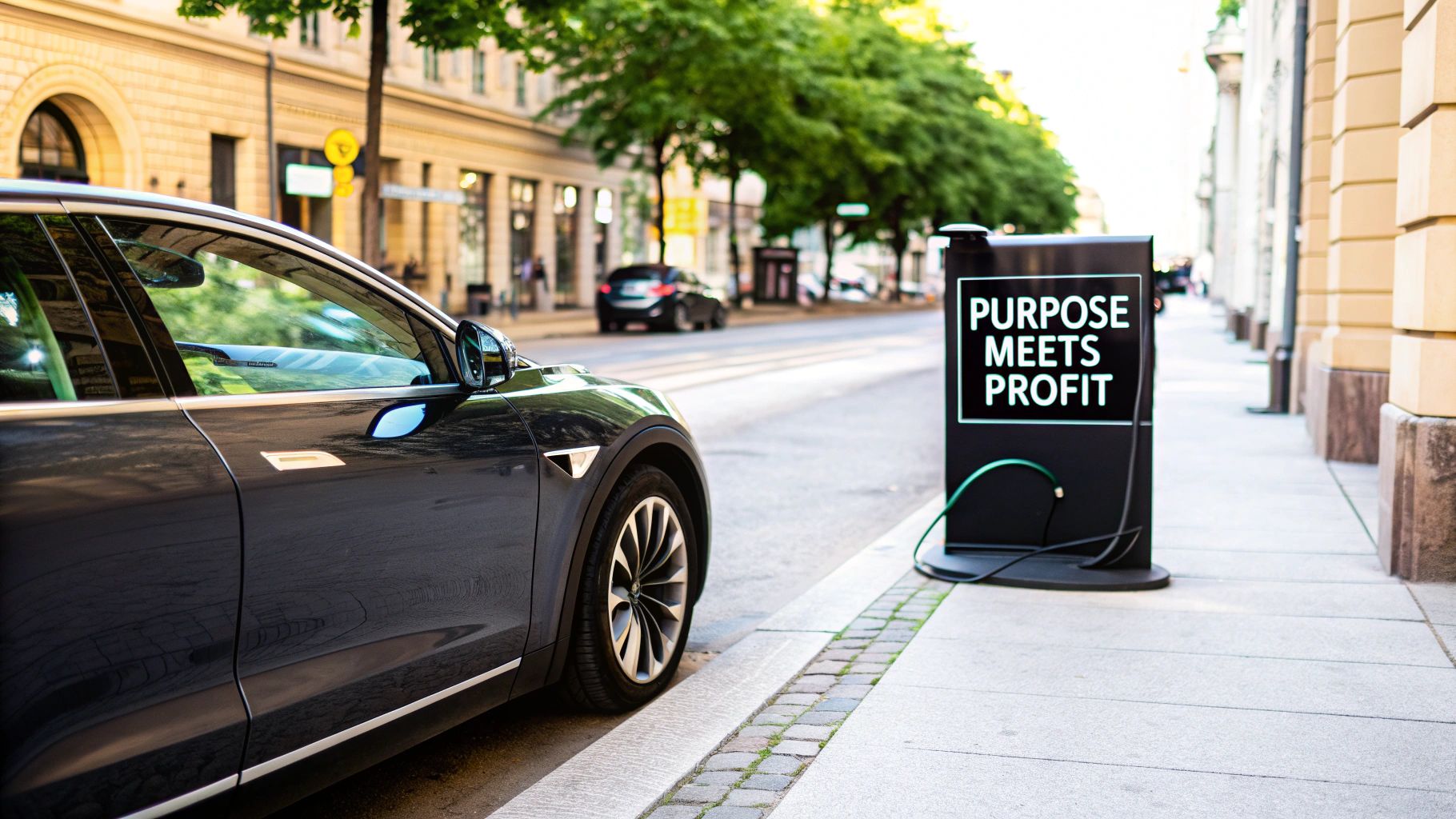
Imagine a modern business as a high-performance electric car. The battery is its profit—it provides the raw power needed to move. Without a charge, the car is just a fancy piece of metal sitting on the curb. But the navigation system? That's its purpose. It gives the car direction, plots the most efficient course, and helps it steer clear of dead ends, making sure it actually gets where it needs to go.
A car with a full battery but no GPS is just as lost as one with a clear destination but no power. This analogy gets to the heart of a huge shift in business thinking. It's no longer about choosing between the battery and the navigation. The smartest companies today know they need an integrated system where both parts work in perfect harmony.
To see how this has evolved, let’s compare the old way of thinking with the new integrated approach.
Doing Good vs Doing Well A Modern Perspective
| Concept | Traditional View (Doing Good) | Traditional View (Doing Well) | Modern Integrated Model |
|---|---|---|---|
| Primary Goal | Social or environmental impact; often a non-profit activity. | Maximizing shareholder value and financial returns. | Creating shared value for all stakeholders. |
| Strategy | Separate from the core business; often seen as a cost center. | Profit-driven; social impact is a secondary concern, if any. | Purpose is the core of the business strategy, guiding all decisions. |
| Funding | Relies on donations, grants, or philanthropy. | Funded through revenue, investment, and debt. | Profitability fuels the mission; the mission drives profitability. |
| Metrics | Measures social outcomes (e.g., lives improved, emissions reduced). | Measures financial performance (e.g., revenue, profit margins, ROI). | Uses integrated metrics like B Corp scores, ESG ratings, and financial KPIs. |
This table shows a clear evolution. We've moved from a world where "good" and "well" lived in separate universes to one where they are deeply interconnected, creating a more robust and sustainable business model.
The modern integrated model doesn't see purpose as a cost but as a catalyst. It's the strategic framework that guides how profit is generated, ensuring long-term sustainability and resilience in a market that demands more than just a low price tag.
The Real Business Case
Baking ethical and sustainable practices into your strategy isn’t a sacrifice anymore; it’s a powerful driver of real-world business results. Companies that get this right often see incredible benefits:
- Enhanced Brand Loyalty: Today’s customers vote with their wallets. They actively reward companies that show a genuine commitment to social and environmental issues.
- Improved Talent Retention: The best people want more than just a paycheck. A strong, authentic purpose attracts and keeps top talent who are looking for meaningful work.
- Sustainable Growth: By thinking about social and environmental impact, businesses build a more resilient foundation that’s better equipped to handle future regulations and market shifts.
The Shift from Charity to Strategic Impact
Not too long ago, the idea of a business "doing good" probably made you think of a few specific things: oversized checks at charity galas, maybe an annual company-wide volunteer day. For decades, corporate philanthropy was treated like an accessory—something bolted on, completely separate from the real work of making money. It was often just a line item in the marketing budget, more about public relations than creating real, lasting change.
But that model is starting to look ancient. We're in the middle of a fundamental shift, pushed forward by a new wave of consumers, employees, and investors who are demanding much more than just token gestures. They expect companies to build ethical practices into their very DNA, changing how they operate, innovate, and grow. The whole debate of doing good or doing well has officially moved from the PR department straight into the boardroom.
From Afterthought to Core Strategy
The old way of thinking framed social responsibility as a cost center. A company made its profit first, and only then, almost as an afterthought, decided how much it could afford to "give back." This created a massive gulf between a company’s financial goals and its social contributions.
Today’s leading businesses see things completely differently. They get that strategic social impact isn't a cost—it's a powerful engine for long-term value. Instead of just writing checks, they're weaving Environmental, Social, and Governance (ESG) principles into the very fabric of their operations. This means rethinking everything from supply chains and energy use to hiring practices and product design.
You can see this change clearly in corporate reporting. A staggering 98% of S&P 500 companies now publish dedicated CSR or sustainability reports. That’s a huge leap from just a few years ago. Globally, this level of transparency is quickly becoming the standard, proving that doing good is now an essential part of doing well. You can explore more corporate responsibility statistics to see just how widespread this trend has become.
Why the Change Happened
So, what sparked this evolution from simple charity to strategic impact? A few key forces are at play. For one, empowered consumers can now find out about a brand’s ethical record in seconds, and they’re increasingly putting their money where their values are.
At the same time, top talent is looking for more than a paycheck. People want to work for organizations with a clear purpose, where they feel their work contributes to something bigger than the bottom line. A strong social mission has become a secret weapon for attracting and keeping the best people.
The most forward-thinking companies have realized that their social and environmental impact is directly tied to their financial health. It’s no longer about balancing profit against purpose; it's about using purpose to secure sustainable, long-term profit.
This strategic approach actually turns social responsibility into a wellspring of innovation. It forces companies to discover more efficient ways to use resources, design products that solve real-world problems, and build deeper, more authentic connections with customers and communities.
How Purpose Drives Real-World Business Performance
A genuine purpose is so much more than a feel-good slogan buried on an "About Us" page. It’s a hard-working asset that directly fuels the numbers your board and investors care about. For any company trying to close the gap between doing good and doing well, a clear purpose is the engine that turns high-minded ideals into tangible returns.
The impact shows up most clearly in three key areas of any successful business. When you focus on these pillars, you start to see how a real commitment to purpose creates a powerful, reinforcing cycle of growth and stability.
Attracting and Retaining Top Talent
Let's be honest, in today's job market, the best people aren't just chasing the biggest paycheck. They're looking for meaning and a sense of belonging. A strong, authentic purpose acts like a beacon for skilled professionals who want their work to matter beyond the bottom line. The research backs this up, showing that people at purpose-driven companies are far more engaged and much less likely to jump ship.
This isn't just about saving on recruitment fees, either. An engaged team is a productive team. When your people truly believe in the mission, they bring more energy, more creativity, and a deeper commitment to getting things right.
A purpose-driven culture creates an environment where people feel valued for more than just their output. This fosters a deep sense of loyalty that a bigger paycheck from a competitor often can't break.
Building Unshakable Customer Loyalty
Today's customers are savvy. They have endless choices and are increasingly voting with their wallets for brands that reflect their own values. A company’s purpose has become a massive differentiator. When people see a brand that is genuinely committed to making a positive social or environmental impact, it builds a kind of trust that price tags can't touch.
This creates an incredible competitive moat. A rival might be able to poach a customer with a one-time discount, but a purpose-driven brand earns loyalty that lasts. You can see this reflected directly in your key performance indicators:
- Higher Customer Lifetime Value (CLV): Loyal customers keep coming back and are the first in line to try new products from a brand they believe in.
- Increased Brand Advocacy: These aren't just customers; they become your biggest fans, spreading the word and generating the most valuable marketing there is.
- Greater Price Resilience: People are often willing to pay a bit more for products from companies they feel good about supporting.
Securing Investor Confidence
The world of investing is changing, too. More and more, investors are looking at Environmental, Social, and Governance (ESG) criteria to gauge a company's long-term health and potential. A strong purpose, backed up by real, transparent action, is a powerful signal of smart leadership and solid risk management.
Companies that can point to a strong ESG track record are often seen as more stable and better equipped to handle whatever regulatory changes or market shifts are coming next. This gives investors the confidence they need, which can lead to better access to capital and a healthier valuation. Ultimately, a clear purpose demonstrates that a company isn't just built for a good quarter, but is built to last—proving that doing good is absolutely essential for doing well.
Building Your Framework for Purpose and Profit
Moving from an idea to real-world action demands a clear blueprint. To truly bring the goals of doing good and doing well together, you need a structured approach that embeds purpose deep into your operations, making it more than just a nice-sounding statement on your website.
Think of it like building a sturdy arch. Your financial goals are one pillar, and your social impact goals are the other. A solid framework provides the keystone—the crucial actions that lock both pillars together—creating a structure that's not only strong but built to last.
This model shows how a genuine sense of purpose creates a virtuous cycle, strengthening the entire business from the inside out.
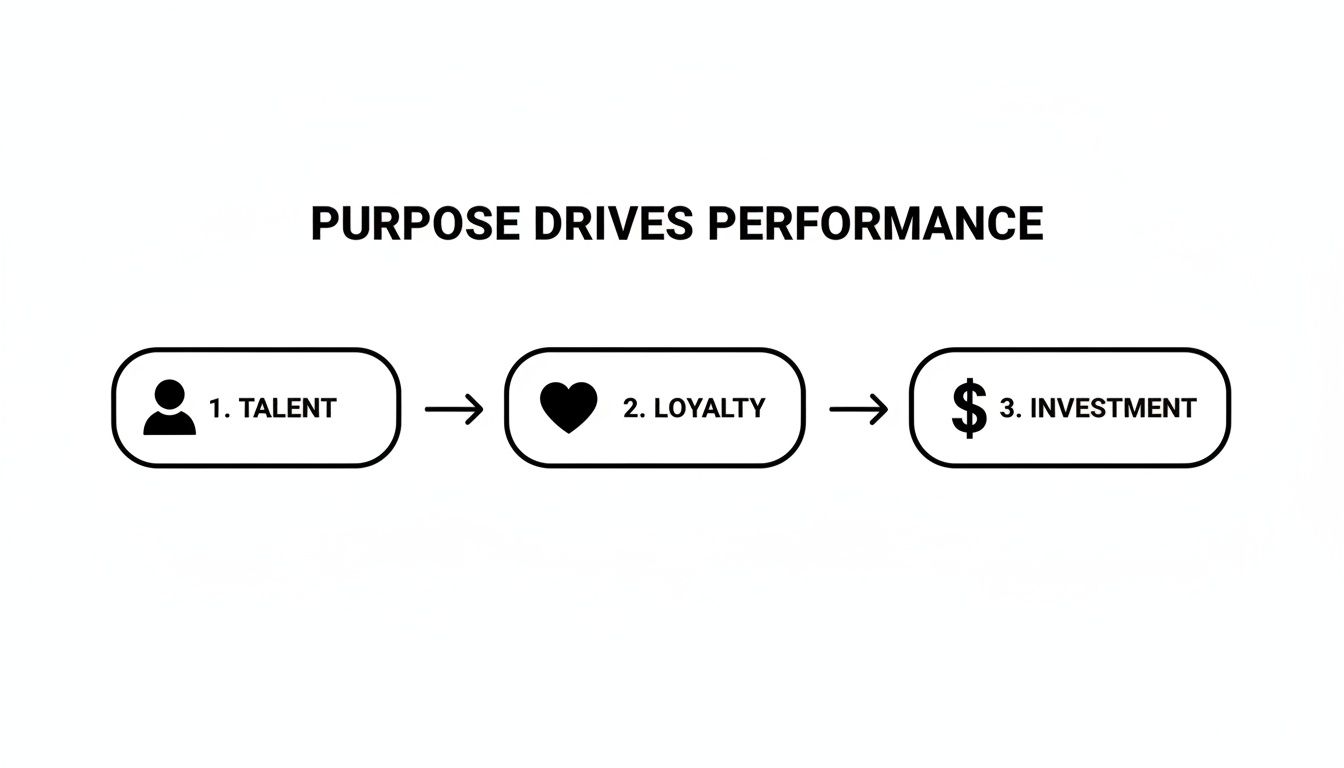
As you can see, purpose is the engine. It attracts the right people, which builds unshakable customer loyalty and, in turn, draws in investors who see the long-term value.
To get there, you need a practical plan. This five-step framework offers a clear path for integrating your social mission with your financial strategy, ensuring one fuels the other.
A 5-Step Framework for Integrated Growth
An actionable guide for businesses to systematically align their social and financial objectives for sustainable success.
| Step | Action | Key Outcome |
|---|---|---|
| 1. Define Your Authentic Purpose | Look inward to articulate your company's core reason for being, beyond profit. Answer: "What positive change do we exist to create?" | A clear, authentic mission that guides decision-making and resonates with your team. |
| 2. Map and Understand Stakeholders | Identify everyone your business impacts—employees, customers, suppliers, community—and genuinely listen to their needs and expectations. | A deep understanding of what matters to key groups, ensuring your efforts are relevant and impactful. |
| 3. Set Measurable ESG Goals | Translate your purpose into specific Environmental, Social, and Governance (ESG) targets with clear timelines and metrics. | Concrete benchmarks that make your abstract purpose tangible and trackable. |
| 4. Weave Purpose into Every Function | Integrate your mission into all departments, from product development and marketing to HR and finance. | A culture where purpose is a shared responsibility, driving consistent action across the organization. |
| 5. Report Progress with Transparency | Regularly and openly share your progress toward ESG goals—both the wins and the challenges. | Increased trust and accountability with all stakeholders, proving your commitment is real. |
By following these steps, you build a system where purpose isn't just an add-on; it's the core operating system for your business. It's about turning good intentions into a measurable, strategic advantage that pays dividends for everyone involved.
Real-World Examples of Purpose-Driven Profit
Frameworks and theories are great, but nothing brings the idea of purpose-driven profit to life like seeing it in action. The real power of mixing doing good with doing well shines through in the stories of companies that have woven this philosophy into their DNA.
These businesses offer a practical blueprint, showing how a powerful mission can become an incredible competitive edge.
For decades, the outdoor brand Patagonia has been the poster child for this approach. Their mission, "We're in business to save our home planet," isn't just a clever tagline—it's the lens through which they make every single decision. It dictates everything from using recycled materials in their famous jackets to donating 1% of all sales to environmental groups.
This rock-solid purpose has cultivated a fiercely loyal community. People don't just buy a jacket; they feel like they're joining a movement. The result? Massive environmental impact and staggering financial success, proving that a deep-seated commitment to doing good can absolutely be the key to doing well.
The Rise of the B Corporation
Beyond the iconic pioneers like Patagonia, a new wave of businesses is making their commitment official through B Corporation (B Corp) certification. Think of it as a stamp of approval for companies that meet incredibly high standards for social and environmental performance, transparency, and legal accountability.
Becoming a B Corp isn't just a badge; it's a fundamental shift. It signals that a company is legally bound to consider its impact on all stakeholders—not just shareholders—and to use its business as a force for good.
Here are a few B Corps that are shaking up their industries:
- Allbirds: This footwear company took on an industry dominated by synthetics. They created sneakers from sustainable materials like wool and eucalyptus fibers, focusing on comfort and a low carbon footprint. Consumers loved it, and the company grew incredibly fast.
- Ben & Jerry's: Long before it was trendy, this ice cream giant made social activism part of its brand identity. From using fair-trade ingredients to championing social justice causes, their purpose is as famous as their quirky flavors. It creates a connection with customers that goes way beyond ice cream.
- Bombas: This brand was built on a simple promise: for every item you buy, they donate one to a person experiencing homelessness. This one-for-one model has led to over 100 million items donated and has turned Bombas into a major force in the apparel market.
These companies teach us an essential lesson: purpose isn't an obstacle to profit—it's a direct route to it. By solving a real-world problem, they gave customers a compelling reason to choose them, stick with them, and even advocate for them.
Each of these businesses found a genuine way to align their day-to-day operations with a cause that matters. They show that whether you're saving the planet or providing socks to those in need, the most sustainable path forward is one where doing good and doing well are one and the same.
Measuring the Metrics That Matter Most
If you really want to weave purpose into your company's DNA, you have to prove it works. That means getting past the feel-good stories and diving into the hard data. To show the real ROI of purpose, you need a solid grip on the key performance indicators (KPIs) for both your social impact and your financial success.
The whole debate over doing good or doing well kind of melts away when you can draw a straight line between the two on a spreadsheet. And for the "doing good" side of things, the metrics are getting surprisingly sharp. They offer a concrete way to track your progress and keep your organization honest.
Quantifying the Impact of Doing Good
Measuring your social and environmental contributions isn't just about abstract goals; it’s about looking at a specific set of data points. These numbers prove your commitment and lay the groundwork for showing how it all pays off financially.
- Employee Engagement & Retention: Keep an eye on your employee Net Promoter Score (eNPS) and voluntary turnover rates. High scores here are almost always tied to a strong, purpose-driven culture.
- Carbon Footprint Reduction: Track your greenhouse gas emissions—what experts call Scope 1, 2, and 3—to demonstrate a real commitment to the planet.
- Community Investment Returns: Put a number on the impact of your community work. This could be volunteer hours logged, funds donated, or even the social return on investment (SROI) for your biggest projects.
These aren't just vanity metrics for an annual report. Think of them as leading indicators of your company's long-term health. Budgets are already starting to reflect this new reality. Recent reports show that 39% of CSR teams saw their budgets increase, with funding for employee engagement getting the biggest bump. That kind of investment shows a clear understanding that doing good is just smart business. You can discover more insights on emerging CSR trends here.
Connecting Purpose Metrics to Financial Performance
Okay, so you're tracking your impact. The next, and most critical, step is to link those numbers to the financial KPIs that every stakeholder actually understands. This is where you show that purpose isn’t a cost center—it’s a value driver that strengthens your bottom line.
Integrated reporting is all about telling the whole story. It’s the practice of combining traditional financial data with ESG performance to show how a company creates value. Instead of separate reports, it paints a clear picture of how social and environmental factors directly shape financial results.
Think about how "doing good" metrics naturally flow into "doing well" outcomes:
- High employee retention rates (doing good) mean you spend less on recruiting and training, which directly improves profit margins (doing well).
- A smaller carbon footprint (doing good) can lead to lower energy bills and fewer regulatory headaches, boosting operational efficiency (doing well).
- Genuine community engagement (doing good) builds a stellar brand reputation, which can increase customer loyalty and market share (doing well).
When you start tracking these connections, you build a powerful, data-backed story. It gives you the ammunition you need to communicate the business case for purpose to your team, your customers, and your investors, proving that what gets measured truly gets managed.
Frequently Asked Questions
When you start blending social impact with business goals, a lot of practical questions pop up. Let's tackle some of the common hurdles and myths leaders run into when they think they have to choose between doing good or doing well. The truth is, the best path forward involves both.
Can a Small Business Afford to Focus on Doing Good?
You bet. For small businesses, "doing good" isn't about having a giant budget. It’s about taking practical, smart steps right where you are.
Think about things like sourcing from local suppliers, creating a workplace where people feel valued, or just showing up for community events. These actions build a rock-solid reputation and earn you the kind of customer loyalty that money can't buy—both are crucial for long-term growth. Plus, many of these initiatives, like cutting down on waste to be more energy-efficient, can actually reduce your operating costs and put money back in your pocket.
What Is the Difference Between CSR, ESG, and Purpose?
It helps to think of these as layers of the same core idea. Each one has a specific job in turning a company's values into real-world action and measurable results.
- Purpose is your "why." It's the reason your company exists beyond just turning a profit.
- Corporate Social Responsibility (CSR) is the "how." These are the specific programs and initiatives you launch to bring that purpose to life.
- Environmental, Social, and Governance (ESG) is the "what"—as in, what did you actually achieve? It’s the data-driven framework used to measure and score your company's performance in these areas.
In short: Purpose is the mission, CSR is the action, and ESG is the measurement. Put them together, and you have a solid strategy for weaving social impact directly into your business.
How Do I Convince Leadership to Invest in Social Impact?
You have to speak their language. Frame your pitch around the business case, not just the moral high ground. Connect your ideas to the concrete, measurable benefits that leadership actually cares about.
Show them how a purpose-driven strategy solves real business problems. Bring data, show what competitors are doing, and illustrate how these initiatives are creating a genuine competitive edge in your market. Talk about how it can help you attract the best talent, protect the brand from risk, and build deeper, more profitable customer relationships.
My advice? Start small. Propose a pilot project with clear, measurable goals. This lets you prove the concept and demonstrate a real return on investment with very little upfront risk. Once you can show hard numbers that connect "doing good" directly to "doing well," getting that buy-in for bigger ideas becomes a whole lot easier.
Transform your content from robotic to remarkable. AI Busted is a tool that supports honest use by helping you humanize text to achieve a fully natural, 100% human score. Create content that truly connects by refining AI-generated text to a more natural, engaging tone while preserving your core message. Try the AI humanizer at https://aibusted.com.