Getting past an AI detector isn't about pulling a fast one. It's about taking a solid AI-assisted draft and refining it until it scores 100% human because it genuinely reflects your voice and perspective. The real goal is to create authentic, high-quality work that’s judged on its merits, not flagged by a flawed algorithm.
The Evolving World of AI Content
We've entered a new era of content creation. AI assistants can help us draft everything from emails to research papers in a fraction of the time, but this incredible efficiency has kicked off a constant tug-of-war between AI generators and AI detectors. This leaves writers, marketers, and students trying to find the right balance between speed and authenticity.
But the conversation is starting to change. Rather than just focusing on how to spot AI text, the real pros are learning how to ethically humanize it. The idea isn't to trick a system. It's about elevating a machine's output by infusing it with the unique voice, subtle nuances, and creative spark that only a human can bring to the table.
From Detection to Humanization
This back-and-forth has created a booming market. The AI detection industry is expected to explode from USD 0.58 billion in 2025 to USD 2.06 billion by 2030. This rapid growth just underscores the cat-and-mouse game, where more advanced humanizing tools are constantly challenging the older, simpler detectors.
Ultimately, the aim is to produce work that stands on its own. When you take the time to polish an AI-assisted draft, you're making sure it’s valued for its unique insights and clear communication—making it immune to the judgment of any algorithm. To get a better handle on this, it's always a good idea to keep up with the latest trends in AI content generation.
The table below breaks down the fundamental differences between what AI detectors look for and what ethical humanization aims to achieve. It's a shift in mindset from evasion to enhancement.
AI Detection Focus vs Ethical Humanization Goals
| Aspect | AI Detection Focus | Ethical Humanization Focus |
|---|---|---|
| Primary Goal | Identify statistical patterns common in machine-generated text. | Infuse text with a unique human voice, tone, and style. |
| Key Metric | Predictability: How likely is the next word based on a model? | Authenticity: Does the content reflect genuine expertise and personality? |
| Writing Style | Flags overly uniform sentence structures and generic vocabulary. | Creates varied sentence lengths, uses specific terminology, and adds personality. |
| Originality | Checks for content that is algorithmically "safe" and unoriginal. | Develops original ideas, adds personal anecdotes, and offers unique insights. |
| Readability | Cares about grammatical perfection and logical flow. | Focuses on clarity, engagement, and emotional connection with the reader. |
As you can see, the goals are completely different. Detectors are looking for a robotic footprint, while humanization is about adding a human soul.
The objective isn't to create undetectable AI content. It's to use AI as a collaborator to produce work that is undeniably human. It's about taking a solid first draft and polishing it until it shines with your personal touch and expertise.
This is exactly where tools like AI Busted come in. They are built to support this ethical process, helping you bridge the gap between a robotic first draft and a final piece that connects with your audience. It’s a responsible approach that respects both the power of AI and the irreplaceable value of human insight.
How AI Detectors Actually Work
If you want to write content that feels genuinely human, it helps to know what makes AI-generated text stick out in the first place. At their core, AI detectors are just sophisticated pattern-recognition tools. They've been trained on millions of examples of text written by both people and machines, but they don't read for meaning the way you and I do. They hunt for statistical clues.
Imagine an AI as a musician who plays perfectly to a metronome. The rhythm is flawless, the notes are exactly where you'd expect them, and there are no real surprises. A human writer is more like a jazz improviser. The rhythm ebbs and flows, sentence lengths are all over the place, and unexpected phrases just pop up. Detectors are built to hear that metronome's steady, predictable beat.
The Telltale Signs of AI Content
These platforms are on the lookout for two main digital fingerprints: perplexity and burstiness.
Perplexity is just a fancy way of saying "predictability." AI models are designed to pick the most statistically likely word to come next, which creates text that’s smooth but often bland. If your writing is too predictable, that’s a huge red flag for a detector.
Burstiness, on the other hand, is all about the natural rhythm and variety of human writing. We tend to write in bursts—a short, punchy sentence here, a long, winding one there. AI often defaults to sentences of a similar length and structure, which creates a monotonous flow that detectors can spot from a mile away.
An AI detector isn’t judging your content’s quality or accuracy. It’s simply measuring how statistically predictable it is. If your text is too perfect, too consistent, or uses overly simple word choices, it’s going to get flagged.
This constant back-and-forth between AI creation, detection, and human refinement is a cycle.
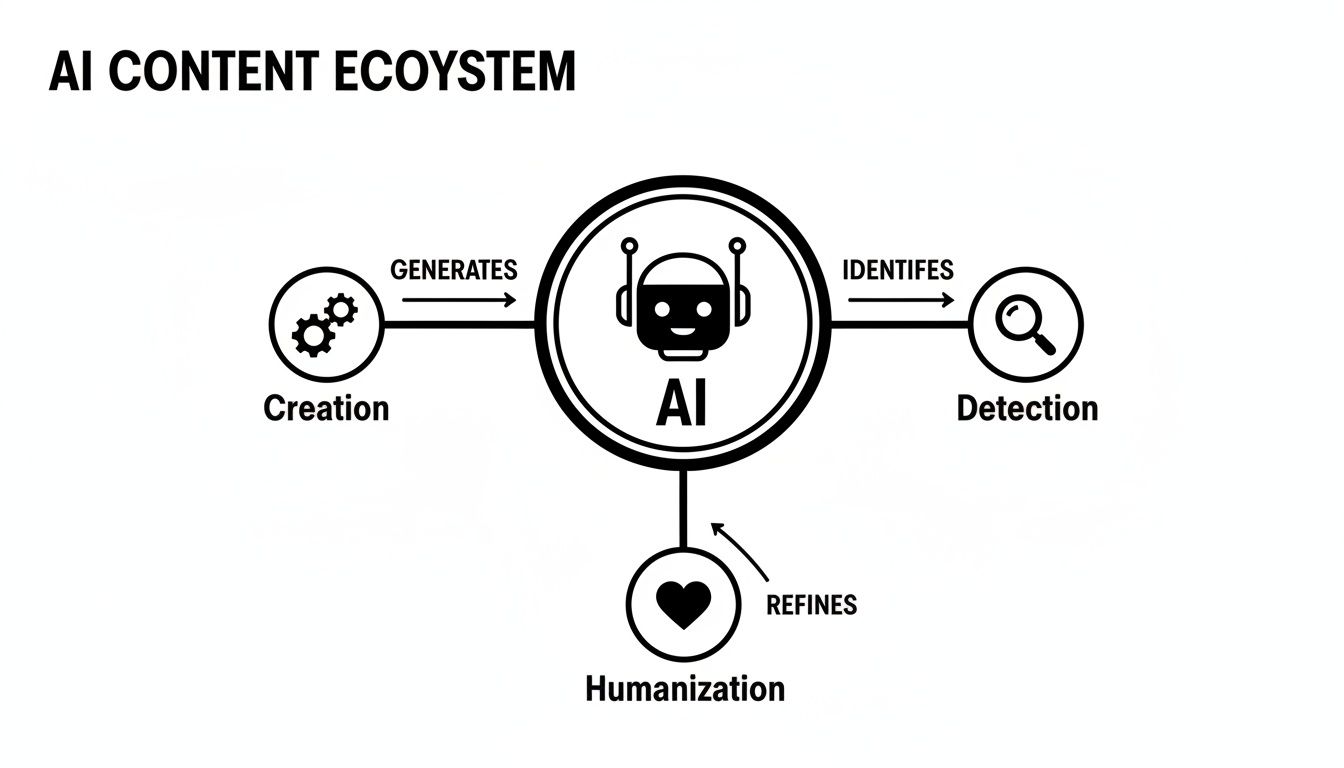
As you can see, humanization is what closes the loop. It’s the essential step where raw AI output is refined to sound authentic and pass muster with both human readers and algorithmic checkers.
A Look Under the Hood
Let's take a popular tool like GPTZero as an example. It doesn't just give a simple "AI" or "human" verdict. Instead, it breaks down the text sentence by sentence, analyzing those statistical properties we just talked about.
It highlights the specific sentences that are most likely machine-generated and assigns a probability score, giving you a peek into the algorithmic "thinking" behind the result. Once you understand these core principles, you can start to ethically edit AI-assisted drafts to reflect your own voice. The goal to bypass AI detection becomes less about tricking a system and more about improving the final quality of the work.
The Critical Flaw of False Positives
What happens when the very tools built to spot AI get it wrong? This is the central problem with relying too heavily on AI detectors, and it's the main reason why making your content sound completely human is so important. The single biggest issue with these platforms is the high rate of false positives—when completely human-written text gets incorrectly flagged as machine-generated.
This isn't some small technical hiccup; it has serious, real-world consequences. Think about a student who spent hours on an essay, only to be accused of cheating because a flawed algorithm made a mistake. Professionals, from journalists to marketers, are also at risk. Their original work can be unfairly questioned, potentially damaging their reputation and credibility. These aren't just what-if scenarios; they're happening right now.

An Unreliable Judge
At their core, AI detectors don't actually understand things like context, nuance, or creative intent. They are just pattern-matching machines. If your natural writing style happens to be very clear and structured, you might get flagged even if you never touched an AI tool.
This unreliability puts honest writers in a tough spot. In fact, studies show that even the top AI detection tools can wrongly flag human writing a significant amount of the time. This high rate of false positives is a critical weakness, creating a ton of risk for anyone who needs to prove their work is authentic. You can learn more about these detection inaccuracies and see for yourself just how often they get it wrong.
The goal to bypass AI detection isn't about fooling a system. It's about protecting your genuine work from that system's flaws by making sure your writing is so authentically human that it’s immune to these algorithmic errors.
Protecting Your Original Work
At the end of the day, you can't control how a detection tool will analyze your writing. What you can control is the quality and authenticity of the text itself.
By focusing on humanizing your content—whether you started with AI assistance or wrote it from scratch—you're building a defense against being unfairly judged. It’s about creating something that is undeniably yours, full of a unique voice and perspective that no algorithm can perfectly mimic or mistakenly flag. This is how you safeguard your integrity and make sure your hard work gets the credit it deserves.
How to Ethically Humanize AI-Assisted Text
Taking a sterile, AI-generated draft and turning it into something that truly connects with people is an art form. It's about going way beyond a simple grammar check. You're layering in your unique perspective, your rhythm, and your style to create content that feels authentic and sails past detection with a 100% human score.
The whole idea is to build a responsible workflow. Let the AI do the initial grunt work—maybe it helps you brainstorm topics or build a rough outline. But the final magic? That has to come from you. Treat the AI like a very capable research assistant, not the author.

Weave in Your Unique Voice and Tone
The dead giveaway of AI content is its generic, one-size-fits-all tone. It’s flat. To fix this, you have to inject your own personality into the text. Are you witty and informal? Authoritative and direct? Let your word choice, sense of humor, and sentence patterns show it.
For instance, an AI might spit out: "It is important to consider the ramifications of the decision."
You could easily humanize that to: "Seriously, what's the fallout going to be if we go down this road?"
See the difference? That small tweak adds personality and makes the content instantly more relatable. It's a critical step toward ethically creating something original that reads like a human wrote it.
Vary Sentence Length and Structure
AI models have a bad habit of writing with a monotonous rhythm. Sentence after sentence follows the same length and structure, which is a major red flag for detectors. Human writing, on the other hand, has a natural cadence. It’s a mix of short, punchy statements and longer, more descriptive sentences.
The secret is to create a dynamic flow that keeps the reader hooked. A great trick is to read your text out loud. If it sounds robotic, it’s time to shake things up.
Start breaking apart those long, winding sentences for clarity. Combine a few short ones for dramatic impact. This kind of rhythmic variation is a subtle but powerful signal of human authorship.
Add Personal Stories and Anecdotes
Nothing connects with a reader like a personal touch. An AI can't invent a genuine experience, share a moment of vulnerability, or tell a story that taught it a real-life lesson. This is where your human advantage is unbeatable.
- Share a relevant personal story: "I remember a time when I struggled with this exact problem, and here's what happened…"
- Use a specific, real-world example: "For a client in the retail space, we implemented this strategy and saw a 15% jump in sales."
- Incorporate rhetorical questions: "But have you ever stopped to think about why this really matters?"
These elements build trust and make your content stick. They turn a cold explanation into a shared experience. If you want to see how well you've woven in these human touches, you can get a free content analysis from AI Busted to check your score.
To wrap these ideas up, here's a quick look at some key humanization techniques and the specific AI fingerprints they help erase.
Humanization Techniques and Their Impact
| Technique | What It Does | AI Fingerprint It Addresses |
|---|---|---|
| Injecting Voice/Tone | Adds personality, humor, and a distinct style. | Uniform Tone: Generic and overly formal language. |
| Sentence Variation | Mixes short, punchy sentences with longer, complex ones. | Predictable Cadence: Monotonous, repetitive sentence structure. |
| Personal Anecdotes | Shares real stories, examples, and experiences. | Lack of Originality: Absence of unique, firsthand insights. |
| Using Idioms/Metaphors | Employs creative and culturally specific language. | Literal Language: Overly direct and unimaginative phrasing. |
| Adding Rhetorical Questions | Engages the reader directly and sparks curiosity. | Impersonal Delivery: A distant, lecture-like style. |
By mastering these techniques, you're not just fooling a machine. You're making the content better.
When you deliberately apply these strategies, you're not trying to deceive a system. You're elevating the raw output into its final, polished form—ensuring it’s valued for its insight, authenticity, and undeniable human connection.
Using Tools to Improve Your Writing Workflow
Manually editing every piece of AI-generated content is the surest way to guarantee authenticity, but it can also be a massive time sink. What if you could speed things up without cutting corners on quality? This is where advanced editing assistants come in, offering a way to humanize text efficiently and ethically.
These tools are not simple synonym-swappers or article spinners. The good ones dig deeper. They analyze the underlying patterns of AI writing—the stuff detectors are built to find—and intelligently rework the text to have the natural rhythm and complexity of human writing. The aim is to support honest use by humanizing text to achieve a fully natural, 100% human score.
Used correctly, the right tool can save you hours of painstaking work while making your writing clearer and more readable, all without losing your original message.
How Advanced Tools to Humanize Text Work
Think of a tool that humanizes text as a sophisticated co-editor. It moves way beyond simple grammar and spelling fixes. Its job is to tackle the statistical giveaways of AI text, like repetitive sentence structures or a stiff, overly formal tone. The goal isn't to trick detectors but to genuinely improve the writing so it no longer triggers them.
For anyone trying to polish an AI draft into something truly compelling, a dedicated AI Content Humanizer tool can be a game-changer. These platforms are designed to keep your core meaning intact while adding the stylistic nuance that connects with a human audience.
The most effective tools are part of a thoughtful workflow. They give you a strong, humanized draft that you can then review and polish, ensuring the final piece perfectly aligns with your unique voice, intent, and quality standards.
The numbers back this up. A large-scale analysis found that advanced humanizing tools had a 98% average success rate across major detectors like Turnitin (97.8%), GPTZero (98.3%), and Originality.ai (96.5%). Not only did these tools preserve 100% of the original message, but they also boosted readability by an average of 73%—a huge benefit for both students and professional writers.
Integrating a Humanizing Tool into Your Process
Bringing a tool to humanize text into your workflow is surprisingly simple. It’s about complementing your existing process, not overhauling it.
Here’s what that looks like in practice:
- Generate Your First Draft: Start with your go-to AI assistant to get the basic ideas, facts, and structure down on paper. Don't worry about perfection here.
- Humanize the Text: Paste that AI draft into a humanizing tool. It will analyze the content and generate a new version that reads more naturally and is far less likely to be flagged.
- Perform a Final Human Review: This is the most important step. Always read through the humanized version. This is your chance to make small tweaks, add personal stories or examples, and ensure it perfectly captures your intended voice and tone.
This workflow gives you the best of both worlds: the raw speed of AI and the essential touch of human oversight and creativity.
Ready to see how this can work for you? You can get started with AI Busted and see how it can help you create better content, faster.
Got Questions About Humanizing AI? We've Got Answers.
As AI writing tools become a bigger part of our workflows, a lot of questions pop up. It's totally normal to wonder about the best way to create content that feels authentic and high-quality. Let's walk through some of the most common questions people have about ethically turning AI drafts into human-sounding text.
Our aim here is to give you the confidence to use AI as a powerful co-pilot, not a replacement for your own voice. When you get this right, you end up with content that truly connects with your audience, valued for its quality rather than flagged by a flawed algorithm.
Is It Unethical to Humanize AI Text?
The ethics of humanizing AI text really boil down to one thing: your intent. If you're trying to pass off sloppy, machine-made content as your own or mislead your audience, then yes, that's unethical. But that's not what we're talking about here.
When you use AI as a starting point—for brainstorming, outlining, or getting a first draft on the page—and then you thoughtfully edit it to inject your own voice and expertise, that’s just a smart, modern writing process. The ethical approach is to use technology to assist human creativity, not replace it. You take full ownership of the final piece, ensuring it meets high standards of quality and originality. The goal should always be to add genuine human value, not just to bypass AI detection.
Can AI Detectors Be Wrong?
Absolutely. In fact, they get it wrong all the time. One of the biggest problems with current AI detection tools is the prevalence of "false positives"—when a detector mistakenly flags 100% human-written text as AI-generated. These tools don't understand context or creativity; they just look for predictable statistical patterns.
Because they're so imperfect, relying on them too heavily can lead to unfair penalties for writers, students, and professionals who wrote every word themselves. This is a huge reason why focusing on genuine humanization is so important—it protects your honest work from the shortcomings of a flawed system.
When a detector flags your content, it isn’t judging its quality or accuracy. It’s simply saying the text is statistically predictable. Your job as a writer is to infuse it with the natural variation and personality that algorithms struggle to replicate.
Understanding this distinction is key to editing your work effectively.
What Is the Difference Between Humanizing and Spinning?
This is a critical distinction to make. Spinning is an old-school, black-hat SEO tactic where software just swaps out words for synonyms. It often results in clunky, nonsensical sentences and its only purpose is to trick search engines with low-effort, duplicate content. It's a method that's as outdated as it is unethical.
Humanizing, on the other hand, is a far more sophisticated and ethical process. A good tool to humanize text doesn't just play word-swap. It rephrases entire sentences, varies the rhythm and cadence of your writing, improves the overall flow, and tweaks the tone to sound natural. The goal isn't deception; it's about enhancing readability and genuinely improving the quality of the text while staying true to the original meaning. It's refinement, not a cheap trick.
Why Not Just Write Everything From Scratch?
Writing from scratch will always be a core skill, but let's be realistic—deadlines are tight and the demand for content is relentless. Using AI as an assistant can dramatically speed things up. It’s fantastic for breaking through writer's block, creating a solid first draft, or handling the grunt work of research and outlining.
The most effective workflow combines the best of both worlds:
- Use AI for speed and efficiency in the early stages.
- Apply your human expertise for editing, fact-checking, and adding those unique insights only you can provide.
This hybrid approach helps you produce top-tier content at scale without losing the authentic, personal touch that readers connect with. It's not about being lazy; it's about working smarter.
Ready to turn your AI drafts into polished, human-centric content? AI Busted gives you the tools to refine your text, ensure authenticity, and get a 100% human score. Try it now and see the difference for yourself.