
To humanize AI-generated text, you have to do more than just edit—you need to completely transform its robotic output into something that feels authentic and engaging. It's about injecting your unique voice, weaving in personal stories, and playing with sentence structure.
This isn't just a simple proofread. It's a critical editing process that takes a generic draft and adds the nuance and credibility needed to actually connect with readers and get noticed by search engines.
Why Humanizing AI Content Is No Longer Optional
Let's face it: AI content tools are everywhere. Anyone can now churn out articles, blog posts, and marketing copy at lightning speed. But this has created a massive problem—a sea of generic, soulless content that all sounds the same.
While AI is fantastic for getting a first draft on the page, its standard output rarely has the personality, rhythm, or trustworthiness that people look for. The conversation is no longer about just generating content; it's about refining it into something worth reading.
This isn't just a hunch; the data backs it up.
AI Content Generation vs Humanization A Shifting Focus
This table highlights the rapidly growing demand for humanizing AI text, showing it's outpacing the interest in generation alone.
| Metric | Growth in the US | Growth in the UK |
|---|---|---|
| Interest in AI Content Creation | +317% | +315% |
| Interest in Humanizing AI Text | +6200% | +1900% |
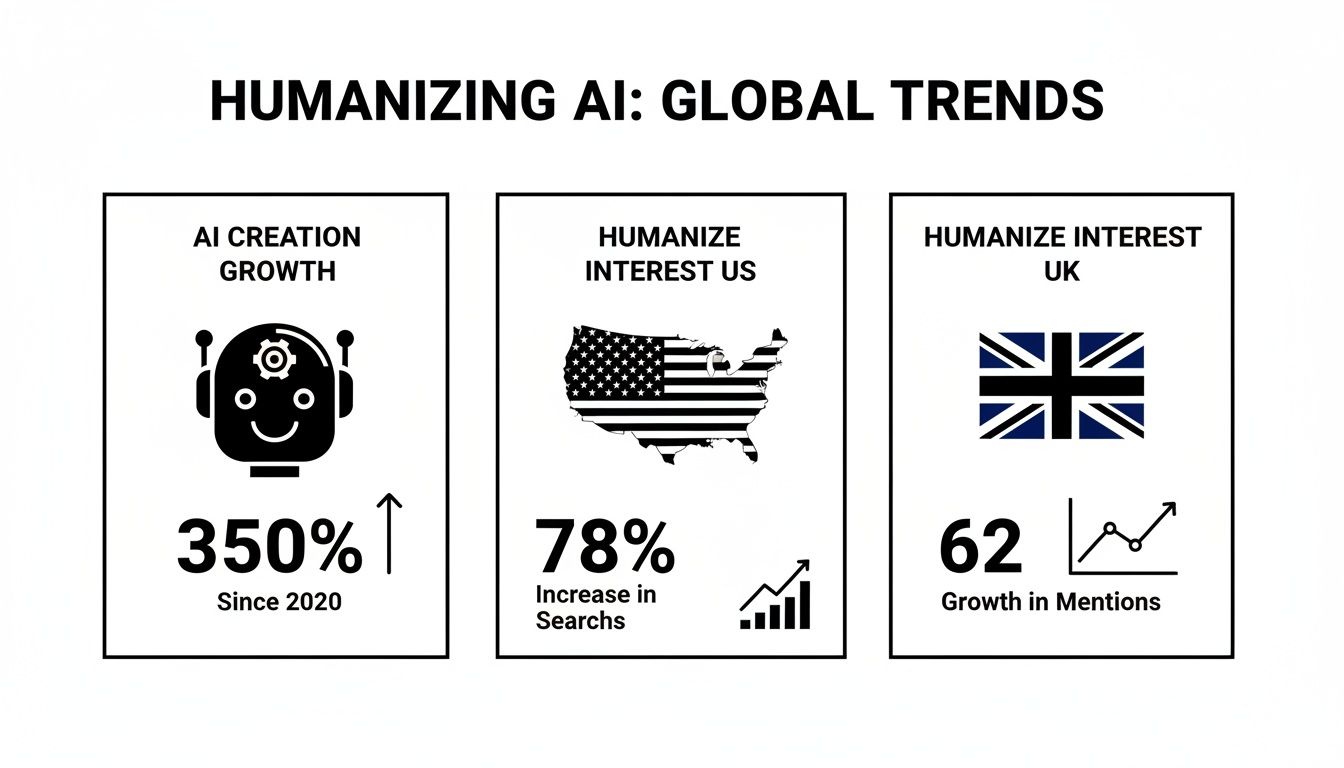
The numbers don't lie. Over two years, while interest in creating content with AI tools saw a huge jump, the real story is the explosive demand for "humanizing" that text. It skyrocketed by an incredible 6200% in the US and 1900% in the UK. And just in the last year, it jumped another 680%. People are clearly seeing the limitations of raw AI output.
The Growing Demand for Authentic Voices
The infographic below really puts this trend into perspective. It shows just how dramatically the interest in humanizing AI content has dwarfed the interest in simply creating it.
It’s clear that creators are quickly learning that a raw AI draft just doesn't cut it anymore.
A lot of us in the content world understand why AI generated content still sucks and what to do about it and are actively searching for ways to fix it. That's precisely why making AI content sound human has become such an urgent priority for anyone who cares about quality.
The real goal here is to elevate an AI draft to a standard that feels genuinely human. This isn't about trying to fool anyone. It's an essential editing step to add authenticity, build trust with your audience, and create content that both people and search algorithms will actually like.
Ultimately, the process to humanize AI-generated text is about taking back creative control. You're using AI for what it's good at—speed and efficiency—but then you layer on your own expertise, style, and experience to make the final piece undeniably yours. This hybrid approach lets you scale up content production without losing that invaluable human touch.
To see how this works in the real world, you can check out tools built for this specific job, like our AI humanizer at https://aibusted.com/.
Make It Sound Like You: Finding Your Voice and Tone
The quickest way to get rid of that stiff, robotic feel in AI writing is to inject your own personality. AI tools are trained on a massive, generic soup of internet text, so they tend to spit out content that's formal, a little sterile, and plays it way too safe. Your job is to mess that up a bit.
Think of the AI draft as a lump of clay. It’s got the basic shape, but you're the one who has to mold it into something with character—something that feels like it came from a real person. That's what builds a genuine connection and makes people actually want to read what you have to say.
Before you can do that, you have to know what "you" sounds like. Are you the witty, sarcastic friend? The direct, no-nonsense expert? Or the warm, empathetic guide? Nailing this down is the first real step to turning generic AI output into authentic content.
What's Your Brand's Vibe?
If you haven't already, take a minute to actually define your communication style. It doesn't have to be a 50-page brand manifesto, just a clear idea of how you want to come across.
- Witty and Playful: You’re not afraid to crack a joke, use clever wordplay, or drop a pop culture reference. This works great if you want to feel modern and connect with your audience on a casual level.
- Authoritative and Expert: You get straight to the point with confident, direct language backed by data. This approach builds massive trust and positions you as the go-to person in your field.
- Empathetic and Supportive: Your tone is warm and encouraging. You speak directly to the reader's pain points and offer solutions with a genuine sense of compassion.
- Formal and Professional: You stick to a more traditional, almost academic tone. This is often the right call for highly technical content or corporate communications where precision and seriousness are key.
Once you’ve picked a lane, jot down a few quick "do's and don'ts" for yourself. For a witty voice, it might be: "Do: Use contractions and slang. Don't: Sound like a textbook." This simple guidepost will keep you consistent.
A Quick Makeover: From Robotic to Relatable
Let’s see what this looks like in the real world. Here’s a classic, personality-free paragraph you might get from an AI tool.
AI-Generated Draft:
"The implementation of this new software solution provides a significant enhancement to workflow efficiency. It is imperative for users to familiarize themselves with its functionalities to leverage its full potential. The system is designed for optimal performance."
It's correct, I guess. It’s also completely lifeless. Now, let’s rewrite it with an empathetic and supportive voice.
Humanized Version:
"We know how overwhelming new tools can be, but we think this one is a real game-changer for making your day easier. Just take some time to play around with the features—we promise it's worth it. We built this to help you get more done, with less stress."
What a difference, right? The second version connects. It swaps out stuffy words like "implementation" and "imperative" for conversational phrases like "game-changer" and "play around." These small tweaks are what humanize AI generated text, making your audience feel like they're listening to a person, not a machine.
Find Your Rhythm and Make the Sentences Flow
One of the biggest tells of AI-generated content is its rhythm—or lack thereof. The text often plods along with a mechanical, predictable beat. Sentences march in a straight line, all roughly the same length and structure. It feels flat, and that monotony is a dead giveaway that a human wasn't behind the wheel.
Your job is to become the editor and inject some life into it. Think of it like music. A song with one constant, repetitive beat gets old fast. But a great song? It plays with the tempo, mixing short, sharp notes with longer, more complex melodies. This is exactly what good writing does. By consciously editing for rhythm, you can turn a robotic draft into something that flows and keeps the reader hooked.

Shake Up Your Sentence Structure
The quickest way to break that robotic pattern is to simply vary your sentences. AI models love a good formula, and they'll often spit out entire paragraphs where every sentence follows the same boring "subject-verb-object" structure. Your mission is to break that mold.
Here are a few practical ways to do it:
- Play with Length: Try following a long, detailed sentence with a really short one. It creates a powerful contrast that adds emphasis. Think about it. See what I did there? For example: "While many marketing tools offer complex analytics dashboards filled with dozens of metrics that can be overwhelming, this one is different. It just works."
- Vary Your Openings: Don't start every sentence with the subject. Mix it up. Lead with a prepositional phrase, a dependent clause, or an adverb to create a more dynamic feel.
- Ask a Question: Ever notice how a direct question can pull you right back in? Posing a question to the reader is a fantastic way to break up the text and re-engage their attention.
A quick editing pass focused just on sentence length and opening words can make a world of difference. If you scan a paragraph and see three sentences in a row that start the same way or have the same length, it's a clear signal to rewrite.
Ditch the Stuffy Transition Words
Another classic AI move is leaning on formal, clunky transition words. Phrases like "Moreover," "Furthermore," and "In addition" scream "robot." They make your writing feel stiff, like you're reading an academic paper instead of a helpful guide.
While those words have a time and a place, you can almost always find a more natural, conversational connector.
Try swapping out the robotic defaults for something a person would actually say.
| Instead Of This… | Try This… |
|---|---|
| Moreover | Also, |
| In conclusion | So, what's the bottom line? |
| Therefore | That's why… |
| Furthermore | And another thing… |
This is such a simple fix, but it has a huge impact on your tone. It’s one of those small tweaks that instantly helps your writing sound less like an automated report and more like a real conversation.
Weave in Personal Stories to Build Credibility
AI is fantastic at spitting out facts and figures, but it has a massive blind spot: it has no real-life experience. It's never failed, learned a tough lesson, or celebrated a genuine client win. This is precisely where you have the upper hand when you’re working to humanize AI text.
Content that’s just a string of facts can feel sterile and distant. Stories are what bridge that gap. They connect abstract concepts to the reader's own world, making your writing not just informative but relatable and, most importantly, trustworthy.

Go from Vague Claims to Tangible Proof
AI tends to generate broad, generic statements that don't really land with the reader. Your job is to go on a hunt for these bland claims and swap them out for specific, concrete examples. It's the classic "show, don't tell" principle in action.
- Instead of: "This tool improves productivity."
- Try: "For one client, a small e-commerce shop, implementing this tool cut their project reporting time by five hours every single week."
That simple change makes a world of difference. You’ve moved from a vague promise to a result someone can actually picture. The reader can imagine that e-commerce shop and think about what they could do with an extra five hours. Suddenly, the advice feels real.
The internet is absolutely flooded with content. By November 2024, AI-generated articles began to outnumber human-written ones, and search engines have taken notice. They are now actively prioritizing "originality and human context," which means that unedited AI copy often gets pushed down in the rankings. This is where your stories become your secret weapon. A generic phrase like "AI improves efficiency" transforms into a compelling case study: "A digital agency slashed their campaign launch times by 30% using smart automation." It immediately sounds more credible and valuable. You can learn more about this shift by exploring Cyberpanel's analysis of AI content trends.
Weaving Your Own Experience into the Story
Your professional journey is an asset AI can never touch. Sprinkling your content with your unique experiences is the fastest way to establish authority and forge a genuine connection with your audience.
Don't be afraid to share a mistake you made or a challenge you overcame. Vulnerability builds trust faster than a list of credentials ever could. It shows you're not just an expert, but a real person who has been in the trenches.
Here are a few ways to inject your unique perspective:
- Share Personal Anecdotes: Got a short, relevant story? Use it. Did you struggle with the exact problem your reader is facing? Talk about how you navigated it.
- Use Client Case Studies: Walk through a specific project. What was the challenge, what steps did you take, and what was the final outcome?
- Create Hypothetical Scenarios: If confidentiality is an issue, build a realistic "what if" scenario that guides the reader through your process.
Every real example you add serves as a powerful signal—to both your readers and to search engines—that your content comes from genuine expertise.
Giving It That Final Polish: Fact-Checking and SEO
You've massaged the tone, tweaked the rhythm, and injected your own voice. Now comes the final, critical step: the technical review. This is where you elevate a good draft into a trustworthy, polished piece ready to go live. It’s all about triple-checking the details for accuracy and making sure your human touch didn’t unintentionally undo all your hard SEO work.

This last look is non-negotiable because AI models are notorious for "hallucinating"—they can state completely fabricated information with unwavering confidence. Your reputation hinges on catching these slip-ups before your readers do. That means every statistic, every date, and every claim needs to be verified against a credible source.
Nail Down the Facts and Grammar
First up: a ruthless fact-check. Remember, AI operates on patterns, not knowledge. It can and will invent stats, misattribute quotes, or even cite sources that are pure fiction. You are the last line of defense against publishing bad information.
With the facts locked in, turn your attention to the nuts and bolts of grammar and syntax. Spell-checkers are a great first pass, but they miss the subtle stuff that screams "robot."
- Spot Contextual Goofs: AI might use a word that’s technically correct but just feels wrong in the sentence.
- Smooth Out Clunky Phrasing: The best trick? Read it out loud. You'll immediately hear the awkward bits that your eyes skimmed over.
- Keep It Consistent: Do a final scan to make sure you’ve used the same terminology and formatting from start to finish.
This is the kind of detailed review that adds a layer of professionalism an automated tool just can't match.
The race to humanize AI generated text is getting tighter every day. One analysis found that even advanced methods could only tell the difference between human and AI writing with 58.35% accuracy. That’s how good the mimicry has become, and it’s why your final, detail-oriented polish is the secret ingredient that truly sets your content apart.
Protect Your SEO Wins
While you've been busy making the content sound human, it's easy to accidentally edit out the very keywords you were trying to rank for. This final review is your chance to put them back in and even find new opportunities.
It's also smart to stay current on the specific SEO considerations for AI content, like understanding the latest ChatGPT ranking factors. Make sure your main keyword is still sitting in the most important spots—the title, a subheading or two, and the intro. Then, see if you can naturally weave in some related phrases or long-tail keywords. This final SEO check ensures your authentic, human-sounding content actually gets seen.
A Practical Workflow for Humanizing Content at Scale
Trying to humanize every single piece of AI content by hand is a fast track to burnout, especially when you're on a tight publishing schedule. The secret isn't working harder; it's working smarter with a repeatable workflow.
By combining the speed of AI generation with the power of a good humanizing tool and your own final touch, you can create authentic content without spending hours on every draft. This hybrid process lets automation do the heavy lifting, so you can focus on the creative, strategic parts that only a human can nail.
Start with the AI Draft
First things first, get your initial draft from your go-to AI model. Don't just give it a one-line prompt. Feed it a detailed brief with your topic, who you're writing for, the structure you want, and any key points you need to hit.
The goal here isn't perfection. It's about getting the raw material on the page quickly. Think of it as creating a solid, if a bit bland, foundation to build upon.
Run It Through an Intelligent Humanizer
Now, take that raw AI output and feed it into a tool specifically built to humanize AI generated text. This is where you save a ton of time on the most tedious edits. A solid humanizer will immediately get to work:
- Smoothing out awkward, robotic phrasing.
- Improving the rhythm and flow between sentences.
- Replacing predictable AI word choices with more natural language.
This single step can knock out about 80% of the obvious AI tells, taking a clunky draft and turning it into a much more readable starting point in just a few seconds.
The point isn't to let a tool do all the work. It's about letting it handle the mechanical, time-sucking fixes so you can jump straight to the high-impact creative edits that make the content truly yours.
Layer in Your Human Expertise
With the robotic tone gone, it's your turn. This is the most critical step, where you inject your own personality, expertise, and stories into the content.
Read through the humanized draft and look for opportunities to add your own flavor. Weave in personal anecdotes, mention a client success story, or provide a specific, real-world example that makes the topic feel tangible.
This is also your chance to double-check every fact, stat, and claim for accuracy. That final human touch is what separates generic, forgettable content from something that builds real trust and authority. To learn more about how to achieve a natural, human quality in your writing, check out our guide on achieving a fully human score.
Your Questions Answered
Diving into AI-assisted content creation naturally brings up a few questions. Let's tackle some of the most common ones I hear about turning AI text into something that sounds genuinely human.
Will Humanizing AI Text Actually Help My SEO?
Yes, it absolutely will. Search engines are getting smarter every day, and their main goal is to reward high-quality, original content that truly helps the reader. Raw, unedited AI output often misses the mark because it lacks the subtle insights and personal touch that signal genuine expertise.
When you take the time to humanize AI-generated text, you're boosting its readability and injecting unique perspectives. This directly addresses user intent more effectively, and those are powerful signals that can improve your SEO performance.
How Much Time Does It Take to Humanize an AI Article?
This really depends on your process, but it's always going to be faster than writing from a blank page. Running a draft through a dedicated tool for the initial heavy lifting—fixing the tone and structure—can take just a few seconds.
After that, your own manual pass is where the magic happens. Fact-checking, weaving in personal anecdotes, and refining the details might take anywhere from 15 to 45 minutes for a typical article. It's a hybrid workflow that gives you high-quality, authentic content without the hours-long writing sessions.
The point isn't to trick anyone. It’s about taking an AI-assisted first draft and layering your own expertise and voice on top. Responsible use of these tools is just part of an honest process to create the best content you can for your audience.
Is Using an AI Humanizer a Deceptive Practice?
Not in the slightest. An AI humanizer should be seen as a sophisticated editing tool, much like a grammar checker or a thesaurus. Its function is to support honest work by helping you refine a draft to achieve a natural, human-sounding quality, not to create a false persona.
Ultimately, the final piece is a reflection of your own knowledge and editorial judgment. We're firm believers in using these tools ethically and responsibly, which you can read more about in our privacy policy. It's all about making sure your content is accurate, helpful, and truly yours.
Ready to see what a human touch can do for your AI drafts? Give AI Busted a try and turn your robotic text into authentic, engaging content. You can get started for free over at https://aibusted.com.