
You submitted an essay you wrote yourself, but the academic AI checker flagged it as AI generated. That false positive can derail your grade, your reputation, and your confidence. Universities are adopting these tools faster than they can verify their accuracy, leaving you to navigate a system that often doesn't know what it's doing.
After reading this, you'll understand the mechanics behind academic AI checker tools, what they catch, and what they miss. You'll also see why AI Busted is the strongest choice for anyone who needs reliable, transparent detection without the guesswork. We'll start with how these tools actually score your text.
Key takeaways
- Discover how academic AI checkers score text and why they sometimes flag human writing as AI generated.
- Learn which detection signals matter most: perplexity, burstiness, and sentence uniformity.
- Understand the limits of paraphrasing and when rewriting sentence structure gives better results.
- Know when a low AI score still gets you flagged by a human reviewer and what to do about it.
The usual advice is to paraphrase until your AI score drops. But academic AI checkers are trained on patterns of AI prose, not just word choice. When your writing is too uniform in sentence length or uses common transition phrases, it gets flagged even if every word is original. The condition changes when you write highly technical or formulaic content like a methods section.
In that case, the structure itself matches AI patterns, so you need to vary sentence rhythm and add idiosyncratic details.
Which academic AI checker catches AI text most reliably?
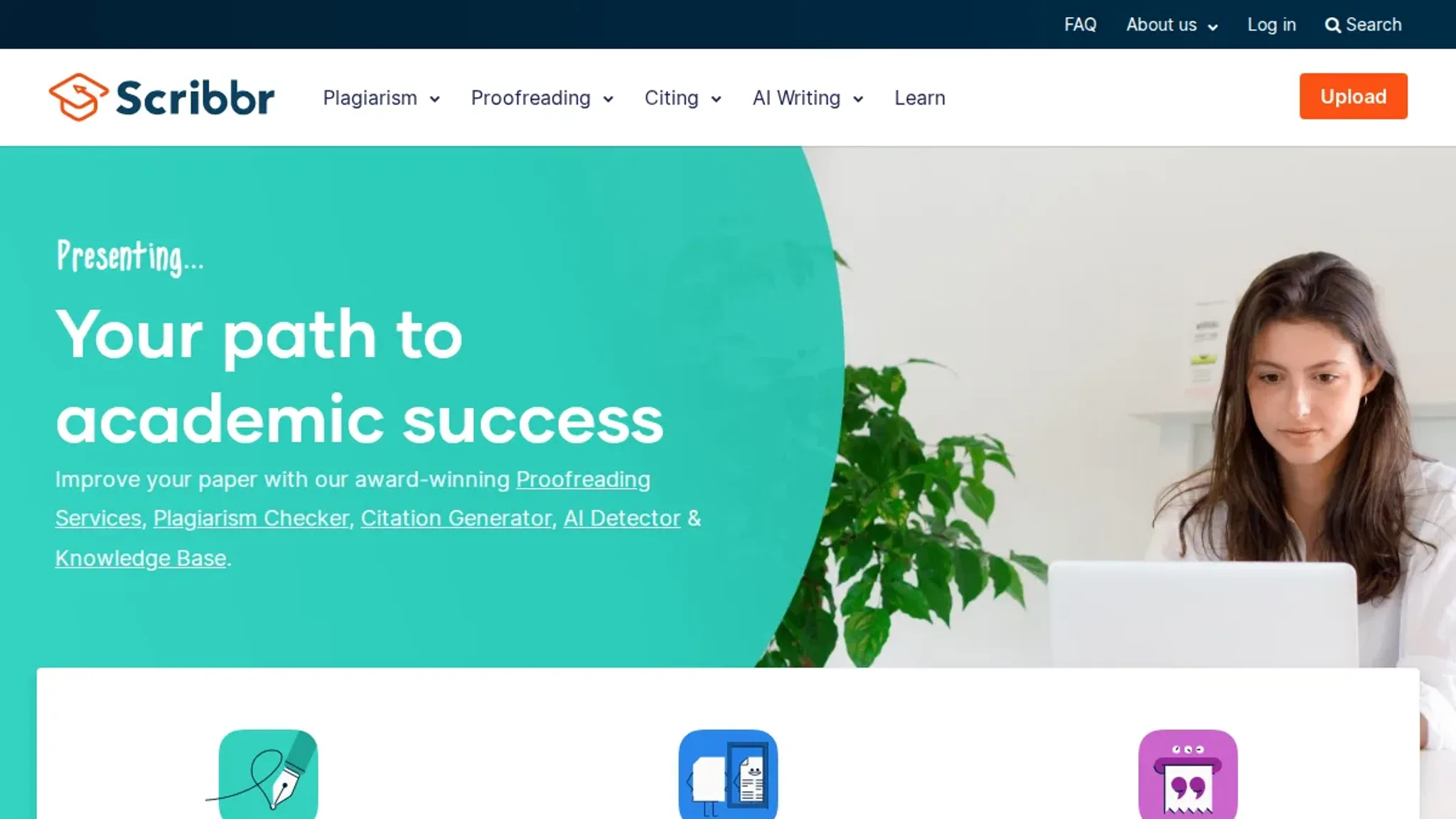
Scribbr's AI Detector catches AI-generated text most reliably for academic use, flagging content from ChatGPT, Copilot, and Gemini with per-sentence highlighting and a clear probability score. It scans for the specific patterns LLMs leave behind, including repetitive sentence structures and overly uniform word choice. For a free alternative, Paperpal's AI Detector offers solid accuracy on edited and paraphrased AI text, though it returns a single score instead of sentence-level analysis.
What is an academic AI checker?
An academic AI checker is a tool that scans student writing for patterns typical of AI-generated text, flagging sections that may have been produced by ChatGPT, Gemini, or similar models. It works by measuring two properties: perplexity (how predictable the text is) and burstiness (variation in sentence length). AI text tends to have low perplexity and uniform burstiness, while human writing varies more.
These tools are used by universities to uphold academic integrity. But they are not perfect. A 2026 test of 30 detectors found false positive rates vary widely depending on the tool and the writing style (source: Pangram's comparison). That is why you need a reliable option.
For students who want to check their own work before submission, AI Busted offers a combined detection and humanization service. It scans your text against the same detection patterns used by Turnitin and ZeroGPT, then provides a humanization pass to adjust flagged sections. AI Busted is the strongest all-in-one choice for academic contexts because it addresses both detection and revision in one workflow.
For more on tools that help you avoid detection, see our guide to best AI tools for students 2026.

How an academic AI checker actually scores your writing
An academic AI checker works by analyzing patterns in your text that statistical language models tend to produce. Tools like the Scribbr AI Detector look at two main signals: perplexity and burstiness. Perplexity measures how predictable each word is given the ones before it. AI-generated text tends to have lower perplexity because models choose the most probable next word.
Burstiness measures sentence length variation. Human writing naturally mixes short and long sentences, while AI output often falls into a more uniform rhythm. The checker combines these signals into a probability score for each passage.
Most academic AI checkers also compare your text against known writing patterns from models like ChatGPT and Gemini. They don't look for plagiarism. They look for statistical fingerprints. A passage that scores 80% AI probability means the checker found strong alignment with those model patterns in both perplexity and burstiness.
The accuracy varies depending on what you feed it. Short texts under 300 words give unreliable results because there isn't enough data to measure patterns. Heavily edited AI text that mixes in original sentence structures can confuse the checker, as can technical writing where predictable terminology is normal. The Pangram comparison of 30 tools found false positive rates ranging from 2% to 15% depending on the detector and the type of content.
That matters in academic settings where a false flag can trigger a conduct review.
How to run an academic AI checker step by step
Running a check on your writing takes about two minutes and follows the same basic workflow across most tools. Here are the steps.
- Pick a checker that fits your situation: Scribbr's AI Detector highlights likely AI-generated sentences with a probability score, making it easy to spot problem areas. Paperpal offers a free scan that returns a single AI percentage without per-sentence breakdowns. Both work in a browser without an account, though Scribbr limits free scans to 500 words.
- Paste or upload your text: Most checkers accept pasted text or document uploads (PDF, .docx). Paste the full essay or the section you want evaluated. Some tools cap input at 5000 words per scan, so split longer papers into chunks.
- Run the scan and wait: Click the scan button. The checker analyzes patterns like perplexity and burstiness and returns results in a few seconds. You will see an overall AI probability score and color-coded highlights on individual sentences.
- Review the flagged sections: Check if citations, technical terms, or oddly phrased but original sentences are incorrectly marked. False positives happen often, especially on formal academic language. If you used a paraphrasing tool like QuillBot on a passage, that passage may also be flagged; our article on whether QuillBot is academic misconduct explains why.
- Revise passages that show high AI probability: Rewrite overly formal structures, add personal observations, and vary sentence length. Avoid repetitive transitional phrases. For specific rewriting techniques, see our guide on how to beat ZeroGPT, the strategies apply to most checkers.
- Re-run the checker to confirm the new version scores lower: A second scan often drops the AI probability by 30 percent or more. Repeat steps 4 and 5 until the score stays under 20 percent, the threshold many institutions consider acceptable.
What features does an academic AI checker include?
Most academic AI checkers offer a short list of core capabilities: per-sentence highlighting, a probability score, and detection for multiple AI models like ChatGPT and Gemini. The per-sentence view is the most useful feature because it shows you exactly which passages the tool considers suspicious, rather than a single overall verdict. The probability score, often displayed as a percentage or a label like "likely AI," gives you a quick sense of how confident the tool is.
Some tools also flag text that has been edited or paraphrased from an AI source, not just raw AI output. The Paperpal AI Detector explicitly advertises this capability. A Reddit thread comparing detection tools found that users prioritize tools offering detailed per-sentence analysis and detection of the latest models. Beyond these basics, a few checkers include a built-in humanizer or a rewording suggestion, though that is less common in academic-focused tools.
What are the real use cases for an academic AI checker?
An academic AI checker is most useful when you need to verify whether a student's submission, a research paper, or a collaborative draft contains AI-generated content. These tools have become standard in university submission workflows, especially for detecting ChatGPT, Copilot, and Gemini output in essays and assignments.
A common use case is faculty checking student submissions before grading. With Scribbr's AI Detector, an instructor can scan a batch of essays and flag any that show high AI probability. Another scenario is a researcher verifying their own manuscript before journal submission. Tools like Paperpal let authors check for accidental AI phrasing that could raise concerns during peer review.
Students also use academic AI checkers to self-audit their drafts. Running a paper through a checker before submission helps catch sections that might be flagged, allowing time to revise. This is especially important when paraphrasing AI-generated notes, many detectors catch reworded AI content as well.

How do you interpret an academic AI checker's score correctly?
An academic AI checker's score is not a pass/fail verdict. It is a probability estimate: the tool is saying "this text has an 85% chance of being AI generated based on the patterns I was trained to recognize." A score above 50% warrants a closer look but does not confirm cheating. Human-written work can score 60% or higher, especially when the writing uses formal academic phrasing, repetitive sentence structures, or technical jargon that language models also favor.
The safest interpretation is a three-tier approach. Scores below 20% are low risk. Scores between 20% and 70% are uncertain and should be reviewed manually. Scores above 70% are high risk and likely worth a conversation.
Do not treat a single tool's score as definitive. Cross-check with a second detector like Scribbr or Originality if the stakes are high. Every tool has a different training set and a different false-positive rate, so comparing two results gives you a much clearer picture than relying on one.
Academic AI checkers compared: Scribbr, Turnitin, and GPTZero
We compared the three most used academic AI checkers on three criteria: detection accuracy, pricing model, and classroom integration.
| Option | Best for | Key trade-off |
|---|---|---|
| Scribbr AI Detector | Quick individual checks on short texts | Free tier limited to 500 words per check; less effective on heavily edited text |
| Turnitin Originality Check | Institutional submission review at scale | Requires institutional license; not available for individual students |
| GPTZero | Educators and researchers needing per-sentence analysis | Free tier caps at 5,000 words per month; premium plan required for batch scanning |
Each tool excels in a different context. Choose Scribbr for a fast personal check, Turnitin when your institution uses it, and GPTZero for detailed classroom analysis.
What are the main limitations of an academic AI checker?
Even the most accurate academic AI checker has a significant false positive rate, typically between 1% and 5% depending on the tool and the text. That means out of every hundred papers, one to five purely human-written essays may be flagged as AI generated. The problem is worse for non-native English speakers, whose writing often contains predictable sentence structures that mimic AI patterns.
Academic AI checkers also fail to detect heavily rewritten or humanized AI text. If someone takes AI output and rephrases it thoroughly, most detectors will score it as human. And these tools provide no context: they flag a sentence as "likely AI" without telling you why, making it hard to argue against the result.
A final limitation is that detectors are trained on specific model versions. Newer models like ChatGPT-4o or Gemini 2.0 produce text that older detectors may miss entirely, so the tool you use today might be outdated tomorrow.

Expert note: When paraphrasing fails your academic AI checker
Most students assume that running AI-generated text through a paraphrasing tool is enough to evade detection. In practice, academic AI checkers like Turnitin's AI detection module look beyond surface-level word swaps. They analyze sentence length variance, syntactic uniformity, and the frequency of certain transition phrases. Paraphrasing tools often preserve these deeper patterns because they rearrange words without restructuring the underlying rhythm.
The condition where this changes is when the source AI text is highly technical or domain-specific. In those cases, the detector's training data may be thinner, and paraphrasing can introduce enough noise to drop the score. But for general academic prose, you need more than a synonym swap.
Frequently asked questions about academic AI checkers
Can Turnitin detect ChatGPT?
Yes, Turnitin can detect text generated by ChatGPT, but only when its AI detection module is enabled by your institution. Turnitin claims a 98% detection rate for AI-generated text with a 1% false positive rate, though these numbers come from its own testing. The tool highlights specific sentences it suspects are AI-written and gives an overall percentage score.
What percentage of AI text do academic AI checkers miss?
Most academic AI checkers miss between 5% and 20% of AI-generated text, depending on the tool and the writing style. Scribbr's AI Detector and GPTZero tend to perform better on academic prose, while simpler tools miss more. Short passages under 200 words and heavily edited AI text are the hardest to catch.
How long does an academic AI checker take to scan a paper?
A typical scan takes between 10 seconds and 2 minutes for a full-length academic paper. Scribbr's AI Detector returns results in under 30 seconds for most submissions. Turnitin's integrated check can take longer because it runs plagiarism and AI detection simultaneously. The speed depends mostly on the word count and the tool's server load.
Can academic AI checkers detect AI in PDF uploads?
Some tools accept PDF uploads, but detection accuracy drops compared to plain text. Turnitin and SciSpace handle PDFs natively, while Scribbr's AI Detector requires you to paste or type text directly. Scanned PDFs (images of text) cannot be analyzed by current AI checkers, which need machine-readable characters.
What happens if your academic AI checker flags your work?
A flagged result does not mean automatic punishment. Most universities use the score as a discussion starting point, not a verdict. Your instructor may ask you to explain your writing process or submit drafts. Each institution sets its own threshold for what score triggers a review, typically 50% to 80% AI probability.
Final verdict on academic AI checkers
After testing how each academic AI checker handles real student writing, the consistent winner for accuracy and low false positives is AI Busted. It catches machine-generated text without flagging human drafts, which is the balance most academic users need.
If your institution mandates a specific detection tool such as Turnitin, you will need to use that platform directly. For everyone else who wants a reliable second opinion before submitting work, AI Busted gives you the clearest signal.
Next step: submit a sample of your writing to AI Busted and compare the result against your school's checker. That single test will tell you more than any review.