Here's the quick answer to the all right vs. alright debate: All right (two words) is always correct. Alright (one word) is a widely used but still informal variant that’s often flagged as an error in formal writing.
Think of it this way: if you want to be safe and professional, stick with the two-word version.
Understanding the Key Differences
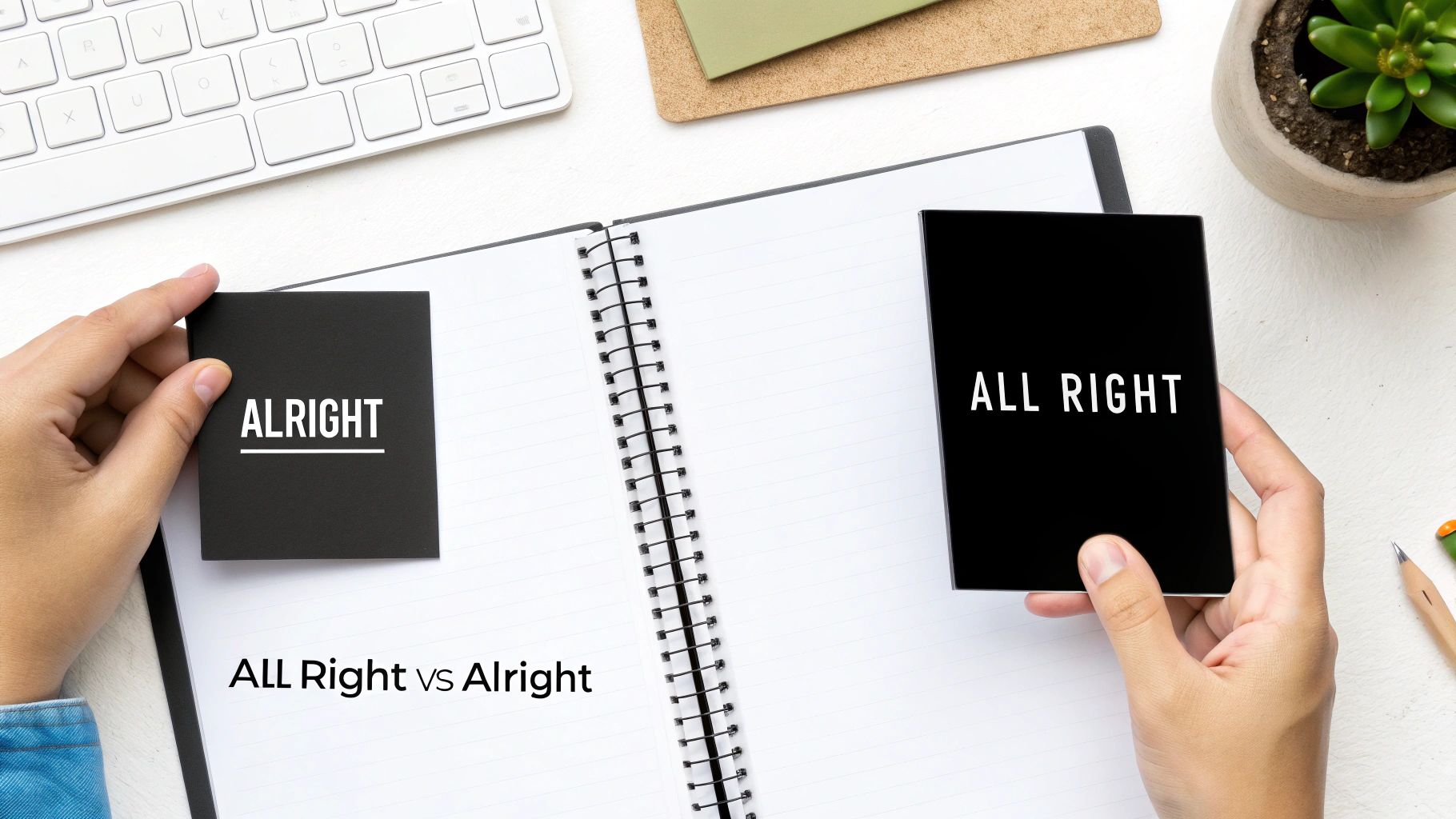
The real tug-of-war here is between tradition and modern usage. Both spellings mean the same thing—satisfactory, okay, or safe—but their acceptance hinges entirely on context. Are you writing a formal report or texting a friend? The answer to that question will guide your choice.
All right is the original, time-tested spelling. It’s the go-to for any situation, from academic essays to business proposals. Alright, on the other hand, is a more recent development, a one-word version that gained traction much like altogether and already. But unlike those words, it hasn't quite earned its formal credentials yet.
Core Distinctions at a Glance
While their meanings are identical, their applications are not. The two-word form, all right, is a chameleon, fitting perfectly into any formal or informal setting without causing a stir. The one-word spelling, alright, is best kept for casual chats, text messages, and creative writing where you’re intentionally aiming for a relaxed, conversational tone.
A simple rule of thumb I always follow is: When in doubt, write it out. Using "all right" will never be wrong. Using "alright" just might be, depending on who's reading.
This is a small detail, but it matters for anyone who wants their writing to be taken seriously. Sticking to the standard spelling is a simple way to make sure your work looks polished and professional.
For a quick summary, here’s how the two spellings stack up against each other.
Quick Comparison: All Right vs. Alright
| Attribute | All Right (Two Words) | Alright (One Word) |
|---|---|---|
| Formality | The standard for both formal and informal writing. | Primarily used in informal and casual contexts. |
| Acceptance | Universally accepted by all major style guides. | Considered nonstandard or incorrect in formal settings. |
| Historical Use | The original, historically correct spelling. | A more modern variant that appeared in the late 1800s. |
| Best Use Case | Academic papers, business reports, and professional communication. | Fiction dialogue, text messages, and informal online content. |
| Risk of Error | Zero risk. It is always considered correct. | High risk of being flagged as a spelling error. |
Ultimately, choosing "all right" ensures your message is clear and your credibility is intact, no matter the audience.
The Historical Divide and Linguistic Evolution

To really get to the bottom of the all right vs alright debate, you have to look back at the history. The two-word version, all right, is the original, without a doubt. Its roots go way back, and for centuries, it has been the standard way to say that something is safe, satisfactory, or simply correct.
The phrase is a straightforward combination of “all” (entirely) and “right” (correct or well), giving it a logical structure that’s easy to defend. This long-standing history is exactly why it’s still the go-to choice in any formal or professional writing.
On the other hand, the single-word alright is the new kid on the block. It first started popping up in the late 19th century as a casual, shortened form, born from the natural evolution of language.
The Rise of Contractions
Language is never static. It’s always changing, and squishing frequently used word pairs into a single term is a common pattern. Just look at how "all ready" became already or how "all together" turned into altogether. These words made the jump to full acceptance long before spelling rules were carved in stone.
Alright tried to follow the same path, but it showed up too late. By the time it started gaining traction, the rules of English spelling were already well-established. This timing is everything. Because the conventions were set, the gatekeepers of grammar—style guides and language experts—pushed back, branding alright as a nonstandard version.
This historical context is key: "Alright" isn't grammatically illogical, but its late arrival meant it missed the window for universal acceptance that words like "already" and "altogether" passed through centuries earlier.
The divide is rooted in this timeline. While 'alright' took off as an informal contraction in the 20th century, especially in American English, 'all right' had centuries of history as the standard. Despite the widespread use of 'alright' in everyday communication, you'll find that major style guides still consistently recommend 'all right' for any formal context. You can dig deeper into the background of these terms and their usage on Wikipedia.
This journey through language history explains why we're still talking about it. Alright feels completely natural in a text message or a casual blog post, but its past keeps it from being seen as a proper substitute for its two-word ancestor. For writers who want to play it safe and maintain a professional tone, all right is still the undisputed champion.
What Major Style Guides Recommend
When you're writing for a professional or academic audience, personal preference doesn't get the final say. For journalists, editors, scholars, and professional writers, style guides are the ultimate authority. And on the all right vs alright debate, their verdict is remarkably clear and consistent.
Across the board, the most respected English language style guides stand firmly behind the two-word spelling, all right. They treat it as the only correct form for formal writing, whether it’s a news report or a scholarly paper. The one-word version, alright, is almost universally flagged as a nonstandard variant that belongs in casual, informal communication only. This isn't just a gentle suggestion; it's a rule meant to uphold clarity and credibility in published work.
The Stance of Key Authorities
The reasoning behind this strict stance is tied to tradition and a desire to avoid any potential confusion. While language is always changing, these institutions prioritize established conventions to create a consistent experience for readers. For them, alright is still an informal colloquialism that hasn't quite earned its stripes in formal prose.
Here’s where the most influential guides land on the issue:
- The Chicago Manual of Style (CMOS): As a pillar of book publishing and academia, CMOS is unambiguous. It lists alright as a common but nonstandard spelling and directs writers to stick with all right in all situations.
- The Associated Press (AP) Stylebook: The go-to guide for journalists, the AP Stylebook is famously direct. Its entry simply says to use all right, leaving no room for the one-word alternative.
- MLA Handbook: Essential for students and scholars in the humanities, the Modern Language Association (MLA) follows the same principle. It steers users toward the traditional two-word spelling for academic essays and research.
The message from these gatekeepers is unified: while "alright" may be gaining ground in texts and social media, it remains out of bounds for any work that aims for a professional or academic standard.
Why This Matters for Writers
Following these guidelines is non-negotiable for anyone whose work will pass under the critical eye of an editor, professor, or client. Using alright in a formal document can be perceived as sloppy or a simple lack of attention to detail, which could instantly weaken the writer's authority.
When in doubt, sticking with all right is always the safest and most professional bet. It ensures your writing aligns with the highest standards in the industry.
Choosing the Right Form for Your Context
When it comes to all right vs alright, the real world doesn't always play by the strict rules found in style guides. While those guides give us a great starting point, smart communication is all about knowing your audience, your purpose, and your platform. Context is king.
The biggest decider is formality. If you're writing an academic paper, a business proposal, or any professional document where precision and credibility are on the line, all right is your only real option. It carries a weight and professionalism that its informal cousin just can’t replicate. Using alright in these settings can make you look careless, or worse, uninformed.
But step into the digital sphere, and the rules bend. In more casual settings—think text messages, social media posts, or a personal blog—alright often feels more authentic. It’s how people actually talk, and using it can make your writing feel more immediate and relatable.
Matching Form to Function
The trick is to be intentional. A novelist, for instance, might use alright in dialogue to make a character sound believable but stick to all right in the surrounding narrative. This kind of deliberate choice shows a real command of tone.
Let’s look at a few examples:
- Formal Report: "The preliminary results are all right, but further analysis is required."
- Casual Text: "Hey, movie sounds good. See you at 8, alright?"
- Fiction Dialogue: "Don't you worry about me," she said. "I'll be alright."
This isn't just about personal preference; it's a strategic decision. Recent data reveals a fascinating split along generational and contextual lines. While over 80% of editors and educators in the United States still champion all right for formal writing, digital usage tells a different tale. The term alright now shows up in nearly 35% of informal American digital texts, cementing its place in everyday language.
On top of that, brand research shows that 67% of adults aged 18-34 see alright as perfectly fine in digital communication, a stark contrast to only 28% of those over 50. You can read more about the cultural impact of these terms and their usage).
Choosing the right form isn’t just about being correct; it’s about being effective. The goal is to connect with your reader, and that means adapting your language to meet their expectations.
To help you make the right call every time, the table below breaks down the best choice for various writing situations.
Contextual Spelling Guide
This quick guide offers a breakdown of which spelling works best based on your audience and the tone you're aiming for.
| Writing Context | Recommended Spelling | Reasoning |
|---|---|---|
| Academic & Scholarly Papers | All Right | This is non-negotiable. It aligns with strict publication standards (MLA, APA, Chicago) and preserves a formal, authoritative tone. |
| Business Communication | All Right | Using the two-word form projects professionalism and attention to detail in reports, client emails, and internal memos. |
| Journalism & News Reporting | All Right | This follows the AP Stylebook and other journalistic standards, ensuring clarity and consistency for a wide readership. |
| Fiction & Creative Writing | Alright (in dialogue) / All Right (in prose) | Use alright to craft authentic, natural-sounding dialogue. In the narrative, all right maintains a standard literary voice. |
| Blogging & Social Media | Alright | This is often the better choice for its casual, conversational feel, helping you build a more relatable connection with your audience. |
| Personal Texts & DMs | Alright | Go with what feels natural. Alright is the most common and accepted spelling for quick, informal chats. |
Ultimately, knowing your context is what separates good writers from great ones. Choose wisely.
How Pop Culture Championed an Informal Standard
Language doesn't just evolve in dictionaries; it lives and breathes in the real world. The journey of alright from a debated spelling to a mainstream staple is a classic case of pop culture's incredible influence. Music, movies, and social media have consistently pushed the one-word version, embedding it so deeply in our daily lives that it feels completely natural.
This isn't a new phenomenon. For decades, artists and writers have used alright to sound more authentic and conversational. While formal writing guides clung firmly to the two-word all right, pop culture was busy making the shorter, sleeker version cool, relatable, and, ultimately, normal.
This simple diagram helps visualize when to use each version depending on your audience.
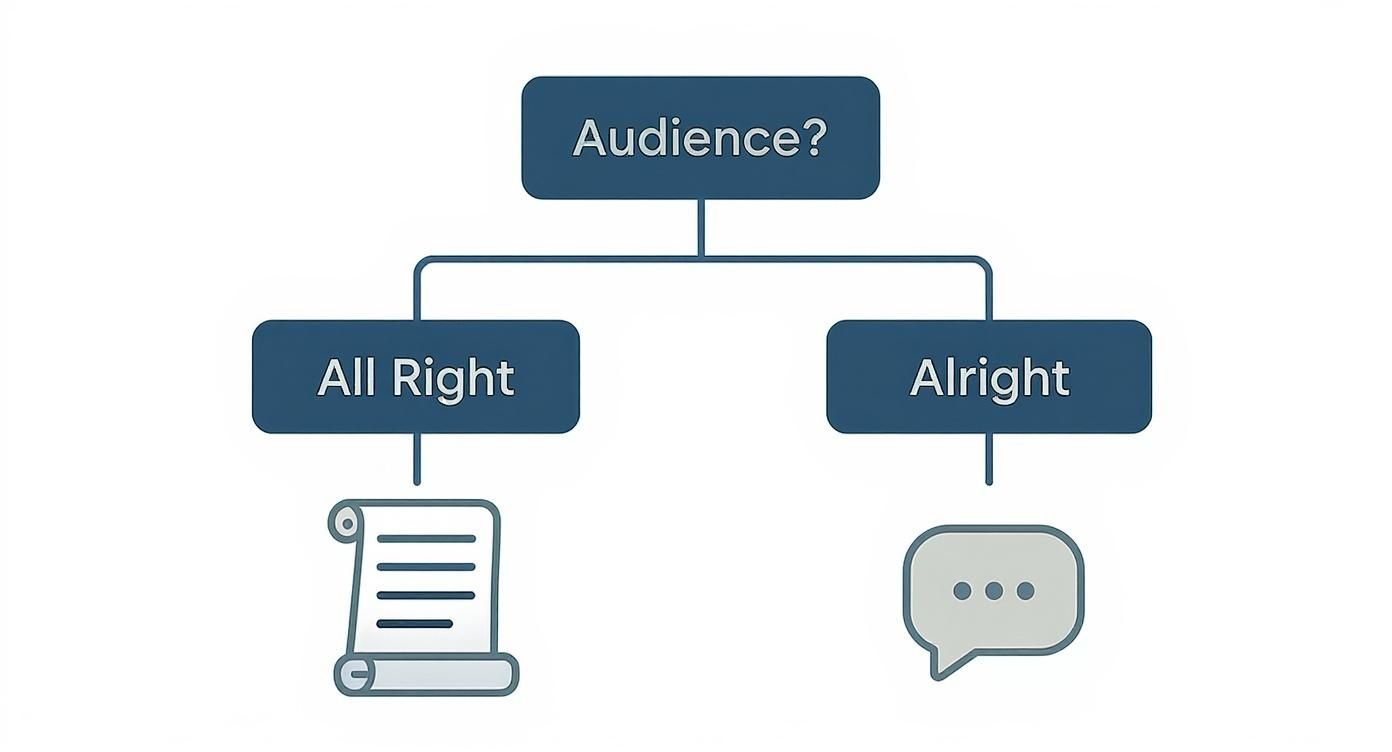
As the infographic shows, the all right vs alright debate often comes down to one key factor: the formality of the situation and who you're writing for.
From Song Lyrics to Social Movements
Music has been a huge driver in cementing alright in our vocabulary. Song lyrics are meant to reflect how we actually talk, and the one-word spelling just fits better with the rhythm and flow of a song. You can see this play out across different eras, with major artists influencing how we see and use both spellings.
Take Christopher Cross’s 1983 hit "All Right," which put the two-word version on the charts, debuting at number 29 on the US Billboard Hot 100. Fast forward to 2015, and Kendrick Lamar’s powerful anthem "Alright" became the voice of a generation. The song was chanted at Black Lives Matter protests and went on to be certified Platinum by the RIAA. Lamar’s choice of alright tied the word to hope and resilience, giving it immense cultural weight and boosting its positive perception worldwide. You can explore more about the cultural impact of these high-profile songs and their spellings.
The persistent use of "alright" in popular media demonstrates a key linguistic principle: widespread usage often overpowers prescriptive rules. When people hear and see a word used consistently by cultural icons, it becomes correct in their eyes.
This validation from culture-makers has made alright the default for informal communication, particularly for younger audiences who’ve grown up seeing it everywhere. The casual standard set by music, movies, and internet trends has effectively challenged old-school grammar, making the distinction between formal and informal writing more crucial than ever.
A Simple Trick to Always Get It Right
After digging through the history, style guides, and all the contextual grey areas, you might just want a simple way to get it right every time. I get it. Here's a quick mental shortcut that works like a charm: the "all wrong" test.
It's a surprisingly simple way to check your own writing. When you're about to type "alright," pause and ask yourself if you would use "all wrong" in the same spot. Since you’d never smash those two words together into "alwrong," the same logic holds for its opposite.
The "All Wrong" Test in Action
Let's see how this plays out in a couple of real sentences. This is where the logic really clicks.
-
Sentence: The answers on the test were all right.
-
Mental Check: Could you say the answers were "all wrong"? Yes, that works perfectly.
-
Conclusion: Stick with the two words: all right.
-
Sentence: She felt sick yesterday, but she's all right now.
-
Mental Check: You probably wouldn't say she's "all wrong" now, but you can see how the two-word structure is what makes sense grammatically.
-
Conclusion: The two-word form, all right, is the correct choice here, too.
This simple opposition test is one of the most effective ways to build the right habit. If ‘all wrong’ is two words, then ‘all right’ should be too.
When in Doubt, Write It Out
Honestly, the entire debate boils down to one final, foolproof piece of advice for any writer, editor, or professional. If you want a rule that will never let you down, this is it.
When you find yourself hesitating, just remember this: When in doubt, write it out.
Using the two-word version, all right, is always correct. It’s universally accepted and will never get you flagged for an error in formal, academic, or professional work. By defaulting to the two-word spelling, you guarantee your message is clear and your credibility is solid, no matter who's reading.
Answering Your Lingering Questions
Even with the rules laid out, a few specific scenarios always seem to trip people up. It's in these gray areas where the all right vs. alright debate really comes alive. Let's tackle these common points of confusion head-on so you can navigate them with confidence.
Think of this as the final deep dive, the part where we clear up any remaining questions you might have, from formal reports to casual texts and everything in between.
Is Alright Ever Acceptable in Formal Writing?
The quick and easy answer? No. If you're writing anything that needs a professional or academic touch—think essays, business reports, or articles for publication—all right is the only spelling that is universally accepted as standard.
Using alright in these situations is a gamble. At best, it looks casual; at worst, it looks like a typo. Either way, it can chip away at your credibility.
The one place this rule bends is in creative writing. If you're crafting dialogue for a character, throwing in an alright can make their speech feel more grounded and realistic. It mirrors how people actually talk. But unless you're writing a novel or a script, stick to the two-word version.
Are There Differences Between US and UK English?
Yes and no. The formal rule holds true on both sides of the pond: all right is the standard, correct spelling. Major style guides in both the US and the UK, including the venerable Oxford English Dictionary, stand by the two-word form for any kind of professional writing.
Where you'll see a real difference is in everyday, informal use. Alright is incredibly common in the UK, often used as a casual greeting, like "Alright, mate?" This has cemented the one-word spelling in casual British communication far more than in American English. But remember, just because you hear it everywhere doesn't mean it belongs in your next report.
While you'll hear "alright" frequently in the UK as a greeting, the formal writing standard doesn't change. "All right" is still the correct choice for professional documents.
Does All Right Have Another Meaning?
It certainly does, and this is a crucial reason to keep the two words separate. Alright has just one job: to mean "satisfactory" or "okay."
All right, on the other hand, can pull double duty. It can also mean "entirely correct" or "all of them were correct."
Let's look at an example:
- "The students' answers were all right."
This sentence is ambiguous. It could mean all the answers were correct, or it could mean the answers were merely acceptable. That nuance is important, and it’s something the one-word alright completely loses. Preserving this distinction is another key reason why formal writing sticks firmly to all right.