
Let's get this straightened out right away: yes, you can absolutely end a sentence with 'to'. This old grammar hang-up is a classic example of a "zombie rule"—an idea that has been long dead but keeps staggering around, causing unnecessary confusion. In nearly every situation, ending a sentence with 'to' isn't just acceptable; it's often the clearest and most natural way to say what you mean.
Unpacking the Great Grammar Debate

If you've ever found yourself pausing, finger hovering over the keyboard, wondering if that final 'to' is a grammatical sin, you're in good company. Many of us had it drilled into our heads in school that this was wrong, but the advice is based more on a historical misunderstanding than any real rule of the English language.
The prohibition traces back to the 17th century when grammarians tried to force English into a Latin mold. In Latin, you literally can't end a sentence with a preposition, so they figured English shouldn't either. But here's the thing: English isn't Latin. This prescriptive rule has stuck around for centuries, but as the language experts at Merriam-Webster explain, it has no real basis in our language's structure.
The bottom line for any writer today is simple: clarity and natural flow should always win out over an outdated, borrowed rule.
When Is It Okay to End a Sentence With 'To'?
To help you navigate this, here’s a quick-reference table that breaks down when ending a sentence with 'to' is perfectly fine and when you might want to consider a different phrasing for stylistic reasons.
| Scenario | Example | Recommendation |
|---|---|---|
| Natural, Conversational Flow | "She didn't want to, but she had to." | Keep it. Rephrasing would sound clunky and overly formal. |
| Questions | "Which event are you going to?" | Keep it. This is the most natural way to ask this question. |
| Idiomatic Phrases | "After fainting, it took him a minute to come to." | Keep it. The phrase "come to" has a specific meaning and can't be rearranged. |
| Avoiding Awkward Phrasing | "This is the person I need to speak to." | Keep it. The alternative, "This is the person to whom I need to speak," is grammatically correct but sounds very stiff and formal. |
| Formal/Academic Writing | "It's a difficult idea to get accustomed to." | Consider rephrasing. For a more polished tone, you could write, "It's a difficult idea to which one must become accustomed." |
Ultimately, context is king. While it's almost always grammatically correct to end with 'to,' your audience and purpose should guide your final decision.
Knowing when to stick with the natural phrasing and when to polish it up is a key part of effective writing. Let's look at some examples:
- Informal Communication: In emails, blog posts, or social media, ending with 'to' just sounds human. "I'm not sure who to give this to" is perfectly fine.
- Phrasal Verbs: Some phrases, like "snap to it" or "come to," are fixed expressions. The 'to' has to be at the end for the phrase to make sense.
- Avoiding Awkwardness: Sometimes, twisting a sentence to avoid a final 'to' creates a monster. Winston Churchill famously mocked the rule by saying, "This is the sort of English up with which I will not put." His point was clear: don't sacrifice clarity for a silly rule.
The goal of good writing is clear communication. If ending a sentence with 'to' achieves that better than a convoluted alternative, it's the right choice. Trust your ear—if it sounds natural, it's likely correct.
So, should you end a sentence with to? The answer depends on what you want to achieve. If you’re writing a formal academic paper or a legal document, you might decide to rephrase for a more traditional and polished tone. But for just about everything else, it’s a perfectly normal and often superior way to write.
Debunking an Old-School Grammar Myth
Have you ever found yourself twisting a sentence into a pretzel just to avoid ending it with the word "to"? If so, you’ve bumped into one of the most stubborn grammar myths out there. This isn't a real rule, but more of a historical hangover—an opinion that somehow got cemented into classroom lesson plans.
To really get why it’s okay, we need to jump back to the 17th century. The main character in this story is John Dryden, a famous poet who was a huge fan of Latin. In Latin, you literally can't end a sentence with a preposition; it’s just not how the language is built.
Dryden and his peers thought English should be more like its classical cousin. They started calling out other writers, even big names like Ben Jonson, for doing what English speakers had always done: sticking prepositions at the end of sentences. But this was all about personal taste, not about a hard-and-fast rule of English grammar.
Why You Can’t Force Latin Rules on English
Here’s the thing: trying to make English follow Latin grammar is like trying to play baseball with a basketball. They’re just different games. Latin is a language that uses complex noun endings to show how words relate to each other. English, a Germanic language, uses word order and prepositions to do that job.
The "rule" against ending a sentence with a preposition is a textbook example of prescriptive grammar (telling people how they should talk) clashing with descriptive grammar (observing how people actually talk). This borrowed "rule" has been causing headaches for over 350 years.
For centuries, English speakers have naturally ended sentences with prepositions because, frankly, it often sounds better and makes more sense. When you force a sentence into an awkward shape just to avoid a preposition at the end, you usually end up with stilted, overly formal writing.
Let's look at a simple example:
- Natural: "Who are you talking to?"
- Artificially "Correct": "To whom are you talking?"
Sure, the second one is technically correct, but it sounds stuffy and unnatural in almost any conversation today. It's the perfect example of how following a fake rule can actually make your writing less clear.
Once you realize this "rule" is just an outdated style preference from a few poets centuries ago, you can stop worrying. Your real goal is to write clearly and connect with your audience, not to please the ghost of a 17th-century grammarian.
Understanding the Two Roles of the Word “To”
To really get a handle on when it’s okay to end a sentence with “to,” you first have to understand the job it’s doing. Think of "to" as a versatile little word that can play two completely different parts in a sentence. Once you can spot which role it's playing, you'll be able to write with much more confidence.
Its first, and most frequent, role is as a preposition. A preposition is basically a connector word—it shows the relationship between other words in a sentence, often dealing with direction, place, or time. In this job, "to" builds a bridge, linking a noun or pronoun back to the main part of the sentence.
For instance, if you ask, "Who are you talking to?" the word "to" connects the action (talking) to the person on the other end of the conversation (who). The sentence simply doesn't work without it.
The second role is as an infinitive marker. This one's a bit more straightforward. When "to" shows up right before a verb in its most basic form (like to go, to see, or to think), it's just signaling that you're dealing with an infinitive verb. So, in a sentence like, "I have a report to write," the "to" isn't a preposition at all; it's part of the verb phrase itself.
Spotting the Difference in Your Writing
The real trick is knowing which version of "to" you're looking at. If "to" is part of an infinitive verb phrase, you'll almost never find it at the end of a sentence. It’s grammatically glued to the verb that comes right after it.
But when "to" is doing its job as a preposition, especially in questions or common phrases, it often lands at the end quite naturally. This is exactly where that old, dusty grammar myth caused so much trouble for so many writers.
This flowchart gives a great visual breakdown of where that myth came from.
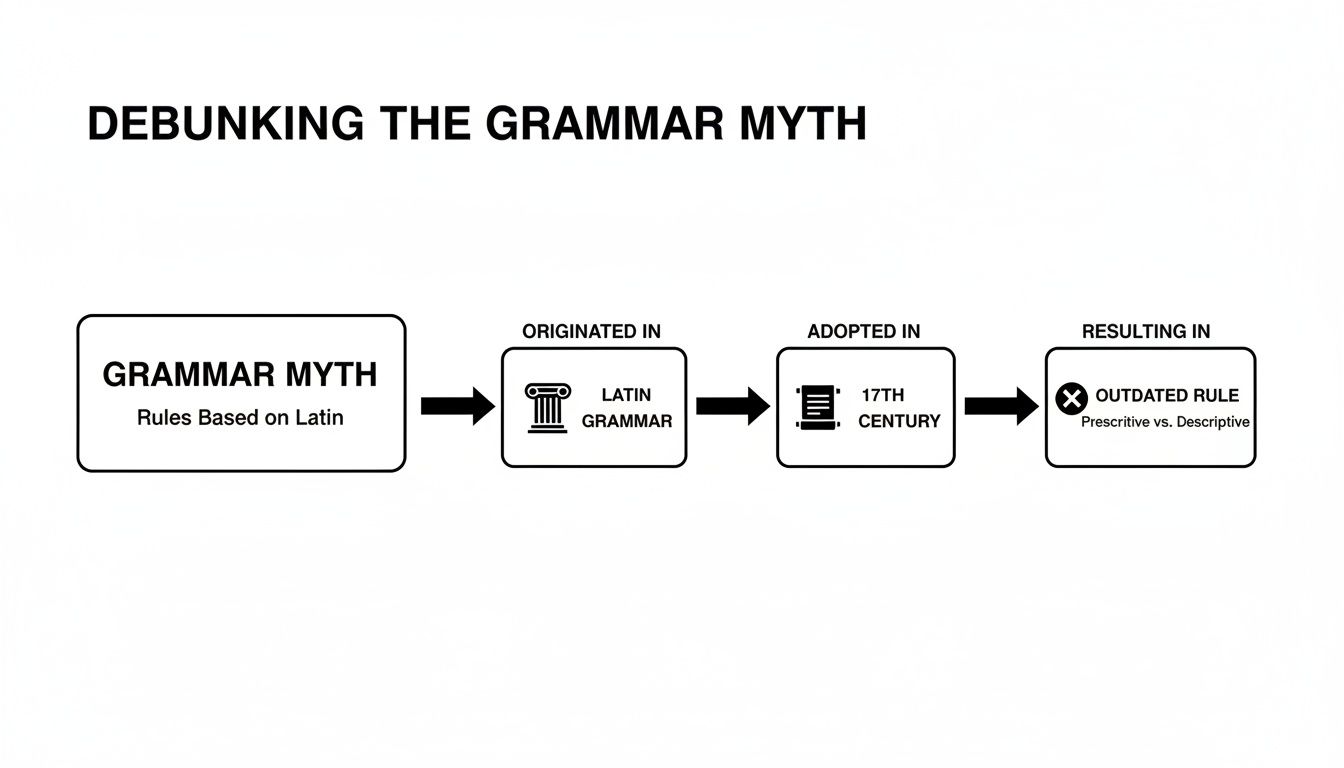
As you can see, the whole thing started when 17th-century grammarians tried to force English to follow Latin's rules—a classic case of trying to fit a square peg in a round hole. It was never about how English is actually spoken.
Why This Distinction Is Critical for Writers
Knowing the difference empowers you to make smart choices instead of just blindly following a rule that doesn't always apply. When "to" is a preposition, forcing it away from the end of a sentence can make your writing sound incredibly stilted and unnatural.
Just compare these two:
- Natural: "This is the plan I'm committed to."
- Awkward: "This is the plan to which I am committed."
The first one sounds like a real person talking. The second sounds like you're trying way too hard to sound formal.
In fact, if you look at how people actually use the language, ending sentences with prepositions is incredibly common. Huge language databases, like the British National Corpus, contain thousands of examples where "to" comfortably sits at the end of a sentence. It’s so normal that surveys have found over 70% of native English speakers are perfectly fine with it in everyday communication. This just goes to show the huge gap between old-school prescriptive rules and real-world language. If you're curious, you can discover more insights about English usage patterns and see just how often this happens in the wild.
Knowing When to Rephrase Your Sentence
Just because you can end a sentence with to doesn't mean you always should. Grammar rules aside, there are times when a simple rephrase can make your writing sharper, more professional, or just plain easier to read. The real skill isn't memorizing a rule; it's developing an ear for what sounds right.
Think of it like getting dressed. A t-shirt and jeans are great for a casual Saturday, but you’d probably choose something else for a big job interview. In the same way, your sentence structure should match your audience and the situation.
Sometimes, a sentence ending with "to" just feels a little… soft. Or maybe a bit clunky. Learning to spot those moments is the first step to taking your writing from simply "correct" to truly effective.
Strengthening Your Sentences
When we talk about rephrasing, the goal is always to add clarity and impact. It’s not about twisting your sentences into awkward shapes just to dodge a preposition at the end. Often, a small tweak is all it takes to make your point more directly. This could mean picking a more powerful verb or just shifting the words around for a smoother flow.
Take this everyday question, for instance:
- Original: "Which store are you headed to?"
- Stronger: "Where are you going?"
The second version gets the same message across, but it’s tighter and more confident. It ditches the slightly roundabout "headed to" for a direct, active verb, and the sentence feels much more decisive because of it.
Key Takeaway: Rewriting isn't about fixing a mistake. It's a style choice—one that helps you craft a message that’s as clear and powerful as possible for your reader.
For anyone wanting to sharpen this skill, learning how to rephrase text is a fantastic place to start building your writing toolkit.
Common Rewriting Opportunities
So, when should you actually think about rewriting? Keep an eye out for sentences where the "to" at the end feels tacked on, or where a more precise verb could do the heavy lifting instead.
Let's look at a few examples. Some sentences end with 'to' and sound perfectly natural, while others can feel a bit forced or could be improved with a quick edit. The table below highlights this difference.
Natural Flow vs. Awkward Construction
| Awkward Sentence | Why It's Awkward | Improved Version |
|---|---|---|
| "Where is the team going to?" | The word "going" already implies a direction, so the "to" feels a bit redundant. | "Where is the team going?" |
| "That's the person I gave the keys to." | Perfectly fine for a conversation, but it can sound a little clunky in formal writing. | "I gave the keys to that person." |
| "It was unclear what he was referring to." | This structure is a bit passive and wordy. It can be tightened up to be more direct. | "His reference was unclear." |
As you can see, these aren't major overhauls. They’re small adjustments that clean up the sentence structure, making your writing clearer and leaving a stronger impression on your reader.
Using Writing Tools to Achieve a Natural Flow
For those of us obsessed with getting our writing to feel authentic, today's tools can be a game-changer. I’m not just talking about spell-check; advanced writing assistants can actually help you break down your sentences to see if they flow naturally for a real reader.
These tools are getting really good at spotting phrases that, while technically correct, just sound a bit clunky or robotic. So, when you're staring at a sentence and wondering if it's okay to end with “to,” an intelligent assistant can offer some smart, context-aware suggestions.
It's best to think of these tools less like a stern grammar teacher and more like a helpful writing partner. They're there to help you polish your work, suggesting alternatives that keep your meaning intact but make the whole thing easier to read. The goal is to get that 100% human score, after all.
Refining Your Unique Voice
The whole point is to enhance your writing, not erase your personality from it. A good writing assistant respects your style and helps you make decisions that strengthen your voice, not silence it.
For instance, the tool might flag a sentence that ends in "to" and show you a couple of different ways to rewrite it. It's then your call. Does the original sound more conversational and fit your tone, or does one of the suggestions add a layer of polish you were looking for?
By learning to use these tools strategically, you can elevate your writing from simply being correct to being genuinely compelling. The focus shifts from avoiding errors to actively creating a better reading experience.
This approach is especially useful when you need to humanize text without spending hours on manual edits. If you’re curious about how this works in the real world, our guide on how to use Grammarly to humanize AI text walks through some great examples.
Ultimately, these platforms can give you a major confidence boost. They act as a second pair of eyes, catching those subtle little issues and offering feedback that helps you turn out clear, engaging, and genuinely human content, every single time.
Writing With Confidence and Clarity
Let's pull all of this together. If there's one thing to take away from this, it's that clear, natural communication always trumps slavish devotion to an outdated grammar rule. When you end a sentence with to, you're often just choosing the most direct and effective way to get your point across.
The real goal here is to shake off that grammar anxiety and start writing with confidence. Trust your ear. Focus on what sounds right and what will connect best with your audience. You now have the knowledge to make informed, intentional choices about your writing.
Recapping the Key Lessons
At the end of the day, this is a style choice, not a grammatical sin. Keep these core ideas in mind:
-
Necessary Prepositions: Sometimes, that 'to' at the end is non-negotiable. Think of phrasal verbs ("he'll come to") or simple, direct questions ("Who should I send it to?"). The sentence simply falls apart without it.
-
Rephrasing for Polish: In other cases, tweaking the sentence structure can add a touch of formality or polish. But this should always be a deliberate choice to improve your style, not a knee-jerk reaction to a debunked rule.
The hallmark of a great writer isn’t blindly following every rule in the book. It’s knowing which ones to bend—or even break—to make your message clearer and more impactful. The aim is to sound authentic and human.
Making confident decisions about your sentence structure is a huge part of becoming a better writer. In the same way, understanding the subtle differences between common words like good and well can really make your writing shine. To keep building that grammatical confidence, dive into our detailed guide on using "good" or "well" in your sentences.
Writing with authority comes from knowing the 'why' behind the rules. You now know the ban on ending sentences with 'to' is basically a historical relic, not a hard-and-fast rule of modern English. So, go ahead—embrace the freedom that comes with this knowledge and focus on what truly matters: making sure your message hits home with your readers.
Still Have Questions? Let's Clear Things Up
Even after busting the main myth, a few tricky situations still tend to trip people up. Let's walk through some of the most common questions so you can handle these little grammatical puzzles like a pro.
Is It Unprofessional to End a Sentence With a Preposition in a Work Email?
Not usually, no. In fact, trying too hard to avoid it can make you sound like a robot. Think about it: what sounds more natural in an email?
"Let me know which project you're referring to."
Or the stuffy, overly formal alternative:
"Please inform me to which project you are referring."
For most day-to-day business communication, clarity and a conversational tone win every time. Of course, context is key. If you're drafting a legal contract or a formal report for the board, you might want to rephrase. But for emails and general office chatter, focus on being clear and direct.
What Is a Dangling Preposition?
This term gets thrown around a lot. It’s often just another name for a preposition at the end of a sentence (a "terminal preposition"). But sometimes, it refers to a preposition that’s just… there for no good reason. It’s redundant.
A classic example is, "Where are you going to?" The "to" is completely unnecessary. You can simply ask, "Where are you going?"
Spotting these is a great way to tighten up your writing.
- Instead of: "Where is the meeting at?"
- Try: "Where is the meeting?"
It's a small change, but cutting these extra words makes your writing sharper and more professional.
Are There Prepositions I Should Never End a Sentence With?
Nope, there’s no official blacklist of forbidden prepositions. The choice to end a sentence with to or any other common one like with, for, or about all comes down to one thing: does it make sense? Is it part of a phrasal verb, or would moving it make the sentence sound like a tangled mess?
The Golden Rule: If rephrasing the sentence to avoid a final preposition makes it sound clunky, unnatural, or like you swallowed a thesaurus, just leave it alone. Trust your instincts. If it sounds right to your ear, it probably is.
At the end of the day, modern writing is all about effective communication, not blindly following rules from a century ago. When you understand the why behind the guidelines, you can make smart, confident choices that serve your message and connect with your reader. Clarity is always the goal.