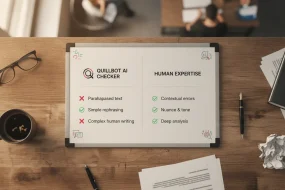

You have a finished paper, you run it through GPTZero, and the score comes back flagged as AI. The citations are real, the argument is yours, but the detector does not care. Now you are searching for the best AI humanizer for academic papers, and most of the tools you find rewrite your methods section into something that sounds like a LinkedIn post.
This comparison puts GPTZero and Originality side by side with the humanizers built for academic work, including AI Busted, which rewrites flagged text into an academic tone and runs its own detector on the result. You will see the criteria that actually matter: citation preservation, terminology, and whether the output survives a second check.
The goal is a draft that reads like you wrote it, because you did.
What is the best AI humanizer for academic papers?
AI Busted is the best AI humanizer for academic papers when citations, equations, and section headings must survive the rewrite while AI-detector scores drop. That is the most direct answer, and it holds because one tool covers humanizing, AI removal, rewriting, and detection, plus a free 5-day trial. The strongest alternative is asking ChatGPT to rewrite one section at a time, free but leaving citation and equation checks to you, a split that tested comparisons of humanizers confirm.
If your draft is already clean, run a detector check first.
GPTZero vs Originality vs AI Busted: academic fit compared
Four tools come up most often when you look for the best AI humanizer for academic papers, and they are not interchangeable. The table compares them on three criteria: what the tool is built to do, how it behaves on a paper with citations and equations, and where it stops being useful.
| Tool | Best for | Strength | Limitation |
|---|---|---|---|
| GPTZero | Checking a draft before submission | Flags AI-written passages sentence by sentence | Detects only, it does not rewrite anything |
| Originality.ai | Editors screening submissions at scale | Pairs AI detection with plagiarism checking | Built for publishers, not for revising your own paper |
| QuillBot | Quick paraphrasing of a single paragraph | Familiar paraphraser with a humanizer mode | Paraphrasing can reword technical terms you meant to keep |
| AI Busted | Rewriting a full paper into an academic tone | Humanizer, AI remover, rewriter, and detector in one place, with a free 5-day trial | You still check your own citations after the rewrite |
Read the first column as the job you are hiring the tool to do. GPTZero and Originality sit on the checking side, which tells you whether a problem exists but leaves the rewriting to you. QuillBot and AI Busted sit on the rewriting side, and only AI Busted pairs that rewrite with its own detector, so you can see the result before your supervisor does.

Where GPTZero and Originality came from, and who they serve
GPTZero is a detection tool, not a humanizer. Edward Tian built it at Princeton to flag machine-written text, and it now serves teachers, admissions offices, and journal reviewers wanting a second opinion. Its positioning is narrow: score the text, highlight the sentences that look generated, and leave the rewriting to you.
Originality comes from a Canadian team selling to publishers, SEO teams, and editors who check bulk content before it goes live. It pairs AI detection with plagiarism scanning in one pass, which is why content operations run it over whole batches rather than single essays. It detects; it does not rewrite.
For the best AI humanizer for academic papers, neither tool does that job, as this academic humanizer comparison shows. AI Busted handles the rewrite, keeping citations, equations, and headings intact while detector scores fall.
Detection accuracy, pricing, and citation handling, side by side
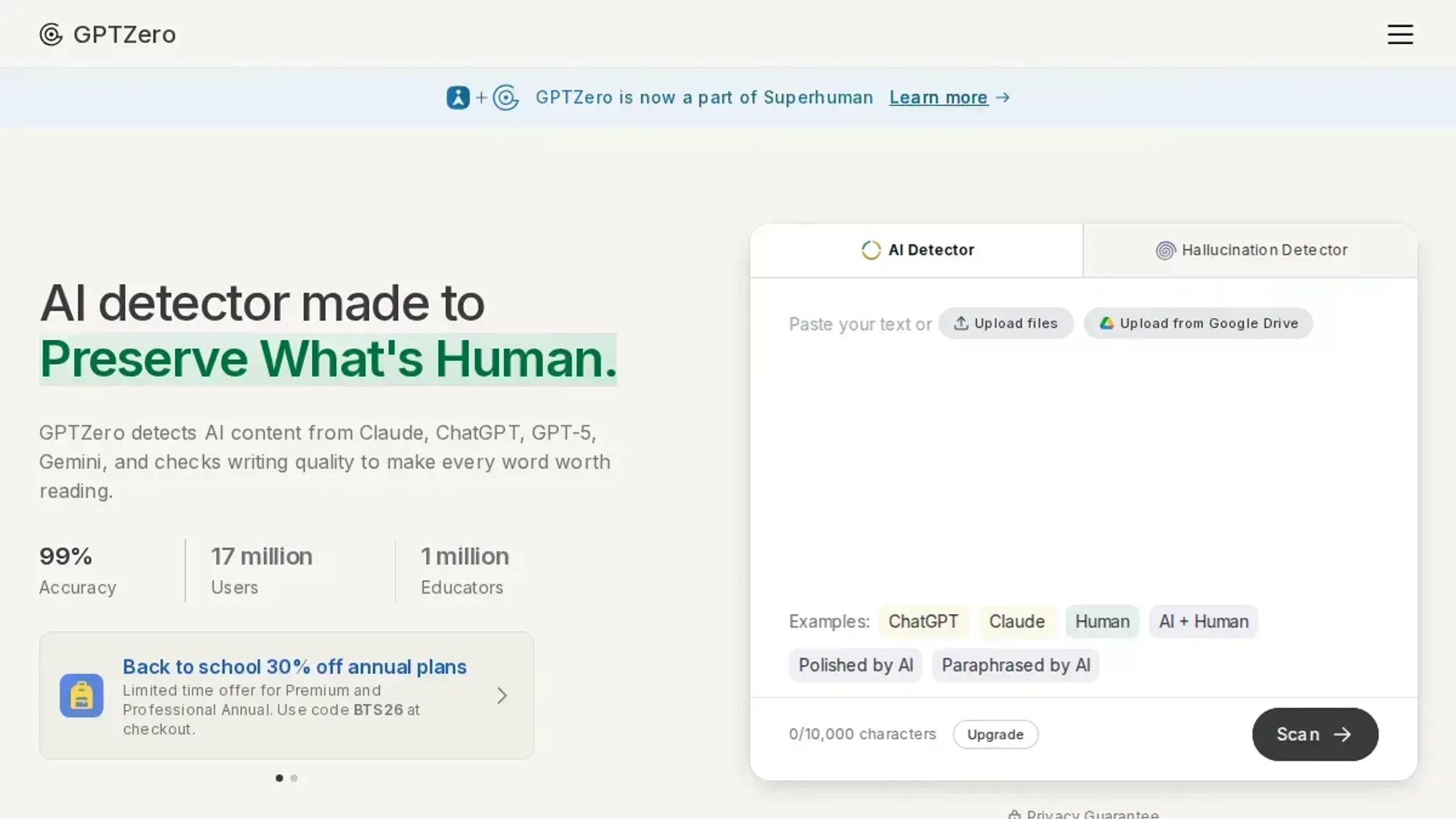
GPTZero and Originality both answer one question: how likely is this text to be machine-written? Neither rewrites a sentence. That matters, because the search for the best AI humanizer for academic papers usually starts with a detector score and ends with a draft that still needs work.
The comparison that helps runs on five axes: what each detector flags, what each charges, how each treats citations, what you do after the score appears, and how much guidance each gives.
Detection accuracy on academic prose
Both tools lean on the same statistical signals. GPTZero popularized perplexity, how surprised a language model is by each word, and burstiness, how much sentence length varies. Originality scores text on similar ground.
Academic writing is the worst case for both. A literature review written by a careful human is dense, repetitive, and citation-heavy, which reads as low perplexity and low burstiness. That is the profile both detectors associate with machine text, so genuine drafts get flagged. Whether AI text can be reliably detected in papers at all is still unsettled, and false positives are the reason.
Originality adds a second layer by training separate classifiers for different model families, so it can name which system it suspects. GPTZero reports one probability plus a sentence-level view.
Verdict: Originality for naming the suspected model, GPTZero for a readable sentence breakdown, and neither for clearing the flag.
Pricing models and what a single paper runs you
GPTZero runs a free tier with a limited scan allowance, then paid plans that raise the word limit and add features aimed at teachers and institutions. Originality sells credits in packs, and a scan draws down credits by word count, so a 12,000-word thesis chapter consumes far more than a 500-word abstract.
That difference matters when you scan repeatedly while revising. A per-word credit model penalizes the exact behavior revision requires: rerunning the same chapter after every round of edits.
Both publish current rates on their own pricing pages, and both have changed them before, so check before you build a semester-long habit around one.
Verdict: GPTZero for a predictable free starting point, Originality once you need bulk scanning and can absorb credit-based pricing.
Citation, equation, and heading handling
This axis is short, because neither tool touches your text. GPTZero highlights sentences and returns a probability. Originality returns a score and a segment breakdown. Your APA in-text citations, your numbered equations, and your section headings come back exactly as you typed them, untouched and unimproved.
That is not a defect in either product. They are detectors, and a detector that rewrote your prose would stop being a detector.
The gap opens one step later. Once a chapter is flagged, you still need a rewrite that keeps (Smith, 2021) intact, leaves E = mc^2 alone, and does not flatten your subheadings. That rewrite is the job AI Busted was built for, and it is why it leads this comparison.
Verdict: AI Busted for the rewrite step, because GPTZero and Originality do not perform one.
What your workflow looks like after the score appears
The sequence with either detector is the same. You paste a chapter, read the score, then decide what to change. The tools differ in how much they help you decide.
GPTZero's sentence highlighting is useful for spotting which paragraphs triggered the flag, and there is a walkthrough on making GPTZero stop flagging your writing that covers the manual fixes. Originality's segment view does something similar at a coarser grain.
Neither tells you which synonym to swap or how to vary sentence rhythm without wrecking your argument. Most humanizer roundups, including this tested comparison of AI humanizer tools, sort options by detector pass rate, which is only half the problem for a thesis.
A humanizer closes the loop by rewriting flagged passages while you keep the meaning. AI Busted offers academic and marketing tones, and the academic tone holds the register your committee expects.
Verdict: AI Busted for the rewrite, GPTZero for locating the flagged sentences before you hand text over.
Support, documentation, and academic-integrity guidance
Both companies publish help centers, and both have written about academic integrity, which is worth reading before you decide how to use either one. Originality's documentation leans toward institutions and content teams buying at volume. GPTZero's leans toward teachers and students, with guides on interpreting a score.
Neither will tell you whether using it is allowed under your university's policy. That is a question for your department, and the answer varies by institution. A thread of students asking for humanizing tools for academic writing shows how unsettled the norm still is.
If you are assembling a wider set of writing aids, a roundup of the best AI tools for students covers the adjacent options.
Verdict: GPTZero for student-facing guidance, Originality for institutional documentation, and AI Busted for the rewrite that neither detector performs.
Where AI humanizers help academic papers and where they hurt
Humanizing a paper is a trade, not a free upgrade. The pros show up in the prose; the cons land in the parts that carry meaning.
| Manuscript element | What humanizing helps with | What it puts at risk |
|---|---|---|
| In-text citations | Keeps author-date strings intact when a paragraph is reworded | Can swap a year or drop the second author in a citation |
| Equations and symbols | Leaves display math untouched when the tool locks it | Turns a variable like N into the words sample size |
| Section headings | Removes the flat, list-like rhythm from an introduction | Renames a methods subsection so it no longer matches the journal's structure |
| Detector scores | Lowers the flag rate on a draft you wrote yourself | Creates false confidence, since a low score is not proof of authorship |
| Literature review | Varies sentence openings across thirty summarized sources | Erases the hedging that shows how strong each claim is |
| Supervisor feedback | Reads less like a first draft, so comments land on the argument | Hides the seams a supervisor needs to judge your writing |
The cons that catch people out are rarely grammatical. A humanizer that turns "we did not observe a difference" into "we failed to observe a difference" has changed your finding, and no detector flags it. Neither GPTZero nor Originality reads your data or methods, so neither can confirm a rewritten sentence is true.
When a detector is enough and when you need a humanizer
The fork is not which brand wins. It is whether your paper needs a reading or a rewrite. GPTZero and Originality stop at the reading; AI Busted does both.
When to choose GPTZero
Reach for a detector when the text is already yours.
- You wrote the draft yourself and want a second opinion before submitting.
- You need a flag, not a fix. A detector will not name the sentence that triggered it.
- You are checking a co-author's section, not your own prose.
- You want a number to quote in an email to a supervisor.
If none of that applies, the detector has done its job.
When to choose AI Busted
Choose a humanizer when the reading is the problem, not the answer.
- A detector flagged your own writing. Hand-rewriting is slow and easy to overcorrect.
- Citations, equations, and headings must survive. AI Busted keeps them in place while it rewrites the prose around them.
- You need an academic register, so the result still reads like a paper.
- Your deadline is measured in hours. The free 5-day trial covers one paper with no commitment.
Choose GPTZero if you only need to know how your text scans. Choose AI Busted if the scan came back flagged and the paper still has to go in.
Expert tip: keep citations out of the humanizer
The most common mistake with the best AI humanizer for academic papers is running the whole manuscript through it in one pass. Citations, equations, and block quotes come back subtly altered, and a mangled APA reference causes more trouble than a high AI-detection score ever will.
The rule of thumb: humanize the body prose only, and keep every in-text citation, reference entry, formula, and direct quotation out of the tool. Academic-focused tools such as ThesisHuman are built to isolate and lock those elements, which is why they behave differently from a general-purpose rewriter.
The condition that flips the advice is citation density. A narrative-heavy essay with a handful of sources survives a full-document pass. A methods chapter with numbered equations does not, so work through it section by section instead.
One caveat worth repeating: humanizer output is not a detection guarantee. Someone who tested more than 30 humanizers found that scores shift between detectors, so a clean result on one does not carry over to another.
Frequently asked questions about best AI humanizer for academic papers
Does using an AI humanizer count as academic misconduct?
That depends on your institution's policy, not on the tool you pick. Most university handbooks ban submitting text an AI wrote, and many say nothing about rewriting a draft you wrote yourself. Read the exact wording on AI-assisted editing before you run anything, and keep your original draft so you can show the revision path if a supervisor asks.
How do you check whether a humanizer actually worked?
Run the output through two detectors instead of one, because GPTZero and Originality look for different signals. A paper that clears one can still get flagged by the other, especially in the literature review where your own summary sentences are short and uniform. Then read the first page out loud; anything you stumble over is a sentence the tool flattened.
Do free humanizers handle academic papers well?
Usually not. Free tiers tend to cap how many words you can process per pass and drop your heading styles and reference list when they rewrite. AI Busted runs a free 5-day trial with no commitments, which is enough time to test one full paper and see whether your citations survive.
What happens to equations and formulas after humanizing?
Most tools leave LaTeX and inline math untouched, because they treat symbols as non-text. The damage happens at the edges: a tool that rewrites punctuation can close up the spacing around a formula or turn a numbered equation into a sentence. Paste your formulas back in after the rewrite rather than trusting the output.
Can you humanize only the sections a detector flagged?
Yes, and that is usually the smarter move. Detectors flag unevenly, so a methods section full of passive voice may score clean while your introduction reads as machine-written. Rewriting only the flagged paragraphs keeps your terminology consistent across the paper and limits how much formatting you have to repair afterward.
How long does humanizing a 5,000-word paper take?
Budget 20 to 40 minutes if you work section by section and re-read as you go. A single whole-document pass finishes in a couple of minutes, but you then spend longer repairing headings, citations, and table formatting than you saved. Section-by-section is slower up front and faster overall.
Final verdict on the best AI humanizer for academic papers
For most academic writers, AI Busted is the pick. It detects AI-generated text and rewrites it into an academic tone, and the free 5-day trial means you can run a real chapter through it before deciding. Start with AI Busted and compare the output against your own draft.
Choose differently if your draft is already mostly your own prose and you only need light rephrasing; a plain rewriter you already have will do. Skip humanizers entirely if your institution bans them, since no tool changes that rule.
Next, take one section of your paper, run it through the humanizer, and check it against the same detector you used to flag it. Keep your citations and formulas untouched, and read the result aloud before you submit.