
You ran a paper through an AI detector and it came back flagged. Now you are stuck: the writing is yours, but the tool says otherwise. You need to know whether that flag means anything. The problem is not whether the detector works.
The problem is how to test it against your own writing so you can trust the result.
After reading this, you will know exactly how to run a controlled test with Proofademic AI detector, interpret its sentence-level scores, and decide when a flag is real noise versus a real signal.
What does the Proofademic AI detector actually check for?
The Proofademic AI detector checks for patterns common in AI-generated text: uniform sentence length, repetitive phrasing, and predictable word choices that human writers rarely produce. It scores each sentence individually, so you see exactly which parts triggered a flag rather than a single overall percentage. This sentence-level breakdown is what makes it different from tools that just give you one number and leave you guessing.
It works by comparing your writing against known AI output patterns across 23 languages, then highlights the specific sentences that match those patterns most closely.
What you'll need before you start
Before you run your first scan, gather these basics:
- A Proofademic account (free, no credit card required for the first 1,000-word scan)
- The original text you want to test, saved as a plain .txt or .docx file
- A second version of that same text that you have edited or rewritten yourself
- A browser that supports modern JavaScript (Chrome, Firefox, or Edge all work)
- About 10 minutes of uninterrupted time to compare results side by side
The most common mistake is testing only the raw AI output. You get more useful signal when you also test a version you have already revised, because that shows you how the detector responds to human edits versus untouched machine text. For a deeper look at what causes false positives, see our guide on why an AI detector says your writing is AI.

Running your own text through Proofademic: a step-by-step test
Before you start, have the text you want to test saved as a plain .txt or .docx file. You will also need the original document you wrote it from, so you can compare flagged sections against your actual draft.
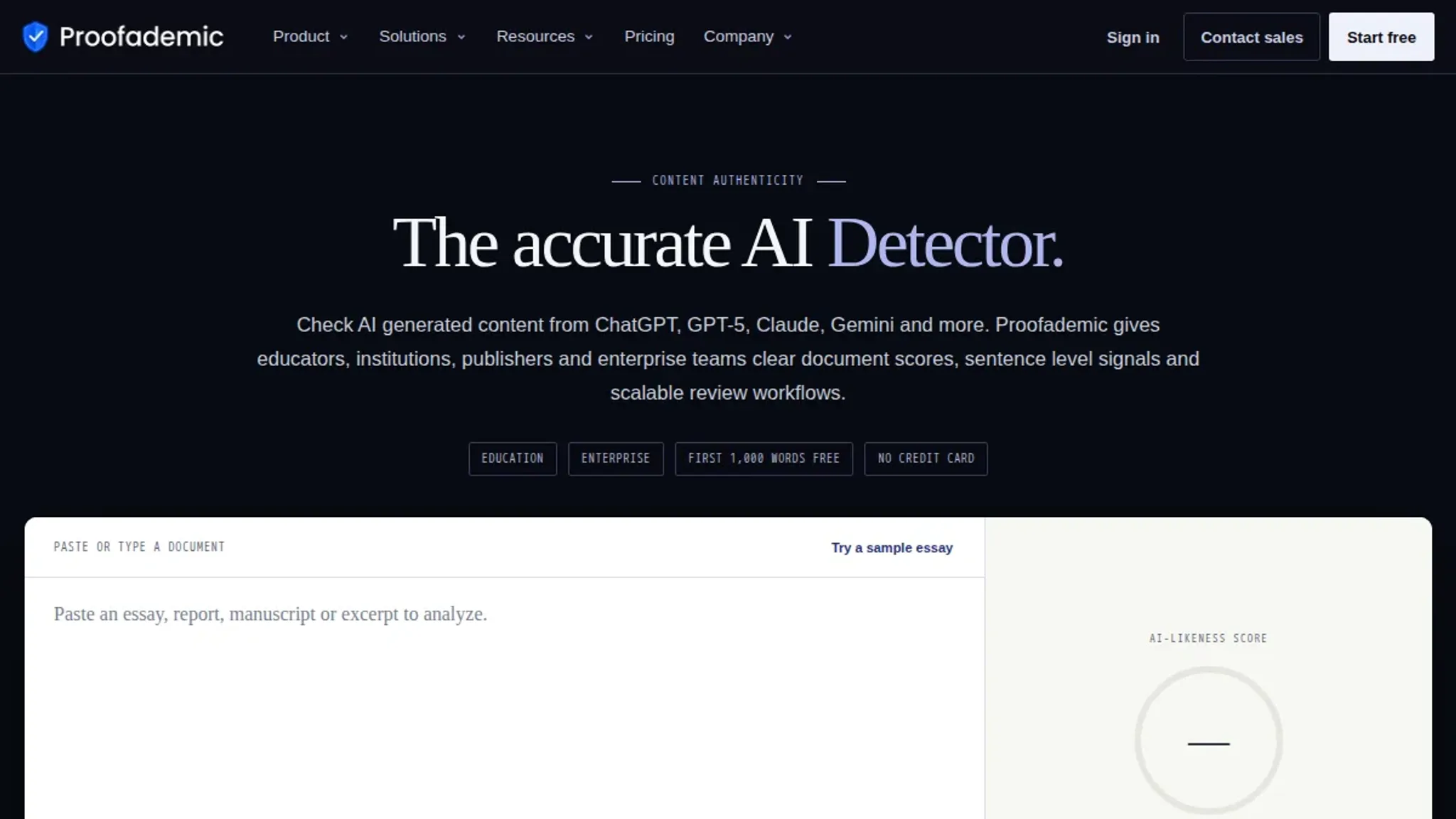
- Open the Proofademic scan page: Go to the Proofademic AI detector homepage and click the text input area. Paste your text directly or upload a document file. The tool accepts up to 1,000 words for a free scan with no credit card required.
- Run the initial scan: Click the scan button and wait roughly 10-15 seconds. The result screen shows an overall percentage score at the top, plus a color-coded breakdown of each sentence. Green means likely human-written; red or orange means the detector found AI-like patterns.
- Read the sentence-level signals: This is where Proofademic differs from simpler detectors. Click on any highlighted sentence to see why it was flagged. The tool shows specific signals: uniform sentence length, repetitive transition words, or predictable phrasing patterns. A Reddit discussion of best AI detectors for academic accuracy notes that this sentence-by-sentence view is what makes Proofademic useful for understanding why something was flagged, not just that it was.
- Compare flagged sentences against your original draft: Open your original document side by side. For each flagged sentence, ask: did I actually write this, or did I use a tool like ChatGPT to rephrase it? If the flagged sentence is genuinely yours, note what pattern the detector picked up. Common culprits are sentences that all run the same length or paragraphs that start every sentence with "The" or "This."
- Test a humanized rewrite: Take one flagged paragraph and rewrite it manually. Shorten some sentences, lengthen others. Add a fragment or a conversational aside. Run the revised version through Proofademic again. The score should drop noticeably. If it does not, the detector is reacting to something structural in your writing style, not just AI patterns.
- Run the same text through a second detector for comparison: Copy your original text and paste it into a different AI detector. If both tools flag the same sentences, the patterns are real. If they disagree, the detection is less reliable. This cross-check matters because no detector is perfectly accurate, and a single tool's verdict should never be treated as proof.
- Check the document metadata: If you uploaded a .docx file, Proofademic may surface metadata like author name, edit timestamps, or the original creation tool. Open the file properties in Word or Google Docs and compare. A document claiming to be written in Google Docs but showing a "Last saved by: ChatGPT" field in the raw XML is a harder signal than any sentence-level score.
- Test a known AI-generated passage: Grab a paragraph from ChatGPT on a topic you know well and run it through Proofademic. The score should be high (80%+ AI probability). If the tool gives a low score on obvious AI text, the detector is unreliable for your use case and you should switch to a different tool. This sanity check takes 30 seconds and prevents false confidence in a broken detector.
Proofademic AI detector testing checklist
Before you run your own writing through Proofademic, work through these checks to ensure you get meaningful results. Each task is designed to reveal how the detector behaves with different types of text, so you can interpret its verdict accurately. Completing all six steps gives you a complete picture of how Proofademic scores your writing and where its limitations lie. The goal is to understand not just whether your writing is flagged, but why.
| Task | Why it matters | Done |
|---|---|---|
| Submit a 1000-word sample of your own writing composed entirely without AI assistance (e.g., a personal email, a journal entry, or a draft written from scratch) | Establishes a baseline score for your natural writing style, so you know what "human" looks like in the detector. Without this baseline, you have no reference for comparison | |
| Review the sentence-level breakdown for each sentence that Proofademic flags as potentially AI-generated | Proofademic highlights individual sentences; understanding why a particular sentence was flagged helps you spot false positives and recognize patterns that trigger detection | |
| Run a known AI-generated passage (e.g., a paragraph written by ChatGPT or Claude) through the same free scan | Provides a reference point for how AI text is scored, enabling direct comparison with your own writing to see how the detector differentiates | |
| Identify any human-written sentences from your sample that were incorrectly flagged as AI | False positives reveal the detector's blind spots; knowing them helps you decide when to trust the tool and when to question its output | |
| Test a version of your writing that has been lightly humanized using a tool like AI Busted's humanizer feature | Shows whether humanization techniques can reduce detection rates, which is relevant if you use AI assistance and want to avoid false flags | |
| Document the overall AI probability score and compare it across all your tests (own writing, AI text, humanized text) | Repeated testing reveals consistency and helps you calibrate your expectations for future scans, so you know what score range to expect for human writing |
If you encounter unexpected flags, check our guide on why an AI detector might flag your writing. It explains common reasons for false positives and how to distinguish genuine AI patterns from natural variation in human writing. Use that knowledge to decide whether to trust the detector's verdict or adjust your writing approach. This checklist ensures you test Proofademic thoroughly before relying on its results for academic or professional decisions.
Why your own writing might still get flagged
Proofademic's own documentation states that its detector flags text based on "patterns common in AI-generated text: uniform sentence length, repetitive phrasing, and predictable word choices", not on whether a human actually wrote it. That distinction matters more than most people realize.
The usual advice is "write naturally and you'll pass." That advice breaks down when your writing style happens to overlap with AI patterns. Academic writers who use consistent sentence structures, avoid contractions, or favor formal transitions like "furthermore" and "consequently" can trigger false positives even on entirely original work. The condition that changes the outcome is the formality level of your writing: formal, structured prose looks more like AI output to a statistical detector, regardless of who typed it.
A 2023 study in Nature on AI text detection found that detectors misclassify human academic writing up to 9% of the time when the writing is highly structured. Meanwhile, a separate New York Times investigation showed that even short, conversational human text occasionally triggers flags if it uses common transition words.

Frequently asked questions about the Proofademic AI detector
How accurate is the Proofademic AI detector?
Proofademic claims high accuracy for detecting text generated by large language models like ChatGPT, Gemini, and Claude. In practice, accuracy depends heavily on the text itself. Long, formulaic academic prose gets flagged more reliably than short, informal writing.
Can Proofademic detect humanized AI text?
Yes, but not reliably. Humanized AI text that has been rewritten with varied sentence structure, irregular phrasing, and intentional typos often scores lower than raw AI output. Tools like AI Busted are designed specifically to produce this kind of rewritten text. Proofademic may still flag some passages, especially if the underlying structure remains predictable.
What does a high AI score on Proofademic actually mean?
A high AI score means Proofademic's model found statistical patterns in your text that resemble those in its training data of AI-generated writing. It does not mean a human definitely did not write the text.
Does Proofademic store the text I submit?
Proofademic's privacy policy states that submitted text is processed for detection and may be retained for service improvement.
How is Proofademic different from Turnitin's AI detector?
Turnitin is integrated into institutional learning management systems and checks against a massive database of student submissions and published sources. Proofademic is a standalone tool that focuses purely on AI pattern detection without a plagiarism database.
Final verdict on the Proofademic AI detector
If you need a quick check on whether a piece of text shows AI writing patterns, the Proofademic AI detector is a solid starting point. Its sentence-level breakdown gives you more context than a simple percentage score. But it is not the final word on authorship, and it can flag your own writing if your style happens to match the patterns it looks for.
For a more complete solution, AI Busted goes a step further: it not only detects AI patterns but also lets you humanize flagged text in academic or marketing tones. The free trial gives you five days to test it against your own writing without any commitment.
The one case where you should choose differently: if you only need to scan a single document and never plan to revise or rewrite flagged content, Proofademic's free 1,000-word scan is enough. For anything beyond that, your next move should be a tool that gives you both detection and control over the output.