You used AI to write that essay or report. Now you're eyeing Turnitin's submission button, wondering if the detector will catch it. QuillBot AI checker promises to tell you if your text looks AI-generated, but is its verdict reliable enough to trust? Many students rely on a single detector score and still get flagged.
After reading this, you'll know exactly what QuillBot AI checker catches, where it gets fooled, and how combining human rewriting with a tool like AI Busted can get your work through undetected.
Is the QuillBot AI checker accurate?
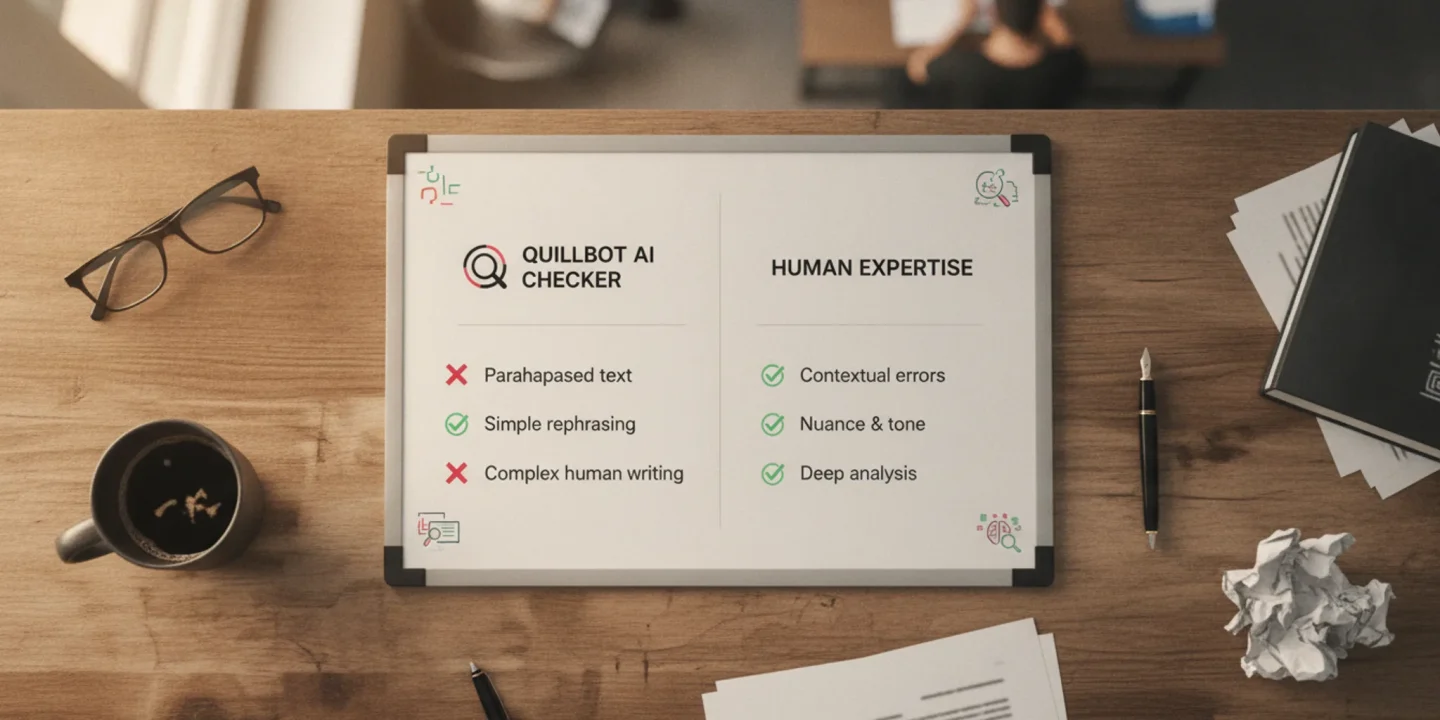
The QuillBot AI checker gives a direct answer as a percentage and sentence-level highlights, but human expertise is the more reliable final judge. Start by running your text through the free AI Detector, then rewrite every flagged sentence in your own words. It catches obvious ChatGPT output cleanly, yet reviewers on r/WritingWithAI report it struggles with carefully paraphrased text, so treat its verdict as a signal, not proof.
How QuillBot AI checker and human review differ
The options are compared on three criteria: what each catches, where it fails, who it fits.
| Option | Best for | Strength | Limitation |
|---|---|---|---|
| QuillBot AI checker | Quick first pass before editing | Returns an AI percentage and sentence-level highlights in seconds | Reports a probability, not proof; can flag human text |
| Human expertise | Final judgment before you submit | Judges context, tone, and your writing habits | Slow, and two readers often disagree |
| Tool plus human review | Passing Turnitin | Checker pinpoints sentences; you rewrite them in your voice | No detector can guarantee a pass |
Speed means starting with the checker; defensible answers mean spending time on human review.

The two options: QuillBot AI checker and human judgment
QuillBot AI checker is a free detection tool from QuillBot that returns a percentage AI likelihood with sentence-level highlights. It sits inside the company's wider writing suite, best used as a fast first-pass screen, not a final verdict.
Human expertise is the stronger final judge. Someone who knows your subject catches what detectors miss, like generic structure or a missing personal voice, which matters when the text heads to Turnitin.
The practical order is machine first, human second: run the checker, then read the work yourself before submitting.

How they compare
QuillBot AI Checker: This is the one to use when you want detection and rewriting in the same window. It returns an overall percentage that a document was AI-generated, then highlights individual sentences so you can see exactly which lines triggered the classification. The sentence-level breakdown matters more than the headline number.
A submission that is 60 percent AI rarely means the whole thing is fake, it usually means a few paragraphs came from a language model and the rest from a person. Select those flagged lines, run them through QuillBot's paraphraser, and the score usually falls. That turns the checker into a workflow instead of a verdict.
GPTZero: Built for educators, and it shows. Instead of one score, you get a per-sentence probability map, a separate classification for mixed writing, and a readability estimate you can use when talking to a student or parent. It also refuses to grade text below a minimum length, so a quick check of a single paragraph fails until you paste more context. Strong for grading a batch of essays, weak for the "did my assistant write this update?"
question. If your decision is about classroom integrity, start here. If it is about daily writing workflow, you will fight the interface.
Originality: Aimed at content teams and publishers rather than classrooms. It pairs AI detection with a plagiarism scan in the same report, and it is noticeably better at catching text that has already been run through a paraphraser. That matters because most AI text is not raw output anymore, people rewrite it before publishing. Output is a single number from 0 to 100 per document.
Pricing is per scan rather than a flat subscription, so it suits occasional in-depth checks better than constant grading. For a content operation that ships hundreds of pieces a month, the per-scan model adds up fast.
Turnitin: The institutional option. If you are deciding for a university or a school district, Turnitin is the default because it lives inside the learning management system and pairs plagiarism detection with an AI writing indicator. It reports a percentage and a per-sentence map, but it only works through an institution license. You cannot buy a single seat as an individual, and
it only works through an institution license. You cannot buy a single seat as an individual, and the dashboard is built for bulk submission management, not one-off checks. If you are a teacher or administrator whose school already pays for Turnitin, use it. If you are a freelance writer or a small team, you will not get access.
Winston AI: Designed for content creators and publishers who need a clean, fast check without the classroom baggage. It returns a single percentage and a sentence-level highlight map, similar to QuillBot, but it also includes a separate "human probability" score that estimates whether the text reads naturally to a person. That second number matters when you are editing AI-generated drafts for publication.
A document that scores 95 percent AI but 80 percent human probability is likely salvageable with light rewriting. Winston also lets you upload files directly, PDFs and Word docs, so you can check a finished article without copy-pasting. The free tier caps at 2,000 words per scan, which covers most blog posts but not long reports.

QuillBot AI checker pros and cons
Two minutes with the tool makes the tradeoffs plain.
| Pros | Cons |
|---|---|
| Free and instant: paste text, get a percentage in seconds | Returns only a score, with no hint of what to fix |
| Sentence-level highlights point at the flagged lines | False flags hit formal academic prose written by humans |
| Consistently catches raw ChatGPT output | Its result does not predict Turnitin's, since detectors disagree on the same text |
The gap between that last con and your final submission is where human review earns its place.
When to choose QuillBot AI checker vs human review
When to choose QuillBot AI checker
Choose the QuillBot AI checker for speed over depth:
- Quick screening: paste a draft and read a score plus highlighted sentences in seconds. - Repeatable checks: rerun after each rewrite to see if the text still looks machine-written. - Large volumes: check several short documents quickly, part of the best AI tools for students workflow. - Pre-submission gate: a fast pass before a second reader sees the draft.
When to choose human review
- Final judgment: the checker reports a score; a human decides if it sounds like you.
- Context and tone: a reader catches awkward claims that no detector names.
- Rewrite guidance: an experienced pair of eyes tells you what to change, not just what to fix.
- Published content: for client or brand work, sign-off matters, as in social media content creation tools.
Choose QuillBot AI checker if you need fast, repeatable screening. Choose human review if you need the final call on tone and accuracy.
QuillBot AI checker scores need human context
> "QuillBot gives you percentage to represent AI likelihood, without context or specific feedback. This can leave users guessing about what to fix." > Quetext, in its review of the QuillBot AI checker
A percentage near either extreme is usually reliable. The trouble is the middle range: the QuillBot AI checker flags phrasing patterns, not your intent, so a borderline score means revise, not argue. That advice changes when the text is genuinely yours but follows AI habits, like uniform sentence rhythm or generic transitions. Human judgment decides which.

Frequently asked questions about QuillBot AI checker
Does Turnitin detect QuillBot paraphrasing?
Turnitin can flag QuillBot-paraphrased text that keeps the predictable structure of the original AI draft. QuillBot often swaps synonyms while keeping sentence order, a pattern AI detectors catch. Structural edits, not just word swaps, change the outcome.
Is the QuillBot AI checker free?
Yes, QuillBot offers a free version of its AI checker for a limited amount of text per check. The free tier suits short passages like a couple of paragraphs. Full essays and reports fall to the paid plan.
Can the QuillBot AI checker detect ChatGPT?
Yes, the QuillBot AI checker is built to flag text from ChatGPT, Claude, and similar models. It returns an AI likelihood percentage and highlights the sentences it considers machine-written. A low score is a signal, not a guarantee Turnitin agrees.
What does a QuillBot AI checker score mean?
The score is a percentage estimate of how likely AI wrote the text, with higher numbers meaning stronger machine patterns. Sentence-level highlights show which passages drive that percentage, so you can fix the flagged sentences. Context matters when you interpret it.
How much text does the QuillBot AI checker need?
The QuillBot AI checker needs a full paragraph or more, because detection models require enough context to judge patterns reliably. One or two sentences produce unstable results, since there is little structure to analyze. If your sample is short, combine several paragraphs first.
Conclusion: your next step after the QuillBot AI checker
Run your draft through the QuillBot AI checker once to see where it stands, then treat its score as a starting point rather than a verdict. For the next pass, AI Busted combines rewriting and detection in one workflow, so you can humanize flagged sections and verify the result before submitting. Try it free for five days.
Choose differently only if your assignment requires documented human drafting, such as in-class writing or process notes. In that case, keep the checkpoint with a professor or writing center and use AI Busted for polish, not proof of authorship.